
What Reading Actually Means
You already know what it means to read something. You read a room before you say a word in it. You read a situation before you decide how to respond. You’ve said, more than once, I can’t get a read on this person, or I need a read on what’s actually going on here. Nobody has to explain what you mean. The word does the work on its own.
It’s worth sitting with that for a moment, because reading, in every one of those uses, means the same thing: resolving signal out of noise. Not reciting facts. Not running through information you already have sitting in front of you. Reading is the act of making sense of something that isn’t handing you its meaning directly. You’re picking it up from tone, from posture, from timing, from the things that don’t get said out loud. It’s assessment, and it’s something you already do constantly, long before a deck of cards enters the room. A weather reading is an assessment of conditions. A reading on a gauge is an assessment of pressure or charge. Reading the room at a funeral or a negotiation is an assessment of what’s actually present underneath what’s being performed. The word never changes meaning. Only the material does.
Think about the last time you asked someone a direct question and watched their face for half a second before they answered. You weren’t being paranoid. You were reading, gathering signal from somewhere other than the words that were about to arrive, because you already understood that words are only one channel and not always the most honest one. Or think about walking into a meeting where nothing has been said yet and somehow you already know the deal is dead. Nobody handed you that information outright. You read it, off the air in the room, the same way you’d read a held breath or a too-quick smile. That capacity isn’t mystical. It’s standard equipment. Tarot simply gives it a dedicated material to work with, and a structure to work inside, which is precisely why static inside that structure feels so unsettling. You’re used to this skill working.
Tarot reading is the same act, applied to a different kind of material. Which is exactly why it’s so disorienting when the cards lay down in front of you, individually clear, and simply won’t resolve into anything. Not because you can’t read them. Because, for a moment, there’s nothing there to read.
When the Cards Won’t Add Up
Every experienced reader has sat in that moment, and almost nobody talks about it, because it doesn’t look like the kind of failure people expect. It isn’t the reading that goes badly because you don’t know the cards. It’s the reading that goes nowhere because you know them perfectly well, and the knowing still won’t cohere. The instinct, when that happens, is to assume the fault sits with you. Not enough skill. Not enough intuition. A wrong read on a card you’ve understood correctly a thousand times before. So you push harder. You try another angle on the same cards. You second-guess competence that has nothing wrong with it, because surely, if you were good enough, this would have come together by now.
That instinct is wrong, and it’s wrong in a specific, locatable way.
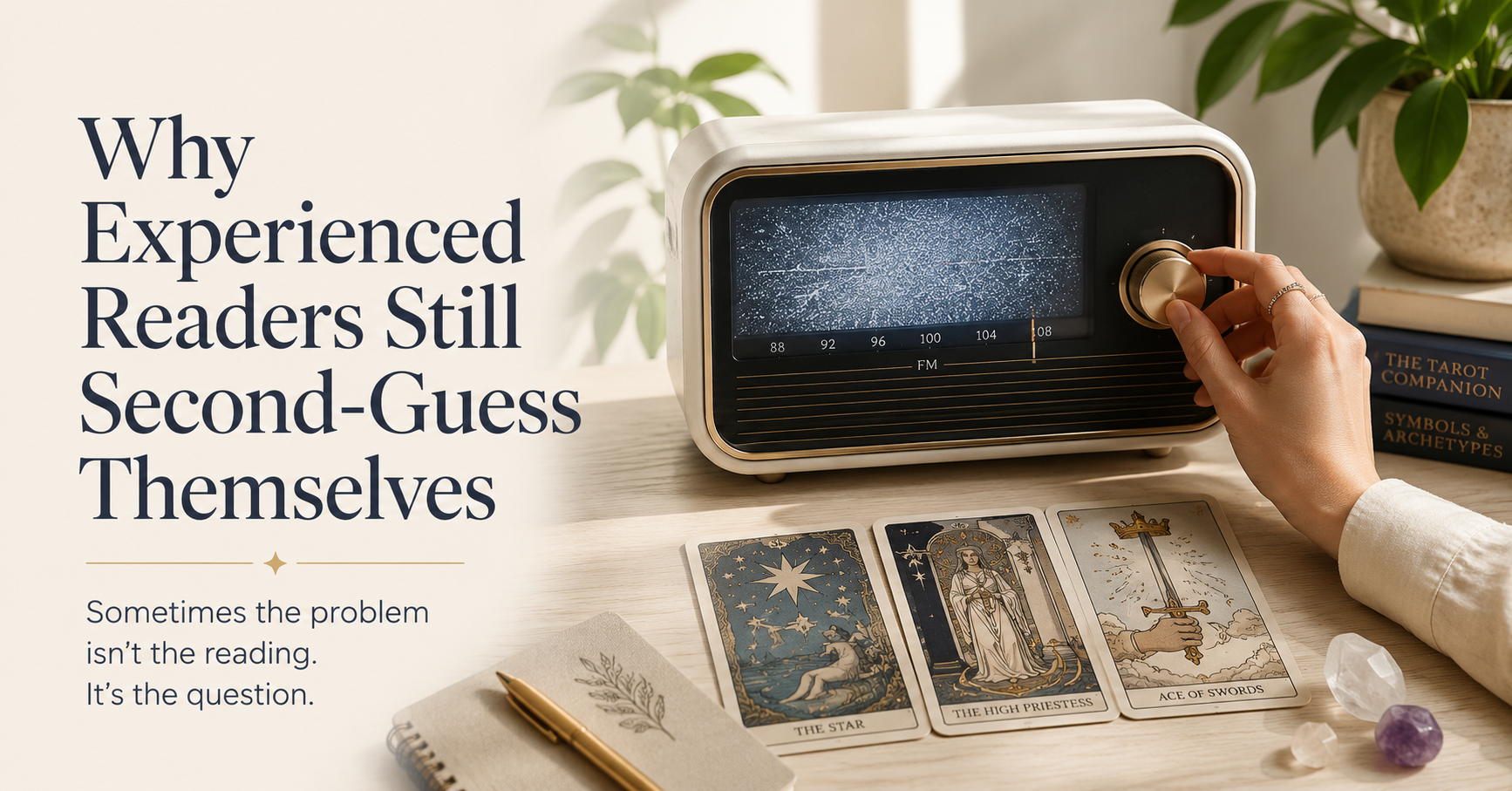
This is exactly what happened with a client a while back. Card after card landed as individually legible, each one making sense on its own terms, and the spread as a whole simply refused to settle into a single line. Static, not silence. The kind of static you get between stations on an old radio dial, where you can tell something is being broadcast somewhere, just not on the frequency you’re tuned to.
I make a point of getting a question dialled down before a reading starts. If someone wants something general, that’s fine too, but I need to know which one we’re doing. This client was adamant about the question they wanted asked, certain of it in a way that left no room to query it further. I took them at their word, the way you do. And the spread sat there in pieces. Each card true. The whole thing static.
There was nothing left to interrogate in the cards. So I went back to the one variable sitting outside them: the question itself. Not because the cards demanded it, but because everything else had already been checked. And it turned out the question they’d been so certain about wasn’t the one they actually needed answered. Once that shifted, once we were genuinely asking what they needed to know rather than what they had arrived believing they needed to know, the next pull landed clean. No more static. A station, tuned.
Checking the Dial, Not the Antenna
Here’s the reframe worth carrying forward: static isn’t bad reception. It’s information in its own right. A spread that won’t cohere is not a malfunctioning instrument, and it isn’t a verdict on your skill. It’s an accurate report that the signal you’re searching for doesn’t exist on the frequency you’ve set.
The fix was never going to be a better antenna. It was checking the dial.
Anyone who’s owned an actual radio with an actual dial knows the difference between these two problems by feel. Static that means the radio is broken sounds different from static that means you’re simply between stations, even though both, in the moment, sound like nothing. You don’t fix the second kind by turning the volume up or replacing the radio. You fix it by moving the dial, slowly, until something resolves. Treating a reading the same way means resisting the urge to turn up the effort, the over-analysis, the third and fourth interpretive pass over cards that have already said everything they’re going to say. It means moving the dial instead, which in a reading means moving the question, even half a turn, and listening again before deciding the instrument itself is at fault.
This is also why the problem gets worse with experience, not better. A newer reader who hits static is more likely to think the cards are just hard to read that day, and move on. An experienced reader can’t let go that easily. They know too many techniques to walk away from a stuck reading. So they keep trying harder, throwing more skill at a problem skill can’t actually fix. Competence doesn’t protect against this. If anything, it makes it worse, because competence is exactly what lets a reader force a reading into shape that should never have come together in the first place.
You can watch this play out in plenty of contexts outside tarot too. A seasoned negotiator talks themselves past a gut sense that a deal is wrong, because years of closing deals has given them a dozen techniques for talking a deal across the line, and not one of them was built to ask whether the deal should exist in the first place. Someone with decades of pattern recognition in any field can talk themselves out of an instinct that something doesn’t fit the expected presentation, precisely because they have so much precedent to draw on. Expertise builds tools. Tools get used. And a tool in hand has a way of making you forget to ask whether you’re looking at the right problem at all.
The Cost of Forcing a Reading Anyway
There’s actually some relief in this, if you let yourself see it. Second-guessing can feel like a step backward, like something years of practice should have fixed by now. But it was never a beginner’s mistake to grow out of. It’s built into reading itself. Recognising that is a sign of progress, not a setback. A reader who used to read static as a failure of skill, and now reads it as a sign to check the question, hasn’t lost anything. They’ve just learned to tell two different signals apart.
And ignoring the question instead of checking it isn’t a safe choice. When a reader pushes past the static and forces a reading anyway, something still comes out the other side.
A story gets told. But it’s not the cards’ story anymore.
It’s the reader’s own invention, wearing the right symbols, delivered with enough confidence to pass as real. The cards just become props for a story that was never actually there. That’s a quieter mistake than getting a single card wrong, and a more serious one, because from the outside it doesn’t look like a mistake at all. It looks like a reading. It can even feel right, to both reader and seeker, until life doesn’t match what was said.
And the seeker rarely has the means to catch it in the moment. They’ve come in without your years of pattern recognition, which is exactly why they’re sitting across from you. If the story you hand them is fluent and confident, they have no way of knowing it was built from a question that was never quite theirs. They’ll carry it out the door anyway, try to act on it, and wonder later why none of it landed the way it should have. That’s not a small cost. It’s the difference between handing someone an accurate tool and handing them a convincing one, and only one of those is actually yours to give.
Learning to Trust the Noticing
That distinction matters because of where second-guessing actually comes from. It rarely starts as a crisis of intuition. It starts as a quiet, grounded noticing, the kind that happens before interpretation even begins, that something isn’t settling. That noticing is reliable. It isn’t a flicker of nerves to push past. It’s information arriving ahead of the analysis, and it deserves the same weight you’d give the cards themselves.
This is worth naming plainly, because it’s easy to mistake for something softer than it is. The noticing isn’t a feeling about the reading. It’s not nerves, and it isn’t doubt in the ordinary sense. It sits underneath both of those, in the same register as the moment before you speak in a room you’re reading, where you already sense the temperature of the thing before a single card or a single word has confirmed it. Learning to recognise that register, and to trust it as data rather than override it as anxiety, is most of what separates a reader who can sit with static from one who panics and overworks it.
The discipline, then, isn’t a technique you apply to the cards at all. It’s a question you ask before you go anywhere near them again: is this static telling me I’ve misread the cards, or is it telling me I’ve misread the question? Almost every time, with enough honesty, the answer turns out to be the second one. The cards were never confused. They were answering accurately. They just weren’t being asked the thing the room actually needed asked.
That’s the territory the COMPASS Method™ works inside. Not as a set of corrective steps for when static shows up, but as an interpretive orientation that addresses why the misalignment develops in the first place. The pillars that sit earliest in the method — centring the reader before the deck is touched, and developing the sense to distinguish signal from the noise of a misframed question — both operate at exactly this juncture. That’s the why of it. The training is where the how lives.
It Was Never Only About the Cards
Which brings the language back around, because this was never only a tarot problem. Anyone who’s said I can’t get a read on this, or this isn’t adding up no matter how I look at it, has stood exactly where that client and I were standing. The static isn’t unique to cards. It shows up anywhere someone is trying to assess something true and keeps meeting noise instead, in a conversation that won’t land, in a decision that won’t settle, in a room that feels wrong for reasons nobody can name yet.
Stop interrogating your skill, and start interrogating the question.
None of this requires throwing out what you know. The cards you’ve spent years learning are still accurate, still doing their job, still worth every hour you put into them. What this asks for is smaller and harder: the willingness, in the moment static shows up, to suspect the frame before you suspect yourself. That’s a different kind of discipline than card knowledge. It has nothing to do with how many spreads you’ve memorised, and everything to do with whether you’re willing to put the question on the table instead of only the cards.
You already knew, before any of this, what it means to read something. You knew it from rooms you’ve walked into and immediately understood, and from rooms that gave you nothing no matter how carefully you looked. What changes, once you’ve sat with a spread that wouldn’t cohere, is what you do with that second kind of room. You stop assuming you’ve lost the ability to read it. You start asking whether you’ve been handed the right room to read at all.
By the end of that reading, the cards hadn’t changed. The client had. What we’d actually been circling, the whole time, was never on the table to begin with. Once it was, the spread did exactly what spreads do when there’s something real to find. It cohered, plainly, the way it should have from the start, because there was finally a station to tune into.
Second-guessing, most of the time, isn’t a verdict on your reading. It’s a signal that the question hasn’t found its way into the room yet. Find that, and the static stops on its own.
The next discernment problem begins once the signal has arrived: knowing when more cards will clarify the reading, and when they will only add noise.
Free checklist
The Discernment Checklist
21 Questions to Ask Before Pulling Another Card
Use this reader’s checklist to test the question, recognise the cards carrying the answer, decide whether another card is needed, and close the reading cleanly when the answer has landed.