
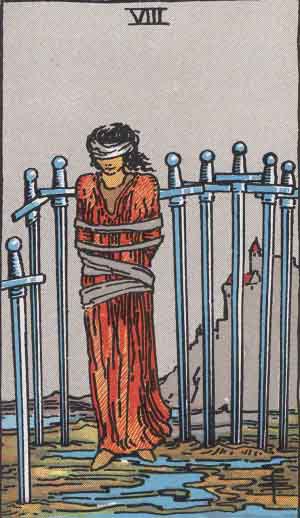
A bound and blindfolded figure stands among eight swords, with openings visible from outside the scene. The question this card keeps returning to ask is which constraints are material, which are interpreted, and what support is needed before any gap can be used.
Core Repeating Message
The Eight of Swords shows a figure bound and blindfolded within a loose arrangement of blades. From the viewer’s position, spaces appear between the swords, but the figure cannot see the whole arrangement and may not be able to move safely while bound on wet ground. This distinction matters. An option visible to an outsider is not automatically accessible to the person inside the situation. The distant structures suggest a wider world, while the image keeps attention on perception, mobility, risk and the support required to move.
This is a card of perceived and actual constraint, and of the difficulty of distinguishing them from within the arrangement. Thought can narrow what the seeker sees, but poverty, coercion, discrimination, disability, law, care obligations and unequal power can also close real paths. The card is most useful when it asks how interpretation and circumstance interact. It becomes harmful if it turns structural or interpersonal restraint into a story that the seeker created their own prison.
When this card appears once, it can mark a moment of felt constraint: narrowed options, uncertain movement or no clear way through. The experience deserves to be taken seriously before its cause is interpreted. The Eight of Swords then asks two separate questions: what is externally limiting, and how is fear, belief or incomplete information shaping the visible range of options? Thought revision may reveal possibilities, but it cannot remove every material barrier.
When this card appears repeatedly, it invites a sustained audit of how the seeker assesses constraint. They may be excluding workable options, accurately recognising severe limitations, or doing both in different parts of the same situation. Repetition does not prove that the swords are less impassable than they seem; it calls for better evidence, perspective and support.
One common pattern is the seeker whose interior narrative about their situation systematically emphasises constraint at the expense of available options. The situation is genuinely difficult; this is not minimised. But the framing the seeker has applied to it, the story they tell themselves about what is possible and what is not, about what would happen if they tried to move and about what the swords represent, is producing a picture of constraint that is more complete and more permanent than the actual arrangement of the blades requires. The gap in the swords is there. The seeker’s narrative about being surrounded prevents them from seeing it.
A second pattern is the seeker who has been constrained by circumstances, bound by real limitation, and who has adapted so thoroughly to the constraints that they have begun to experience the constraint as natural and the absence of option as simply how their life is rather than as a condition produced by particular circumstances. The blindfold has been in place long enough that the seeker no longer actively notices it; the state of constrained perception has been normalised.
A third pattern belongs to the seeker whose experience of constraint is primarily cognitive and bound up with their self-concept: who experiences themselves as incapable, unqualified, too damaged, too limited, or too deeply compromised by their history to access options that are, in fact, available to them. The eight swords in this case are primarily interior: the beliefs about the self that are functioning as the binding and the blindfold.
A fourth pattern is the seeker living with external constraint, who faces real limitation that thought revision cannot eliminate, and for whom the Eight of Swords is marking the challenge of navigating real constraint with psychological freedom: of not allowing the external limitation to become an interior one as well.
When This Card Repeats Weekly
A week of Eight of Swords repetition can mark an immediate experience of narrowed choice that needs to be mapped rather than judged. Some limits may be firm, others negotiable and others still unclear. The seeker’s framing matters, but so do resources, timing, safety and the behaviour of other people. The first useful movement may be gathering information or support, not stepping forward alone.
The card this week is not dismissing the difficulty. It is asking the seeker to look at the arrangement of the swords with an open mind: to identify whether the framing of the situation as having no good options is accurate, or whether there are spaces between the swords that the current narrative is not allowing the seeker to perceive.
When This Card Repeats Monthly
A month of Eight of Swords repetition suggests that the pattern of constraint-amplifying thinking is operating across multiple situations and domains, producing a consistent experience of limitation that is broader and more complete than any one of those situations would require.
The monthly framing asks the seeker to look at the common thread across the month’s experiences of felt constraint. Not the circumstances themselves, which may be different, but the cognitive response to them: the way the seeker’s thinking consistently emphasises constraint, consistently reduces visible options, consistently produces the experience of being surrounded by swords with nowhere to go. This common thread is the pattern, and the pattern is what the monthly repetition is asking the seeker to examine.
When This Card Repeats Seasonally
A season of Eight of Swords appearances can mark a sustained period in which the experience of felt constraint is the seeker’s predominant reality, and the relationship between the external constraints and the internal ones has become the central question. The circumstances may be difficult and the swords present, while the seeker’s thinking amplifies the experience of being surrounded. That interaction deserves careful examination.
The seasonal frame may accompany circumstances that narrow options: a health challenge, financial difficulty, family obligation, professional restriction or unsafe relationship. These are real and should not be spiritualised away. Across the season, the card asks where agency remains, what assistance could widen it and which constraints must be accommodated, challenged collectively or accepted for now.
When This Card Repeats Across Years
The Eight of Swords returning across years or major life phases can describe a seeker for whom the cognitive pattern of constraint-amplification is deeply established: a characteristic way of experiencing their situation, capacities and available options that consistently produces a more constrained picture of reality than the situation requires.
This long-arc pattern may resonate with seekers whose early experience included powerlessness or restricted choice, so caution remains active after some circumstances change. That is one possible history, not a conclusion supplied by the card. For others, major constraints remain current. The work is to update the map accurately, recognising increased agency where evidence supports it without denying continuing limits.
Across years, what the Eight of Swords asks of this seeker is one of the more demanding forms of cognitive development: the revision of a perception pattern that is so established it feels less like a pattern and more like an accurate view of how constrained their situation is.
Life Area Interpretations
Love & Relationships
In love and relationships, the Eight of Swords can describe the seeker who feels trapped in their relational circumstances: who perceives their relational options as having closed in, who sees no good path through the difficulty they are facing, who experiences the choices available to them as consistently inadequate.
The card asks the seeker to look honestly at whether the relational constraints they experience are as complete as the pattern of perception suggests. Are the swords so arranged that movement is not possible? Or is the framing of the situation, the story about what would happen if movement were attempted, closing off options that closer examination might reveal?
The card may also appear where a relationship is controlling, unsafe or materially difficult to leave. In that context, it must not imply that captivity is primarily mental or that the seeker should confront, disclose or leave without preparation. Confidential specialist support, legal information and safety planning can help identify realistic options while respecting the risks that may not be visible to an outsider.
Career & Purpose
In career and purpose, the Eight of Swords can reflect professional or vocational constraints that limit movement towards more satisfying or meaningful work. Some limits may be structural, contractual, financial, geographical or connected to care and health. Others may be assumptions that deserve testing. The card cannot determine in advance that more options are available.
The card asks the seeker to investigate the options that have been assessed as unavailable: the vocational directions that have been dismissed as impractical, the professional changes judged impossible, the creative or purposeful dimensions of work that have been set aside as unrealistic. Are these unavailable, or has the eight-swords framing ruled them out before they have been investigated?
Money & Stability
The Eight of Swords in financial contexts can mark genuine material constraint, including debt, insecure income, dependence or limited access to services. It may also mark assumptions that exclude a workable option before it is investigated. The card cannot decide which is true. Verified figures and qualified financial, legal or benefits advice are more reliable than symbolic interpretation for assessing what is actually available.
The card may also mark the seeker under severe material constraint, who needs to maintain sufficient psychological freedom within the constraint to see and pursue whatever options do exist.
Spiritual Growth
In spiritual growth, the Eight of Swords marks the seeker whose spiritual life is significantly shaped by the experience of constraint: who feels unable to access the spiritual experiences, practices, or communities that would be nourishing, who experiences the path of spiritual development as blocked by forces they cannot navigate around. The swords may be doctrinal, cultural, historical, familial, or internal; understanding both their nature and the seeker’s relationship to them matters.
The card asks whether the spiritual constraints that feel most binding are as impassable as the eight-swords framing makes them appear. Where are the spaces between the swords? What forms of spiritual development are available within the actual constraints of the seeker’s life, rather than only those that would be available in the idealised circumstances the constraint-pattern assumes are required?
Emotional & Mental Patterns
In emotional and mental patterns, the Eight of Swords most often marks a characteristic relationship to personal limitation and the perception of one’s own capacities in which the seeker’s self-concept functions as a primary constraint on what they believe is available to them. The specific beliefs about what they are capable of, what they deserve, what their history permits them to attempt, and what kinds of life are realistically accessible to them are producing a picture of available options that is significantly narrower than the actual situation requires.
This is among the most interior forms of the eight-swords pattern, and it is often among the most persistent, precisely because the beliefs are experienced as simple accurate self-knowledge rather than as learned cognitive patterns with specific historical origins. The blindfold in this case is not over the eyes that perceive the external world; it is over the internal mirror that shows the seeker who they are and what they are capable of.
Family & Generational Dynamics
In family dynamics, the Eight of Swords most often marks the seeker who absorbed from the family of origin a specific set of beliefs about what is possible, available, or permitted for people like them. These beliefs may have been communicated explicitly, through statements about what the family does and does not do, about what kinds of success or life are realistic, about the constraints the family associated with people like the seeker. Or they may have been communicated atmospherically, through the quality of life the family modelled, through the range of options they treated as available, through the implicit horizon of possibility that the family system established.
The generational work this card can symbolise is distinguishing inherited expectations from current conditions, while recognising that social and material constraints may also pass between generations. The seeker need not turn every limit into a belief problem. Some swords require advocacy, resources or collective change; others can be revised through new evidence and experience.
Health & Energy
The Eight of Swords in health contexts symbolically reflects how constraint may be experienced in the body. Some people notice guarded posture, shallow breathing, tension, numbness or reduced movement when they feel trapped, while others do not. These experiences have many possible causes, including pain, illness and disability, and should never be treated as proof that the limitation is thought-created.
Gentle attention to comfort, mobility and available space may support reflection, but movement is not a test of mindset and physical expansion is not appropriate for every body. Persistent or concerning symptoms deserve professional assessment. Any embodied practice should be adapted to the seeker’s capacity, consent and medical needs, with the aim of choice rather than proving that a gap exists.
Advanced Interpretive Sections
The Shadow Expression
The Eight of Swords in shadow can describe an identity narrowed around constraint, where every new situation is interpreted through an established expectation of no choice. This reading must not blame someone for captivity, disability or systemic exclusion. Its purpose is to ask whether the story has become broader than the evidence and where identity contains capacities, relationships and values that the constraint narrative does not fully represent.
A second shadow is the seeker who uses the language of external constraint to avoid accountability for choices that are available to them: who describes options as having been eliminated by circumstances over which they had no control, when closer examination would reveal choices they have made and continue to make.
The Integrated Expression
The integrated Eight of Swords seeker has developed the capacity for honest assessment of their own constraints: they can see external limitation clearly, without minimising it, and they can also see the contribution of their own thinking to the experience of constraint, without either dismissing the external or over-attributing the internal. They can navigate real limitation with psychological freedom, seeing what is available within the constraint rather than only what is not available.
This seeker has also removed the blindfolds that covered the internal mirror: they have examined the beliefs about their own capacities and available options that were operating as inherited constraint, and they have developed a relationship to those beliefs that allows conscious choice rather than automatic deference.
Why This Energy Has Not Released Yet
The Eight of Swords pattern can persist when the seeker has not yet separated external constraints from the cognitive amplification of those constraints. Without this distinction, it can be difficult to judge which aspects of their felt constraint are not negotiable and which are products of a thinking pattern that is capable of revision.
The pattern also persists when the seeker has not yet examined the specific beliefs about their own nature, capacities, and available options that function as the internal binding. These beliefs are often the most influential constraint and the least examined, precisely because they present themselves as simple accurate self-knowledge rather than as learned cognitive patterns with specific origins.
What This Card Wants the Seeker to Understand
The Eight of Swords asks the seeker to separate what can be seen, tested or supported from what remains unknown. The blindfold and bindings may symbolise fear, missing information, coercion or limited capacity as well as belief. Some parts of the arrangement may be accessible to reflection; others require assistance, protection or external change.
The card invites the possibility that gaps exist, but it does not guarantee that they are safe, reachable or sufficient. Increasing perception means seeing the full arrangement: openings, bindings, unstable ground, external resources and real barriers. A genuine option is one the seeker can assess and pursue with proportionate support, not merely one an observer can imagine.
Signs the Pattern Is Beginning to Resolve
The Eight of Swords pattern begins to resolve when the seeker begins to perceive options that were previously invisible to them: when inquiry into what is available reveals paths that the constraint-pattern had been excluding from consideration. Even one newly discovered option, in a domain where the seeker had believed all options were foreclosed, represents significant movement.
It also resolves when the seeker can distinguish, with some reliability, between external constraint and the cognitive amplification of constraint: when they can say clearly “this is not available to me in my current circumstances” and “this is available but my thinking has been treating it as unavailable.” Making this distinction in a particular situation is often where the eight-swords pattern begins to shift.
And it resolves when the seeker takes one genuine step through a gap in the swords that their previous narrative had told them was impassable, and discovers that the ground on the other side is real.
Reflective Questions
-
Where in your current life do you most consistently experience the sense of having no good options: of being surrounded by constraints with no clear path through? Describe the arrangement of the swords as specifically as possible.
-
Which surrounding swords are external, which may be negotiable, and which are not yet understood? What evidence and expertise would help you classify them more accurately?
-
What specific beliefs about your own nature, history, capacities, or worthiness are functioning as internal bindings in your current situation? Can you name them as beliefs rather than as simple facts?
-
What is the most significant gap between the swords in your current arrangement: the option that your narrative has been most consistently excluding from your perception of what is available?
-
When did you last step through a gap in the swords: when did you last attempt something that your constraint-narrative had told you was not available, and discover that it was? What was that experience like?
-
What did your family of origin communicate about the range of options available to people like you? How have these inherited beliefs shaped your current sense of what is genuinely possible?
-
If your body responds when you think about the constraint, what do you notice without assuming a cause? What adaptations, care or professional assessment might be appropriate?
-
Is there a way in which the experience of constraint has become part of your identity: a story about who you are that would require significant revision if genuine options were found to be available?
-
What would it require for you to remove the blindfold: to look directly at your situation, including the gaps between the swords, without the filter of the constraint-narrative? What specifically is the blindfold protecting you from seeing?
-
If someone who loved you and knew your situation well were to look at the arrangement of your eight swords, what would they see that you are not currently seeing? What possibility might they help you investigate?
Practical Integration Actions
Separate the genuine from the amplified. Write two separate accounts of your most significant current constraint: in the first, list only what is externally constrained in ways that cannot be changed by any action available to you. In the second, list what your thinking and narrative are treating as constraint that may be negotiable. Comparing the two lists can clarify what is not available and what cognitive amplification has been adding to the picture.
Identify three genuine gaps. In your most significant eight-swords situation, look for up to three paths that your current account has not treated as genuine options. For each, assess whether it is actually usable: what would make it safe, accessible and adequately resourced, and who could help verify it? A possibility is not automatically an available choice, and there is no requirement to find three or to claim a gap where none is currently available. The exercise widens inquiry without denying real barriers or demanding commitment.
Challenge one belief about the self. Identify one specific belief about your own capacity, worthiness, or available options that is functioning as an internal constraint, and actively investigate it: look for evidence of its accuracy, look for counter-evidence, speak about it with someone who knows you well enough to offer an informed perspective. Not to force a positive revision, but to develop an evidence-based rather than assumption-based relationship to the belief.
Develop an embodied practice of expanded space. Choose a gentle, safe action that helps you experience a little more room to move or choose within your body’s actual capacity: changing position, adjusting the space around you, asking for assistance, taking comfortable movement or declining an unsuitable demand. Notice any felt difference without requiring expansion or ease. Do not force posture or breath, and do not use bodily ease as evidence that a practical constraint is unreal. Adapt the practice or seek guidance where pain, illness or disability is involved.
Take one step through a gap. Identify the smallest gap in your current arrangement of swords, the option that is genuinely available but that the constraint-narrative has been most readily excluding, and take one concrete step towards it. Not the full commitment, not the complete resolution, but the first step: the inquiry, the conversation, the application, the small deliberate movement through a space that the pattern has been treating as impassable. The experience of stepping through the gap can be a powerful way of revising the pattern.