
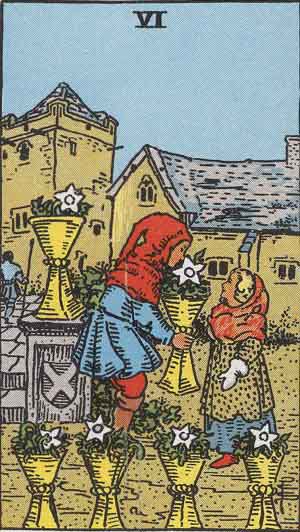
A child hands a cup full of flowers to another. The past leans gently into the present, bearing gifts. The question this card keeps returning to ask is not whether the past was tender, but whether the seeker has yet learned to carry its gifts forward rather than returning to live inside them.
Core Repeating Message
The Six of Cups shows a scene of childhood and gentle reminiscence: two figures, one offering a cup filled with white flowers to the other, surrounded by other cups similarly filled. The setting has a quality of familiar warmth, a walled garden that speaks of safety and enclosure, of a time before the full complexity of adult life arrived. The image is suffused with a particular kind of tenderness: the innocent generosity of an earlier self, the uncomplicated gift, the emotional simplicity of a past that, in memory at least, did not yet carry its full weight of complication.
This is the card of nostalgia, childhood memory, the emotional past and the way it reaches into the present. It is one of the most layered cards in the suit precisely because what it describes is not inherently problematic: memory and its gifts are genuine and valuable, and the past that nourishes us is not a resource to be abandoned. The difficulty the Six of Cups marks, when it repeats, is not the existence of the past but the seeker’s relationship to it: what they do with what the past offers, how far back they live, and what the quality of their engagement with the present consequently becomes.
When the Six of Cups appears once, it can accompany reminiscence, reconnection, generosity, or contact with an earlier part of life. When it appears repeatedly, it brings the seeker’s relationship with memory into focus: which recollections comfort, which shape present expectations, and which invite a more adult understanding. Memory is meaningful but reconstructive, so the card does not certify any recollection as complete or objectively exact.
The most common pattern is a seeker who receives more emotional nourishment from remembered life than from current experience. The past may seem to hold safety, warmth, simplicity, or belonging that adulthood has not reproduced. Nostalgia can preserve real gifts while smoothing contradiction and complexity. The question is not whether the memory is true or false, but how comparison with its edited warmth is influencing participation in the present.
A second pattern concerns relational habits first learned in childhood and repeated without much examination: who comforts, who stays quiet, who anticipates needs, who is permitted to receive. Early experience can influence these habits without fixing them permanently or explaining every present relationship. The Six of Cups invites the seeker to compare inherited roles with current facts, adult capacities, and the actual people involved.
A third pattern is longing for a past connection, place, person, period, or earlier self that is no longer available in the same form. The Six of Cups acknowledges the tenderness of that longing without turning it into an instruction to return. It asks whether remembrance is enriching current life, crowding it out, or revealing a need for belonging, play, safety, creativity, or continuity that might be met differently now.
A fourth pattern appears when an early experience of care becomes the unspoken standard for every later bond. What was received may have been genuinely nourishing, yet no adult relationship can recreate childhood conditions exactly. The seeker may need to identify the qualities beneath the memory, such as attention, predictability, shared ritual, or uncomplicated welcome, so they can be sought and built in age-appropriate forms.
When This Card Repeats Weekly
A week of Six of Cups repetition can mark an immediate engagement with the past: a visit, a memory, a reconnection with someone from earlier life, a situation that has returned the seeker to earlier emotional territory. Something from the past may feel close this week, and the card is asking the seeker to be conscious of what they are doing with it.
The weekly repetition might mark a specific encounter that has triggered genuine nostalgia: a smell, a place, a conversation that has opened a doorway to earlier experience. The card is not asking the seeker to close this doorway; the past’s gifts are real. It is asking whether the seeker is visiting the past or moving in.
It may also mark a week in which a current interaction resembles an earlier family or relational dynamic. Similarity does not prove that the situations are the same. The Six of Cups asks what belongs to the present facts, what expectation has arrived from memory, and what response the seeker’s adult position now makes possible.
When This Card Repeats Monthly
A month of Six of Cups repetition suggests that the seeker is in sustained engagement with their own past: through memory, through relational patterns that echo earlier experience, through genuine reconnection with people or places from earlier chapters of life, or through a quality of nostalgia that has become the month’s predominant emotional register.
The monthly framing asks the seeker to look at the quality of their present engagement. Are they as available to the present as they are to the past? Is the past providing genuine nourishment that is enriching the present, or is the present being somewhat dimmed by comparison with a memory that may glow warmer than the complexity of now?
The monthly repetition may also mark a season of reconnection with roots: a time when going back to earlier sources, earlier places, earlier versions of self is necessary work. In this case, the Six of Cups is supportive rather than cautionary; the past has something to offer that the present requires.
When This Card Repeats Seasonally
A season of Six of Cups appearances can mark a sustained period of examining the seeker’s relationship to their past, their origins and the experiences that shaped their emotional life. This is significant territory and deserves a season.
The seeker may be revisiting formative experiences through memory, geography, family conversation, archives, or therapeutic work in order to understand them with adult perspective. The Six of Cups does not recover hidden facts or verify another person’s account. Its constructive use is to compare sources, tolerate complexity, acknowledge what was and was not given, and revise conclusions that no longer fit current evidence.
What the seasonal repetition asks is that this revisiting be purposeful: that the gifts the past offers be genuinely received and then carried forward, and that the season of looking back be clearly understood as preparation for engagement with the present rather than as a destination in itself.
When This Card Repeats Across Years
The Six of Cups returning across years or major life chapters can describe a seeker for whom the emotional past, whether as nostalgic refuge, relational template, or unrevised inner world, is operating as a primary organiser of present experience. The cups of childhood are not only remembered; they are in some essential way still the primary currency of the seeker’s emotional life.
This long-arc pattern belongs to seekers who found the past genuinely more nourishing than much of their subsequent experience, and for whom no present chapter has yet offered an equivalent. The emotional climate of early life, or of a particular period that carried exceptional warmth and safety, continues to operate as the standard, and the present is experienced through the gap between what is and what the past provided or seemed to promise.
Across years, the Six of Cups asks a deepening and increasingly honest question: what would the seeker need to find, build, or allow in the present to provide genuine emotional nourishment equivalent to what the past held? Not the recreation of childhood, which is not possible, but the development of adult conditions for emotional sustenance. The past’s gifts are real; the question is whether they can be carried forward rather than returned to.
Life Area Interpretations
Love & Relationships
In love and relationships, the Six of Cups can highlight familiar patterns in how care is offered, requested, withheld, or recognised. A seeker may expect adult partners to occupy roles learned in the family of origin, or may interpret present behaviour through an earlier bond. These influences are possibilities to examine, not a complete explanation. Direct conversation and current conduct remain more reliable than symbolic resemblance.
The card may also mark the seeker who is longing for an earlier relationship: a first love, a lost partner, a connection that carried something that has not since been found in the same form. This longing is real, and the card is not dismissing it. But the seeker living primarily in the nostalgia of what that connection once was may not be genuinely available to the connections that are currently present and currently possible.
The Six of Cups can also coincide with literal reconnection, but it neither predicts a return nor endorses contact. If an earlier relationship reappears, discernment includes what has changed, why contact ended, whether boundaries are respected, and whether renewed communication is wanted and safe for everyone involved. Nostalgia is not evidence of present compatibility.
Career & Purpose
In career and purpose, the Six of Cups can describe a seeker whose vocational sense of self was formed in early life and has not yet been updated. They may have known from childhood what they wanted to do, or been told what they were good at, or absorbed from the family system a specific understanding of what meaningful work looks like, and may be operating from this early template with more fidelity than their actual adult experience warrants.
The card may also mark nostalgia for an earlier period of work: a job or project or creative period that felt alive in ways the current work does not. The seeker who keeps returning to that earlier period in memory, who measures everything since against it, may be missing the genuine aliveness available in their current work because the past’s glow is obscuring it.
Money & Stability
The Six of Cups in financial contexts can draw attention to the seeker’s inherited relationship to money: the emotional templates from the family of origin about what money means, how it is managed, what it represents, and what relationship to it is considered appropriate. These templates, formed in childhood, often operate beneath conscious awareness and can significantly shape adult financial behaviour in ways the seeker has not yet examined.
The seeker may notice financial habits that resemble those observed in childhood, including spending, saving, secrecy, generosity, anxiety, or attitudes towards debt and security. Resemblance does not make the pattern inevitable. The Six of Cups supports an inventory of learned beliefs alongside current income, obligations, goals, and qualified advice, so adult choices can respond to present conditions.
Spiritual Growth
In spiritual growth, the Six of Cups can speak to a seeker whose spiritual orientation is primarily retrospective: who finds the richest spiritual meaning in the traditions, practices, or experiences of earlier life and who has not yet found or built a spiritual relationship to the present that is equally alive. The childhood faith, the early spiritual experience, the formative encounter with prayer or ritual or mystery, carries a quality of genuine nourishment that later spiritual life has not fully recovered.
The card returning in spiritual contexts is not asking the seeker to abandon what the past gave them spiritually. It is asking whether the gifts of the past can be genuinely carried forward into a present spiritual life rather than accessed only through return, through nostalgia, through the specific quality of a remembered relationship to the sacred that no longer exists in quite that form.
Emotional & Mental Patterns
In emotional and mental patterns, the Six of Cups highlights attention that repeatedly returns to earlier life because remembered experience feels vivid, coherent, or emotionally available. The present may seem flatter by comparison, especially during loneliness, transition, or uncertainty. This is an experiential pattern rather than a diagnosis. If memory, low mood, or disconnection is persistently disrupting daily life, the seeker may need support beyond symbolic reflection.
The mental pattern that accompanies this often involves a regular turning of attention toward the past: reviewing, remembering, comparing, finding in memory a quality of emotional richness that the present seems to offer only partially. This orientation is not inherently dysfunctional. But it can, over time, produce a present that is less inhabited than the past: remembered richness draws attention back, and what is currently available receives less of it.
Family & Generational Dynamics
In family dynamics, the Six of Cups is centrally at home. This is, more than any other card in the suit, the card of the family of origin: of what the family gave, what it withheld, how it shaped the seeker’s emotional world, and how that shaping continues to operate in the seeker’s adult life.
The cups may represent real experiences of warmth and belonging. They may also reflect selective memory, family stories that emphasise sweetness, or longing for care that was inconsistent or absent. Several versions can coexist. The card does not determine which is correct; it asks the seeker to hold affection, disappointment, documentary facts, and other people’s differing memories without forcing them into one simple family narrative.
Whatever the family’s actual gift, the Six of Cups returning across years is asking the seeker to examine it with adult eyes: to see what was given and nourishing, what was not given and what the absence has cost, and how the early experience continues to shape the present in ways that are and are not still serving.
Health & Energy
In health and energy readings, the Six of Cups may mirror a felt contrast between the vividness of memory and reduced engagement in the present. Low energy, flatness, concentration changes, or altered sleep have many possible causes and cannot be attributed to nostalgia or childhood experience through a card. Persistent or concerning changes deserve appropriate health assessment.
The embodied invitation is modest: notice what helps the seeker orient to current time and place, whether movement, daylight, sensory detail, companionship, creative activity, or familiar routines. Present-tense engagement may feel enlivening, but it is not a treatment or guaranteed result. Memory can remain a resource while attention is deliberately widened to include what is happening now.
Advanced Interpretive Sections
The Shadow Expression
The Six of Cups in shadow depicts the seeker who uses nostalgia as a complete defence against engagement with the present. The past appears wholly beautiful; the present cannot compete; no effort is made to bring the conditions that produced the past’s beauty into the present in updated form. The childhood garden is not carried forward; it is retreated into, again and again.
A second shadow is the seeker who uses the language of childhood innocence to avoid adult accountability: who relates to others from the emotional position of the child offering the cup of flowers, asking them to become indulgent parents rather than peers. They cannot be met as an adult equal while the emotional grammar remains embedded in earlier positions.
The Integrated Expression
The integrated Six of Cups seeker carries the past’s genuine gifts forward with gratitude and without needing to return to it. They can remember with warmth, can draw on the emotional wisdom and nourishment of earlier experience, and can also be fully engaged in the present: the two orientations are not in competition.
This seeker has done the work of examining the family inheritance: knowing what they were given and what they were not, what they are carrying forward by conscious choice and what they are releasing, what the early cup of flowers actually contained and what they have added to it from their own experience since.
Why This Energy Has Not Released Yet
The Six of Cups pattern may persist when the past as remembered has not yet been placed beside the fuller record. Memory is selective and can preserve warmth, pain, or longing with particular intensity. Adult perspective does not reveal one final, uncontested version of childhood, but it can hold more context: what is known, what is uncertain, what others recall differently, and how the seeker’s present needs shape the meaning of the memory now.
The pattern also persists when the present has not yet developed as a reliable source of the emotional nourishment the past provided. If the adult life has not yet built community, intimacy, or creative or spiritual aliveness that competes with the memory of early warmth, the past may continue to win the competition for the seeker’s attention. In this case, the work is the active development of present conditions for nourishment rather than the management of nostalgia alone.
What This Card Wants the Seeker to Understand
The Six of Cups wants the seeker to understand that the past’s gifts belong to them, genuinely and permanently. What was genuinely received does not need to be returned to for safekeeping; it has already become part of who the seeker is, and it travels with them into the present. They do not need to live in the garden to keep the flowers.
The card wants them to know that genuine tenderness toward the past is not the same as exile from the present. The child offering the cup of flowers is not asking the seeker to go back; the child is offering the cup so the seeker can carry it forward.
Signs the Pattern Is Beginning to Resolve
The Six of Cups pattern begins to resolve when the seeker begins to find in the present a quality of emotional nourishment that genuinely rivals what the past provided: when a current relationship offers something of the warmth and recognition that once lived primarily in memory, when a current creative or spiritual practice produces a quality of aliveness equivalent to what the past held, when the present begins to develop its own specific warmth rather than being only the place that is not the past.
It also resolves when the seeker can look at the family of origin with equanimity: neither idealising nor condemning, neither returning nor fleeing, but understanding what was given and consciously choosing what to carry forward. And it resolves when the cups of childhood can be held with gratitude from within the seeker’s adult present, rather than requiring a journey back to wherever they were left.
Reflective Questions
-
What specific memory or period from your past do you find yourself returning to most often? What does it offer that your present does not consistently provide?
-
When did you last feel the specific quality of emotional warmth or safety or belonging that the Six of Cups depicts? Was this in the past or in the present?
-
In what ways, if any, are you still relating to people in your current life with the emotional grammar of the family of origin? What roles are being replicated, what implicit contracts renewed?
-
What did your family of origin genuinely give you that you carry with gratitude? What was genuinely not given, and how has that absence shaped who you are?
-
Is there a person or a connection from your past that you are still longing for: a return, a reunion, a version of something that cannot exist in quite the same form it once did?
-
In what domain of your current life do you most consistently measure the present against the past and find it lacking? What is the standard the past has set?
-
What would it mean to carry the genuine gifts of your past into your present life as a resource rather than a destination? What from the past, if genuinely integrated, would most enrich where you are now?
-
Is there something you understood about yourself in childhood or early life that your adult life has not yet honoured? A quality, a longing, a way of being that got set aside as circumstances required?
-
How specifically do you understand your relationship to nostalgia: does it nourish you, protect you, or keep you somewhere you can no longer entirely live?
-
If you were to describe your present life with the same specificity and warmth with which you describe what was best about your past, what would you find? What is present now that carries genuine value?
Practical Integration Actions
Carry the gift forward. Identify one genuine quality that the past gave you: a way of relating, a creative capacity, a quality of warmth or curiosity or wonder, something that was genuinely alive in your earlier self. Write about how this quality is currently present in your adult life, and how it could be more deliberately expressed or honoured. The goal is to bring what the past gave into active present-tense use, rather than returning to the past to access it.
Write a genuine family accounting. Without either idealising or condemning, write an honest account of what your family of origin actually gave you emotionally: the genuine gifts and the genuine absences. Not as a grievance list or a tribute, but as a clear-eyed adult understanding of the inheritance. What do you choose to carry? What are you ready to set down?
Map where you live in time. For one week, simply notice when your attention is in the past: in memory, in nostalgia, in imagined conversation with people or places from earlier life. And notice when it is genuinely in the present. This is not about correcting the ratio; it is about becoming conscious of what it currently is. Consciousness of the pattern is the beginning of genuine choice about it.
Build one present condition for nourishment. Identify one thing that the past provided, in terms of genuine emotional sustenance, that your current life does not yet reliably offer: a quality of community, creative aliveness, spiritual warmth, physical safety, genuine belonging. Choose one specific action toward building this in your present life. This is the work of bringing the past’s lessons forward into new form rather than returning to the past itself.
Reconnect with someone from your past consciously. If someone from earlier life still holds meaning, first consider why contact ended, whether either person requested distance, and what outcome you are hoping for. Reconnection is optional and may be inappropriate where there was harm, coercion, repeated boundary crossing, or a clear wish for no contact. Where contact is welcome and safe, approach the person as they are now, without requiring them to restore the past.