
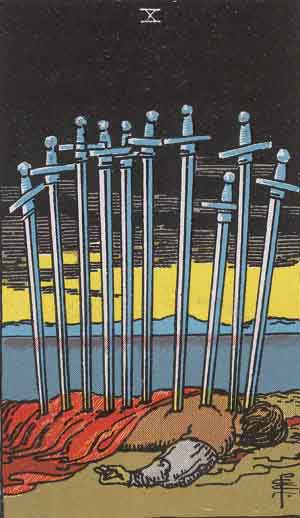
A figure lies face down in the dark, ten swords fixed in their back, while the horizon begins to lighten. The image can speak to a genuine ending, the fear of one, or the exhaustion that follows repeated strain. Its question is not whether pain should be hurried away, but what has actually ended, what remains, and what support is needed now.
Core Repeating Message
The Ten of Swords shows an image of apparent finality: a figure prostrate, ten swords embedded in their back, and a horizon beginning to brighten. Symbolically, it can mark the point at which a particular path, belief, relationship, role, or narrative can no longer continue in its former shape. It can also describe a mind that has extended present difficulty into a total conclusion before the available facts support that conclusion. The card’s severity makes careful distinction essential.
When this card appears repeatedly, it can point to one of two principal patterns, and the distinction matters for what the card is asking. The first is the seeker whose mind habitually reaches the ten-swords position before the situation warrants it: who consistently generates catastrophic projections of how things will end, whose cognitive relationship to difficulty involves the characteristic anticipation of complete collapse even when the actual circumstances are not yet at that point. This seeker does not only experience actual endings; they also live, between endings, in the perpetual anticipation of the next one.
The second pattern belongs to the seeker who has experienced a genuine ending or rupture: a real loss, separation, failure, exposure, or change after which the previous form cannot simply be restored. Here the card’s repetition need not mean that the person is refusing recovery. Grief and reorientation take their own time, and practical consequences may still be unfolding. The light on the horizon represents possibility, not a deadline or a promise that pain will quickly pass.
Both patterns ask for precision about scope. What exactly has ended, what is feared, and what remains intact? Naming the actual boundary of the loss can prevent one ending from becoming a verdict on every part of life, while still honouring the scale of what occurred.
A third pattern, often overlapping with both, belongs to the seeker who has accumulated so many unprocessed minor endings that the cumulative weight produces a chronic quality of ten-swords exhaustion: not from any single catastrophe, but from the sustained experience of things ending without acknowledgement, grief, or completion.
When This Card Repeats Weekly
A week of Ten of Swords repetition brings immediate attention to endings, worst-case thinking, or deep exhaustion. Something may genuinely have reached its limit, or current uncertainty may be getting translated into a total forecast. Before acting, separate verified facts from feared outcomes and identify any practical support that the situation requires.
The card this week is asking the seeker to look at the complete image: not only the fallen figure with ten swords, but the horizon behind it. Where an ending has occurred, the question is whether it is the entire picture.
When This Card Repeats Monthly
A month of Ten of Swords repetition suggests a sustained encounter with the territory the card marks: either a period in which catastrophic thinking has been the consistent cognitive orientation, or a period of aftermath in which a significant ending is still being processed across the month.
The monthly lens asks the seeker to examine their relationship to endings during this period: how much of the month’s mental life has been organised around what has ended or might end, and whether the seeker’s orientation has yet begun to turn towards the dawn that is visible in the same image as the fallen figure.
When This Card Repeats Seasonally
A season of Ten of Swords appearances marks sustained contact with endings and their aftermath. The distinction between a real loss, an ongoing unsafe or unstable situation, and anticipatory worst-case thinking may have become difficult to hold. A trusted professional, advocate, or informed support person can help assess what is factual, what remains uncertain, and what needs action.
The seasonal repetition can accompany someone living with the consequences of a significant ending for longer than they expected. That duration does not by itself mean they are processing it incorrectly. The invitation is to notice whether grief, practical repair, rest, safety, or specialised support is missing, and whether any small part of life is ready to receive attention alongside the loss.
When This Card Repeats Across Years
The Ten of Swords returning across years or major life phases can describe a seeker for whom the cognitive anticipation of catastrophe, or the sustained processing of genuine endings, has become so foundational a pattern that they may no longer be aware of the degree to which their orientation to life is organised around what ends rather than what begins.
For the catastrophising seeker, this long arc marks the development of a cognitive habit of worst-case projection, now so automatic and so rapid that the seeker may not notice the anticipatory quality of the collapse. They experience it as clear-eyed realism; others around them may experience it as perpetual crisis not fully matched by the actual circumstances.
For the seeker living in the aftermath of a real ending, years-long repetition can draw attention to a loss that still shapes their view of what is possible. The ending was real. The long-arc question is whether anything alongside that loss can now receive attention, and what grief, practical repair or support is needed for that shift. It does not assume that the consequences are over or that continued grief is a refusal to move on.
Life Area Interpretations
Love & Relationships
In love and relationships, the Ten of Swords can reflect a painful ending, a breach of trust, or the fear that an earlier rupture will recur. It does not prove betrayal or predict that a current relationship will end. The useful inquiry is whether present evidence supports the feared conclusion, what repair or boundary is possible, and whether the relationship is safe enough for direct conversation.
When fear of a repeated rupture governs the present, it can lead to relational pre-emption: the seeker who withdraws before the anticipated ending arrives, who identifies signals of collapse in ambiguous situations, or who cannot fully invest because the cognitive and emotional resources are already consumed by the probable ending. The relational present is managed through the lens of the last ten-swords moment.
Career & Purpose
In career and purpose, the Ten of Swords can mark the end of a role, project, ambition, or professional identity, as well as a tendency to turn uncertainty into a forecast of total failure. Even real professional momentum may prompt a forecast of how that progress will collapse. It does not predict dismissal, exposure, or collapse. Check the actual employment or project facts, seek appropriate advice where needed, and distinguish one ending from the end of professional possibility.
The card may also mark the seeker whose relationship to ambition involves a characteristic cognitive shortcut from aspiration directly to worst-case conclusion: the seeker who cannot hold the middle ground of effort and uncertainty without immediately generating a forecast of total failure.
Money & Stability
The Ten of Swords in financial contexts can reflect genuine hardship, the end of an unsustainable arrangement, or fear that a difficult period will become complete ruin. The card cannot determine the seriousness of a financial situation. Work from verified balances, dates, obligations, and available options, and seek qualified financial, legal, or debt advice when the consequences are significant.
When worst-case thinking is present, it can consume the attention needed for practical decisions. When the risk is real, however, anxiety should not be dismissed as disproportionate. The task is to turn an undifferentiated sense of disaster into a factual picture, then identify the next time-sensitive action and the support required to take it.
Spiritual Growth
In spiritual growth, the Ten of Swords can describe a seeker confronting an ending: a period of spiritual collapse in which a previously sustaining framework, practice, or understanding has reached its terminal point and cannot be reassembled in its previous form.
Where a spiritual framework has truly ended, returning to its old form may no longer be possible. The work is to develop the capacity to look towards what could follow without bypassing the reality of what was lost. The card asks the seeker neither to hurry past the fallen figure nor to overlook a possibility on the horizon when one becomes available.
Emotional & Mental Patterns
In emotional and mental patterns, the Ten of Swords can describe the seeker whose characteristic response to threat, difficulty, or perceived loss is to generate the complete catastrophic conclusion before the situation has reached that point: a cognitive pattern of pre-emptive collapse so rapid and so automatic that the seeker experiences it not as projection but as accurate assessment.
The emotional cost of this pattern is the sustained experience of endings that have not yet occurred. The seeker inhabits the emotional world of the ten-swords scene even when the actual circumstances are at an earlier point in the sequence. The exhaustion this produces is genuine even when the catastrophe it anticipates is not.
Family & Generational Dynamics
In family dynamics, the Ten of Swords can point towards a history in which losses or ruptures were not openly processed, or in which crisis language made every difficulty feel final. This is a possible pattern to investigate, not a claim about the seeker’s family history.
Where that family pattern is present, a person may become highly practised at anticipating endings or crisis. They may carry that frame into later situations even when present conditions differ. Exploring the pattern can help distinguish inherited expectations from current evidence without denying losses that were real.
Health & Energy
In health contexts, the Ten of Swords is a symbolic image of pain, depletion, fear, or reaching a limit. Anticipating catastrophe may itself feel exhausting or physically tense, even before the feared event occurs, while sustained real demands can also leave little room for recovery. These experiences do not establish the cause of a symptom, and the card cannot diagnose a condition. Severe pain, sudden symptoms, persistent sleep disruption, or profound fatigue warrant appropriate professional assessment rather than a tarot explanation.
The card can also invite an honest review of cumulative demands, recovery, and available care. If the image connects with thoughts of self-harm, suicide, or not being safe, treat that as a real need for immediate human support rather than as symbolism: contact local emergency or crisis services, or a trusted person who can stay present and help.
Advanced Interpretive Sections
The Shadow Expression
The Ten of Swords in shadow can appear when a past catastrophe becomes both a principal lens for new situations and a fixed point of identity: proof of what the seeker has survived, but also a barrier to further risk or present engagement. This is not a moral failure or evidence that someone is choosing pain. It may be a protective adaptation that once made sense and now needs careful updating through present evidence, support, and experiences of agency.
A second shadow is the seeker whose catastrophic thinking has become a form of cognitive control: whose ability to generate the worst-case ending in advance provides the feeling of having already survived what is most to be feared, at the cost of engagement with actual present circumstances.
The Integrated Expression
The integrated Ten of Swords seeker has developed the capacity to hold the complete scene: to acknowledge actual endings when they occur without prematurely reaching the ten-swords conclusion in anticipation, and to orient toward the dawn dimension of the scene without bypassing or minimising what ended. They can recognise actual worst-case situations when they arrive without generating them in advance, and they can recover from cognitive and emotional collapse while turning towards what follows.
This seeker also understands that an ending can coexist with the earliest signs of continuation. The dawn is a symbolic possibility rather than guaranteed improvement. Integration means remaining honest about loss while becoming able to notice choices, relationships, resources, or meanings that are genuinely present now.
Why This Energy Has Not Released Yet
The Ten of Swords pattern can persist when the seeker has not yet found a way to process what ended without either minimising the ending or remaining permanently oriented toward it. An actual ending calls for acknowledgement of its scope; the catastrophising pattern calls for accumulated experience of surviving situations that were anticipated as worse than they proved to be.
The pattern can also persist when an ending that helped establish it has not had space to be grieved: when the ten-swords moment happened, was survived, and was not given the processing that would allow the seeker to turn toward the horizon in the same scene. The unprocessed ending continues to organise the cognitive anticipation of endings when the earlier loss has not yet been adequately acknowledged.
What This Card Wants the Seeker to Understand
The Ten of Swords wants the seeker to see the complete image: the fallen figure, the ten swords, and the dawn on the horizon. Not as a demand to feel better about real endings, but as a recognition that the card contains all of it simultaneously. Endings are in the image; so is the dawn. Neither cancels the other.
The card also wants the seeker to understand that the ten-swords position is specific: it marks the complete ending of what could not continue, not the complete ending of everything. The ten swords are in one figure’s back in one scene; the horizon is already light. The specificity of what ended is important; the extension of that ending to everything is the catastrophising pattern, not the card’s meaning.
Signs the Pattern Is Beginning to Resolve
The Ten of Swords pattern begins to resolve when the seeker develops the capacity to distinguish between actual worst-case situations and anticipated ones: when the characteristic cognitive move from difficulty to catastrophic conclusion slows enough for careful assessment of the actual situation to intervene before the worst-case has been fully inhabited.
It also resolves when an actual ending has been processed far enough that the seeker’s orientation to the scene has begun to include the horizon: when the grief and the recognition of loss are present without being the totality of what the seeker can perceive about their circumstances.
And it resolves when the seeker begins to develop confidence, grounded in experience, that they have survived endings, including significant and complete ones, and that survival of an actual ending is within their actual demonstrated capacity.
Reflective Questions
-
When you encounter difficulty in a current significant situation, how quickly does your thinking move to the ten-swords conclusion? How much of this movement is an assessment of the situation’s actual trajectory, and how much is the habitual pattern reaching the worst-case before the situation requires it?
-
Is there a genuine ten-swords ending from your past that has not yet been fully processed? What specifically about that ending remains unacknowledged, ungrieved, or incompletely addressed in how you understand yourself and your life now?
-
What might the dawn in the Ten of Swords represent in your current situation? Without forcing optimism, what choice, resource, relationship, or possibility is genuinely present alongside what has ended?
-
When you anticipate the worst-case outcome of a current situation, write it out completely. Then assess honestly how many of the steps between where you currently are and that outcome are genuinely inevitable, and how many are supplied by the habitual pattern rather than the actual circumstances.
-
Think about a situation you predicted would end catastrophically that did not end that way. What did you learn about your projection, and how much has that experience revised the habitual pattern’s authority in subsequent situations?
-
What did your family of origin teach you about endings? Were endings in your family accompanied by acknowledgement and processing, or were they consistently managed, minimised, or carried forward without adequate engagement?
-
What is the emotional state you inhabit between actual crises? Does your baseline carry the anticipation of the next ten-swords moment, and if so, how much of your daily cognitive and emotional energy is consumed by that anticipatory work?
-
Is there a version of yourself that you believe no longer exists because of something that ended? What specifically about that ending was so complete that it ended not only the situation but your sense of what was available to you within it?
-
In your experience of collapse, loss or catastrophe, what has remained? What has not, in fact, ended? Being specific about the actual scope of the ending is often very different from experiencing it as total.
-
What would it mean to orient towards the horizon in your current situation: not to deny what has ended or is ending, but to look at what is already beginning to become visible in the same scene?
Practical Integration Actions
Write the complete ending. For the most significant ending that still organises your cognitive pattern, write an account of what ended: what it was, when it ended, what its ending meant, and what the actual scope of the ending was. Be specific about what ended and what did not. The exercise develops precision about the actual dimensions of the ten-swords moment, distinct from the extension of it into everything.
Map the catastrophising sequence. In a current situation where the ten-swords cognitive pattern is active, write out the sequence of thinking that leads from the current situation to the worst-case conclusion. Identify where the sequence crosses from assessment of actual risk to the habitual pattern’s contribution. The point of crossing is where you can pause, check the evidence and reconsider the next step.
Find the dawn in the scene. In the area of life most shaped by the ten-swords pattern, write about anything beginning or still available alongside the ending: a choice, relationship, resource or possibility supported by your current circumstances. This is not forced positivity, and you do not have to find a hopeful answer before one is there. Looking at the complete image does not deny what was lost. If immediate needs or personal safety require attention, first identify what would make the next twenty-four hours more manageable, such as food, rest, medication as prescribed, company, practical assistance or professional advice; prioritise urgent human support where needed.
Practise tracking predictions. Over the coming weeks, when the habitual pattern generates a worst-case prediction, note the prediction explicitly and then track what actually happens. Not to prove the pattern wrong, but to accumulate evidence about the accuracy of the ten-swords projection, comparing its apparent certainty with the outcomes you record.
Give the genuine ending adequate acknowledgement. If there is a specific significant ending that has not been adequately acknowledged, find a way to mark it clearly: a deliberate act of recognition that the ending was real, that what was lost was real, and that the loss matters. This is not the same as remaining oriented toward it. Acknowledgement can make room to look towards the horizon without requiring the loss to stop mattering.