
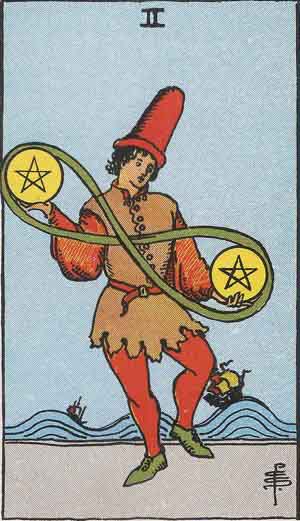
The figure in the Two of Pentacles is skilled. The pentacles remain in motion, and the ships behind them ride high waves without capsizing. Repetition asks whether this competent management allows anything to develop, or simply keeps everything aloft. An honest capacity test must distinguish a temporary response, a workable long-term design and an imposed condition that personal efficiency alone cannot solve.
Core Repeating Message
The Two of Pentacles shows a figure in motion, juggling two large pentacles connected by an infinity loop, while ships navigate rough seas in the background. The figure is not panicking; they are managing competently. But the management requires constant attention: both pentacles must be tracked simultaneously, and changing how one is held affects the balance of the other. The seas suggest unsettled external conditions that the figure must work with rather than control.
When this card appears once, it may reflect a period in which adaptability is required: several legitimate claims compete for limited resources, and dynamic balance serves a purpose. Repeatedly, it can describe active management that remains functional but leaves little capacity for settled engagement or deeper development. Complexity may be imposed by low income, care duties, disability, insecure work or inadequate support. The card should not turn structural pressure into a personal failure to simplify.
One pattern is a material life containing more simultaneous demands than the available money, time or energy can sustain. The job pays the bills, creative work feeds the soul, family needs attention and health requires consistent care. Each claim may be legitimate; setting any of them aside can carry a cost. The unresolved issue is not always a choice the seeker has avoided. It may be a resource gap requiring support, negotiation, collective responsibility or changed external conditions as well as personal prioritisation.
A second pattern belongs to the seeker who has made juggling part of their identity. Being able to keep several balls in the air, handle complexity and remain dependable is a real, often socially valued skill. It can become so central to their sense of self that putting something down by deliberate choice feels like losing a quality they cannot afford to lose. Simplicity might allow material development, yet it is experienced as diminishment rather than a gift. The complexity continues partly because being the person who manages it has become a way of knowing who they are.
A third pattern is reactive management: the seeker did not choose the present level of complexity but arrived at it through separate, sensible decisions. Each added a little to the load, without any one addition looking like the moment when enough became too much. They do not necessarily prefer the juggle. The question of what can be put down may not yet have been asked, or each item may appear indispensable when assessed alone rather than alongside everything else it requires them to carry.
A fourth pattern belongs to the seeker whose natural rhythm includes periods of active management followed by rest and consolidation, but who has lost access to that quieter phase. The high-demand period may have been appropriate; what is missing is the ability to recognise when it has ended and settling is available. Instead of allowing the space to remain, the seeker generates new demands to fill it. Where external demands really have eased, the task is to let consolidation become part of the rhythm again.
These patterns concern material complexity and the sustained attention that development needs. The Two keeps returning to a life whose main texture is active management: things are held in motion, but little has room to grow. Sometimes the next step is a difficult choice; sometimes it is securing the support or changed conditions that would make a choice possible. The important distinction is between a balance that serves the life and one that uses all its available capacity merely to continue.
When This Card Repeats Weekly
A week of Two of Pentacles repetition draws attention to immediate competing demands: two or more things need practical attention at once, and there may not be enough resource to give each the sustained engagement it deserves. The short timescale makes the current pressure easier to identify, even if it cannot all be resolved within the week.
This week, the card asks which resource is most stretched: money, time, physical energy or focused attention. Does every claim need the level of active management it currently receives? Could something be safely completed, temporarily deprioritised or delegated without a serious loss? Consider the claims together, so that an adjustment to one does not simply move its cost somewhere else in the juggle.
The immediate practical question is: what is the minimum viable version of each competing demand, and would that free enough resource for one priority to receive sustained attention this week?
When This Card Repeats Monthly
A month of Two of Pentacles repetition suggests that competing demands have become more than a temporary spike. Across several contexts, active management continues while development stalls, and the arrangement becomes more entrenched rather than settling. Looking across the month helps distinguish an unusually busy week from a structure that repeatedly produces the same divided attention.
The monthly lens asks what has stayed in the air over the past several weeks. Has anything in the material domain advanced or changed in a meaningful direction, or has the month mainly consisted of competently managing existing commitments? Maintenance has value; the question is whether it has also left room for what the seeker hoped would develop.
Monthly recurrence also asks what the seeker most wants to develop in the material domain, and whether the present distribution of resources supports that development or consistently crowds it out.
When This Card Repeats Seasonally
A season of Two of Pentacles energy gives enough time to examine whether management has become the condition of life rather than a path towards something more settled. The same demands are handled again and again, while focused engagement with any one direction remains difficult. The season asks what the juggling enables, what it prevents and whether the current arrangement leaves space for development as well as continuity.
The central seasonal question concerns choice within the room actually available. If the seeker were choosing from their values rather than following the accumulated momentum of commitments, what would they want to develop? What could be set down, concluded, delegated or restructured to create the conditions for that development, and what support would be needed where those changes cannot be made alone?
When This Card Repeats Across Years
When the Two of Pentacles returns across years, perpetual management may have become a long-running pattern. Through several phases of life, practical resources are spread across more demands than they can sustain, while the simplification that would allow development remains unavailable or unchosen. That distinction matters: a life constrained by necessity asks different questions from a life that keeps adding complexity when alternatives are possible.
A long-arc pattern may follow early circumstances in which managing competing demands was necessary and valued. The seeker may have learned to be the capable person who can handle complexity without learning how to choose simplicity when it serves what they want to build. Adult conditions can also repeatedly overload available resources, and the card cannot determine the origin. The useful inquiry is whether simplification is available, what it would cost and which supports or structural changes could make it possible.
The long-cycle Two can also describe responsibilities that have accumulated beyond what one person can sustainably carry. Delegation, structured support and practical boundaries may help distribute the load more equitably, where other people and resources are available to share it. Developing those skills may be part of the work; lacking the means to use them is a different problem. Neither should be treated as a failure of character.
Across years, the growth arc moves towards material clarity: learning what to invest in among competing legitimate claims, and developing the practical skill of saying no to some valid demands in service of chosen priorities. The aim is not to deny that the other claims matter, but to make a life in which something important has enough room to develop.
Life Area Interpretations
Love & Relationships
In love and relationships, the Two of Pentacles often shows practical competence alongside limited room for sustained relational presence. The seeker keeps the shared life moving, attends to arrangements and handles what needs doing, yet finds it harder to settle into the relationship than to manage its demands. The distinction is between functioning together and also having time to be together with undivided attention.
One person may be dependable and engaged in the practical life of the relationship while the constant managing leaves little room for the attention intimacy also needs. In another expression, the relationship itself becomes one more item in the juggle, receiving only the time and energy left after other claims have been partly met. Both ask how the connection might receive something more than the remainder.
Career & Purpose
In career and purpose, the Two of Pentacles describes several legitimate income streams, professional commitments or vocational directions competing for attention. Each is real, yet none may receive the sustained focus through which skill and vocation can deepen. The question concerns how that division is working, rather than assuming that having more than one professional direction is itself a mistake.
The seeker may have several vocational skills and interests, all partly expressed and none fully developed. Managing these partial engagements becomes the work in itself. Which direction would gain most from sustained practical investment rather than a share of divided attention, and what would it take to make that investment feasible? The answer has to account for the income and responsibilities that the other commitments currently support.
Money & Stability
In financial contexts, the Two of Pentacles may describe careful management of competing obligations on limited resources. Bills may be paid while savings, debt reduction or longer-term goals remain difficult. This can reflect skill under constraint rather than poor discipline, and the arrangement may or may not be sustainable.
The card asks whether current management protects essential needs and leaves any room for longer-term development, or whether a temporary balancing arrangement has become permanent. Which obligations are negotiable, and are additional income, benefits, debt advice or shared responsibility needed? Use current figures and written terms. Seek qualified financial, legal or debt support where appropriate, especially before missing payments or changing essential commitments.
Spiritual Growth
In spiritual growth, the Two of Pentacles can describe practice absorbed into the general juggle. It exists and matters to the seeker, but receives whatever time and energy remain after everything else has been managed. The resulting rhythm is interrupted and inconsistent, leaving little room for sustained development. Commitment may be present; the practical conditions that would give it continuity have not yet been created.
In this context, the card asks the seeker to treat spiritual development as a practical commitment deserving protected time and energy, rather than leaving it as the last item in the managing.
Emotional & Mental Patterns
In emotional and mental patterns, the Two of Pentacles describes an inner life that mirrors the outer juggle. Several concerns are tracked at once, and another demands attention before the previous one is resolved. Even while the seeker attends to one thing, the management of everything else continues in the background, making full presence difficult.
The emotional cost can accumulate gradually: a persistent sense of being not-quite-rested, not-quite-focused, not-quite-fully-present. The seeker may have come to regard it as the ordinary texture of contemporary life rather than a pattern worth examining. Recognising it creates a question about the demands and support around them, without assuming that every source of strain is within personal control.
Family & Generational Dynamics
In family dynamics, the Two of Pentacles invites inquiry into whether scarcity, variable income or unevenly shared responsibility made active management a familiar role. Keeping several necessary demands in the air may have been an early survival skill, while settled ease was absent or brief. That is one possible history, not one established by the card; memories, household patterns and current expectations should provide the evidence.
The seeker can examine whether complexity feels synonymous with competence or security: perhaps managing several demands feels like being on top of things, while simplicity brings a bodily sense that something important is falling. That vulnerability may come from unfamiliarity, or something important may genuinely be at risk. The distinction must be tested through concrete consequences and present realities rather than inferred from the card.
Health & Energy
In health contexts, the Two of Pentacles can symbolically reflect the strain of repeated switching, limited recovery and multiple care demands: always tracking, adjusting and tracking again, with little space to settle. This may be a useful description of experience, but tarot cannot establish what the nervous system is doing, diagnose depletion or determine the cause of fatigue, concentration difficulty or other symptoms.
Some people notice a gradual sense of never quite having enough energy or focus, rather than a clear episode of acute exhaustion. Fatigue, divided attention and reduced recovery under practical load can also have medical, psychological, occupational or environmental explanations. Track workload, sleep and symptoms without assuming the card is causal. Persistent, severe or changing symptoms warrant appropriate professional assessment.
Advanced Interpretive Sections
The Shadow Expression
In shadow, juggling can become a source of identity, stimulation or avoidance. As one demand resolves, another is generated; existing obligations are reorganised to keep the same level of active management, and simplicity feels threatening or dull. This interpretation should not blame the seeker for demands they did not create or cannot safely set down. Its relevance depends on whether complexity is repeatedly chosen when workable alternatives exist.
Another shadow expression uses busyness as a sophisticated form of material avoidance. The seeker stays so occupied with managing what already exists that the question of what they want to build never has to be faced. Competence in keeping things moving becomes a way of postponing direction.
The Integrated Expression
The integrated Two of Pentacles seeker has developed practical discernment: managing simultaneous demands when necessary and choosing simplification when circumstances support it. They can distinguish complexity that serves development from complexity that substitutes for it. Settled focus becomes something they can tolerate and use, rather than a gap that must immediately be filled with more demands. Their skill in managing remains available without defining every moment of material life.
Why This Energy Has Not Released Yet
The pattern may persist when the seeker has not identified what simplification would require them to set down, or has not decided whether they are willing and able to do so. Each item has a reason to remain. Holding them all at once can defer a difficult choice of priority, even when a change is possible; where it is not, the question turns to what support would create room for one.
The pattern may also persist when complexity feels linked with security, usefulness or belonging, so that simplification is experienced as risk rather than relief. That feeling deserves examination, but simplification should not be presumed safe. Assess objective conditions, dependency, contractual duties and the likely effect on other people before deciding what can change.
What This Card Wants the Seeker to Understand
The Two of Pentacles wants the seeker to understand that perpetual juggling can limit material development, even when the management itself is highly skilled. The infinity loop can be read as sustained motion without accumulation, but it may also describe a necessary holding pattern while resources or conditions are constrained.
The card is not asking the seeker to abandon legitimate responsibilities. It asks whether any could be set down, and how the cost of doing so compares with the ongoing cost of having no room to develop. Both costs deserve an honest assessment.
Signs the Pattern Is Beginning to Resolve
One sign of resolution is a deliberate reduction in complexity that gives a priority room to develop: an item is actually concluded or handed over, rather than merely pushed to the bottom of the list. Where that is possible, the freed capacity stays available instead of immediately being filled. Where demands cannot safely be removed, securing support may be the necessary step towards the same aim.
Another sign is a growing familiarity with practical settlement: being fully present with one material engagement rather than partly present with several. The quieter focus may begin to feel alive rather than dangerously simple. That shift is experiential, and should be considered alongside whether the practical arrangement really is sustainable.
Reflective Questions
-
Make a list of everything competing for your money, time and physical energy. Looking at the full list, is any one thing receiving enough attention to develop, or is everything being maintained and nothing being built?
-
What would your material life look like if you could give one practical domain your full, sustained attention for six months? What would you choose, and what would need to be set down to create the conditions for that focus?
-
Has there been a pattern across several phases of your life in which practical resources were spread across more competing demands than they could sustain? What produced the complexity in each phase, and is there a common thread?
-
What does practical simplicity feel like to you? Is there a quality of relief or a quality of threat or both? What specifically does the simplification of material life feel like in your body?
-
Which items in your present juggle did you choose as priorities, and which accumulated through separate, sensible decisions whose combined effect was not fully assessed?
-
How able are you to say no to valid material opportunities and demands? What makes declining practical requests difficult, and what might that reveal about the relationship between your identity and the complexity of your life?
-
What did your early family experience teach you about the expected level of practical activity and the response to material simplicity? Was busyness associated with safety, worth or the way love was expressed in your household?
-
Is there one practical domain you most want to develop? What would need to change in your current arrangements for that domain to receive sustained investment?
-
What is the minimum viable version of your material life: the commitments and responsibilities that would sustain the life you want without requiring the perpetual juggling of the current arrangement?
-
If the Two of Pentacles has been appearing for a sustained period, what possibility for practical simplification has it invited you to examine? Which item, if it could safely be set down, would free the most resource for development, and what currently prevents that change?
Practical Integration Actions
Map the full load. Write out every commitment drawing on your practical resources: financial obligations, professional work, domestic responsibilities, relational investment and personal projects. Do not edit as you list. Then look honestly at the whole picture. Which items help sustain or develop the life you want, and which mainly preserve the existing complexity? Keep necessary maintenance visible even when it produces no new growth.
Identify one thing to set down. From the list, identify an item that could be concluded, handed over or deprioritised for a defined period, freeing capacity for something more important to you. It need not be unimportant to deserve reassessment. Check legal, financial, care and relationship consequences, then make a concrete plan for the transfer or conclusion rather than merely letting it drift. If nothing can safely be set down, pursue support, income, an accommodation or shared responsibility instead. Review whether the change frees usable capacity.
Create one protected practical space. For the next month, protect a time each week for one priority engagement, keeping it free from competing claims as far as your responsibilities allow. It might be two hours or two mornings; the duration matters less than the quality of the protection. Use it to experience attending fully to one thing within a life otherwise characterised by division, and notice what that continuity allows to develop.
Practise practical saying-no. For the next four weeks, pause before accepting a new commitment. Assess what it would require, what it would displace and whether it serves the priority you have identified. This is not an exercise in inflexibility. It develops the skill of judging priorities at the moment a demand is added, when its effect on the whole load can still be considered before it becomes another obligation.
Examine the complexity-security link. Write honestly about the relationship between practical complexity and your felt sense of security. Does managing several things at once feel safer than having fewer demands? If so, consider where that association may have been learned and whether it accurately reflects the relationship between complexity and security in your present circumstances. Separate the feeling of staying on top of things from the concrete conditions that make the arrangement safe or unsafe.