
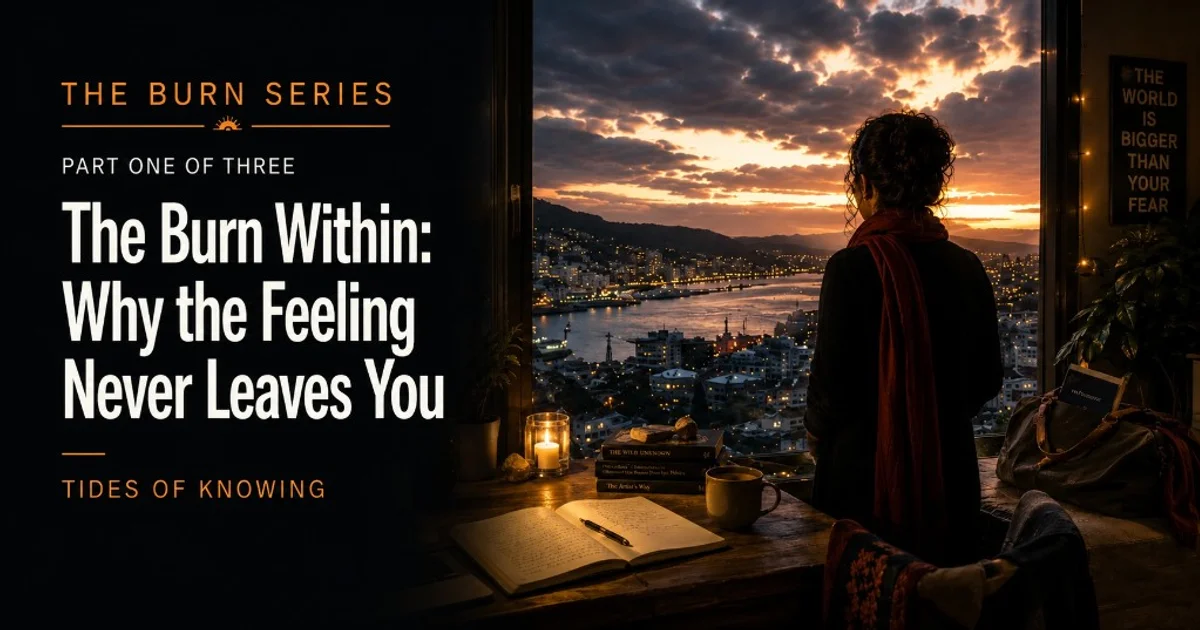
There is a particular kind of longing that doesn’t resolve – and most people who carry it assume something is wrong with them.
Not grief, which has shape and moves through stages. Not restlessness, which responds to a change of scene. This is more persistent: a sense that something fundamental is missing regardless of what you’ve built, found, or become. You achieve the thing you were reaching for, and the reaching continues. You build the life that should be enough, and it still isn’t. The gap remains.
If this describes you, you are not broken. You are carrying something the mystic traditions recognised long ago, named with precision, and understood as one of the most significant spiritual conditions available to an embodied human being.
I’ve carried this feeling my whole life. I’ve called it the burning. It has been low sometimes, almost banked. Sometimes it has flared. It has never gone out, and it has never been satisfied. Three years ago it told me to move to Mexico – permanently, to a country I’d never visited, where I know no one. Not fleeing anything. Moving toward something I couldn’t name. The urgency, when it landed, was specific: if I don’t go by September 2026, it will be too late. Too late for what? I still don’t know exactly. But the feeling had the quality of truth that doesn’t need explaining.
The burning turned out to have a name.
What Is Viraha? The Bhakti Name for Spiritual Longing
The mystic traditions across the world have a name for this burning. The bhakti lineage I’ve been drawn to over the years calls it viraha, the longing of the separated soul. The Sufi tradition speaks of it through Rumi’s reed cut from the reed bed, crying for its home, and the crying becoming music. The Christian mystics called it the wound of love, an arrow lodged in the heart, a fire that purifies without consuming. The Buddhist traditions point at it through the First Noble Truth, the unsatisfactoriness of conditioned existence, which is not a complaint but an invitation to look directly at what we actually feel.
I came to the language of these traditions slowly. I’ve sat on the fringes of many of them in this life, drawn in and then stepping back, never quite enrolling. But bhakti is the one that’s recognised something in me. Perhaps because it holds the long view across many lifetimes. Perhaps because the Bhagavad Gita has been one of those texts I return to without needing to explain why. The longing in those pages, Arjuna’s crisis on the battlefield, Krishna’s patient instruction, the recognition that we are always in a relationship with something larger than ourselves whether we acknowledge it or not, these things have always felt true to me in a way I couldn’t explain.
It was within this slow, lifelong returning to bhakti that I finally found a name for what I’d been carrying. Not as a problem. As a description.
Viraha. The longing of the separated soul. The burning that doesn’t go out.
In bhakti, viraha is not considered a malfunction. It’s not a karmic debt being paid down. It’s not a problem to be solved by spiritual development.
Viraha is the highest spiritual state available to an embodied being. Higher than union. Higher than fulfillment. Higher than peace.
I want to be careful here. I’m not interested in viraha because I want to claim the highest spiritual state. That would be the kind of ego dressed in spiritual clothing that the tradition itself warns against. I’m interested in it because it gives me a framework for accepting what I’ve actually been living. And what I’ve been living is hard. Sometimes lonely. Often unsettling. As I get older the question presses: will I ever be able to call somewhere in the material world home, even temporarily? Will the reaching ever still?
I remember a night in Wellington, a few years ago, sitting at the kitchen table after a reading that had gone well. Client happy, work done, nothing requiring my attention. The flat was quiet. I had everything I needed in that moment. And there it was anyway: the burning, steady as ever, indifferent to the adequacy of my circumstances. Not sadness exactly. Not dissatisfaction with anything specific. Something more like the awareness of a distance that does not close. I had stopped expecting it to close by then. What I hadn’t worked out yet was how to stop wishing it would. That night was when I understood that the burning was not situational. It was constitutional. No arrangement of my circumstances was going to resolve it, because it wasn’t arising from my circumstances.
That is what viraha feels like from the inside. Not dramatic. Not acute. A persistent low-grade orientation toward something that cannot be pointed at directly.
What Persistent Longing Means in the Second Half of Life
There’s something particular about carrying this in the second half of life. When you’re young the longing can feel like potential, like the promise of something not yet arrived. You assume it will resolve through the right choice, the right partner, the right work. You believe the architecture of an adult life will eventually contain it. The burning is forward-facing, and the future feels wide enough to hold it.
But by sixty you’ve made the choices. You’ve done the work. You’ve loved and lost and loved again. You’ve built things that matter. And still the longing remains. Still there’s something just around the corner. The traditions are clear about this. The longing is not a problem of incomplete adulthood. It’s not something to be solved through better life decisions. It’s structural to embodied existence itself.
This is hard news at sixty. It would have been easier at thirty, when there was still time to believe the longing was about something specific I hadn’t yet found. Now I know it isn’t. And I have to find a way to live with what I know.
The Mexico decision is not the response of someone running from what they have. My life has been full. The work has been real. The community has been genuine. I am going toward something, not away from anything. But I cannot entirely name what the something is. That used to trouble me. It troubles me less now. I’ve learned, over the accumulated weight of six decades, that the longing doesn’t come with a destination notice attached. It comes with direction. It points. It does not explain.
At sixty you also carry a particular knowledge of time that wasn’t available at thirty. Some doors that felt permanently open are closing. Some seasons of life do have natural endings, and if you’re paying attention you can feel them. The urgency that arrived alongside the Mexico decision wasn’t anxiety. It was orientation. The difference matters. One contracts the field. The other focuses it.
The traditions don’t pretend the longing is easy to carry. They honor the weight of it. They acknowledge the cost of not having what you reach for. But they also point at something that satisfaction-seeking cultures have largely forgotten.
The burning is the path.
Why the Mystic Traditions Consider Unfulfilled Longing Sacred
Because longing keeps the soul oriented toward what it actually seeks. The moment longing is satisfied, attention turns elsewhere, to the satisfaction, to the next thing. But longing held without resolution keeps the soul perpetually facing toward the source.
Radha is exalted in the bhakti tradition not because she unites with Krishna, but because she longs for him. Her longing is the highest love. The gopis weep for Krishna’s absence and their weeping is sacred. The pain of separation is itself the relationship. To want him is to know him. To miss him is to be with him in the only way available to embodied beings.
This isn’t poetic framing. This is the actual teaching.
Rumi’s reed, cut from the reed bed, cries throughout his entire poetic project. Listen to the reed, how it tells a tale, complaining of separations. The reed isn’t supposed to stop crying. The crying is the music. The separation creates the song. Without the cut, there is no flute. Without the longing, there is no voice.
Teresa of Avila spoke of being pierced by longing for God, a wound that doesn’t heal because healing would end the relationship. She used the image of an arrow lodged in the heart, and the strange truth that she didn’t want it removed. To remove it would be to lose what the wound had given her.
Across these lineages, the same recognition. Unfulfilled longing isn’t an error in the system. It’s a particular spiritual condition that does something satisfaction cannot.
What it does is keep you open.
What the Longing Is Actually Pointing At
I sat with all of this and realised something about my own life. The burning I’d carried wasn’t a signal that I was doing something wrong. It was the felt experience of being oriented toward something larger than my immediate life. The pull wasn’t a problem to be solved. It was a structural feature of being who I am.
And if I’d settled into satisfaction, if Wellington had been enough, or Hawke’s Bay, or any of the places I lived, I would have shrunk to fit the satisfaction. There’s a kind of small life that comes from feeling settled. A reasonable life. A good enough life.
The burning kept me from settling into good enough. It kept some part of me reaching toward something I couldn’t name. While that was painful, it also meant I never let my horizons collapse to what was already in front of me.
The longing was the thing that kept me open.
But I want to be honest about something the traditions also say. Something I’m only beginning to understand.
The longing I’ve been carrying wasn’t for Mexico. Mexico is just the form the longing is taking now, the corner I’ve been walking around for sixty years finally turning. The “something just around the corner” was never a place. It was a state. The state of being fully alive. The state of being met by my own life rather than managing it.
What I’ve actually been longing for is the experience of unguardedness. Of being present in my own existence rather than perpetually preparing for the next configuration of it. The traditions would say I’ve been longing for the source itself, for the divine, for whatever name we give to that which made us and toward which we’re always quietly orienting.
When I feel the gap most acutely, I find myself stepping into it. Reaching for connection with the divine. The evenings I spend in spiritual community have always been less about answers and more about being met: by the chanting, by the people gathered there, by whatever moves through that space. The gap is where the divine becomes accessible. The longing is the doorway.
The Paradox: Why Separation Becomes the Path to Connection
This is one of the strange paradoxes the traditions point at. We assume connection happens through fullness, through satisfaction, through arrival. But the mystics tell us the opposite. Connection happens through the gap itself. The very feeling of separation is what makes union possible. If we felt whole already, we’d have nowhere to reach toward.
In bhakti terms, the longing of separation becomes the longing of love. Same energy. Different relationship to it. Still reaching, but no longer experienced as deficit. The reed continues to play. But it knows now what its song is for.
The transformation the traditions promise isn’t the end of longing. It’s the recognition that the longing itself is the connection. When I have the strength to stay present with that, the burning stops feeling like deficit. It starts feeling like the actual orientation it has always been.
That strength comes and goes. Some days I can stay with it. Some days I cannot. The traditions are honest about this too. The path isn’t a steady ascent. It’s a long oscillation between forgetting and remembering, between deficit and presence. The work is to keep returning. Not to arrive.
I think this is something many of us carry without naming. The sense that something is missing. The feeling that we’re almost there but not quite. The driven quality that pushes us forward without ever letting us rest. We’re told this is a problem to be solved through achievement, through accumulation, through the right relationships or the right work. But the traditions suggest something else. They suggest the longing itself is sacred. That what we’re reaching for isn’t a thing we can grasp. That the reaching itself is the path.
I accept the challenge of it. Not because it’s easy. Not because I want to be exemplary. But because the alternative, closing down, deciding the burning is a problem to be eliminated, would mean losing the very thing that’s kept me reaching toward what matters.
The reed has been crying my whole life. I’m only just learning to hear it as music.
There’s an instruction in the London Underground that I think about often. Mind the gap. Mind the space between the train and the platform. Mind the place where you could fall.
Mind the gap. Tend to it. Stay with it. The gap is not the danger. The gap is the doorway.
You have one too. You’ve felt it. The question isn’t whether to acknowledge it. The question is whether you’re willing to let it teach you what it knows.
The next article, Why So Many People Feel Empty Despite Having Enough, examines why this longing feels so acute in the contemporary age – and what collapsed when the cultural containers that once held it thinned to almost nothing.
Leigh Spencer is the founder of Tides of Knowing and founder of the COMPASS Method, a framework for the conditions of attention that make intuitive reading reliable under pressure. With 30 years in professional journalism and 40 years as a tarot reader and intuitive practitioner, she writes at the intersection of symbolic literacy, perceptual development, and the changing landscape of human knowing.