
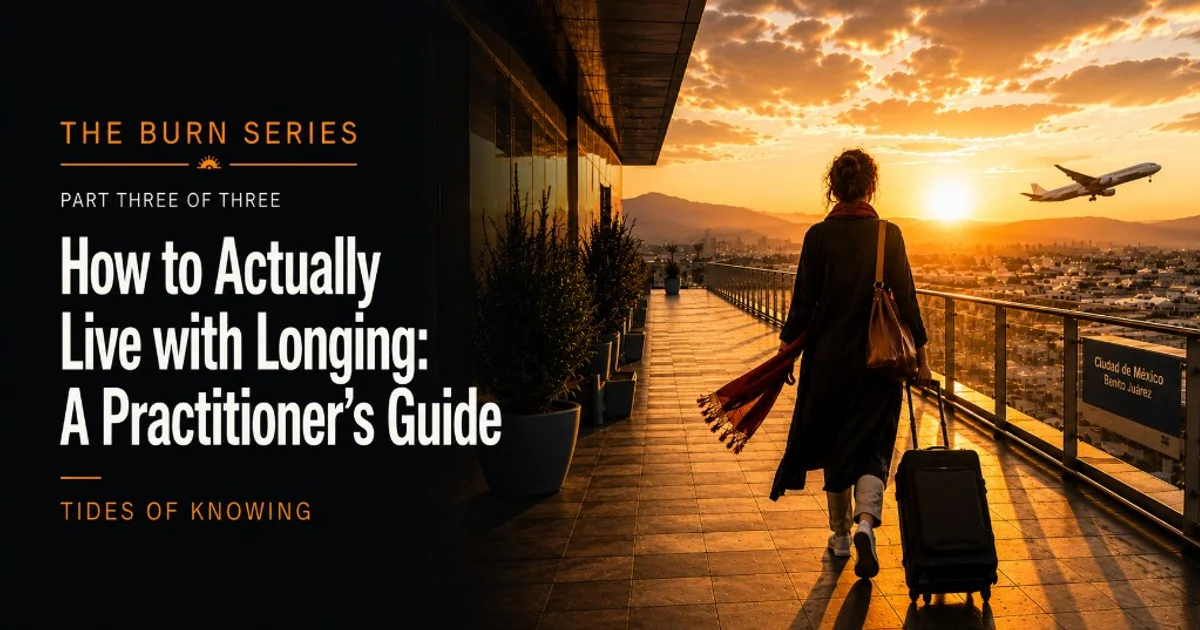
Understanding that longing is sacred doesn’t automatically make it liveable.
The first piece in this series made the case that persistent longing isn’t a malfunction – it’s an orientation the bhakti traditions call viraha. The second examined why that longing feels so acute now: the cultural containers that once held it have collapsed, and most of us are carrying sacred reaching without architecture to make it livable. But most people get the insight and then face the practical question – what do I actually do with this? How do I live with something that doesn’t resolve, without being consumed by it or numbed to it?
This is the practical piece. Not theory. What works, and what doesn’t, drawn from forty years of intuitive practice and a life spent in motion.
There is one central paradox to name before going further: living well with something formless requires structure. This sounds counterintuitive. The traditions speak of releasing, dissolving, letting go. But every major tradition is built on form – daily practices, appointed times, devotional rhythms. The Buddhist monk follows a precise schedule. The Sufi has set times for dhikr. The bhakti devotee has morning practices and evening rhythms. The freedom these traditions point at doesn’t come despite structure. It comes through it. The container is what makes presence possible.
I’m a gypsy by temperament, and for much of my life I believed the longing was driving the movement – that the next place might be the one that finally held what I was reaching for. I’ve owned two houses. The second, where I raised my daughter, came closest to feeling like home – not because of the house itself, but because of her. When she grew up and I began house-sitting, moving through other people’s spaces for three years, I stopped expecting home to arrive through any door I hadn’t already walked through in myself. There’s a reason we call them possessions. Too much of the stuff and it starts to possess you in return, weighing you to a spot you were only ever passing through. What I’m preparing for now isn’t a fixed arrival. It’s portable groundedness – an anchor I carry rather than one I inherit from a postcode. The plan isn’t to settle into one place. It’s to move between more than one base while knowing, finally, where inside myself I’m standing.
What Doesn’t Work When Living with Persistent Longing
Let me start there, because it’s the place most of us begin, trying things that don’t work and then wondering why the burning persists.
Beating yourself up doesn’t work. I’ve spent enough time doing it to know. The longing is not a personal failing. The fact that you feel something is missing doesn’t mean you’re missing something. The cultural messaging suggests otherwise, that if you just achieved more, acquired more, became more, the longing would resolve. It won’t. And blaming yourself for the persistence of what is structural to embodied existence is a form of suffering that adds nothing useful.
Forcing doesn’t work. I learned this slowly, over years of trying. If I want a door to open and it isn’t opening, banging on it harder doesn’t help. The door opens when it opens. My job is to be ready when it does. Patience with myself, patience with others, patience with the timing of things. This is not passivity. It’s an honest acknowledgment that I don’t control as much as I sometimes wish I did.
Obsessive thinking doesn’t work. The mind will try to solve the longing by turning it over and over, examining it from every angle, looking for the hidden answer that will make everything click into place. There is no such answer. The mind cannot solve what the soul is reaching for. At some point I have to discipline my own thoughts, kindly but firmly, not let the obsessive ones keep entering the room. This is a practice in itself, and it takes years to get even passably good at it.
Beyond these, what doesn’t work is anything that closes you down. Anything that pretends the longing isn’t there. Anything that tries to numb it, distract from it, or argue it out of existence. The longing is information. It’s pointing at something. Closing off the signal doesn’t make the signal stop, it just means you stop receiving it. And then it finds other ways through – as anxiety, as compulsion, as the low-grade restlessness that some people carry for decades without understanding where it comes from.
What Actually Works: Practical Approaches That Hold
What does work is harder to describe but easier to do once you find your way to it.
The first thing is honest, objective, compassionate attention to your actual circumstances. Honest, because evasion costs more than facing what’s true. Objective, because emotional reactivity distorts what we see. Compassionate, because beating yourself up about what you see doesn’t help anyone. This kind of attention is a discipline. It’s also a relief. Most of us are exhausted from carrying around inaccurate narratives about ourselves. Putting them down and looking clearly at what’s actually happening is a kind of rest.
The second thing is permission to stop. Not stop forever. Stop for an hour, an afternoon, a day. Lie on a beach. Sit on a bench. Get a massage. Give yourself explicit, deliberate permission to not be thinking, not be solving, not be performing. The longing doesn’t go away during these times, but it gets held differently. It becomes background rather than foreground. The body’s quiet creates a space the mind hasn’t been able to make. I’ve found the beach particularly useful for this. Something about the horizon, the constancy of the water, the fact that no one expects anything of you there.
The third thing is recognising you’re human and not perfect, and that this is fine. The longing the traditions point at is the longing of an embodied being. It is not a sign that you’re failing at being human. It’s a sign that you’re succeeding at it. Humans are creatures who reach. The reaching is part of the design. When I remember this, something loosens. The reaching doesn’t feel like a problem anymore. It feels like being alive.
The fourth thing is finding tools that give structure to what would otherwise be formless yearning. For me, the central tool has always been the cards.
Tarot as a Practice for Attending to the Inner Life
I’ve used tarot for over forty years. Not in a hurried way, not in a give-me-an-answer way. The way I’ve always come to the cards is different. I sit down, I lay them out, and I say something close to this: be brutally honest with me. I don’t want to be let off the hook. I want to understand what has me hooked in the first place.
The cards are good at this kind of honesty because they bypass the rational mind’s defenses. They speak in symbol, in image, in archetype. They tell me things I wouldn’t have let myself hear in plain language. They show me what I’m avoiding. They name what I’ve been circling around. They don’t tell me what to do, they show me what’s actually happening underneath what I’ve been telling myself.
Over forty years they have consistently pointed to the same themes: movement, journeying, the soul in perpetual motion. For a long time that was uncomfortable to sit with. Restlessness, when held up by something as unsparing as the cards, can look like a verdict. It took years to understand it as description rather than criticism. As orientation, not diagnosis.
I want to be clear about what I think tarot is and what I don’t think it is. I have never used the cards as divination, not in the sense of predicting the future or telling me what’s going to happen. I use them as energetic opportunity. The cards show me what’s present, what’s pressing, what wants attention. They don’t tell me destinations. They tell me where I’m standing and what’s available to me from here.
The cards aren’t a way of finding out where I’ll arrive. They’re a way of being present with where I am.
This is, I think, exactly the same wisdom the longing traditions point at. The reaching isn’t toward a destination. The reaching is the relationship.
This is also why tarot has become, for me, one of the most useful practices for living with longing. Because the cards give the longing somewhere to go. They give it form. They give it language. They turn the unnamed yearning into something I can sit with, look at, work with. They don’t dissolve the longing, that’s not what they’re for. They honor it by giving it a container.
This is what I mean when I say that tarot is a glimpse into the gap. The gap the previous articles described, the doorway the mystics whispered about, the space where the longing actually meets what it’s reaching for – the cards are a tool for attending to that space. Not for closing it. For attending to it. The same territory Tarot as a Pre-Symbolic Interface names structurally, and the same attentional discipline the COMPASS Method trains when pressure rises. Readers who want to practise this relationship directly can explore the tools built for that work.
Why Structure Enables Presence (Not Despite It)
This is the practical truth the traditions have always known and that contemporary spiritual life often forgets. The longing the previous articles have explored, the viraha, the reed’s complaint, the wound of love that does not heal, all of it requires practice. Not as a way of solving the longing, but as a way of being present with it. And practice requires container. The container is what makes presence possible.
What I mean by container is the structure within which the practice happens. It might be a time of day. A physical space. A set of objects. A ritual sequence. A community of others. It doesn’t matter much what form it takes. What matters is that it’s consistent, that it tells the body and the nervous system that now is the time to arrive. The container isn’t the practice itself. It’s the holder that makes the practice possible.
One of the containers I’ve carried throughout years of moving is as simple as a doorway. I’ve learned to treat doors as portals – pausing at any threshold before entering a new space, setting a conscious intention for how I want to arrive. It marks the transition in a way the nervous system understands. Something is ending here, something is beginning. I contain my own energy enough that my presence, which can be strong, doesn’t simply arrive and overwhelm what is already there. It honours what I’m walking into. This is a portable practice, built over years of moving through other people’s spaces, and it will travel with me into every room I open in Mexico.
Container is what closes the gap between knowing and doing. It makes the abstract liveable.
Without container, intention disperses. I can want to attend to the longing, I can know intellectually that the gap is the doorway, I can believe everything these three articles have said, and still spend my days doing everything but sitting with what matters. Container is what closes the gap between knowing and doing. It makes the abstract liveable.
How to Prepare for a Major Life Transition Without Losing Ground
Which brings me back to Mexico.
I leave New Zealand in just over two months. I will arrive in a country I have never visited, where I know no one, where I don’t speak the language. By any measure this should be destabilising. And in some ways it is. But I am preparing the structure that will hold the move.
The itinerary I’m building for the first month is intentional. I’ve chosen to arrive in Mexico City first, the largest concentration of cultural density in the country, the layers of pre-Columbian, colonial, and contemporary all stacked against each other in a city of twenty-one million people. I’ll spend the first weeks learning the rhythms of a neighbourhood before expanding the circle. Where to walk safely, at what hours. Where the markets are. What the morning sounds like. This is orientation work, not tourism. It’s the work of learning to be somewhere rather than merely passing through.
I will explore during the day, when it’s safer and the city is most readable, and work at night. I’ve already locked in Bhakti yoga at a temple for at least one evening a week, because I know I need to maintain a community-focused spiritual link from the beginning, not as something to find later when I’m settled. Community is not a reward for having established yourself. It’s part of establishing yourself.
The exploration during the days will be to suss out other parts of the city, to discover where I want to base myself for the months that follow. The first month is not the destination. It’s the reconnaissance. The ground I’ll work from.
I don’t fully know why Mexico. I have my best guesses. Something about the layers of culture there. New Zealand is comparatively new, the European settlement is recent, the cultural strata are thin. Mexico has been inhabited for thousands of years by civilisations that built and fell and built again. The layers are deep. I feel called to those layers in a way I can’t fully explain. There’s a kind of richness available in old ground that new ground, however beautiful, doesn’t offer.
Something also about not speaking the language. For thirty years as a journalist – in daily print, in magazines, in broadcasting – words have been my primary medium: my tool for thinking, for exploring places and ideas, for making meaning and offering it to others. Language has been the current I’ve moved through most of my conscious life. Going to a country where I have none of that is not a loss I’m dreading. It’s a disruption I’m actively seeking. We live in a relentlessly Yang world – do more, achieve more, acquire more, signal more. The Yin in me is ready for something quieter: finding expression through art, through silence, through simply being rather than translating being into performance. I’ve decided to buy an old manual typewriter. Not for nostalgia, but because it enforces a slowing – the mind must quieten to the pace the fingers can manage. That discipline of intentional communication, saying exactly what you mean and nothing more, is part of what Tides of Knowing is built on. The burning knows something I don’t. I’m following it into that not-knowing.
What to Carry Into the Unknown
I’ll bring the practice. That’s the only thing I’m certain I need to bring. The cards. The discipline of morning attention. The willingness to sit with the gap rather than running from it. The evening community once a week, the chanting, the shared space.
I’ll bring what a Vedic chart confirmed not long ago in a way that was, frankly, startling in its obviousness – the kind of clarity that arrives not as revelation but as recognition. The chart mapped what I had already lived with a precision that felt almost comic. An elephant in the room I had somehow moved around for decades without naming. Born in the Chinese Year of the Fire Horse, it pointed unmistakably to a life of motion: someone who finds home on the hoof, not at a fixed address. But it also pointed to peace, and the nature of that peace was specific. Not the peace of arrival. The peace of knowing, with full acceptance, that this world is not our true home – and choosing to love it deeply anyway, in full knowledge of the gap.
I’ll bring the knowledge that structure enables freedom, that the container travels with whoever builds it, that the Fire Horse doesn’t need to stop moving to find ground. I’ll build that container in a new country, piece by piece, day by day. Not a permanent address. A practised arriving.
For a personal account of how the attentional framework behind this work developed over time, see The origin of the COMPASS Method.
In just over two months I will close the door of a small Wellington flat, take a final walk through streets I have known, hand over keys, and leave. The plane will lift off from a country I have moved through my whole life, never quite settling. The reasons I’m going will still be only partly understood. The reasons may never be fully understood. That’s allowed.
I will arrive in a city I have never seen. I will not speak the language of the people around me. I will walk during the days, observing what I can’t yet name. I will work at night, in the quiet, with the longing as my companion the way it has always been. I will go to the temple one evening a week, and I will sit with whoever else has gathered there, and I will let the chanting do what it does. I will let myself be met.
This is the practice. Not arrival. Departure. Not the resolution of the longing. The willingness to let it move me. Not the closing of the gap. The trust that the gap is a doorway worth walking through.
Mind the gap, the voice says in the London Underground. Mind the space where you could fall. But the mystics whisper something else.
Mind the gap. Tend to it. Stay with it. The gap is not the danger. The gap is the doorway you came here to walk through.
So I’m walking through it. Three articles, sixty years, and the same instruction the traditions have been offering since they began: trust the burning. Follow it. Let it bring you where it’s been bringing you all along.
I’ll see you on the other side.
Leigh Spencer is the founder of Tides of Knowing and founder of the COMPASS Method, a framework for the conditions of attention that make intuitive reading reliable under pressure. With 30 years in professional journalism and 40 years as a tarot reader and intuitive practitioner, she writes at the intersection of symbolic literacy, perceptual development, and the changing landscape of human knowing.