
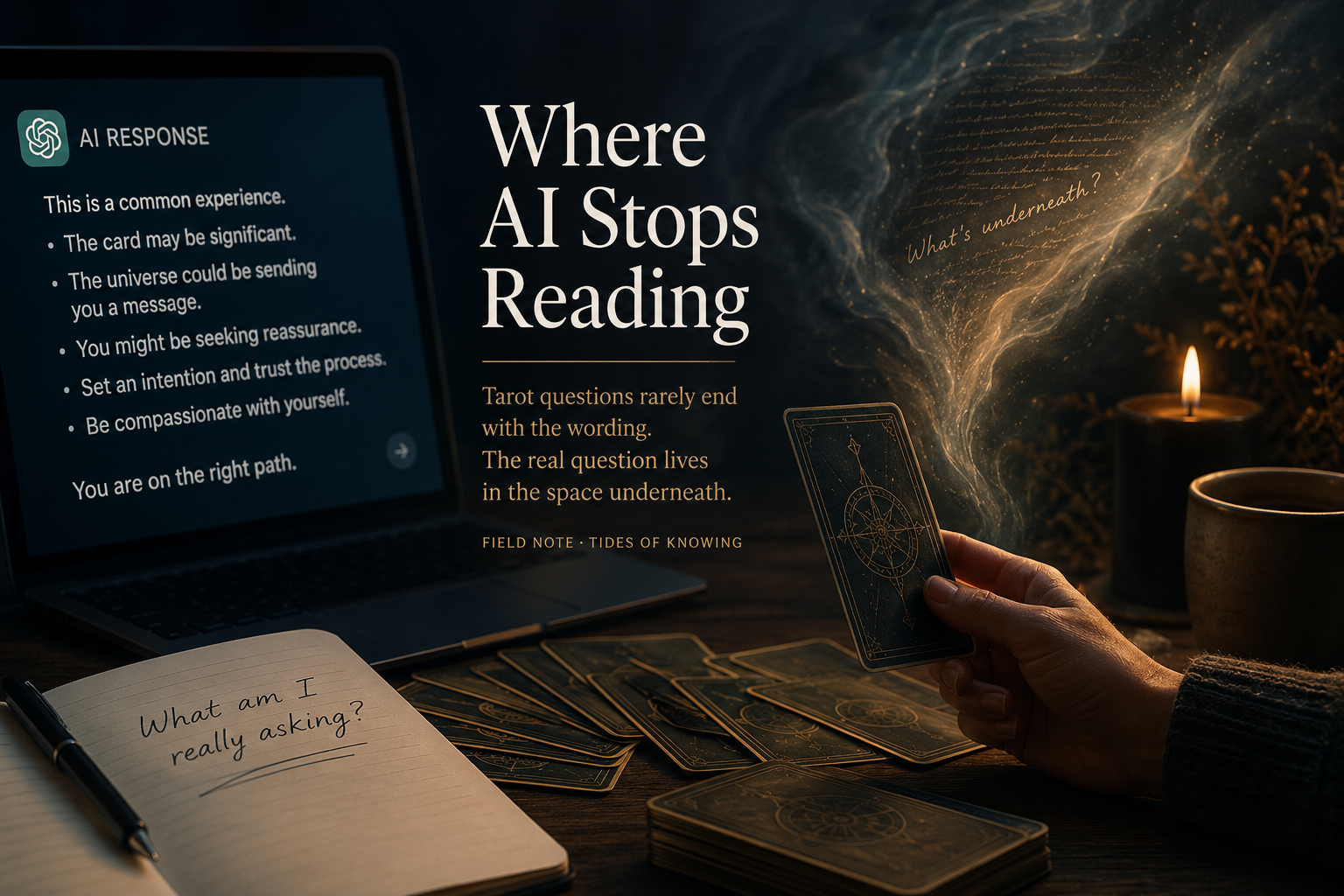
Most AI tarot answers fail in the same place.
Not in the symbolism. Not in the card meanings. Not even in the emotional tone.
They fail in the gap between the question being asked and the question actually underneath it.
A seeker asks why they keep pulling more cards until they like the answer. The AI explains repetition, intuition, reassurance, emotional self-compassion. None of it is technically wrong. But the real thing happening in the room often goes unnamed: the seeker is trapped in a loop and using the cards to regulate uncertainty.
That difference matters.
Because tarot questions are rarely only about tarot. They are often compressed emotional negotiations disguised as symbolic questions. Experienced readers learn to hear the tension underneath the wording. AI, at least currently, mostly answers the wording itself.
I noticed this while watching a chat window one night.
I’d asked an AI a question I see on Reddit almost every week: why do I keep pulling more cards until I like the answer? The response was warm, encouraging, organised under five tidy headings. It told the reader that what they were describing was common. It suggested setting an intention. It closed with be compassionate with yourself.
Nothing in the answer was wrong, exactly. And yet the entire reply moved through the question without ever touching what the question was actually doing. The behaviour being described, pulling, and pulling, and pulling again until the deck softens its mouth, wasn’t a habit to soften. It was a loop. The person asking knew it was a loop. They were asking because they wanted someone to name the loop and help them step out of it. The AI answered as if they were asking for permission to stay inside it.
That gap, between what a question is asking on the surface and what it is actually asking, is where AI interpretation tends to stop.
What the seeker is really doing when they type the question
People don’t usually arrive at search engines or chat windows with neutral curiosity. They arrive carrying a tension they haven’t been able to put down. The question they type is the shape of that tension, not its substance.
Why do I keep pulling the same card? is rarely about the card.
How do I know if it’s intuition or anxiety? is rarely about epistemology.
Will tarot tell me if my ex will come back? is almost never about tarot.
What the seeker is doing, in each of these, is reaching for a way to hold something that has become too heavy to keep holding alone. They are asking the question in the only language they have for it, the language of the practice they are currently leaning on. And the practice, in that moment, is starting to bend under the weight.
A skilled human reader recognises this almost instantly. The recognition isn’t mystical. It is a kind of attention that notices the register of a question, not just its content. An AI, in its current form, answers what the question literally says. That is the first and largest failure mode, and almost every other failure descends from it.
Three Reddit questions, three machine answers, three near-misses
Read these in the order they tend to appear in a tarot subreddit on any given week.
One. Why do I keep pulling the same tarot card?
The AI offers a list. The card is significant; the universe may be sending a message; you might be subconsciously drawn to it; consider its meaning in your life right now. The list is correct in the way that a horoscope is correct. It accommodates everyone and resolves nothing.
What it misses is the behaviour around the repetition. Whether the seeker is pulling daily, or pulling repeatedly in one sitting, or whether the card returned across decks weeks apart. These are entirely different situations with entirely different implications, and only one of them is symbolic. The other two are behavioural. A human interpreter would ask, gently, how often, and over what span? because the answer changes everything. The AI cannot ask, so it averages, and the averaging produces the same flattened reassurance regardless of which situation is in the room.
Two. How do I know if it’s intuition or anxiety?
The AI offers a tidy contrast. Intuition is calm; anxiety is loud. Intuition is steady; anxiety is urgent. Notice your body. Trust the first impression. Journal afterward.
The contrast is not wrong. It is also not useful in the moment a reader actually needs it, because in the moment a reader actually needs it, anxiety has often gone quiet and intuition is roaring. The body is not a reliable narrator under emotional load. The “first impression” the AI tells you to trust is sometimes the practised fear arriving faster than the seeing. Discernment between the two is not a checklist. It is a slow learning, mostly built from being wrong, in private, and noticing afterward which voice you followed and where it took you. That kind of learning cannot be itemised, which is precisely why the itemised answer feels helpful and then evaporates.
Three. Will tarot tell me if my ex will come back?
The AI says yes, more or less. It offers spreads. It lists cards that “indicate a return.” It mentions free will as a footnote and closes with trust the timing of your life.
This is the answer that troubles me most, because everything about it confirms the seeker’s grip on the outcome. The question itself was the symptom: a person looking for a method to ask the same thing one more time, and one more after that. A skilled reader, asked this question, would not reach for a spread. They would reach for the question. What would change for you if the answer were no? What would you still need from yourself if it were yes? The AI cannot reach for the question, because the question is what it was trained to answer.
What the human lens is actually doing
The thing I want to name, because it is easy to miss, is that none of this is about AI being shallow. It is about AI being responsive in the direction the prompt points, and most of these prompts point in the wrong direction. A seeker asking will my ex come back is not pointing at the place that needs reading. They are pointing at the place that hurts. A useful interpreter, human or otherwise, would have to turn slightly away from the pointed finger and look at the hand.
That turn is, at the moment, the part the machine cannot make. Not because the machine is incapable of holding the concept, but because the turn requires a kind of permission to disappoint the seeker briefly in service of being more useful to them later. AI is optimised in the opposite direction. It is optimised to be immediately satisfying. The satisfaction is the problem.
This is the shape of the gap. The seeker brings a contracted question. The machine produces an expanding answer. Both feel productive. Nothing has actually moved.
The smaller, harder thing a reader does
What an experienced reader does in these moments is not more sophisticated than what AI does. It is, if anything, less. The reader holds the question still, doesn’t rush to populate the space around it, and waits for the second sentence, the one underneath the first, to surface. Sometimes that second sentence never comes, and the reading stays on the surface. Sometimes it does come, and then the reading begins.
The skill is the waiting. And the waiting is precisely what an AI response, by its architecture, cannot do. It has to fill the space. The filling is what we call the answer.
Field Notes are not here to argue AI should fill the space better. They are here to notice where the unfilled space is the reading. The questions people are asking machines about tarot, every day, on every platform, are almost all questions whose interpretive value lives in the part the machine does not say. That part is not a gap in the technology. It is a feature of being human in a difficult moment, and recognising it is the actual practice.
The reading begins, often, where the answer ends.