Preview
This Field Note explores how I use the four Knights in tarot as focused working energies when a project needs movement. It is for readers, writers, solo practitioners, and intuitive workers who want a practical way to clarify whether their work needs steadiness, emotional attunement, intellectual clarity, or creative momentum.
Sometimes I need more than a to-do list. I work alone much of the time, which gives me space and creative range, but it also means there is no colleague across the desk when I need to test an approach or get a piece of work moving again.
When that happens, the question is rarely “what should I do?” I usually know what needs doing. The better question is: what kind of energy does this work need from me now?
That is where the four Knights come in. I separate the four Knights from the deck, shuffle only those four cards, and draw one. That Knight becomes the energetic companion for the work in front of me. I am not asking the card to predict the outcome. I am asking it to help me change my approach.
Why the Knights?
I do not see the Knights as merely youthful or impulsive figures. That can be useful in some readings, but it is not the archetype I draw on here.
In older symbolic terms, Knights were sent out when something needed to be done. They served with loyalty and carried a charge on behalf of something larger than themselves. That is what makes them useful in a working context: they move, respond, and serve.
Most people working alone default to more effort: more hours, more output, more force, more thinking. But effort is not always the problem. Sometimes the problem is the kind of effort being used. A project can stall because I am being disciplined when the work needs courage, analytical when the work needs warmth, or inspired when the next useful thing is simply a practical step.
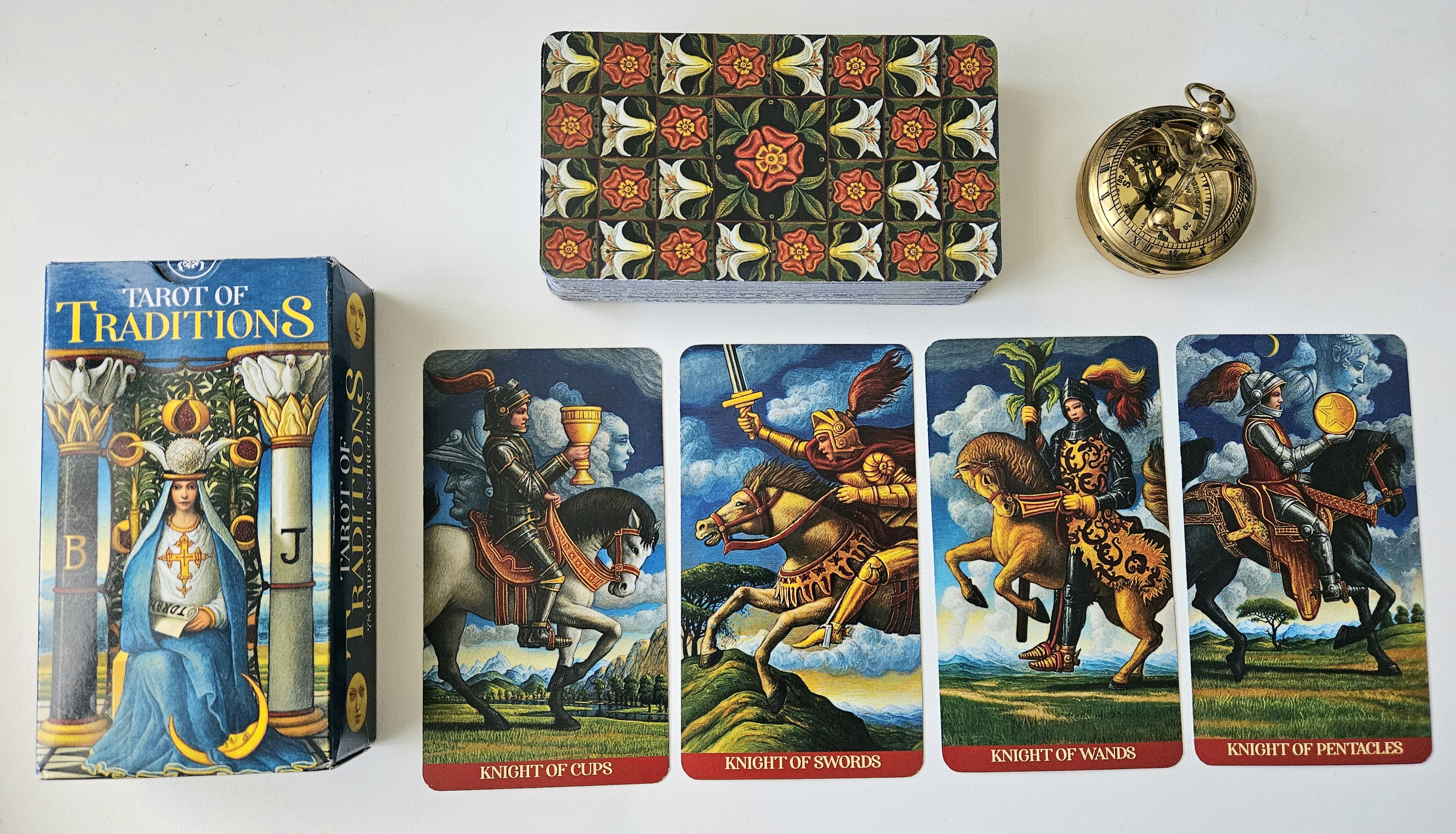
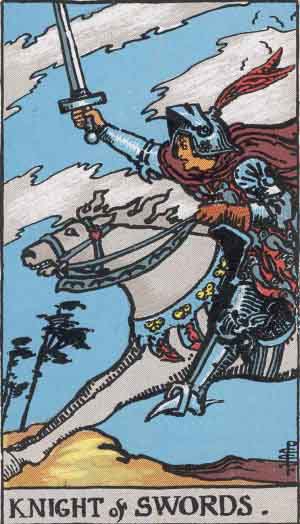
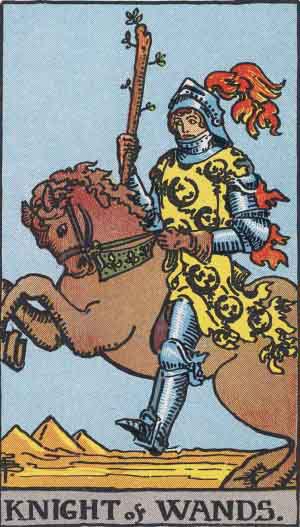
The Knights help me identify the mode of movement the work requires. If the Knight of Pentacles appears, I become more practical. If the Knight of Cups appears, I attend to tone and feeling. If the Knight of Swords appears, I sharpen the thinking. If the Knight of Wands appears, I let more creative heat back into the work.
Why not the Pages?
I could use the Pages for a different kind of practice, but they would answer a different question.
For me, Pages are exploratory. They are curious, inventive, receptive, and still learning their relationship with the element they carry. I might choose them if I wanted to ask what is emerging, what wants to be noticed, or where beginner’s mind would help.
That is not the question I am asking here. When I call on the Knights, the work is already asking for motion. I am not trying to discover the field. I am trying to move through it with the right kind of energy.
Pages help me notice. Knights help me proceed.
The Four Knights as Working Energies
I do not reduce the four Knights to keywords. Each is a full symbolic field, but for practical work it helps to begin with the kind of movement each one carries.
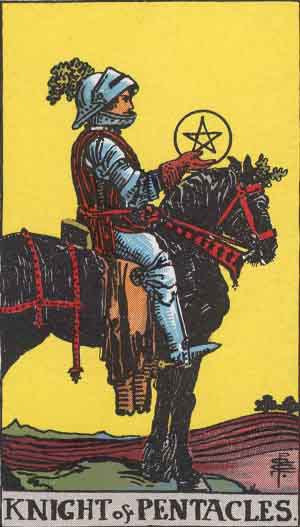
The Knight of Pentacles gets the work done. He is methodical, practical, and organised, and he reminds me to stop circling the task and return to the work itself. One of the clearest experiences I have had with this practice was the Knight of Pentacles appearing for me seven days in a row. Part of me wanted something more interesting or expansive, but the message was clear: be practical, identify the next step, get organised.
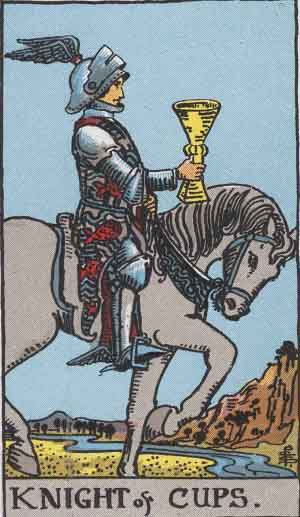
The Knight of Cups brings emotional and relational intelligence. He is useful when the work involves tone, audience, timing, or the subtle atmosphere around a decision. He refines the way action is taken.
The Knight of Swords brings clarity and intellectual force. He helps me name the issue, cut through noise, and stop drifting in the field of possibility.
The Knight of Wands brings creative ignition. He is useful when the work has become too cautious or trapped in preparation. He helps me ask what wants to begin, and where courage is more useful than another round of planning.
The Deck Compass as a Working Example
I used this four-Knight practice extensively while building The Deck Compass. Behind it sits systems, reader pathways, interpretive frameworks, and the development work that helps readers hone their abilities in a live environment. That build has taken eighteen months so far, with more still to come.
A project like that requires staying the distance through technical work, fatigue, and uncertainty. The Knights helped me keep the work moving without stripping it of intuition. Pentacles brought me back to the next practical step. Cups reminded me to consider the reader and seeker experience. Swords helped clarify structure and decisions. Wands kept creative momentum alive when the work became heavy.
The Knights did not replace project management. They gave project management a more intuitive working intelligence, alongside The COMPASS Method™ in the Tides of Knowing practice field.
When I Brought in The High Priestess
There were times when the Knights were not enough. When I was tired, or when the building, chasing, formulating, and solving started to feel too much like an outside job, I brought in The High Priestess.
She served a different function. The Knights helped me move. The High Priestess reminded me why the movement mattered. She brought me back to the inner work and the truth that everything of value must have soul.
In a project like The Deck Compass, that matters. A platform can become all structure if you are not careful. The High Priestess reminded me to keep the visible build connected to the unseen layer beneath it.
Choosing the Deck
For this practice, I use the Knights from Tarot of Traditions by Giuliano Costa. That choice is subjective, and deliberately so.
If I am going to work with the Knights as energetic companions, I need to like how they appear. I need to feel that I can sit with them, look at them, and allow their presence to influence the work.
I recommend readers choose the deck whose Knights they resonate with most strongly. It does not have to be the deck someone else considers definitive, or even the deck they use most often for readings. What matters is knowing why those particular Knights are being chosen, because that choice is part of the intuitive process.
Try This Practice: Calling in the Four Knights
Use this practice when a project or task needs movement, especially if you feel overwhelmed, stalled, or too close to the outcome.
Separate the Knight of Pentacles, Knight of Cups, Knight of Swords, and Knight of Wands from your deck. Place the rest of the deck aside. Write the task or project in one sentence, then shuffle only the four Knight cards and ask: “What kind of movement does this work need from me now?”
Draw one Knight and let it guide your next work block. Do not turn it into a prediction. Let it describe your approach.
Knight of Pentacles: organise, ground, complete, follow through.
Knight of Cups: listen, attune, soften, consider the emotional field.
Knight of Swords: clarify, analyse, decide, cut through noise.
Knight of Wands: initiate, energise, create, take the first bold step.
At the end of the session, ask: “Did this energy help me move the work forward?” That final question matters because it turns the practice into discernment rather than dependency.
Do Not Dull the Swords
I do not use this practice constantly. A Knight’s sword can become dulled through overuse.
Some practices lose power when they are used for every passing hesitation. I call on the Knights when the work genuinely needs movement, not when I am avoiding ordinary responsibility or looking for a more interesting answer than the one already in front of me.
The Knights do not tell me what to do. They help me understand how to move.
Quick Answer: How can you use the four Knights in tarot for work and focus?
You can use the four Knights in tarot as symbolic working energies by separating them from the deck, shuffling only those four cards, and drawing one to guide your approach to a task or project. The Knight of Pentacles supports steady execution, the Knight of Cups supports emotional and relational intelligence, the Knight of Swords supports clarity and analysis, and the Knight of Wands supports creative momentum.
Related Questions
What is the difference between Pages and Knights in tarot?
Pages are exploratory court cards. They notice, learn, test, and begin a relationship with the element they carry. Knights are directional court cards. They carry the element into motion and are better suited to questions about progress, effort, and how to move a situation forward.