
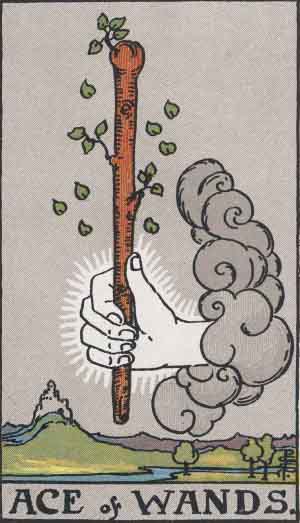
The wand in this image is not a stick. It is a living branch still putting out leaves, still in the act of becoming, held up by a hand that has emerged from cloud into the clear air above the landscape below. The card does not ask whether the seeker has fire. It asks what happens in the moment between the fire’s arrival and the choice to let it take hold.
Core Repeating Message
The Ace of Wands shows a hand emerging from cloud, grasping a thick, living branch from which green shoots burst outward. The wand is not a finished implement. It is still growing, still vital, still in the process of becoming what it will be. Below the hand, the landscape opens: green and fertile, a river in the distance, a structure on a hill that suggests what is possible if the energy in the hand is allowed to travel. Everything in the image is directional. The wand does not sit in the hand; it rises.
This is the card of genuine desire at its earliest stage: the spark before the fire, the impulse before the action, the first warmth of creative, vocational or personal energy when it turns from dormancy towards a particular direction. The Ace of Wands does not know yet what shape the desire will fully take. What it knows is that the aliveness is present, that the wand is in the hand, and that it is pointed upward.
When this card appears repeatedly, it can mark a creative impulse, desire or initiative that keeps forming without receiving enough protection to develop. The repetition does not prove that every exciting idea is viable. It asks the seeker to distinguish a passing stimulus from an impulse that remains meaningful after rest, reflection and a small amount of real-world contact.
One common pattern is the seeker who smothers the spark before it has time to catch. The impulse arrives: a creative idea, a desire to begin something new, a pull toward a direction that feels like it would actually matter. And almost immediately, a second movement follows: the practical objections, the assessment of whether this is a serious idea or a passing fancy, the comparison with other people’s more developed work, the voice that asks whether this is the right time or whether they have sufficient ability. By the time this second movement has finished, the spark is cold. The seeker experiences this as a lack of discipline, or a failure to generate worthwhile ideas, or evidence that they are simply not the kind of person who makes things. What is actually happening is that the fire is being rigorously assessed before it has been permitted to catch, and rigorous assessment at the initial stage is among the most effective means of ensuring that a fire never starts.
A second pattern is the seeker who begins in earnest but does not protect the beginning long enough to move through it. The initial enthusiasm is real; the fire at the outset is warmth, not performance. But the Ace of Wands marks only the first stage of a process that requires sustained tending, including protection through the moment when the initial excitement passes and the demands of the work become clear. This seeker begins with fire and consistently leaves at the point where sustained effort would be required, returning to something new rather than continuing through the difficult middle of what was already started. The stack of unfinished beginnings is the evidence.
A third pattern belongs to the seeker whose life force is present but has been routed away from what they most want. The energy is real. The aliveness is there. But it is currently going into obligations, other people’s priorities, the maintenance of structures that no longer nourish the seeker in any meaningful way. The Ace of Wands keeps appearing not because this seeker has no fire but because their own fire has not been given space to direct itself. The desire exists. The desire has simply not been given authority over any significant territory of the seeker’s life.
A fourth pattern follows a discouraging or costly beginning. After disappointment, exhaustion, humiliation or hurt, a person may pull back from new enthusiasm before they have consciously considered it. The desire may remain, even as it brings a familiar tension or urge to retreat. That caution may be proportionate, or it may generalise from one experience until every spark is treated as the beginning of the same ending. The card invites comparison between the earlier conditions and the present ones, without treating that felt response as proof of a hidden physiological cause.
Whatever the shape of the pattern, the Ace of Wands directs attention to vitality, initiative and permission. It does not prove that a particular desire is sustainable. It asks what happens between the arrival of interest and the work of discovering whether that interest can become something.
When This Card Repeats Weekly
A week of Ace of Wands repetition draws attention to an immediate creative impulse, desire or opportunity for initiative, and to the way the seeker responds to it. Something is alive and wanting to begin, and something is also preventing that beginning from being trusted, protected, or acted upon.
The card this week is asking the seeker to notice the particular spark: what is the desire that is currently present, and what is happening to it? Is it being smothered by assessment? Left unprotected against the first wave of doubt? Redirected into something safer and less deeply wanted? Named and then immediately moved past?
The weekly repetition does not require grand action. It requires careful attention: can the seeker identify what is alive in their life right now, and what is preventing them from treating it as worth protecting?
When This Card Repeats Monthly
A month of Ace of Wands repetition suggests a developing pattern in which desire or creative impulse repeatedly meets the same form of interruption, and the pattern is becoming clear enough to be examined.
The monthly lens asks the seeker to look at what has been consistent across the month: how many times has a meaningful impulse appeared, and what has happened each time it appeared? The pattern beneath the individual occasions, the characteristic move that follows the spark’s arrival, is more important than any single instance.
A month of this card also marks the seeker who is at the beginning of a period in which their creative, vocational or personal life is ready for a fresh beginning. Something has been dormant; the fire is returning. The monthly recurrence asks the seeker to notice this returning aliveness and consider whether the fire can be tended rather than repeatedly left to gutter.
When This Card Repeats Seasonally
A season of Ace of Wands energy marks a sustained encounter with the territory the card names: desire, creative vitality and the impulse to begin, alongside a characteristic response that keeps preventing that vitality from developing into something lasting.
The seasonal repetition often accompanies a seeker who is in a creative or vocational period that calls for initiation: a period in which something new is beginning to emerge, and the season keeps offering the invitation while the seeker’s pattern keeps declining it. The season is long enough to recognise a pattern of refusal rather than a series of unrelated events.
What an Ace of Wands season asks of the seeker is not the forcing of production or the performance of creative confidence. It is open curiosity about the pattern of interruption: what specifically happens when the spark arrives, what the body does, what the mind does, what the seeker does in the moment between the fire’s appearance and its being allowed or disallowed to catch. The season offers enough time to come to know the answer.
When This Card Repeats Across Years
The Ace of Wands returning across years or major life phases can indicate a long-running relationship between desire and interruption. Creative fire, personal initiative and permission to want may repeatedly become important at moments when the seeker’s life is ready to change direction.
Earlier discouragement is one possible origin, especially where enthusiasm was mocked, failure punished or duty consistently prioritised. It is not the only explanation. Present constraints, perfectionism, fluctuating interest, lack of resources or a mismatch between idea and values may produce a similar pattern. Where earlier discouragement fits the person’s history, the fire may have learned to burn low, protected from the exposure that fuller expression would require. The card asks for evidence about this person’s actual history.
The multi-year Ace of Wands pattern also belongs to seekers who have experienced the exhaustion of creative or vocational burnout: who gave their fire fully to something that ultimately consumed rather than nourished them, and who have not yet found a way to trust the desire that keeps forming without immediately connecting it to the experience of depletion that followed the last time they gave it full rein.
Across years, the growth arc this card traces is from habitual interruption to permission: the seeker who begins to distinguish between a meaningful spark and the pattern that follows it, and who develops, gradually, the capacity to protect that desire long enough for it to become something their life actually contains.
Life Area Interpretations
Love & Relationships
In love and relationships, the Ace of Wands most often marks the seeker whose desire for a vital relational life keeps forming without being acted upon, protected or trusted. This might look like the seeker who feels attraction and consistently manages it into something more reasonable before acting on it; who wants deeper aliveness in a current relationship but has not expressed that want; or who keeps approaching the threshold of something new in their relational life and finding a reason to wait.
The card may also mark a seeker whose relational life is currently characterised more by obligation and management than by desire: who is doing the things a relationship requires without the fire that makes those things wanted rather than performed. The Ace returning in this context is not a diagnosis of the relationship but an inquiry into where the seeker’s relational fire currently lives, and whether it is being given any expression.
Career & Purpose
In career and purpose, the Ace of Wands speaks particularly directly. This is the suit of creative vitality and vocational desire: the wanting that orients a life toward its most meaningful work. When the Ace repeats in this domain, it marks the seeker who has a creative or vocational desire, an impulse toward specific work, a vision of what would matter to make or build or offer, and who is consistently not giving that desire the protection and the priority it requires to develop into something real.
This might look like the creative work that keeps being deferred until the conditions are more favourable, the business that exists in planning but not in practice, the artistic impulse that surfaces and is assessed away, the vocational direction that the seeker feels drawn towards but has not yet permitted themselves to move towards because the practical risks of commitment are not yet being weighed honestly against the cost of the desire’s continued deferral.
Money & Stability
In financial contexts, the Ace of Wands often highlights tension between creative or vocational desire and practical constraint. The constraint may be entirely real. Instead of assuming either fear or feasibility, cost the smallest safe experiment, protect essential reserves and seek qualified financial advice where a decision could materially affect security.
The card may also mark the seeker who is using energy and initiative primarily in the service of financial stability rather than in the service of their own fire, and who is finding that the stability thus achieved is not producing the quality of aliveness they expected it to produce. Stability without room for desire can carry a particular flatness, and the Ace keeps appearing because the fire that was supposed to be allowed once security was achieved is still not being allowed.
Spiritual Growth
In spiritual growth, the Ace of Wands marks a spiritual life asking for reinvigoration: a return of fire, a desire to turn towards the sacred, or a longing for something spiritual life could offer that is not currently being sought or received.
Spiritual fire is not the same as spiritual discipline. A seeker can maintain discipline without desire; the practice continues but the aliveness has receded. The Ace of Wands returning in spiritual contexts is asking not whether the practice is happening but whether the seeker wants it: whether spiritual desire is present and being followed, or whether the practice has become routine that is no longer wanted.
For seekers with a creative spiritual practice, the Ace often marks a creative impulse within spiritual life that has not yet been trusted: the mode of prayer or ceremony or contemplation or offering that the seeker’s own fire is pointing toward but that has not been given permission because it does not match received expectations of what spiritual practice is supposed to look like.
Emotional & Mental Patterns
In emotional and mental patterns, the Ace of Wands most often marks the seeker whose relationship to their own desire and vitality involves a characteristic pattern of assessment that precedes permission: who processes the impulse before allowing it, who evaluates the desire before following it, who thinks their way around the fire rather than through it.
The assessment is often intelligent. The reasons offered for why this is not the moment, why this particular desire is suspect, or why the impulse should be tested further are frequently coherent. In this pattern, however, coherent reasons can also serve an established reluctance to begin. The question is whether the seeker is examining the desire honestly or using their intelligence mainly to explain why it cannot be followed.
The card also marks the seeker whose emotional life includes chronic low-level frustration: a background sense that what they want is not finding expression, that something in them keeps reaching toward something that keeps not arriving. The frustration is the desire’s signal that the pattern of interruption has been operating for long enough that the denied fire is no longer silent about what it costs.
Family & Generational Dynamics
In family dynamics, the Ace of Wands most often marks the seeker who grew up in an environment that responded to desire and initiative in a particular way: where wanting was treated as excessive, impractical, self-indulgent, or risky in ways that made learning to manage and minimise one’s own desire the intelligent adaptation.
In some families, practicality or duty may have received more support than experimentation. A person can then find it difficult to tell the difference between a considered present-day judgement and an inherited expectation about what is reasonable to want. This is a possibility to investigate through memory and current evidence, not a universal explanation for creative hesitation.
The generational work this card marks is learning to recognise what one desires, distinct from what one has learned to find acceptable to want.
Health & Energy
In health contexts, the Ace of Wands may symbolically reflect changes in motivation, restlessness or the wish to feel more engaged with life. A person may describe a flatness that feels different from exhaustion, or a sense of wanting to move while continually holding back. Those experiences can accompany many ordinary circumstances and health conditions; the card cannot establish their cause or determine whether energy is present but blocked.
The tension between wanting and repeatedly holding back may also be felt in the body, even when little visible action is taking place. Notice whether a small, safe act of creative engagement changes that felt tension, mood or attention, treating the observation as personal information rather than medical evidence. Persistent fatigue, agitation, pain, sleep disturbance or changes in functioning deserve assessment by an appropriate health professional.
Any experiment should be modest enough to stop without penalty. The useful question is whether the activity feels sustaining, draining or neutral over time, not whether one burst of enthusiasm proves a larger interpretation.
Advanced Interpretive Sections
The Shadow Expression
The Ace of Wands in shadow produces two distinct patterns.
The first is the seeker who uses the experience of the spark as a substitute for the development of the fire. The spark arrives, is felt, is talked about, imagined into its fully developed future form, and never protected through the awkward early stages in which it is most vulnerable and most dependent on careful tending. The seeker lives in the register of the beginning without ever entering the register of the middle, and the constant presence of new beginnings insulates them from the demands of sustained creative or vocational development.
The second shadow is the seeker whose fire has turned against them: whose desire, unmet and consistently deferred, has curdled into frustration, envy, or contempt for the desired thing itself. The spark is still present, but it has become distorted by the pattern of its own suppression into something that criticises what it originally wanted, diminishes the achievements of others who have built what the seeker has not permitted themselves to build, or presents as indifference toward a desire that is in fact central.
The Integrated Expression
The integrated Ace of Wands seeker has developed a trusting relationship with their own fire: they can recognise the arrival of desire and give it the protection it needs in its earliest, most vulnerable stage, holding it through the first wave of assessment long enough for the impulse to clarify into something that can be tended and developed.
This seeker is recognisable by ongoing initiative: not the performance of enthusiasm or the social presentation of creativity, but the sustained engagement with work and desire that characterises a life in which their own fire is consistently given permission. They begin things and continue them through the difficult middle. They know the difference between a spark that is genuinely theirs and one that is borrowed from someone else’s enthusiasm. They have tolerance for the awkward early stages of anything real.
Why This Energy Has Not Released Yet
The Ace of Wands pattern can persist when the seeker has not yet honestly named what they want, distinct from what they have learned to find acceptable to want. The desire beneath the managed version may be precisely what the interruption protects them from confronting, and naming it makes that confrontation possible. Not as aspiration or abstract possibility, but as an honest, clearly stated desire: this is what I actually want, and this is what I have been doing instead.
The pattern can also persist when the seeker has not yet worked through the cost of the last time they followed their fire and were burned. This can be an important part of the Wands pattern: not a general fear of failure, but a particular experience that taught this seeker to associate desire in one direction with a certain kind of loss. While that experience remains unresolved, a protective move may arrive almost automatically with renewed aliveness.
Finally, the pattern persists when the seeker has not yet accepted that the cost of ongoing deferral is itself a kind of loss. The choice is not between the risk of following desire and the safety of not following it; it is between two different kinds of cost, and the cost of the ongoing suppression of their fire is not neutral. Naming this honestly is often what finally gives the seeker motivation to protect the next spark rather than assessing it out of existence.
What This Card Wants the Seeker to Understand
The Ace of Wands wants the seeker to understand that the wand in this image is already alive. The leaves are already growing from it. The fire does not need to be created from nothing; it is already present in the hand. What the card is asking for is not the generation of desire the seeker does not feel, but the protection of the desire that is already there, in the moment when the protection matters most: the first phase, before the spark has become fire, when it is most easily extinguished and most dependent on the seeker’s willingness to hold it.
The card also wants the seeker to understand that desire for what matters to them is not a luxury or an indulgence. It is an orientation that can give the work of a life coherence and direction. A life organised around the ongoing deferral of desire carries its own loss, and the card is patient in its return because it takes that loss seriously enough to keep naming it.
Signs the Pattern Is Beginning to Resolve
The Ace of Wands pattern begins to resolve when the seeker begins to notice the moment between the spark’s arrival and the assessment’s arrival: when they can recognise the felt quality of desire before the pattern moves to manage it, and can sometimes choose to hold the desire for longer than the pattern would usually allow before making any decision about it.
It also resolves when the seeker begins, in concrete terms, to protect one beginning: to give one creative, vocational or personal impulse the sustained tending it requires through the awkward middle stage, and to discover from that experience what sustained development of their own fire feels like. One thing carried through is often more transformative than the pattern can prepare for.
And it resolves when the seeker becomes familiar with what their own fire feels like in the body, distinct from excitement borrowed from external sources, so that they can recognise personal desire as distinct from the performance of enthusiasm, and treat each differently.
Reflective Questions
-
Think about the most recent time you felt a creative or vocational impulse, a sense that something wanted to start. What happened in the moments immediately after that feeling arrived? Did you protect it or assess it? And if you assessed it, what specifically did the assessment produce?
-
What is the desire that keeps forming in your life that has not yet been given permission? Not the abstract version of it, but its specific content: what do you keep wanting, and what do you keep doing instead?
-
Is there a specific experience from your past in which following desire led to a particular kind of hurt, failure, or exhaustion? If so, how might that experience have shaped your immediate mental or bodily response to new desire?
-
Think about your current relationship to beginning things. Do you have a stack of unfinished beginnings, or do you rarely begin at all? What does your pattern of beginning and not-continuing reveal about where the interruption in the Ace of Wands cycle is most active?
-
What did your family of origin communicate, through atmosphere and example, about desire, initiative, and the pursuit of what one wanted? Was wanting treated as something to be trusted and resourced, or as something to be managed, curbed, or made practical?
-
When your life force is not being directed toward something you genuinely want, where does it currently go? What is it currently sustaining, maintaining, or serving that it would not be serving if your desire were given priority?
-
What is the voice that arrives after the spark does? Can you describe the content of what it says, the tone in which it speaks, and whether you recognise it as belonging to a particular period of your life or a figure in your relational history?
-
Have you experienced genuine creative or vocational fire in your life? If so, what did it feel like in the body, and what were the conditions, internal and external, that allowed it to be present? What can this experience tell you about what your own fire requires in order to catch?
-
What would you begin, or continue, if you were certain the desire itself was worth trusting, regardless of outcome? Being specific is important: not the general category but the particular thing. Name it honestly, even if only in writing.
-
If the Ace of Wands has been appearing in your readings for a sustained period, what is it that the desire has been consistently asking you to acknowledge, protect, or begin, that you have consistently not yet fully allowed? What would giving that desire permission look like in the practical terms of your current life?
Practical Integration Actions
Name the desire plainly. Before any other practice, spend time writing specifically and honestly about what you actually want: not the acceptable version, not the hedged version, not the version that has already incorporated the reasons why it is not currently possible. The desire itself, stated plainly. Write it in the first person without qualification. This is not a commitment to act on it immediately; it is the practice of knowing what your fire is actually pointing at, which is the prerequisite for all the practices that follow.
Protect one spark through its first week. Choose one low-risk creative, vocational or personal impulse. Give it five to ten minutes a day before making a final judgement about it, through writing, drawing or a small concrete step towards it. Record what continues to interest you and what does not. Delay comparison and perfectionism, but do not ignore safety, cost, consent or obligations. The aim is to gather lived evidence before dismissing the idea.
Examine one unfinished beginning. Choose one thing you started with genuine enthusiasm and did not continue. Write specifically about the point at which you stopped: what was happening in the project at that moment, what was happening in you, and what the continuation would have required that you did not provide. The exercise is not self-criticism; it is an inquiry into where the interruption occurs in the process, because this is the point at which tending is most needed.
Audit where your energy is currently going. Make a list, as honest as you can make it, of the significant things your life force is currently sustaining. For each item, note whether it is something you genuinely want to be sustaining or something you are sustaining out of obligation, habit, or the management of someone else’s expectations. The exercise is not a plan to abandon obligations; it is an inventory of the gap between where your energy currently goes and where desire would direct it.
Give your fire a small specific form. Rather than waiting until conditions are fully favourable to begin the large desired thing, identify the smallest concrete form you could give a creative or vocational desire this week. Not the finished project, not the fully formed beginning, but the smallest workable version: one hour, one page, one conversation, one step. The exercise develops familiarity with what it feels like to give the fire permission in the conditions of your life, rather than in the ideal conditions that the deferral pattern perpetually waits for.