
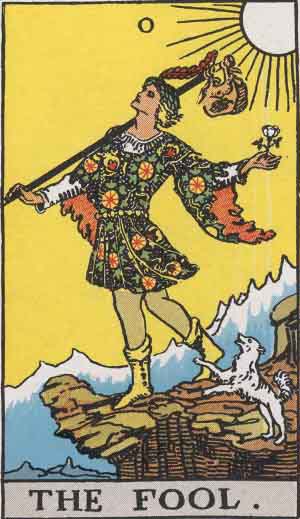
A card that appears once is announcing something. A card that keeps appearing is asking why it hasn’t been answered yet.
Core Repeating Message
Look first at the number. Zero sits before one, but it isn’t really “before” anything. It’s the condition that exists prior to any particular thing being chosen: pure, unshaped possibility, before a direction has narrowed the field down to one option. That’s what makes The Fool different from every other card in the deck. It has no fixed position in the sequence, because it represents the moment before sequence begins at all. Seen once, it signals a threshold: new territory, an invitation to step forward without a map. Seen again and again, its meaning changes shape. It stops announcing a beginning and starts asking a harder question: why hasn’t the beginning happened, or why do beginnings keep looping without ever settling into something that lasts, or what event taught this person that trusting the unknown wasn’t safe.
Three distinct situations bring The Fool back repeatedly. They look different from the outside, but underneath each one sits the same question: what is this person’s current working relationship with uncertainty, and what is it costing them to maintain it.
The threshold that hasn’t been crossed. Here the edge has already been identified. The Seeker can describe the next move in detail. They may have been describing it for years. It’s been discussed, planned around, prepared for in every way except the one that counts. The Fool keeps returning because the knowing is present and the movement isn’t. Something is holding the person in place at that exact spot: a relationship they keep almost leaving, a piece of creative work they keep circling, a career, a city, a belief they’ve outgrown but continue to live inside because the alternative asks them to trust ground they can’t yet verify. The card isn’t being impatient here. It’s simply still there, confirming that the invitation hasn’t expired.
The habit of starting. This person does leap, often, and with real enthusiasm each time. But something consistently interrupts the arc before it can finish. They leave situations before the interesting complications arrive, before they’d have to be properly seen. Relationships, projects, jobs, towns: the pattern repeats across all of them, always with a promising early phase and always with an exit before depth is required. Each new start feels like it might be the one that holds. The Fool’s return here isn’t pointing at hesitation. It’s pointing at its mirror image: a pull toward newness that has itself become a way of avoiding what comes after newness, which is the sustained middle where effort and exposure are unavoidable.
The trust that broke. This Seeker was once open and trusting, capable of extending into the unknown without needing guarantees first. Somewhere in their history, that extension met with a landing that wasn’t merely disappointing but structurally damaging: a serious betrayal, a failure with consequences that outlasted the event itself, a loss that arrived exactly when hope was at its highest. Since then, protection has been built and worn continuously. The Seeker hasn’t returned to any real edge. They may be doing well within carefully managed limits. But The Fool keeps appearing because some part of them hasn’t accepted the armour as a permanent arrangement.
All three situations circle the same question: can this person trust that life will hold them once they move past what’s already known and verified?
That question has nothing to do with optimism. The Fool is not promising a soft landing. In the image, the figure steps off the edge into open air, and the ground below is truly unknown, not secretly safe. What the card is asking, on repeat, is whether the Seeker can move without requiring certainty as the entry price. Whether they can commit to a relationship, a body of work, a changed life, without a guarantee attached. Whether that original willingness to begin can survive actual contact with experience.
When The Fool won’t stop showing up, it’s confirming that this has become the central territory of the person’s life right now. The strategies built to manage it, avoiding the edge, cycling through starts, staying protected since the wound, have stopped functioning as protection and started functioning as a limit. They may still offer short-term comfort. They’re costing something larger over time.
There’s a quieter layer worth naming carefully. The figure in The Fool doesn’t yet know who they are, and that not-knowing is part of the card’s openness rather than a flaw in it. Someone who keeps drawing this card may be in the middle of a profound identity change: the old sense of self is dissolving, and the next one hasn’t formed yet. That in-between state feels unstable because it is unstable. This isn’t disorder. It’s what real transformation actually feels like from the inside.
So what’s usually happening, practically, for someone who keeps meeting this card? They’re standing at a threshold they keep declining, or cycling through starts they keep abandoning, or carrying a broken trust they haven’t grieved properly, or becoming someone new without yet knowing who that is. Often it’s some combination, because these aren’t separate problems. They’re different expressions of the same disrupted relationship with beginning itself.
The card doesn’t judge the hesitation or push against the armour. It simply keeps returning, patiently, until the person is ready to sit with the actual question underneath it: what would it take to begin in earnest?
When This Card Repeats Weekly
When The Fool shows up several times inside a single week, the pressure is immediate and tied to something identifiable in the Seeker’s current circumstances. Movement is being called for, and it hasn’t happened yet.
That might be a conversation being repeatedly postponed. A decision that’s ready but stuck in suspension. An opportunity with a closing window. Weekly recurrence tells you the conditions for beginning are already in place, the opportunity is already present, and hesitation is the main variable still unresolved.
This short-term repetition often arrives with a particular restlessness. Distraction, a mind that circles the same thought without landing anywhere new. That isn’t anxiety without a cause. It’s the physical sensation of an action that’s ready but hasn’t been released. The body frequently registers this before the thinking mind admits it: there’s something to begin, and the not-beginning is quietly accumulating its own pressure.
Weekly recurrence often coincides with an acute identity moment too. Something about who this person is, or is becoming, sits right at the surface this week. They may be close to saying something true about themselves for the first time, sharing work they’ve kept private, making a commitment that changes how others see them. The card’s return across the week is confirmation that the moment has arrived, and that the sense of readiness they’re waiting for may only appear once the action is underway, not before it.
The useful question at this timescale isn’t whether to move. It’s what the movement actually requires. The person finding The Fool returning across their week can usually name the specific thing they’re circling: the email, the conversation, the application, the piece of work not yet shown, the decision not yet spoken aloud. At the weekly level, this card is rarely vague. It’s pointing at something particular, and the Seeker generally already knows what it is.
When This Card Repeats Monthly
When The Fool holds steady across several weeks, the situation has moved past a single decision point and into the actual structure of how this person is living. Their relationship to beginning has become a recurring feature of daily life, not a one-off threshold.
Monthly recurrence often means the Seeker is living at the edge of substantial change they’ve been preparing for over an extended stretch. That preparation may be entirely real: honest inner work, real conversations, real shifts in thinking. But at this timescale, the card keeps returning because preparation has reached its natural limit. What comes next isn’t more preparation. It’s the step itself.
This pattern also shows up when someone’s life has become structured around perpetual transition: always about to change something, always on the cusp, always mid-decision. The card appearing monthly in this context is naming a habit of dwelling at the edge that has become comfortable in its own strange way. The discomfort of not-yet-beginning has been normalised to the point where its original urgency has faded.
Monthly repetition often lines up with outside signals that reinforce the same message. Opportunities present themselves. Circumstances shift and create viable openings. Other people may name potential in the Seeker that the Seeker seems reluctant to act on. This recurring pattern is telling them the moment hasn’t passed, the invitation keeps renewing because the readiness is already present, even if the willingness to act on it isn’t yet complete.
This is also the timescale at which the habit of serial starting becomes most visible as a pattern rather than a string of unconnected decisions. Looking back over the month, someone might identify three or four points where they began something and then quietly withdrew. The card’s monthly return is asking for an honest accounting, not of the external reasons each retreat seemed sensible, but of what was consistently avoided each time by not continuing.
When This Card Repeats Seasonally
Across three or four months, The Fool’s continued presence points to something operating at the level of deep structure rather than immediate event. A significant chapter has been gestating. An identity is undergoing real transition. This is bigger than any single decision and longer than any moment of pressure.
Seasonal repetition is often the mark of initiation, not the decorative version of the word, but the demanding process of being moved from one way of being into another. The old form of the life, the role, the self-understanding that used to work, no longer fits. It’s too finished, or too much a product of who they were rather than who they’re becoming. The new form hasn’t settled yet. This card keeps appearing because that in-between state is the actual territory being worked through, not a waiting room before something else starts.
This can be deeply disorienting. There’s often difficulty putting the feeling into words for other people. Old competencies and identities stop feeling like a reliable description of who the person is. There’s a quality of uncertainty that goes deeper than the situational, closer to a recalibration of the fundamental coordinates of self and direction. That’s precisely what seasonal Fool energy points to: not a problem needing a quick fix, but a rebuild that takes time and some tolerance for not knowing.
Seasonal recurrence also marks the point where the Seeker has to choose between entering the change willingly or being moved through it without much say in the matter. The in-between doesn’t stay still forever. The old form can’t be resurrected by holding onto it harder. The question the card is asking across a season is whether the Seeker will consciously cooperate with what’s happening, or keep managing and deferring while the change proceeds regardless.
There’s often a significant relationship to permission bound up in this. The Seeker may be waiting for someone or something outside themselves to confirm that the leap is sanctioned, that the timing is right, that the direction is correct. They may be seeking approval from a person whose validation they’ve historically needed, or waiting for a certainty from institutions and outcomes that simply won’t arrive in the form expected. The Fool doesn’t move because it’s been given permission. It moves because moving is its nature. Across a season, its return is pointing at exactly this dependency: the habit of waiting for outside authorisation before acting on something already known internally.
The central work at this timescale is to build a different relationship with not-knowing. This is not the forced positivity that dresses itself as trust without having substance behind it, but the more honest recognition that the Seeker has already survived more uncertainty than they may credit themselves for, and that the discomfort of being between identities is not the same as being lost.
When This Card Repeats Across Years
When The Fool has been present across a year, or keeps returning across major chapters of a life, it’s become a companion to something foundational. This isn’t visiting a single decision. It’s a long-term marker of one of the person’s core operating questions: what is their relationship to beginning, to trust, to extending into what isn’t yet known.
Across years, this card may point to what could be called a pattern of perpetual preparation: a life always approaching fuller expression but consistently deferring the actual living of it. The person who draws The Fool year after year often has a vivid, developed inner life. They think carefully about what they want and who they are. But a gap has built up between that internal richness and any outward expression of it. The knowing and the living have come apart from each other, and this card’s long-term presence is naming that gap as the real unfinished business.
Across years, this card also functions as a marker of a recurring life lesson, the territory a person’s experience keeps returning them to because it remains both persistent and significant. Just as some people keep encountering themes of power, or loss, or truth-telling, The Fool’s sustained presence names the threshold itself as this particular person’s defining subject. That isn’t misfortune. It’s an indication that the deepest work of this life involves developing a grounded, non-naive trust in the capacity to begin.
The question of broken trust matters most at this timescale. Someone for whom this card has been a long-term companion may be carrying a wound in their relationship to openness that predates the current phase of life considerably: a childhood environment where enthusiasm wasn’t supported, where hope was consistently met with disappointment, where extending oneself openly produced loss rather than warmth. The adult pattern, whatever shape it takes now, wasn’t invented from nothing. It was learned, and what was learned can, with time, be reconsidered.
Long-cycle recurrence also raises a harder question: what would this person’s life become if they stopped waiting for conditions to align before beginning? Years spent in the almost, the nearly, the not-yet, represent a real accumulation of unlived life. Not something to feel ashamed of, but a resource that’s actually available. The clarity built up during the waiting, the self-knowledge, the understanding of what matters most, is real and usable.
There’s a particular form of courage this card’s long-term presence points to. Not the courage of the dramatic leap, and not the courage of someone with nothing left to lose, but the courage of someone with a great deal to lose who begins anyway. Someone who’s circled a threshold for years isn’t naive about the risks. They know the costs in a way the original innocent figure in the image does not. The version of beginning available to them isn’t zero-point innocence. It’s a mature, eyes-open extension into the unknown that carries the whole weight of accumulated experience into the leap. That isn’t a lesser courage. It’s a deeper one.
The long-cycle version of this card also raises a question of legacy, in the broadest sense: what sustained hesitation has cost not just the individual life but the people and work that would have benefited from what might have been built, made, or offered. This isn’t guilt. It’s the recognition that beginning isn’t only a private act. What isn’t made, entered, or pursued leaves an absence in the world that extends beyond the Seeker’s own experience of it.
Life Area Interpretations
Love & Relationships
The Fool repeating around love usually points to one of three situations, each with its own texture but the same question about trust and extension underneath it.
The first is the relationship not being entered. Someone may be at the edge of meaningful connection and consistently finding reasons to defer, to stay adjacent rather than actually inside it. From the outside this can look like sensible caution: they’ve been hurt before, the timing feels wrong, they want to know the other person better first. Some of that reasoning may hold up. But when the card keeps returning, the hesitation has usually moved past reasonable and into structural. The person isn’t waiting for more information. They’re waiting for a certainty relationships don’t offer before entry, only during and after it.
The second dynamic is the relationship that starts but never sustains. Real chemistry, real interest, real hope, followed reliably by an exit once depth, negotiation, or full visibility become necessary. Each new start feels like it might turn out differently. The endings pile up without much recognition of the consistent role played in producing them. When this card names the pattern, it’s naming the cycle itself, not the specifics of any one relationship.
The third involves a relationship that’s technically over but hasn’t been properly left. The person may be out of it physically and functioning well on the surface. But the loss, the betrayal, or simply the grief of something that didn’t become what was hoped for, hasn’t been fully acknowledged. This card returns because a fully new beginning isn’t available to someone still internally occupied by what ended. The threshold to something new can’t be crossed while significant emotional space is still held by the past.
Inside existing relationships, this card repeating can mean a necessary renewal is being resisted. Long partnerships move through repeated cycles of ending and beginning within the same relationship. Something between two people has completed its current shape and needs to begin again, differently, but one partner is holding to the old structure rather than letting the relationship evolve. Here the card isn’t pointing toward leaving. It’s pointing toward letting the relationship become something new.
What the card is really asking, in the relational domain, is whether this person can allow themselves to be seen before the outcome of the connection is known. Real intimacy means extending into the uncertainty of another person’s response, being seen before any outcome is settled. For someone carrying a significant wound here, that extension can feel like exposure rather than connection. The Fool showing up repeatedly in love readings names that fear precisely and asks whether the protection still serves the life this person actually wants.
Career & Purpose
In work and vocation, The Fool repeating most often points to a calling being approached but not entered: a creative direction, a professional reinvention, a shift from income-work to expression-work that’s been circled with real desire and repeatedly deferred.
The shape is usually recognisable. The person knows what they want to build. They have some of the skills, or a clear picture of what’s missing. Preparatory steps have happened: courses finished, conversations had, plans sketched out. But the actual beginning, the piece of work made and shown, the service offered for the first time, the business opened, hasn’t happened yet. This card keeps naming that gap between knowing and doing.
It’s also notable when someone is in a role or field that no longer fits. A sense that the work has essentially ended, even if the job title hasn’t changed, is this card’s particular territory in the career domain. Its recurrence here is identifying that the person is staying past a chapter’s natural conclusion, and that the next one can’t begin while the previous one is being kept alive past its actual expiry.
The habit of serial starting shows up distinctly in vocation too. Someone who launches multiple projects, pivots often, starts creative work and abandons it before it finds an audience, is visible in this card’s recurrence. Each new direction feels like the real one. The enthusiasm is sincere, but the follow-through is absent, and a quiet private story about unreliability may be building alongside the pattern, reinforcing it. This card isn’t asking why they keep starting, since starting is natural to this energy. It’s asking what makes the middle feel impossible to inhabit.
There’s often a relationship between this card’s repeated career appearance and the question of permission. Whose approval has this person decided they need before pursuing their actual direction? A parent’s voice that’s never fully quieted. A professional norm defining legitimate work in ways that exclude their actual interests. An inner critic demanding more credentials, more proof, before the real work is allowed to start. The Fool has no interest in permission. Its repeated appearance in career readings is often a direct confrontation with whatever outside authority has been substituted for the person’s own knowing.
Once the pattern is honestly named, there’s a considerable gift available here. This energy is well suited to building something from nothing. The creative entrepreneur, the artist working in a new form, the practitioner stepping outside established frameworks: these are Fool vocations at their best. Fully integrated rather than perpetually deferred, this energy produces real originality precisely because it doesn’t start from convention. The open question is whether the person is willing to live that originality in practice, not just imagine it.
Money & Stability
The Fool repeating around money and stability carries a particular tension, because the impulse to begin and the need for security pull in different directions. That tension isn’t something to resolve by choosing one side over the other. It needs to be navigated consciously, on its own terms.
The most common pattern is someone who has tied financial safety so tightly to risk-avoidance that any movement toward what they actually want feels like a threat to their basic security. This card returning here isn’t encouraging recklessness. It’s identifying a link that may be too rigid: the belief that any movement into the unknown is inherently destabilising, that security and beginning can’t coexist.
The opposite pattern shows up too: someone who has repeatedly launched into financial commitments without enough grounding, making decisions driven by the excitement of new possibility rather than a considered look at what’s actually viable. This is the shadow side of the same energy, made visible in material terms. The card here may be asking for an honest look at the relationship between excitement and judgement in financial decisions, and whether enthusiasm has consistently been allowed to override proper evaluation.
There’s a quieter financial dimension too: staying in work or financial arrangements that no longer nourish, not because they are strictly necessary, but because leaving would require tolerating uncertainty about income that currently feels intolerable. The card isn’t suggesting financial stability doesn’t matter. It is suggesting that the price paid for it, in vitality, purpose, and the life not being lived, is worth examining honestly.
The useful distinction here is between risk that is objectively imprudent and risk that feels dangerous primarily because it is unfamiliar. These aren’t the same thing, though the nervous system rarely separates them cleanly. Practical planning, an honest assessment of what’s actually needed versus what’s being projected onto the unknown, and small, clearly defined beginnings that test a new direction without requiring a complete financial overhaul: these let this energy move constructively through the money domain without demanding either recklessness or standing still.
Spiritual Growth
The Fool is, underneath everything else, as much a spiritual card as a personal one. It represents the condition of the soul before it’s been shaped by accumulated experience, before it’s learned defensive postures, before loss has taught it to protect what remains rather than extend toward what might be. When this card keeps returning in a spiritual context, it’s usually pointing at one of three things: a need to return to a beginner’s relationship with the sacred, an invitation to release a spiritual identity that’s become too fixed to stay alive, or a call to trust the next stage of growth even without a map for it.
A beginner’s relationship with the sacred isn’t the same as ignorance. It’s a quality of openness, a willingness to remain open to not knowing, that can quietly get lost across years of practice or study. Someone with a long spiritual history may have built, without fully intending to, a solid structure around what their spirituality looks like, requires, and produces. That structure can become a container too small for the next depth of engagement. This card asks whether the spiritual life inside it is still alive and developing, or has become a well-organised arrangement of familiar territory.
The question of spiritual identity matters here too. Many people build real parts of their self-concept around their practice or worldview: the person who meditates, who reads tarot, who follows a particular tradition or teacher. When maintaining that identity becomes more important than the inquiry it was originally meant to support, it stops being a spiritual path and becomes a spiritual position. This card repeating in spiritual readings may be pointing at exactly this: the next real growth requires releasing a self-concept about spiritual advancement that has become its own form of attachment.
The call to trust without a map is the card’s most essential spiritual teaching. Every established contemplative tradition has some version of it: a point where the structures that supported growth become the very thing further growth requires moving past. The maps run out. Teachers have taken a student as far as their particular territory extends. What follows is open ground. This card returning at that point isn’t abandonment. It’s initiation into a more direct encounter with the unknown, without the buffer of framework or tradition.
This can be frightening in direct proportion to how much someone has relied on those structures for a sense of spiritual security. But the wisdom here is precise. The soul’s original openness, its capacity to meet what’s real without insisting it fit prior categories, isn’t lost. It’s simply been layered under useful but now potentially confining accumulation. The card keeps returning to point at what’s still there, underneath: the beginner still present beneath those accumulated structures, ready to meet experience directly.
There’s also a dimension of spiritual courage worth naming. Beginning a practice or inquiry that has no established template in a person’s community or tradition asks for the same quality of trust as any other threshold this card marks. Someone may be at the edge of something distinctly their own, not inherited, not pre-approved, not yet legible to anyone else. This card’s repeated appearance in spiritual readings can be confirmation that what’s stirring is real, and that the absence of outside recognition isn’t evidence against it.
Emotional & Mental Patterns
Persistent Fool energy produces a recognisable emotional and mental landscape, even when the specific content of a person’s life varies considerably.
The most common is overthinking used as a substitute for movement. The mind is actively engaged with the questions life is posing, but the thinking has turned circular. It revisits the same ground without producing a different outcome. Every pass ends in the same place: uncertainty, awareness of risk, the recognition that no further thinking will produce the guarantee that would make the leap feel safe. Real mental energy is being spent here, but it isn’t moving anything. The card’s return points at the way thinking has become a holding pattern rather than a tool for actual discernment.
A related pattern is a low-level activation that isn’t quite fear and isn’t quite excitement but shares something with both. A state of suspended readiness, somewhat alert to possibility and somewhat unsettled by the unlaunched thing being carried. It isn’t comfortable, but it’s become familiar enough to feel like a baseline. This card’s return is noting that it isn’t actually a natural resting state. It’s the felt experience of something prepared but not yet released.
The emotional cost of habitual starting is worth naming clearly too. Each abandoned attempt leaves a small residue of disappointment in oneself, a quiet confirmation of a story about unreliability. Over time these residues build into something larger: I don’t finish things. I get excited and then pull back. I can’t be trusted with my own ambitions. This card returning isn’t confirming that story. It’s asking for a closer look at what each withdrawal was actually protecting, what it was avoiding, what fear was being honoured at the cost of something that had begun to grow.
There’s also a particular relationship to perfectionism at the threshold worth naming: the sense that the beginning can’t be made until the conditions, the preparation, the certainty about direction, are all precisely right. This kind of perfectionism presents itself as careful discernment. It’s usually avoidance dressed up convincingly.
The real emotional work this card points to isn’t suppressing anxiety or forcing action. It’s a fundamental reassessment of the Seeker’s relationship with not-knowing, treated not as something to endure until certainty arrives, but as the permanent condition of a life actually being lived.
Family & Generational Dynamics
The Fool’s appearance around family and generational patterns often reveals where a person first learned their current relationship to beginning, risk, and trust.
Families transmit characteristic ways of relating to the unknown, usually without meaning to. Some family systems are built around safety and risk management: new beginnings get assessed for threats before possibilities, enthusiasm is tempered by memories of past failure, stability is prized over expansion. Someone raised in a system like this may have internalised those values so completely that the desire to begin something new registers as transgressive or irresponsible. The card returning here is naming a loyalty to family values that’s now working against the person’s own life.
The opposite family pattern produces the same repetition. Some families are characterised by instability, by beginnings that never settled, by adults who modelled the habit of starting and retreating without the child having language for it at the time. Someone who grew up watching a parent perpetually launch and withdraw may have inherited that exact pattern, or developed the opposite reaction: an extreme caution born of watching what happens when beginnings are made without enough ground under them.
This card’s family dimension also surfaces when someone is the first in their line to attempt a particular kind of beginning: a creative vocation inside a family of pragmatists, a different kind of relationship in a family with rigid templates, a departure from inherited belief. These are consequential thresholds into territory with no inherited map handed down from anyone who came before. The weight of that aloneness is real and often what makes the leap feel disproportionately large.
The generational work this card sometimes points to is a conscious choice to carry a different pattern forward. Not as a rejection of family, but as a contribution of something new: the willingness to begin that previous generations didn’t have, the trust that wasn’t modelled, the willingness to enter unfamiliar territory without needing someone else to have mapped it first. These become gifts to what comes after, not only to the Seeker’s own life.
Health & Energy
When The Fool keeps returning around physical energy and general wellbeing, it usually points to a kind of energetic suspension: the depletion that comes from sustained tension between an impulse to move and the consistent holding-back of that movement.
The body has its own relationship to this threshold. When something is ready to begin and that readiness keeps getting held back, the system carries the charge without release. This can show up as a restlessness that doesn’t resolve with rest: physical agitation that isn’t clinical anxiety but is the felt presence of unlaunched energy. Tiring more easily than circumstances seem to warrant, or a sense that energy is present but not quite available for full engagement, are common signs of this.
The nervous system is relevant here too. Sustained vigilance from someone always at an edge they aren’t crossing takes a real toll on the system’s capacity to regulate itself. Cycling between over-activation, restlessness and reactivity, and under-activation, flatness and low motivation, often corresponds directly to the threshold dynamics playing out elsewhere in the life. Approaching the beginning and then pulling back reinscribes that cycle in the body each time.
Habitual starting has its own energetic signature too. Each launch and retreat activates and then abruptly withdraws the system’s engagement. Over time, the body can develop a real wariness about committing its full energy to anything new, because the repeated experience has been extension followed by sudden withdrawal. The body learns, reasonably enough, to hold something back in reserve.
The movement this card’s health dimension points to is embodied, not mental. Anyone drawing this card repeatedly may find real benefit in practices that reconnect them to the physical experience of moving forward: walking, swimming, any rhythmic movement with a clear sense of direction. The body’s relationship to beginning can be worked with directly, not only resolved in thought. Sometimes the body needs to remember what going somewhere actually feels like before the mind is ready to follow.
Advanced Interpretive Sections
The Shadow Expression
The shadow expression of The Fool, in its repeated form, is a life lived almost but not quite. Someone in this shadow has built a sophisticated and largely unconscious system for managing the threshold. Always in preparation. Always developing readiness. Always just about to begin the thing that matters most, and therefore always able to tell themselves that the thing itself is still coming.
This management system is remarkably good at producing the sensation of forward motion without the substance of it. Courses taken, plans made, conversations had, skills developed: each one sincerely experienced as progress toward the real beginning. None of that is wrong exactly. Preparation is real. The shadow appears when preparation becomes the permanent mode, and the beginning keeps receding just far enough ahead to stay out of reach.
The shadow also shows up as fresh starts that never develop into sustained engagement. Each new beginning carries the convincing freshness of something new. The enthusiasm is real, the hope is real, the commitment made at the outset is sincere. What’s shadow is the absence of honest recognition that the cycle itself is the pattern: that this isn’t the first fresh start, and that the freshness has become the actual point, rather than what’s supposed to grow once the freshness wears off.
A sharper shadow expression belongs to someone who’s withdrawn from this energy entirely: the person who doesn’t begin because they’ve accepted the wound’s final verdict on openness, who has structured a life around avoiding exposure rather than managing it sensibly. This shadow doesn’t present with the restlessness of an unfinished leap or the enthusiasm of habitual starting. It presents as a settled diminishment: a life that’s functional and well defended but missing the particular aliveness that comes from venturing into the unknown.
In every form, this shadow isn’t malicious. It’s protective. The real question it invites is whether the protection is still proportionate to whatever threat it was originally built to guard against.
The Integrated Expression
The integrated expression of The Fool isn’t the naivety of the original image. Someone who has integrated this work doesn’t step off cliffs without looking. They step off with full awareness that the ground below isn’t yet visible, and do it anyway because they’ve built a real, working relationship with their own capacity to handle what comes next.
Integration produces a quality of grounded openness. New directions become available without needing to be certain first. Something can be begun without requiring it to be finished before it starts. A relationship can be entered without demanding guarantees about how it ends. A creative project can launch before it’s ready in every particular, because readiness, it turns out, often only becomes real inside the doing.
The integrated version has also made peace with the middle. The perpetual freshness of new beginnings is no longer required, because depth has its own aliveness, the particular quality of engagement that only arrives once someone has stayed with something long enough for it to become complex, demanding and rewarding in ways beginnings can’t yet be.
Trust is the core of this integration. Not trust in guaranteed outcomes, and not a belief that things will simply work out. A working trust in one’s own capacity to respond to whatever arrives, to navigate difficulty without being destroyed by it, to find a way even when the path isn’t marked. This trust isn’t naive. It’s earned, through the lived experience of moving through hard territory and discovering that survival, and even growth, was possible.
The integrated version of this energy also becomes a resource for others: someone who can sit with another person’s threshold anxiety without rushing them, who can hold space for someone else’s new beginning precisely because they’re no longer compulsively managing their own.
Why This Energy Has Not Released Yet
This pattern usually persists for reasons more personal than they first appear. General explanations such as fear, resistance or low confidence may be accurate, but they are incomplete. The reason a particular threshold remains uncrossed is usually more precise and deserves honest attention.
The most common specific reason is a grief that hasn’t been fully acknowledged. There may have been an experience, sometimes long past, where wholehearted openness led to profound loss. That wound was real, and protecting against further harm made sense for a while. But the grief of the original loss, the unresolved grief of what it felt like to extend fully and be met with devastation, was never fully moved through. The protective response became permanent instead, and the grief stayed frozen underneath it. The pattern doesn’t release because the underlying loss hasn’t been properly honoured. The protection is guarding an unprocessed wound, not an ongoing threat.
The second reason is identity investment. Someone may have built a real part of their self-concept around the threshold state itself: the almost, the nearly, the still-preparing. Being about to begin gives access to a sense of potential that can feel safer than the specific, finite reality that actually beginning would produce. As long as the beginning hasn’t happened, the best-case version of it stays intact. Beginning means accepting the particular and imperfect result of this attempt. An identity organised around potential has not yet made peace with becoming finite and real rather than remaining hypothetically limitless.
The third reason is relational reinforcement. People nearby may be participating in the pattern’s maintenance, entirely without bad intention. Someone perpetually preparing receives interested attention and encouragement. Someone who actually begins is now in the exposed position of doing the thing rather than planning it, and the people around them may not have a ready script for that version. Or the beginning itself would shift the relational dynamic in ways that feel destabilising to everyone involved.
The fourth reason is the most uncomfortable to name: the hidden benefit of not beginning. There’s something being protected from as long as the leap hasn’t been made. Perhaps the verdict. Perhaps the feedback reality would provide on the hope attached to it. Perhaps the responsibility for outcomes of a freely chosen direction, rather than outcomes attributed to circumstances not yet addressed. This pattern persists partly because it holds open a particular kind of freedom, the freedom of not yet being committed to anything defined enough to create accountability. Naming this honestly isn’t self-criticism. It’s the clarity that actually lets the pattern move.
What This Card Wants the Seeker to Understand
This card’s repeated presence isn’t a comment on anyone’s worthiness or readiness. It isn’t suggesting a failure to manage something by now, or that the threshold being approached is beyond someone’s capacity. It’s simply confirming, patiently and precisely, that the beginning hasn’t yet been made and that it’s still available.
What the card most wants understood is that a relationship with the unknown isn’t fixed. It’s a learned pattern, assembled from experience and the lessons formed through a particular life. What was learned can be consciously reconsidered. The armour can be examined, and whatever parts of it are no longer proportionate to the actual threat can be set aside, piece by piece. Beginning again does not require recovering an innocence that experience has already changed. It requires a conscious decision, made with full awareness of everything already experienced, to extend again anyway.
The card also wants the in-between space itself understood properly. The place of not-yet-started isn’t nothing. It’s active territory. Real work is happening there even when it isn’t visible: readiness accumulating, clarity forming about what matters, while the capacities required for the next chapter quietly develop. The card’s patience isn’t passivity. It’s trust in a process of becoming that’s already underway, whether or not its progress is visible yet.
And finally: the beginning doesn’t need to be perfect. The figure in the image carries only a small pack. Not everything is prepared or resolved. The step is taken from a position of necessary incompleteness, because complete preparation was never available before the beginning and never will be. The beginning is what makes completion possible in the first place. Waiting to start until everything is ready means waiting for a condition that only beginning itself can create.
Signs the Pattern Is Beginning to Resolve
Resolution of persistent Fool energy rarely arrives as a dramatic breakthrough. It tends to accumulate gradually, in small observable shifts that signal a meaningful change in the underlying relationship to the threshold.
One of the earliest signs is a change in the texture of thinking about the unlaunched thing. Where the thoughts used to be circular, revisiting the same ground without movement, they become more focused and practical, oriented toward what’s actually needed to begin rather than toward everything that might go wrong. Thinking about first steps starts to replace thinking about ultimate outcomes.
A related sign is the ability to tolerate smaller versions of the unknown without the same level of activation. Trying new things in lower-stakes settings and discovering the uncertainty, while still present, is navigable. Changing a routine, entering a conversation that would previously have been avoided, trying a creative practice, making a small commitment that would previously have been deferred. None of these are the threshold itself, but they’re rehearsals for it, and their accumulation gradually shifts the nervous system’s relationship to the unfamiliar.
In relationships, a resolving pattern often shows as an increased capacity for vulnerability: willingness to be unknown and seen at the same time, without needing to manage the other person’s response before letting something real be visible. Connection is allowed to develop at its own pace rather than being controlled or exited the moment it requires real exposure.
For habitual starters, resolution looks like a choice to stay: remaining with a project, relationship, or direction past the point where initial excitement has settled, into the quieter, more substantial engagement of the actual middle. The first time this happens it can feel uncomfortable, even wrong, as though a familiar signal to move on has been overridden. That discomfort is itself a sign of progress. The pattern is being consciously interrupted.
The clearest sign that this energy is integrating is beginning something clearly defined and continuing with it. Not perfectly, and not without doubt, but with a particular quality of commitment that doesn’t need certainty as an ongoing condition.
Reflective Questions
-
What specific beginning have you been approaching and withdrawing from? What would it actually mean for your daily life if that beginning happened tomorrow?
-
Looking back across the last two years, is there a pattern in what you start and what you sustain? Where does your engagement consistently end, and what’s usually happening at that exact point?
-
What would you need to trust, and in whom or what, to take the next step without requiring certainty of outcome first?
-
Where did you first learn that extending yourself openly into new territory was dangerous or inadvisable? What did that experience cost you, and have you fully grieved it?
-
Is there a version of yourself, younger or different, who was capable of beginning without every condition being met? What did that person know that the current version of you has set aside?
-
Who in your life has, intentionally or not, benefited from you remaining at the threshold? Who would be affected, and how, by your decision to begin?
-
If you knew the beginning you’re avoiding wouldn’t produce the outcome you most hope for, would you still begin it? What does your answer tell you about what the beginning is actually for?
-
What is the specific fear living at the edge of the thing you most want to start? Not the general anxiety, but the precise imagined outcome. Is that outcome as inevitable as it feels, or has it been treated as fact when it’s really a story?
-
What have you been telling yourself constitutes preparation? How much of it has been useful in practice, and how much has been a sophisticated way of remaining at the threshold without crossing it?
-
What would it mean for the shape of your life, not in five years but in the next six months, if you decided that incomplete readiness was enough to begin?
Practical Integration Actions
Moving this energy from perpetual threshold-dwelling into a committed beginning requires action on several levels at once: mental, relational, embodied and practical. These aren’t sequential steps. They’re concurrent practices that reinforce each other.
Name the specific thing. Write it down. Not a category or a direction, but the particular beginning: the conversation, the piece of work, the decision, the application, the first practice session. Specificity is where accountability starts. Vague intentions stay at the threshold. Specific, named actions have a real chance of happening.
Identify the smallest possible first action. The threshold often feels enormous because the whole arc of what follows gets loaded onto the first step. Separate the first step from everything that comes after it. What is the smallest action that would still constitute a beginning? Write it down separately, and make it the only thing that needs to happen this week.
Create a witnessed commitment. Tell one person who will actually hold you to it, not someone who will encourage you indefinitely, but someone who will ask next week whether it happened. A threshold is far easier to sit at in private than in front of someone who knows you intend to cross it. Choose that person carefully: someone who is sincerely invested in your progress, not someone who will quietly collude with the deferral.
Journal the grief. If there’s a past experience where extending yourself produced real loss, give it deliberate attention. Not to revisit the wound compulsively, but to complete what was left unfinished. Write what happened, what it cost, what you stopped believing about yourself or the world because of it, and what you’ve been protecting since. Grief that’s been named can begin to move. Grief converted straight into protection, without first being acknowledged, keeps that protection in place well past its useful life.
Practise beginning small things and finishing them. Not monumental completions, modest ones: the book finished, the conversation had, the small project seen through to its natural end. The nervous system learns through accumulation. Habitual starting is re-patterned the same way, by building evidence that beginning and completing are both possible, and that completing doesn’t destroy the capacity to begin again.
Work with the body’s relationship to forward movement. Walk regularly, with real attention to the physical sensation of moving forward. Let the body rehearse what the mind has been deferring. Swimming, dancing, any movement with a clear directional quality can help loosen what’s been held at the threshold. The body and the mind aren’t separate systems, and the body sometimes moves first.
If an outside authority has become a required intermediary, experiment with acting without that sanction. Anyone who can’t begin without a teacher’s approval, a parent’s internalised voice, a credential, or an institution’s endorsement has work to do with the source of that dependency. This does not mean rejecting sound guidance. It means building the capacity to act on inner knowing even when outside permission hasn’t been granted. Choose one specific context to act in without waiting for that permission, and notice what actually happens.
If the pattern is specifically relational, name the threshold to the person involved. Not as a demand or ultimatum, but as an honest disclosure: I’ve been at an edge in this relationship and haven’t moved. That’s an act of courage in its own right. It brings the threshold into the conversation instead of carrying it alone, and gives the relationship a real chance to meet you where you actually are.
Return to this entry when the card appears again. The Fool repeating after a period of committed action is not evidence of failure. It may be the card arriving at a deeper octave, pointing to a more refined version of the same underlying question at a new stage of the life. Read the entry again with fresh eyes and notice which section lands differently than it did before. That shift in resonance is itself a sign of integration underway.