
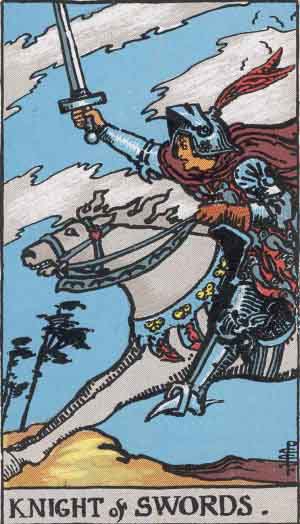
A mounted figure drives into the wind with sword raised and direction fixed. When the Knight of Swords repeats, the issue is not courage but pace: whether evidence, consequence and other people have had time to enter the decision before momentum makes it difficult to change course.
Core Repeating Message
The Knight of Swords shows a figure on horseback at full gallop, sword raised, moving with enormous speed and commitment into the wind. The image is of pure forward motion: the decisive charge that has left deliberation behind and committed fully to the direction. There is courage in this image, and will, and momentum. The card does not question these qualities. What it examines, when it repeats, is the relationship between the feeling of clarity that produces the charge and the actual clarity that a more considered assessment might have provided.
When this card appears repeatedly, it can mark a pattern of meeting difficulty, urgency or decision with the Knight’s charge: moving from perception to action before context has been fully tested. Decisiveness may be an asset, especially in situations that truly require speed. The repeating question is whether the response fits the actual urgency, or whether action is being used to end the discomfort of uncertainty.
One pattern is mistaking intensity of conviction for depth of examination. A conclusion can feel exceptionally clear because attention has narrowed around it, not because every relevant fact has been considered. The Knight asks what is known, what is assumed, what remains reversible and whose perspective has not yet entered the frame.
A second pattern belongs to the seeker whose decisiveness is partly a defence against the anxiety of deliberation. Staying with a decision, holding two competing possibilities open, tolerating the uncertainty of the not-yet-resolved: these experiences are difficult for this seeker, and the charge provides relief from them. The momentum of the committed action resolves the tension of the unresolved question by moving fast enough to leave it behind.
A third pattern is the seeker whose intellectual engagement with situations is rapid and perceptive but who has not yet developed the capacity to pause between perception and action: who can see quickly and clearly and who moves to action at the same speed, without the intervening practice of sitting with what has been perceived long enough for the full assessment to develop.
A fourth pattern is the seeker whose communication style carries the quality of the charge: who speaks decisively, forcefully, and with great speed; who makes their position clear at the first available moment and who has not yet developed the capacity to hold a position provisionally open while more information arrives, or to speak from the middle of uncertainty rather than from a settled conviction.
When This Card Repeats Weekly
A week of Knight of Swords repetition highlights fast decisions, forceful conversations or pressure to act. Identify which matters are truly time-sensitive, which can tolerate a pause and which would benefit from one independent check before commitment.
The question is not whether the speed was inappropriate but whether the seeker arrived at the aftermath of any charge this week and found consequences they had not fully examined before the gallop began. If so, these are the week’s most direct material.
When This Card Repeats Monthly
A month of Knight of Swords repetition suggests a sustained period of high-momentum engagement in which the characteristic pattern of charge-first, assess-aftermath has been consistently active across enough different situations to be identifiable as a pattern rather than as a single appropriate response to a single urgent situation.
The monthly lens asks the seeker to look at the cumulative picture of the month’s commitments, conversations, and decisions: how many were preceded by the pause needed for full deliberation, and how many followed the momentum of the seeker’s usual engagement style.
When This Card Repeats Seasonally
A season of Knight of Swords appearances can mark a sustained period in which the charge is the primary mode of engagement with significant situations, and the costs of this consistent pattern are becoming visible. Something significant has been committed to at the speed of the Knight’s gallop, and the season is long enough that the full shape of the aftermath is now in view.
The seasonal repetition often accompanies a seeker who is in a complex situation that was initially engaged with at Knight-speed, and who is now working through consequences that a more deliberate approach might have altered. The question at the seasonal scale is not self-criticism but learning: what the pattern’s consistent deployment across this season has produced that a different characteristic mode might not have.
When This Card Repeats Across Years
The Knight of Swords returning across years or major life phases can describe a seeker for whom the high-momentum decisive charge has become so established as the characteristic mode of engaging with significant situations that the seeker may no longer be aware of the degree to which the speed of the charge is consistently outpacing the depth of the deliberation.
This long arc often produces a seeker who is decisive and courageous but who has a recognisable pattern, visible across the years, of arriving at the aftermath of commitments that were made at a speed that the complexity of the situation may not have warranted. The pattern is not the absence of intelligence or even of reflection; it is the habit of moving from perception to action faster than the full assessment can travel.
Across years, what the Knight of Swords asks of this seeker is not the abandonment of decisiveness but the development of the capacity to hold the perception briefly without immediately translating it into the committed charge: the development of a still point between insight and action from which the full range of what the insight implies can be examined before the horse reaches full speed.
Life Area Interpretations
Love & Relationships
In love and relationships, the Knight of Swords can describe the seeker who brings the quality of the charge into their closest connections: who makes significant relational commitments or significant relational exits at the speed of the Knight’s gallop, who communicates their position and their feeling with great force and decisiveness, and who has arrived more than once at the aftermath of a relational charge and found consequences they had not fully examined.
One cost of this pattern in an intimate relationship is the relational whiplash that the other person may experience: the seeker’s decisive commitments can be intense and meaningful, and they can also turn quickly on the strength of the next wave of decisive feeling. The seeker’s relational truth in the moment of the charge is sincerely felt; its relationship to the full complexity of the seeker’s interior is less certain.
Career & Purpose
In career and purpose, the Knight of Swords can describe a seeker who characteristically engages with professional opportunities, conflicts, or decisions at the speed of the charge: who commits to directions, communicates positions, or exits situations with a momentum that consistently outpaces the deliberation those decisions might have warranted.
This seeker is often highly effective in situations that genuinely require decisive action and high-momentum engagement. The pattern the card marks is the degree to which the charge has become the characteristic mode regardless of whether the situation actually requires it: the seeker who charges at the same speed through situations that needed full deliberation as through situations that genuinely needed immediate decisive action.
Money & Stability
The Knight of Swords in financial contexts can describe the seeker whose financial decisions are made at the speed of conviction rather than at the speed of full assessment: who commits to financial positions, makes significant financial moves, or exits financial situations with the quality of the Knight’s gallop, and who has arrived at the financial aftermath of charges whose full consequences were not examined before the commitment was made.
This seeker is often perceptive about financial opportunity and decisive in acting on their perceptions. The pattern the card marks is the gap between the speed of the perception and the speed of the full assessment of what the commitment involves.
Spiritual Growth
In spiritual growth, the Knight of Swords can describe a seeker who brings intellectual decisiveness and force of conviction to their spiritual engagement, but who has not yet developed the capacity to stay with the open uncertainty that deeper spiritual exploration can require.
This seeker charges towards spiritual insight with enthusiasm and intelligence, and may reach an insight quickly. The pattern the card marks is the degree to which the charge through spiritual territory consistently leaves behind the slower, more patient engagement with what has been found that would allow the insight to be integrated before the next charge begins.
Emotional & Mental Patterns
In emotional and mental patterns, the Knight of Swords can describe the seeker who experiences their emotional and mental life at the speed of the charge: whose feelings arrive with great force and clarity, whose positions and perceptions crystallise quickly, and who translates both into action, communication, or commitment at the same rapid speed.
This seeker is not superficial; the feelings and perceptions are real. The pattern the card marks is the gap between the force of the feeling and the full complexity of the interior landscape it is moving through: the Knight at full gallop does not have the same access to the full terrain as the Knight who has briefly stilled the horse. The aftermath of the charge often reveals dimensions of the interior landscape that the speed of the charge did not allow to surface before the commitment was made.
Family & Generational Dynamics
In family dynamics, the Knight of Swords may resonate with a seeker who grew up in an environment where decisive action was valued and deliberation was implicitly or explicitly associated with weakness, hesitation, or inadequacy: where the Knight’s charge was the rewarded mode and the still point between perception and action was not modelled or available.
Where this inheritance is present, the seeker is competent in the mode of decisive action and uncomfortable with the sustained ambiguity of deliberation. The generational work the Knight of Swords marks is the development of the capacity to inhabit the still point between perception and action as a place of assessment rather than of anxious inadequacy.
Health & Energy
In health contexts, the Knight of Swords may symbolically reflect difficulty slowing down, sustained mental activation or a habit of pushing through tiredness. Momentum can feel energising while it lasts, so a seeker may notice their exhaustion only after stopping. Tarot cannot identify a physiological cause or diagnose a condition. Persistent pain, sleep disruption, distress or changes in functioning deserve appropriate professional assessment.
Where it is safe to do so, notice which signals call for rest, adjustment or qualified advice rather than another effort to override them. Keep any medically necessary activity or monitoring in place. The symbolic invitation is to make room for assessment before choosing the next pace.
Advanced Interpretive Sections
The Shadow Expression
In shadow, the Knight’s speed can become coercive or careless: interruption replaces dialogue, certainty displaces evidence, and other people are expected to absorb a decision already in motion. The concern is not assertiveness itself but force applied without proportion, consent or adequate regard for impact.
A second shadow is the seeker who uses the charge as a consistent means of avoiding examination of the implications of their own positions: who stays in the gallop as a way of not having to sit with the full complexity of what the charge is in service of, and whose momentum consistently prevents the internal inquiry that slowing down would require.
The Integrated Expression
The integrated Knight of Swords seeker has developed the capacity to choose between the charge and the still point. They can move with decisive momentum when a situation requires it, and can also briefly still the horse before charging, allowing the fuller assessment that momentum alone would leave behind.
This seeker has also developed tolerance for the uncertainty of deliberation: the capacity to hold a significant decision open while the full range of its implications develops, without the urgency of the unresolved tension driving a premature charge. The decisiveness is still real; it is now informed rather than primarily momentum-generated.
Why This Energy Has Not Released Yet
The Knight of Swords pattern can persist when the seeker has not yet developed comfort with the experience of sustained open uncertainty: when the still point between perception and action remains uncomfortable in a way that consistently produces the charge as relief. Until the experience of sustained deliberation becomes more tolerable than it currently is, the momentum of the charge will tend to serve as the primary available means of resolving the tension of the unresolved.
The pattern also persists when the cost of the charge has not yet become clear enough that the seeker has a reason to develop the still point. Many Knight of Swords seekers have been effective through the charge in enough situations that the pattern’s costs are not yet sufficiently visible to produce motivation for a different characteristic approach.
What This Card Wants the Seeker to Understand
The Knight of Swords wants the seeker to understand that the feeling of clarity that accompanies the charge is a real and important signal but is not the same as the full assessment that the still point provides. The clarity of the charge is the clarity of committed momentum; the clarity of the still point is the clarity of deliberation. Both are real; they produce different kinds of knowing, and both kinds are available.
The card also wants the seeker to know that the still point between perception and action is not weakness, hesitation, or inadequacy. It is the posture in which the full implications of the charge can be assessed before the commitment is made. The Knight who can still the horse briefly is not less decisive than the Knight who cannot; they are more fully informed when the charge finally begins.
Signs the Pattern Is Beginning to Resolve
The Knight of Swords pattern begins to resolve when the seeker begins to develop the capacity to inhabit the still point without the urgency to resolve it through the charge: when the experience of sustained open deliberation becomes less uncomfortable and the quality of what the still point provides begins to be valued.
It also resolves when the seeker begins to notice, in specific situations, the distinction between circumstances that genuinely require the Knight’s speed and circumstances that the habitual pattern is meeting with the charge when a more considered approach would serve better. This discernment is the development the card’s repetition is working towards.
Reflective Questions
-
In the most significant commitments or decisions of the past year, how much of the deliberation happened before the charge began and how much happened in the aftermath of it? What specifically did the pre-charge assessment include, and what did it leave out?
-
What does it feel like in your body when you are in the charge: fully committed, moving fast, sword raised? And what does it feel like in your body when you are in the still point: holding a decision open, tolerating the uncertainty of the not-yet-resolved?
-
Is there a significant decision, commitment, or communication in your current life that you have arrived at in charge-momentum? Looking at it now, from the aftermath, what do you see about the full implications of the charge that was not fully visible before you made the commitment?
-
What kind of discomfort do you experience during deliberation: in holding a significant question open without resolving it through the charge? Can you name what specifically makes the sustained uncertainty uncomfortable enough to produce the momentum towards resolution?
-
Think about a situation where you stilled the horse before charging and the deliberation produced a different decision or approach than the initial momentum would have. What did the still point make available that the charge would have left behind?
-
In your communication with people who matter to you, how often do you speak from the middle of uncertainty versus from a settled conviction? What is the difference in the quality of the conversations that each mode tends to produce?
-
What did your family of origin model about the relationship between thinking and action? Was decisiveness rewarded and deliberation viewed with impatience or suspicion? How much has this inheritance shaped the characteristic speed of your charge?
-
Is there a current situation in which you already sense that the charge has carried you into terrain that was more complex than the pre-charge assessment registered? What specifically is the aftermath of this charge revealing that the momentum did not allow to surface before the commitment was made?
-
What would it require of you to briefly still the horse in your most active current situation: to hold the commitment or the communication open for long enough to examine the full implications before the charge begins? What specifically makes this difficult?
-
When you imagine a version of yourself who can choose freely between the charge and the still point, selecting each when the situation calls for it, what is different about that version? What have they learned or developed that allows that choice to be available?
Practical Integration Actions
Introduce a deliberate pause before one significant commitment. Choose one non-emergency decision or communication in the coming week that carries charge momentum. Before committing, write down the observable facts, your interpretation, the likely impact on others and what remains reversible. Set a short review point suited to the stakes, note what the pause reveals that the initial momentum overlooked, then decide. The aim is informed pace, not indefinite delay.
Write the aftermath before the charge. Before making a significant commitment, decision, or communication in the next month, write explicitly about the most likely aftermath of the charge: what the consequences of this commitment will look like in a week, a month, a year. This is not an exercise in pessimism but in developing the capacity to extend the assessment past the moment of the charge into the territory the commitment will enter.
Distinguish genuine urgency from momentum-urgency. When the Knight-charge feeling arises, practise asking this question: does this situation genuinely require immediate action, or does the urgency I feel belong to the habitual pattern of resolving uncertainty through momentum? The distinction between genuine situational urgency and the urgency the pattern generates is the discernment the Knight of Swords card is working to develop.
Practise speaking from genuine uncertainty. In one significant relationship or conversation in the coming weeks, practise saying what you do not yet know: communicating your current position as provisional, open to what further engagement reveals, rather than as the already-arrived-at conviction of the charge. Note what this mode of communication produces in the conversation that the charge-quality communication would not.
Examine the pattern’s history. Look back at three significant commitments or decisions made in the characteristic charge mode and examine each one for what the aftermath revealed that pre-charge deliberation might have surfaced. Not as self-criticism but as an assessment of the pattern’s track record, which provides direct evidence about the relationship between the speed of the charge and the quality of the outcomes it produces.