
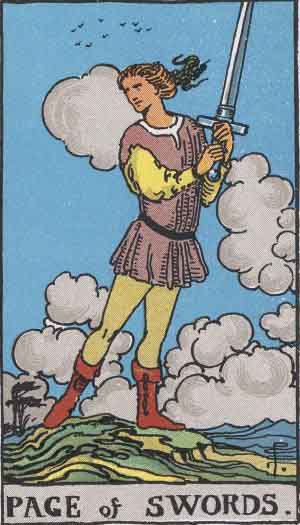
A young figure stands on high ground, sword raised, eyes moving across a windswept horizon. The posture holds curiosity, readiness and inexperience at once. When this card repeats, it asks how information is being gathered, tested, communicated and turned into responsible action.
Core Repeating Message
The Page of Swords shows a young figure on elevated ground, alert, sword raised, eyes scanning the distance with a quality of intense watchfulness. The wind moves through their clothing and hair; they are in full engagement with the environment. The image is not of aggression or of passivity but of something in between: a readiness, a sharpness, an active relationship with the surrounding world that has not yet resolved into action.
When this card appears repeatedly, it can mark quick perception, intellectual appetite and alertness to changing circumstances. What the repetition examines is the direction and discipline of that intelligence. Is it serving learning, clear communication and evidence-based inquiry, or has observation become continuous monitoring that produces more information without greater understanding?
One possible pattern is defensive alertness shaped by experience. A person may notice changes in tone, timing or behaviour very quickly, yet an observation is not proof of another person’s motive. The Page asks for a pause between noticing and concluding: what was directly observed, what is inferred, what other explanations fit, and what can be respectfully clarified?
A second pattern belongs to the seeker who is on the threshold of significant intellectual or creative development without yet committing to it: the Page who has climbed to the high ground and raised the sword but not yet determined what the sword is for. The alertness is real but has not yet resolved into direction. The seeker is sharp, perceptive, curious, and is holding their capacity for intellectual engagement in readiness without fully entering it.
A third pattern is the seeker whose intelligence and perceptiveness are real but who consistently uses them to stay one step removed from engagement. They analyse, observe, and assess with real precision from the high ground, but the precision serves distance more than it serves contact. The sword is always raised; the return to ground level, to the unguarded engagement with what is actually present, is consistently deferred.
A fourth pattern belongs to the seeker whose intellectual sharpness has been turned primarily inward as self-monitoring and self-critique: whose perceptive capacity is applied most consistently to scanning their own performance, their own adequacy, and their own exposure rather than to the outward inquiry the Page’s posture could indicate.
When This Card Repeats Weekly
A week of Page of Swords repetition highlights active observation, new information, a learning edge, or a conversation that needs preparation. Keep questions specific, check sources, and decide what information would genuinely change the next action. The card does not require constant vigilance.
The card this week is asking the seeker to notice where their intelligence is directed: what they are watching for on the horizon, and whether the scanning is primarily oriented towards threat or towards discovery of what the current landscape contains.
When This Card Repeats Monthly
A month of Page of Swords repetition suggests a sustained period of intellectual alertness and watchfulness that has not yet resolved into the engagement that this alertness could lead towards. The seeker’s sharpness and perceptiveness have been consistently active, and the question across the month is what they have been primarily in service of.
The monthly lens asks the seeker to examine the direction of their intelligence across this period: how much of it has been directed towards learning, inquiry, and open engagement with what is present, and how much towards vigilance, assessment of risk, and the maintenance of readiness for a threat that may or may not be as significant as the scanning treats it.
When This Card Repeats Seasonally
A season of Page of Swords appearances can mark a sustained period in which the seeker is in the territory the card names: living with the sword raised, with the intelligence consistently oriented towards watchfulness rather than discovery, or with a significant intellectual or communicative threshold in view that has not yet been crossed.
The seasonal repetition often accompanies a seeker who has a capacity for learning, inquiry, or intellectual engagement that has been shaped by experience into something primarily defensive. The season is long enough to see the pattern clearly: the sharpness is always present; the engagement it could enable is consistently held at readiness without being fully entered.
When This Card Repeats Across Years
The Page of Swords returning across years or major life phases can describe a seeker for whom the posture of alert watchfulness has become so established that the seeker may no longer be aware of the degree to which their intelligence is occupied in scanning for what might come rather than in open engagement with what is present.
This long arc may belong to someone who learned that careful watchfulness reduced risk, or to someone whose curiosity was encouraged without enough practice in discernment and follow-through. Either history is possible. The card invites investigation rather than supplying a biography or diagnosis.
Across years, what the Page of Swords asks of this seeker is not the abandonment of perceptiveness but the gradual development of discernment about when the sword can be lowered: when open inquiry, learning, and unguarded engagement are available as real options, distinct from the situations that originally required the raised-sword posture.
Life Area Interpretations
Love & Relationships
In love and relationships, the Page of Swords can mark curiosity, tentative communication, or close attention to changes in a connection. It does not confirm dishonesty, surveillance, or a hidden motive. Relational intelligence becomes useful when observations can be discussed with consent and respect, without interrogation or intrusion into another person’s privacy.
When monitoring becomes the main form of engagement, the seeker is perceptive and often keenly observant of the dynamics of the relationship, but the observation is not the same as full presence. The sword is raised; the lowered-sword quality of unguarded intimacy is consistently held just out of reach. The other person may sense the intelligence without fully feeling the presence.
The card may also mark someone new to a form of relational engagement and still learning its language. Ask direct, proportionate questions; listen to the answer; and use patterns of observable behaviour, not isolated clues, to guide boundaries and trust.
Career & Purpose
In career and purpose, the Page of Swords marks research, skill development, new communication responsibilities, or a professional environment being closely observed. The challenge is to convert scattered intelligence into a defined question, credible sources, and a piece of completed work rather than remaining indefinitely in reconnaissance.
The card may also mark a seeker who is at the beginning of significant intellectual or professional development and who is holding that capacity in alert readiness without fully entering it: sharp enough to have climbed to the high ground, not yet certain enough of the direction to commit to the charge.
Money & Stability
In financial contexts, the Page of Swords favours due diligence: reading terms, checking figures, comparing claims and identifying what remains unknown. It does not guarantee that suspicion is justified or that research alone removes risk. Significant decisions may require qualified financial or legal advice.
The seeker may be perceptive about financial risk and skilled at identifying vulnerability. The pattern the card marks is the degree to which the intelligence is primarily deployed in watchfulness rather than in the practical engagement with financial reality that the sharpness could also enable.
Spiritual Growth
In spiritual growth, the Page of Swords can describe a seeker who brings intellectual sharpness to their spiritual inquiry but who consistently keeps that inquiry at a critical distance: who examines spiritual teaching, experience, and practice with real intelligence, often from the high ground of analysis, without fully allowing the inquiry to become experiential engagement.
This seeker is often highly perceptive about the dynamics and limitations of various spiritual frameworks and sincere in their interest. The card marks the point at which the intelligence that enables the discerning examination is also what can obstruct the unguarded engagement that would allow the inquiry to develop further.
Emotional & Mental Patterns
In emotional and mental patterns, the Page of Swords can describe analysing feelings faster than they can be experienced, or forming a conclusion before enough evidence has arrived. Analysis can create useful language and distance, but it is not the only form of contact with emotion.
When analysis takes the place of experiencing emotion, intellectual precision about feelings can coexist with little felt access to them: the seeker who can describe, analyse, and assess their emotional experience with real accuracy from the high ground of the sword’s perspective, and who struggles to come down from the high ground into the actual emotional territory without the raised-sword posture.
Family & Generational Dynamics
In family dynamics, the Page of Swords can suggest a learned habit of reading the room, tracking what could safely be said, or gathering information before acting. That origin should be treated as a possibility to explore, not a certainty about childhood or family life.
The adult who carries this inheritance often brings extraordinary situational intelligence and real perceptiveness to all subsequent relationships and environments. The generational work the Page of Swords marks is the gradual development of discernment about which current situations actually require the raised-sword posture and which are being met with watchfulness out of inherited habit rather than present necessity.
Health & Energy
In health contexts, the Page of Swords may symbolically reflect alertness, difficulty disengaging from monitoring, or mental fatigue. Maintaining watchfulness can feel tiring even when no threat materialises, and a seeker may notice that attention kept in readiness leaves less energy for other things. These experiences can have many causes, and tarot cannot identify a physiological mechanism or diagnose a condition. Persistent sleep difficulty, distress, pain, or changes in functioning deserve appropriate professional assessment.
If rest feels difficult, consider whether pausing the scanning brings a sense of exposure or vulnerability, even in a setting where rest is available. This is one possible experience, not proof that a situation is safe. Experiment with a clear boundary around checking, news, messages or symptom searching, while respecting any monitoring that is medically or practically necessary. The aim is not to ignore genuine risk but to distinguish useful attention from attention that no longer changes the response.
Advanced Interpretive Sections
The Shadow Expression
The Page of Swords in shadow can turn perceptiveness into a defence against exposure: finding another person’s vulnerabilities before they can see the seeker’s own. Inquiry may then become interrogation, fact-finding may cross boundaries, or scepticism may harden into conclusions built on fragments. Intelligence is not diminished by recognising uncertainty. Its ethical expression includes consent, privacy, source quality and willingness to revise a view.
A second shadow is the seeker who uses their intelligence to maintain a consistent position of critical superiority: who occupies the high ground as a permanent posture, scanning for the inadequacies of others’ thinking and the risks of engagement, never fully committing to the terrain below the high ground where collaborative inquiry would require the sword to be lowered.
The Integrated Expression
The integrated Page of Swords seeker has developed discernment about when the sword needs to be raised and when it can be lowered. They can bring their perceptiveness and intellectual alertness into open inquiry, learning and unguarded engagement when those modes are available and appropriate, while retaining the capacity for watchfulness when a situation requires it.
This seeker has allowed their intelligence to develop in the direction of curiosity rather than exclusively in the direction of threat detection, and has begun to discover that open inquiry and unguarded engagement produce learning and connection that the watchful posture on the high ground, however precise, cannot provide from its distance.
Why This Energy Has Not Released Yet
The Page of Swords pattern can persist when the seeker has not yet had sufficient experience of open engagement being safe: when the accumulated evidence still weighs heavily towards the conclusion that the raised-sword posture is the more reliable mode of engagement with what the world contains.
The pattern also persists when the seeker has not yet found a context, relationship, or domain in which the curiosity and open inquiry that the Page could also represent have been met with a receptive response. The intelligence needs somewhere real to go that is not primarily in the service of vigilance. Without that experience, the watchful posture tends to remain the default.
What This Card Wants the Seeker to Understand
The Page of Swords wants the seeker to understand that the intelligence they carry is real and significant and that it has a wider range of application than the scanning posture has allowed it. The same perceptiveness that detects threat is also capable of open inquiry, discovery, and engagement with what the world offers when the primary orientation is curiosity rather than watchfulness.
The card also wants the seeker to know that the high ground on which the Page stands is a position of perspective, not a permanent fortress. The view from the high ground is real and valuable; it is also not the full experience of being in the landscape below it, where contact and learning require the sword to be lowered at times.
Signs the Pattern Is Beginning to Resolve
The Page of Swords pattern begins to resolve when the seeker begins to experience curiosity directing the intelligence more consistently than vigilance does: when the scanning opens into something more like inquiry, and the seeker notices that what they are tracking on the horizon is not only threat but discovery.
It also resolves when the seeker begins to develop experience of the lowered-sword mode of engagement: moments of unguarded intellectual or relational presence that produce outcomes the watchful posture could not. These experiences begin to revise the habitual assessment of what openness costs and what it enables.
Reflective Questions
-
What is the intelligence you carry primarily in service of right now? In your most significant current relationships, decisions, and engagements, what is your perceptiveness primarily pointed at: towards threat detection, towards inquiry, or towards some combination of these? What is the ratio?
-
When has your characteristic watchfulness been necessary? Which experiences may have shaped your intelligence towards vigilance, and how closely do those circumstances resemble the situations you are navigating now?
-
Think about a time when you lowered the sword and engaged with openness in a situation that felt like it might require the raised-sword posture. What happened? What did the open engagement enable that the watchful mode would not have?
-
Is there a domain, relationship, or question where your intelligence is curious rather than primarily watchful? What is different about that domain that allows curiosity rather than vigilance to be the primary orientation?
-
What do you notice in your body when you are in the raised-sword scanning posture, and how does that compare with moments of ease? How much of your daily experience is spent in each? What signs tell you that observation has shifted from useful attention into tiring repetition? What helps you pause without ignoring information that genuinely matters?
-
What threats or risks are you watching for in your current significant situations, and how probable and immediate does each appear on the evidence available? Separate what you directly observed from what you inferred, then identify what would support, weaken or leave each interpretation unresolved.
-
In the area of your life where your intellectual sharpness is most active, what would open inquiry look like, distinct from vigilant monitoring? What would you be doing differently if curiosity rather than watchfulness were the primary orientation?
-
How did the people around you in your family of origin respond to intellectual curiosity and open engagement? Was curiosity rewarded, or did the environment consistently require a more guarded form of intelligent engagement?
-
Is there an area of learning, development, or intellectual engagement that you have been holding at readiness without fully entering it? What specifically is preventing the commitment to that engagement, and what does the hesitation protect you from?
-
In one safe, low-stakes encounter this week, how could you bring your intelligence as curiosity rather than judgement while still keeping any necessary boundary intact?
Practical Integration Actions
Map the direction of your intelligence. Take one week and notice, in each significant encounter or decision, what your intelligence is primarily pointed at. Note whether each instance is closer to inquiry or to vigilance. At the end of the week, examine the ratio and ask what it reflects about the current primary orientation of your perceptiveness.
Practise lowering the sword in one low-stakes context. Choose a safe, low-stakes encounter in the coming week in which curiosity can take more of the lead without abandoning necessary boundaries. Bring your intelligence as open inquiry rather than continuous assessment: name an observation without presenting your interpretation as fact, ask a direct question and listen to the answer. Notice what becomes available through participation and whether new information changes your view. Respect privacy and do not use the exercise to test or entrap another person.
Examine the high ground. Write about the high ground you habitually occupy: what it gives you, what it costs you, and what it prevents. Be specific about the view it provides and equally specific about what is not visible from that altitude. The exercise is not a demand to leave the high ground but an examination of what the posture enables and what it forecloses.
Identify one genuine curiosity and follow it. In the domain where your intelligence is most active, identify one question, one area of inquiry, one thread of genuine curiosity that has nothing to do with threat detection or risk management, and give it sustained attention. The practice develops intelligence in the direction of discovery rather than exclusively in the direction of vigilance.
Track what actually requires the raised sword. Over a month, note when you adopt a watchful scanning posture and what risk or uncertainty it is responding to. Track what happens, what information changes your action and whether the watchfulness helped you respond. Where repeated checking no longer adds useful information, try a clear boundary around that stream of messages, news, analytics or searches. Keep monitoring required for safety, work or health, and do not treat the absence of an adverse event as proof that a precaution was unnecessary. Review what the record suggests about discernment between useful vigilance and a habitual posture.