
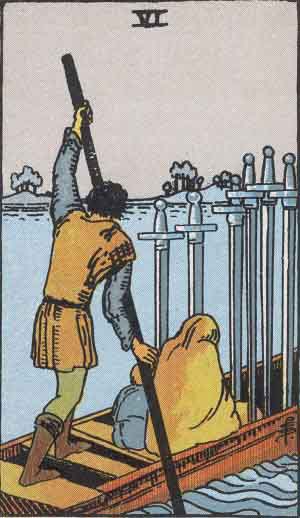
A boat moves between rough and calmer water while carrying every sword. The question this card keeps returning to ask is what kind of transition is under way, what must travel with it, and what would make the passage safer and more sustainable.
Core Repeating Message
The Six of Swords shows a ferryman poling a small boat across water, with two passengers, one of whom is hooded and bent in a posture of difficulty or grief. Six swords stand upright in the prow of the boat: they are being carried across, not left behind. The water on the near side of the boat is rough; on the far side, it is visibly calmer. The crossing is in progress. The destination is quieter. And the swords, the thoughts, the difficulties, the mental content of the turbulent water, are making the journey too.
This is a card of transition: passage from one mental, relational or practical climate towards another that may offer more room to think. It is not a guarantee of escape or improvement. The swords in the boat suggest that memories, responsibilities and unresolved questions travel too. The transition is not the resolution. It is a change of position that may make different responses possible, provided the destination and means of travel are genuinely safer and more workable.
When this card appears once, it can mark a passage in progress, sometimes accompanied by effort, uncertainty or the sadness suggested by the hooded passenger. When it appears repeatedly, it may illuminate the seeker’s relationship to transition itself: beginning, delaying, reversing, remaining between places or carrying old strategies into new conditions. The card describes a pattern for inquiry rather than announcing an inevitable destination.
One common pattern is the seeker who repeatedly reaches the threshold of a change without completing it. They may believe the present situation no longer serves them, yet lack resources, safety, consent, information or confidence about the destination. Familiarity, grief and practical constraint can all hold the boat near shore. The card asks what is actually preventing movement rather than assuming the obstacle is merely attachment to difficulty.
A second pattern is the seeker who makes a change and later finds familiar difficulties reappearing. This does not prove that they unconsciously recreated the problem. New environments can contain similar pressures, external conditions can persist, and old strategies may remain useful until safer alternatives are practised. The swords were carried across, so the task is to distinguish what belongs to the seeker’s habits from what belongs to the conditions on either shore.
A third pattern belongs to the seeker who is facilitating other people’s crossings, perhaps professionally as a therapist, counsellor, or guide of some kind, or relationally as the steady presence whose quieter water others navigate toward, while the seeker’s own mental life has not yet completed the crossing. They know the territory of the troubled water very well. They know how to help others move through it. Their own passage has been deferred.
A fourth pattern is the seeker who has become so accustomed to a conflicted or highly activated mental climate that alternatives are difficult to imagine. The Six of Swords can invite comparison rather than diagnosis: when does thinking feel more spacious, what conditions support that difference, and what remains outside the seeker’s control? A different quality of experience may be possible, but the card cannot promise it or prescribe a single crossing.
When This Card Repeats Weekly
A week of Six of Swords repetition can mark an immediate period of adjustment. The transition may involve changing how a concern is approached, reducing exposure to a conflict, seeking support or allowing a decision to develop. The aim is not to force the mind into calm, but to identify one movement that reduces unnecessary turbulence without ignoring facts that still require attention.
The card this week is asking about the quality of movement: is the passage genuinely occurring, however gradually? Is the seeker in the boat, making the crossing, even slowly and even with the hooded passenger’s grief? Or is something keeping the boat at the troubled shore rather than allowing it to move?
When This Card Repeats Monthly
A month of Six of Swords repetition suggests examining a transition unfolding across this period. Movement may be clear, partial, interrupted or largely imagined. The month becomes useful evidence: what has materially changed, what only feels different, and which swords remain active regardless of location?
The monthly framing asks the seeker to assess the quality of the movement. Is there a perceptible shift in the quality of the mental climate across the month, even if small and uneven? Or does the month end in essentially the same turbulent water as it began, with the crossing repeatedly initiated and not completed? This honest assessment points to different kinds of work: if the crossing is occurring in a workable direction, patience and continuation may help; if the crossing is not occurring, the specific obstacle to it needs closer examination.
When This Card Repeats Seasonally
A season of Six of Swords appearances can mark a sustained transition in outlook, circumstances or both. Progress may be uneven and the far shore may remain uncertain. The seasonal frame acknowledges the labour of passage while asking for evidence that the chosen direction is more sustainable, rather than treating movement itself as proof of improvement.
The question the seasonal repetition asks is what would allow the transition to reach a workable conclusion. Is the calmer water closer than it was at the beginning of the season? What would allow the boat to reach it? What still holds the boat near shore?
When This Card Repeats Across Years
The Six of Swords returning across years or major life phases can name a seeker for whom the mental transition the card describes is long-arc work. The movement from troubled to calmer water may involve revising thinking patterns, cognitive orientations and interior narratives that have been established for a long time and do not change quickly or easily.
This seeker may have made multiple attempts at the crossing, each representing genuine movement, and found familiar turbulence returning afterwards. Established patterns may contribute to that return, alongside pressures that persist on either shore. The long-arc work of the Six of Swords is not the single dramatic crossing but the sustained and patient work of identifying what keeps filling the boat with swords: revising the thought patterns, cognitive habits and interior narratives that contribute to the difficulty, while addressing the circumstances that keep renewing it.
Across years, the arc of this card may trace a gradual change in the seeker’s relationship to difficulty: greater choice about when to engage, leave, ask for help or remain. The aim is not permanent calm, which no life can guarantee, but a wider repertoire than automatically returning to the same troubled water.
Life Area Interpretations
Love & Relationships
In love and relationships, the Six of Swords can mark transition after conflict, loss or prolonged uncertainty. It may involve leaving a relationship, changing how the relationship functions, or learning to engage differently. The card does not instruct someone to stay or leave. Where coercion, violence or practical dependence is involved, confidential support and safety planning are more important than a symbolic call to cross quickly.
The card may also invite examination of repeated relational conditions that produce troubled thinking. This should not become blame for being harmed or for lacking safe options. The useful questions concern observable patterns, boundaries, available support and which conditions would make steadier connection possible.
The swords in the boat in relational contexts are often the specific thoughts and narratives that the seeker is carrying out of the difficult relational period: the learned conclusions, the protective assessments, the ways of thinking about intimacy and trust that the troubled water has generated. These travel with the passenger; the crossing does not leave them behind. The question is whether they can be held differently from the calmer water.
Career & Purpose
In career and purpose, the Six of Swords can mark a seeker in vocational transition: moving from a professional context that has produced sustained mental strain, anxiety or conflict towards one that may offer a different quality of work-related mental life.
The card may mark someone considering a vocational change that appears promising but remains uncertain. The threshold can be difficult because work affects income, identity, visas, care duties and access to support. The swords in the prow include realistic risks as well as doubt. A responsible crossing tests assumptions, plans for material consequences and does not confuse symbolic encouragement with career advice.
Money & Stability
The Six of Swords in financial contexts can symbolise efforts to move from instability towards more sustainable arrangements. It does not confirm that hardship is ending or that a proposed move will improve finances. The swords in the boat include debts, obligations, habits and understandable worries that remain relevant during any change.
The card asks whether the mental climate reflects current figures, earlier insecurity or both. Financial worry can continue after circumstances improve, but worry may also be an accurate response to continuing risk. Reviewing verified information and seeking qualified advice where needed helps distinguish a lingering narrative from a material problem that still requires action.
Spiritual Growth
In spiritual growth, the Six of Swords marks the seeker in spiritual transition: moving from one orientation towards meaning, the sacred, or the interior life towards something meaningfully different. This transition may be gradual and barely noticed, or it may involve the sadness of the hooded passenger, the grief of leaving behind a spiritual framework or community that once provided genuine nourishment.
The card is patient about the grief of spiritual transition. The hooded passenger is not wrong to be bowed under difficulty, and no one must keep moving simply to satisfy the symbol. The invitation is to ask whether the passage remains aligned with the seeker’s values and safety, and whether pausing, returning or seeking community would be wiser than insisting on forward motion.
Emotional & Mental Patterns
In emotional and mental patterns, the Six of Swords can describe difficulty adjusting to a quieter mental climate after the circumstances that generated anxiety or conflict have changed. The turbulent water of an earlier period has become familiar, and familiarity can create an attachment of its own: the troubled thinking is known, predictable and, in one sense, manageable because the seeker has established ways of relating to it. Calmer water may feel less familiar and therefore, paradoxically, less immediately comfortable.
This is one psychological territory of the Six of Swords: familiar thought can feel more predictable than an untested alternative, even when it is difficult. Yet persistence may also reflect present danger, neurodivergence, illness or material pressure rather than attachment to turmoil. The card is strongest when it expands inquiry instead of reducing every return to a failure to move on.
Family & Generational Dynamics
In family dynamics, the Six of Swords can mark the seeker working to cross out of an inherited cognitive climate: a way of thinking about the world, safety, relationships and what can be expected that was shaped by the family of origin and that the seeker is now trying to revise. The swords in the boat may be generational: thoughts, narratives and cognitive orientations learned in the family system that make the journey into new territory whether the seeker intends them to or not.
The generational dimension of the crossing can be significant, but inherited narratives should not be presumed from the card alone. Where such patterns are recognised, revising them may require time, community context and practical change as well as reflection. The seeker can honour what once protected a family while deciding which beliefs remain useful on the present shore.
Health & Energy
The Six of Swords in health contexts symbolically links transition with the body’s experience of change. A person may notice shifts in energy, tension, sleep or concentration as circumstances alter, but these experiences are non-specific. The card cannot assess nervous-system function, establish that calm will improve symptoms or identify whether a health condition is present.
Adjustment may take time, and bodily symptoms do not always change in step with circumstances or thought. Gentle routines, treatment, rest and support may help depending on the person, but the body is not obliged to follow a symbolic mental crossing. Persistent, severe or sudden symptoms deserve appropriate medical assessment rather than interpretation through the card.
Advanced Interpretive Sections
The Shadow Expression
The Six of Swords in shadow can describe the seeker who has made the boat itself into a permanent residence: who is always in transit, always in passage, always between the turbulent and the calmer water, as a way of never quite arriving anywhere that would require the full weight of commitment to particular ground. The crossing is indefinitely extended; the far shore is always approaching; the transition is the permanent condition.
A second shadow is the tendency to interpret every recurrence of difficulty as proof that the seeker has recreated it. Familiar strategies can contribute to repeated turbulence, but environments and other people’s actions also matter. Shadow work here requires responsibility without self-blame and enough evidence to tell internal pattern from external condition.
The Integrated Expression
The integrated Six of Swords seeker has completed mental passages and arrived at calmer cognitive ground. They carry the swords with them and have learned to work with them from the far shore in ways that were not possible amid the turbulence. They have developed a grounded relationship to transition: they know what a crossing requires, know the grief of the hooded passenger and recognise the quality of the calmer water on arrival.
This seeker also knows when new turbulence calls for a crossing: they can distinguish between difficulty that requires a change of shore and the ordinary rough weather of an active life, which can be navigated without leaving the current shore.
Why This Energy Has Not Released Yet
The Six of Swords pattern may persist when what holds the boat near shore has not been identified. The obstacle might be grief, fear or belief, but it might equally be money, safety, disability, caregiving, immigration status, missing information or lack of support. Naming the actual constraint prevents the seeker from treating every delayed transition as a private failure of courage.
The pattern can also persist when previous crossings ended in a return to troubled water, leaving the seeker doubtful that calmer conditions are reliable or convinced that the swords will recreate turbulence wherever they are taken. Revising that conclusion takes more than reassurance: new experience of reaching and remaining on calmer water can help, together with sustained engagement with the carried concerns and the conditions that made the earlier crossings difficult.
What This Card Wants the Seeker to Understand
The Six of Swords asks the seeker to imagine that another shore may be possible without treating it as guaranteed. Calmer water is a direction to investigate, not a promise made by the card. Trust can grow through small evidence: safer conditions, shorter periods of turbulence, stronger support and choices that remain workable after the initial movement.
The card also wants the seeker to know that the swords making the journey need not prevent arrival. The thoughts, the concerns, the difficulties that are carried into the crossing do not all need to be resolved before the boat can depart. They travel in the prow. They can be engaged with from the other side.
Signs the Pattern Is Beginning to Resolve
The Six of Swords pattern can begin to resolve when the seeker notices a shift in their habitual thinking, even incrementally: when the turbulent water is, on reflection, less consistently present than it was, and periods of calmer thought feel distinct from the troubled baseline that has been home. This incremental shift, noticed and acknowledged, is one sign of arrival.
It also resolves when the seeker can remain in more workable conditions for meaningful periods and respond to carried concerns without assuming that every difficult moment means a return to the beginning. Another sign is improved discrimination between new external turbulence, an old pattern being activated and an ordinary fluctuation that requires neither escape nor self-accusation.
Reflective Questions
-
What is the turbulent water in your current mental life: the specific quality of troubled, anxious, or conflicted thinking that the Six of Swords is marking as the near shore? Can you describe its characteristics?
-
What might the far shore represent, and what evidence suggests it would be more workable rather than simply different? Which hopes remain untested?
-
What is holding the boat near shore: an attachment, fear, practical constraint, safety concern, missing resource or something else? Which part is within your influence?
-
Have you made a crossing like this before? Have you previously been brought from a troubled mental climate to a genuinely calmer one? If so, what produced the crossing, and did you remain on the far shore? If you returned to the turbulent water, what brought you back?
-
What are the swords in the prow of your boat: the specific thoughts, concerns, narratives, and difficulties that you know are making the journey with you? Can you name them one by one?
-
Is there a cognitive pattern or interior narrative that has been so consistently present in your mental life that you have ceased to experience it as a pattern and simply experience it as how your mind works? What would be different if you could see it clearly as a pattern?
-
If you guide others’ crossings, what would you need to make your own crossing, rather than waiting at the familiar troubled shore while helping others move?
-
What does the grief of the hooded passenger represent in your transition: the specific loss or sadness that the crossing involves? Has this grief been genuinely acknowledged?
-
What conditions in your current life would most effectively support the completion of the mental transition the Six of Swords is marking? What is currently preventing those conditions from being established?
-
If you imagine yourself on the calmer shore, having genuinely made the crossing with the swords in the boat: what would you do with those swords from that position that you cannot effectively do from the troubled water?
Practical Integration Actions
Name the specific passage. Write clearly about the mental transition the Six of Swords is marking in your life right now: the troubled water you are moving from and the calmer orientation you are moving towards, both in as much detail as possible. Vague transitions do not produce clear crossings. The more specifically the near and far shores can be named, the more navigable the passage becomes.
Identify the swords in the prow. List, as specifically as possible, the thoughts, concerns, narratives, and difficulties that you know will be making the crossing with you: the things that are not being left behind on the near shore. For each one, consider what it would mean to engage with it from the calmer water rather than from the current troubled position. This exercise may reveal that some of the swords are less of an obstacle to the crossing than they appear from the near shore.
Develop one genuine calmer-water practice. Identify one activity or condition that reliably makes thought feel slightly more spacious, such as creative work, movement, quiet, practical planning or supportive connection. Use it as a point of comparison, not as a cure or escape. Notice when it helps, when it does not and what external conditions affect the result.
Examine the inherited crossed water. Where you recognise inherited patterns, write about the cognitive patterns and orientations that were established in the family of origin and that are making the journey with you as the swords in the prow: the specific ways of thinking about safety, trust, expectation, and what can be hoped for that were learned before you had the capacity to choose them. Naming these patterns clearly, rather than experiencing them as simply how your mind works, is the beginning of being able to engage with them from the far shore rather than being governed by them from the turbulent one.
Trust the incremental. A transition may unfold through small changes, reversals and pauses rather than one dramatic event. Record concrete evidence of movement, such as a boundary kept, information gathered, support contacted or a calmer interval, alongside evidence that the route needs revision. Small steps count, but they do not oblige you to continue towards a shore that proves unsafe or unsuitable.