
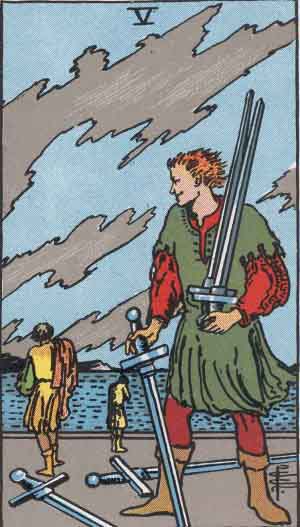
One figure collects the fallen swords while two others walk away beside a flat grey sea. The card is not asking whether the seeker won. It is asking what the winning cost, and whether the fight was ever the right way to meet what actually needed addressing.
Core Repeating Message
Three figures occupy the scene: one in the foreground holding several swords, wearing an expression closer to smugness than triumph, and two in the middle distance, walking off with their shoulders down, hands empty. The sky is the colour of a headache. Nothing in the image reads as resolution. The two departing figures have not been defeated in any way that will teach them something; they have simply left a situation that stopped serving them. And the figure holding the swords is not celebrating. He is merely holding on to what he took.
This is the card for a battle won at the wrong price, or fought in the wrong shape entirely, or for conflict that has become a seeker’s default setting even in situations that would respond far better to plain engagement than to strategy. It does not condemn conflict itself. Some conflicts need to happen, and clean, decisive confrontation sometimes produces exactly the flat, unglamorous aftermath this card shows. What the repeating card is pointing to is a habit: reaching for the fight as the first move, regardless of whether the particular situation calls for one.
A single appearance of this card marks one specific fight and its specific comedown: the price of a particular win, the flatness of a particular victory, or the sense that what was fought for turned out not to be what was actually gained. Repetition changes the story. It stops being about one dispute and starts describing how the seeker relates to being right, to winning arguments, and to using sharp words or sharper logic on the people closest to them.
The most common shape of this pattern belongs to the seeker who wins arguments reliably and finds, every time, that winning delivers neither the resolution nor the closeness they were quietly hoping for. The point lands cleanly. The other person has nothing left to say. And what follows is not relief or a changed mind but exactly what the card shows: the other person gone, unconvinced, and the seeker holding a victory that cannot do what an actual resolution would have done.
A second shape belongs to the seeker who treats conflict as a first response to feeling dismissed, threatened or misunderstood. The sword comes out fast, ahead of any real assessment of whether the moment warrants it, functioning as both shield and pre-emptive strike against a threat that has not yet been confirmed. This produces fights with people the seeker never actually chose to fight, and those unwanted skirmishes add up.
A third shape belongs to the seeker whose intelligence has quietly become a form of dominance they have not fully noticed in themselves. They are, in plain terms, sharper than most people they argue with. They spot the flaw in a position quickly and name it precisely. Somewhere along the way, without deliberate intent, this precision turned into a pattern: conversations that end with the seeker having made their point and the other person feeling smaller for it. The seeker is not trying to wound anyone. They are simply thinking clearly, in a way that keeps leaving other people behind, and that has become its own kind of conflict.
A fourth shape belongs to the seeker locked in a long-running dispute with a person, an institution, or a set of circumstances that will not be settled by drawing more swords, and who has not yet found another way to engage that might actually move things forward.
When This Card Repeats Weekly
A week carrying repeated Five of Swords points to an active, current pattern: an argument or sharp exchange in which something is won at the same moment something else is lost. The card is asking the seeker to hold both sides of that ledger at once rather than only counting the win.
This might be one recurring fight with one person, ending the same way each time: one side technically vindicated, the other gone, nothing settled underneath. Or it might be a week in which the seeker’s usual sharpness has surfaced in several different rooms, each time leaving the same residue behind: a frayed connection, a point technically made but nothing genuinely resolved, the flat feeling of having been right about something that improved nothing.
When This Card Repeats Monthly
A month of this card suggests that conflict has become the operating mode rather than an occasional response. The seeker keeps meeting the same aftermath, and the repetition is doing something useful: it is showing that this is not a string of unlucky incidents but a consistent way of handling challenge or threat, one that produces this particular outcome with unusual reliability.
The monthly view asks for a tally rather than a single scorecard: not how each individual argument ended, but what a month of this pattern has done in total. What state are the seeker’s important relationships in after four weeks of this? What is the seeker’s own read on how they have been moving through the world? Is there a particular tiredness, a hollowed-out quality, that all this winning has left behind?
When This Card Repeats Seasonally
A season of this card marks a longer stretch spent wrestling with the question of when conflict is warranted and when it is not. The seeker may be inside a genuinely contested situation, one that calls for sustained advocacy and a position held firm over time. Here the card asks whether the advocacy is still doing its job, whether the swords being gathered are still serving the actual goal, or whether the fight has quietly started costing more than the thing it defends is worth.
This seasonal frame often belongs to someone locked in a long dispute with an institution, a relationship, or a set of circumstances, now facing the harder question of whether continued battle is genuinely the answer, or whether something more inventive, more strategically patient, or simply more willing to concede ground is what the situation actually calls for.
When This Card Repeats Across Years
When the Five of Swords keeps returning across years or major stretches of life, it describes a seeker for whom conflict, argument and sharp analytical thinking under pressure have become a fixed feature of how they relate and how they think. Year after year the battles recur, and year after year the same comedown follows: the hollow win, the relationship that has drifted or broken, the next battle already forming.
This long-arc pattern most often belongs to people for whom sharp thinking and quick argument were a genuine survival skill earlier in life: the child or teenager who learned that being right, being fast, being analytically superior, was one of the few reliable ways to earn safety or respect in an environment that offered little else. The skill was built for good reason. The problem is that it is still being deployed, decades later, in situations that would respond far better to something other than sharpness, and the seeker has not yet built that alternative with the same fluency.
Across years, what this card is asking for is a wider relational range: the ability to meet conflict, challenge and the need to be understood through means that are not primarily adversarial. This is slow, real work. It requires a willingness to be uncertain, to be imprecise, and occasionally to lose the argument, in situations where those very qualities would serve connection better than the familiar edge.
Life Area Interpretations
Love & Relationships
In relationships, this card most often describes a couple whose arguments have settled into a fixed shape: one person consistently wins and the other consistently walks away unconvinced, or both people win different arguments inside the same unresolved conflict that never quite reaches an ending.
The cost shows up in the accumulation: small argumentative victories that slowly crowd out actual closeness, the particular distance that grows between two people once one or both have got reliably good at deploying their point and correspondingly worse at simply staying present with their own uncertainty and their own need to be understood.
The card can also describe a couple stuck in a real, unresolved disagreement, where more arguing has only produced a stalemate that cannot be broken from inside the current terms. Something about how the fight is being fought needs to change before the actual issue underneath it can be reached.
Career & Purpose
At work, this card describes a professional environment built on competition, argument, or analytical one-upmanship as the main currency of respect. The seeker is often genuinely capable of winning the arguments they walk into; the card’s question is what that steady stream of wins is actually producing, and whether it serves the work they are supposed to be doing.
It can also mark a significant professional conflict, with an employer, a colleague, or an institution, that now needs an honest look. Can this fight actually be won on terms that serve the seeker’s wellbeing? Or has loyalty to the fight itself become a habit that now costs more than the original position is worth defending?
Money & Stability
In financial matters, this card most often describes a sustained dispute, with a business partner, a family member, an institution, or a legal situation. The conflict may well be necessary; money disputes sometimes require sharp, sustained advocacy. The question the card raises is whether the ongoing investment in the fight is proportionate to what the fight can realistically deliver.
It can also point to a competitive streak that shows up specifically around money: the swords brought into negotiations and business dealings, producing a pattern of technical wins alongside relationship or reputational damage that deserves a closer look.
Spiritual Growth
In matters of belief and practice, this card describes a seeker whose engagement with spiritual ideas, frameworks or communities has a strong critical edge. The same analytical precision built elsewhere gets carried into this territory and applied the same way: picking apart inconsistencies, holding every claim to sustained scrutiny.
That rigour has real value in spiritual inquiry. The question is whether it has become the only mode available, whether the seeker has spent so long as the critic and the challenger that they have lost touch with the openness and vulnerability that spiritual growth actually depends on.
Emotional & Mental Patterns
Emotionally, this card most often describes a default response to feeling challenged, dismissed or misunderstood: the fast reach for an argument or a sharp analytical point, used defensively and often pre-emptively. The sword comes out quickly. The position is defended cleanly. The other person ends up in the role of the departing figures in the image.
The feeling underneath this pattern is often invisible to the seeker themselves, largely because the thinking is so loud it crowds everything else out. Underneath the sharp argument there is usually something softer: a real need to be understood, a real sting at feeling dismissed, a real fear of being found lacking. The sword is drawn to protect that softer thing, not the position it appears to be defending.
Family & Generational Dynamics
In family systems, this card most often describes someone who learned early that intellectual dominance, debate and winning arguments were the main way to hold a place within the family. Families built around debate, competition or sharp critical exchange as their primary mode of relating tend to raise adults who are fluent with the sword and considerably less fluent with softer forms of connection.
The seeker may also be carrying a long-running family conflict, one kept alive for years or decades through the same repeated exchange of swords, until the terms of the fight are all that remain and neither side can clearly recall what the original injury was or what a resolution would even look like.
Health & Energy
Physically, this card draws attention to the strain that can accompany sustained conflict. A seeker who is often bracing for the next exchange might notice tension, tiredness or difficulty settling afterwards. These experiences are worth attending to, without assuming that conflict is their only possible cause.
This is not an argument for avoiding necessary conflict. It is a case for being honest about how much of the seeker’s conflict is actually necessary. The question is what the fight serves: a present need, or a habit of self-protection whose momentum has never been questioned. How the body feels is worth noticing, but it cannot settle that question on its own.
Advanced Interpretive Sections
The Shadow Expression
In its shadow form, the Five of Swords produces a seeker for whom winning has become the point in itself: not interested in resolution, connection or being understood, but in the specific feeling of being right and being seen to be right. This shadow can put real intelligence in the service of a fundamentally defensive, sometimes punishing, stance towards other people, and it can be hard to spot precisely because the content of the argument is often accurate.
A second shadow belongs to the seeker who strikes first to avoid being struck: who has concluded, from real experience, that conflict is coming regardless, and has decided to be the one who starts it rather than the one who receives it. This can be a form of hard-won survival instinct. It also reliably produces the exact aftermath the card depicts.
The Integrated Expression
An integrated relationship to this card means being able to tell the difference between conflict that the moment actually requires and conflict that is simply habitual, between the situation that genuinely calls for the sword and the one that only triggers the reflex to reach for it. This person can still argue precisely and advocate hard when it truly matters, and they can also recognise the moments that call for presence, uncertainty and a willingness to be wrong instead.
This person is also capable of repair: of going back to the figures walking away, in whatever form that honestly takes, and dealing with the aftermath of the conflict rather than simply standing there holding the swords.
Why This Energy Has Not Released Yet
This pattern does not loosen until the seeker has actually looked at what the fight is really for. The argument about the specific point is usually standing in for something else: a need to feel respected, understood, seen as capable. Until that underlying need is named honestly, it cannot be met, and the sword keeps getting drawn in service of something it was never built to provide.
The pattern also holds while the seeker lacks confidence in any mode of engagement besides the adversarial one. The sword is familiar. The alternatives are not. Until real fluency with those alternatives has been built through practice, the sword stays the automatic answer to whatever challenges the seeker most.
What This Card Wants the Seeker to Understand
This card wants the seeker to see clearly what the sword cannot do. It can win an argument. It cannot produce understanding. It can establish who was technically correct. It cannot repair a relationship. It can hold a position. It cannot manufacture agreement.
The figures walking away are carrying something the seeker also needs and will never find on the battlefield: another person’s willingness to stay in real contact despite being repeatedly cut by the seeker’s sharpness. Where that willingness exists, it is worth a great deal, and it does not survive indefinitely under repeated exposure to this pattern.
Signs the Pattern Is Beginning to Resolve
This pattern starts to loosen when the seeker notices the habitual reach for the sword and manages to pause before using it, turning what used to be an automatic response into an actual choice. Not every paused fight needs to be abandoned; some conflicts genuinely need to happen. But the presence of real choice about when and how to fight is itself a meaningful shift.
It also loosens when the seeker gets curious about what sits underneath the pattern, when they can notice that the reach for the sword is connected to something more vulnerable than the position being argued, and start engaging with that vulnerable thing directly instead of through the argument. And it loosens further when the seeker takes one concrete step towards repairing a relationship this pattern has damaged.
Reflective Questions
-
Think of a conflict that keeps recurring in your life. What do you actually have, once it is over, that you did not have before? Is it what you wanted when you first entered the fight?
-
What specific need sits underneath your pattern of arguing or fighting: the thing the winning is quietly trying to secure? Can you name it precisely, rather than in general terms?
-
In your most important current relationship, how often does disagreement turn adversarial? What does the relationship feel like after a stretch of sustained conflict?
-
If sharpness, argument or winning became useful skills in your family of origin, what made them useful? How has that history shaped the way you engage with people now?
-
Can you recall a conflict where you genuinely did not try to win, where you stayed with uncertainty and curiosity about the other person instead? What did that feel like, and what happened afterwards?
-
What has the habit shown in this card actually cost your closest relationships? Be specific about what the repeated use of sharp words has taken from the people who matter most to you.
-
Is there a conflict in your life right now that has gone on well past the point of being useful? What would it actually take to let that one go?
-
When you feel dismissed, challenged or misunderstood, what is the first thing that rises in you? Is that response about this moment, or about an older pattern this moment happens to be triggering?
-
What would it feel like to walk into a disagreement genuinely willing to be wrong, open to the real possibility that the other person’s view is not just understandable but more accurate than your own?
-
What do you know about actual repair: going back to someone from whom conflict has created distance, and dealing with what happened rather than simply keeping the swords you collected?
Practical Integration Actions
Name the need underneath. Before your next serious argument, practise naming to yourself what you are actually hoping to get from it. Not the position you are defending, but the real need underneath it: to be respected, understood, or seen as capable. This is not an instruction to drop the position. It is a way of becoming clear-eyed about what the position is serving, so you can judge honestly whether it is actually the best route to that outcome.
Pause before you draw. Build the habit of a genuine short pause between whatever triggers the reach for the sword and the moment you actually use it. Two or three seconds is often enough to notice the habitual response arising and choose, deliberately, whether to follow it. This is not the same as backing down. It is the difference between an automatic reaction and a real decision.
Practise sitting with not knowing. Pick one lower-stakes conversation each week and deliberately hold back your full analytical force. Let yourself say, plainly, that you are not sure yet, that you are still thinking it over, that the other person’s point carries real weight you want to sit with before responding. This is not dishonesty. It is building a form of engagement that the habit of arguing has crowded out.
Choose one relationship to repair. Pick one relationship where this pattern has created real distance, and think through what genuine repair would actually require. Not more argument, and not pretending nothing happened, but a real reckoning with the cost, real curiosity about how the other person experienced it, and real openness to engaging differently going forward. Simply sitting with this question, rather than staying in possession of the swords, is already a meaningful shift.
Trace the original fight. For one long-running conflict in your life, write down what actually started it: what was genuinely at stake at the beginning, and how far the current terms of the fight have drifted from that starting point. Long conflicts often wander well away from their original ground, and the swords being collected now may have little to do with what the fight was originally about. Seeing that drift clearly is often where a different way forward begins.