
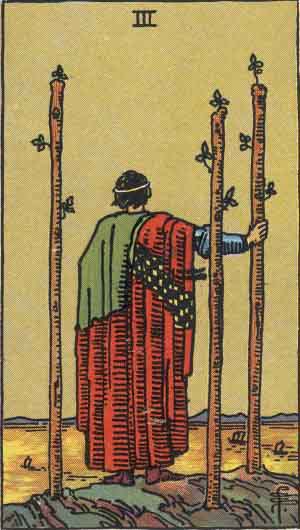
When the Three of Wands repeats, something has already been sent beyond the seeker’s immediate control. The live question is how they manage the interval between initiative and evidence: what still needs tending, what must simply be awaited, and what anxiety is trying to decide too soon.
Core Repeating Message
The Three of Wands shows a figure standing on high ground, looking out across the water towards ships already underway. Three wands surround the figure: ground already staked, presence already established. The figure is not beginning something here. They are watching something that has already been begun. The posture is expansive but patient: one arm extended to a wand, facing outward, holding the watching position while the venture moves on its own trajectory.
When this card appears once, it may mark movement beyond the Ace’s first impulse and the Two’s threshold decision into the exposed phase that follows commitment. What has been sent out is no longer entirely under the seeker’s control. When the Three repeats, it can indicate a recurring difficulty with this interval, especially with distinguishing patient attention from passive waiting, anxious surveillance or premature abandonment.
One common pattern is the seeker who sends things out and cannot wait for them to come back. The launch was real; the energy and intention behind it were genuine. But the waiting period, the stretch of time in which the venture is on the water and the seeker is not actively doing anything, produces an anxiety that the seeker relieves by beginning something new. Another launch is initiated before the first has returned. Then another. The horizon becomes populated with outbound ships, none of which have yet come back, and the seeker’s creative or vocational life is characterised by an unfinished abundance: many beginnings, few arrivals.
A second pattern is the seeker who waits but waits in the wrong quality of attention. They are not doing something new; they are watching the horizon with a form of anxious monitoring that is not the productive watching of someone who trusts the launch. Every absence of visible return is interpreted as evidence that the launch was insufficient, the ship lost, the direction wrong. The mind constructs increasingly plausible narratives about what is going wrong out there on the water, and by the time anything actually returns, the seeker has already decided the venture has failed and has begun to withdraw their investment from it, psychologically if not practically. The return, when it finally comes, is received with distrust because the seeker has spent the waiting period becoming convinced it would not arrive.
A third pattern is the seeker who launches in earnest and then systematically dismantles what they launched during the waiting period. The dismantling is not dramatic; it is a series of small but real retractions: the email not followed up, the connection not maintained, the project not tended in the ways that would allow it to develop. The seeker is watching the horizon, but these small withdrawals may also limit what a return would ask of them, sometimes without that protective purpose being consciously recognised. The ship comes back lighter than it was sent out.
A fourth pattern belongs to the seeker who has not yet developed trust in what they send out. Their work, initiative or creative offering may be sound, while the experience of putting creative or vocational fire into the world and waiting to see how it lands has historically been associated with disappointment or rejection. The Three of Wands returning repeatedly in this seeker’s readings is marking the unresolved relationship between creative initiative and the exposure that follows it.
What all these patterns share is a difficulty with the phase of waiting that creative and vocational commitment requires: the phase in which the work is out in the world and the seeker must hold the position of patient presence without either abandoning the watch or collapsing it into anxious control. The card returns because this phase keeps being entered and keeps being difficult, and the difficulty has not yet been understood as something to work with rather than something to relieve through redirection or distrust.
When This Card Repeats Weekly
A week of Three of Wands repetition marks an immediate situation in which something the seeker has already launched, already committed to, already set in motion, is following its own trajectory and the seeker is in the phase of holding the watching position while it moves.
This might be a creative work sent out for feedback or response. A job application or professional proposal that has been submitted and not yet answered. A conversation that has taken place and is now complete, with the other person processing it in their own time. An investment of energy or resource that is now operating in the world independently of the seeker’s direct control.
The weekly repetition is asking the seeker to notice the quality of their watching: is it the open, patient watching of someone who trusts the launch, or is it the anxious monitoring of someone who is already preparing themselves for the failure they expect? What is the seeker doing with the space that waiting creates?
When This Card Repeats Monthly
A month of Three of Wands repetition suggests that the seeker’s characteristic relationship to the aftermath of initiative is stabilising as a pattern visible across multiple contexts rather than a single situation. The month is offering enough material to see what consistently happens once the seeker has committed and the commitment is out in the world on its own trajectory.
The monthly lens asks the seeker to look across the past weeks and notice: what has been launched, and what happened in the waiting period that followed each launch? Is there a consistent quality to how those waiting periods are occupied? A consistent move toward a new launch when the watching becomes uncomfortable? A consistent withdrawal of trust at the exact moment when patience would be most productive?
A month of this card also frequently marks the seeker who is in a productive period of expansion, with multiple initiatives out in the world simultaneously. Here the Three is not marking a pattern of avoidance but the reality of multiple ventures in flight, and the invitation is to hold the watching position across all of them without collapsing into either panic or premature abandonment.
When This Card Repeats Seasonally
A season of Three of Wands energy marks a sustained period in which the seeker’s life is asking for a quality of patient, trusting expansion: the willingness to hold the watching position for longer than feels comfortable, to resist the reflexive move towards new initiative when the current initiatives have not yet returned, and to develop the discipline of waiting attentively.
What the seasonal recurrence offers is enough time to see the pattern clearly. One waiting period is easy to explain. Three or four waiting periods, all handled with the same characteristic quality of anxiety or redirection or dismantling, are harder to attribute to circumstance alone. The season is long enough for the seeker to recognise their relationship to aftermath, and potentially long enough to begin to change it.
A Three of Wands season also asks the seeker to examine what they believe about what they send out: whether they trust the quality of what they offer, whether they expect the world to receive it generously or suspiciously, and where those expectations come from. The watching posture on the hilltop is not passive; it is the active exercise of trust, and trust in creative work is something that can be developed.
When This Card Repeats Across Years
The Three of Wands returning across years names a seeker whose relationship to the phase following initiative has been a recurring site of difficulty across many chapters of their life: who consistently launches with fire and consistently finds the waiting period between launch and return to be where the pattern becomes active.
One possible origin is a history in which visible effort, self-expression or initiative was met with disappointment, rejection or unpredictable response. That history can make later waiting periods feel more charged than the present facts warrant, with anticipated rejection shaping the watch before the person has consciously considered the current situation. It is not the only explanation. Long external timelines, unclear processes, limited resources or repeated exposure to genuinely unreliable people can produce similar behaviour. The work is to compare the inherited expectation with the current evidence.
The multi-year Three of Wands also marks seekers who have developed, over time, expertise in beginning things while the later phases of creative or vocational development remain less practised. The ships keep launching; the harbour is always full of outbound vessels. The question the long arc is asking is whether the seeker is willing to be present for the returns as well, and whether they can receive what comes back with openness rather than predetermined assessment.
Across years, the growth arc this card traces is from anxious monitoring to trust: the seeker who develops the capacity to hold the watching position with patience, to await what they have sent out, and to receive the return, whatever its form, as information rather than verdict.
Life Area Interpretations
Love & Relationships
In love and relationships, the Three of Wands marks the seeker whose characteristic difficulty is with the vulnerability of having expressed care, interest or desire, and now waiting to see how it is received.
This might be the seeker who has finally said the true thing to someone they care for, or who has made a relational investment, and who now finds the waiting period for the response to be almost unbearable. The vulnerability of having put relational fire out in the world and not yet knowing what it will return is precisely the territory this card marks. How the seeker occupies that waiting period, whether with anxious monitoring, with pre-emptive withdrawal, or with patient presence, is what the repeated return of the card is asking them to examine.
The card may also mark the seeker in a relationship whose investments have been made and are now on their own trajectory: the conversation that shifted something, the commitment that changed the dynamic, the reaching-out that is now in the space between offer and response. The Three of Wands is asking the seeker to trust what they have sent out, without undermining it in the waiting period.
Career & Purpose
In career and purpose, the Three of Wands marks the seeker who has made creative or vocational commitments and is in the phase of waiting to see what those commitments will return. Work submitted, applications sent, creative projects released, professional relationships initiated.
The challenge this card marks in vocational contexts is the discipline of continuing to work and build in the period between a launch and evidence of its outcome, without either abandoning the field prematurely or collapsing the productive, open waiting into anxious obsessive monitoring.
The card also marks the seeker whose vocational life involves an outward orientation: who has begun to work at the scale at which what they offer goes out into the world and returns in forms they cannot fully predict or control. This challenge is distinct from beginning. The seeker can no longer manage the fate of what they have made. They can remain patiently attentive, continue to work and respond to evidence as it becomes available.
Money & Stability
In financial contexts, the Three of Wands may symbolise the period after money, time or business resources have been committed and before the outcome is clear. It does not confirm that a return will arrive or that an existing investment is sound.
The useful inquiry is whether the original decision has a documented time horizon, review point and exit criterion, and whether those facts have changed. Reactive withdrawal and reactive additional spending can both be attempts to relieve uncertainty. Material decisions should be tested against current figures and, where appropriate, qualified financial, legal or tax advice rather than against the card alone.
It may also accompany a period of financial or commercial expansion beyond the seeker’s previous comfort level. Here the card’s question is practical: which outcomes are still within the expected range, what maintenance remains the seeker’s responsibility, and what evidence would justify changing course?
Spiritual Growth
In spiritual growth, the Three of Wands marks the seeker who has made spiritual commitments through practices, dedications and shifts in how they orient their inner life, and is now in the phase of awaiting what those commitments will produce.
Spiritual development can follow this arc: effort precedes visible fruit, and the waiting period between the two is exactly where the practice is actually happening. The seeker who has launched a spiritual initiative and then finds the waiting period uncomfortable is often the seeker who is being asked to discover that the watching, the patient holding, the trusting presence in the absence of visible return, is not separate from the spiritual work. It is the spiritual work.
The Three of Wands repeating in spiritual contexts also marks the seeker who keeps beginning spiritual practices and not staying long enough with any of them to discover what sustained commitment might produce. The ships keep setting out. The harbour never experiences an arrival.
Emotional & Mental Patterns
The Three of Wands in emotional and mental patterns marks the seeker whose characteristic response to personal investment is the eventual substitution of anxious monitoring for patient presence. The mind moves in, assessing and reassessing what was sent out, constructing narratives about its likely fate, filling the waiting space with activity that feels like engagement but is really the management of anxiety.
This seeker often experiences the waiting period as the most emotionally demanding phase of an initiative, more demanding than the actual launch. The launch involves action, and action is generally within the seeker’s characteristic comfort zone. Waiting requires a quality of relinquishment, a willingness to hold the absence of control without filling it with something, and this is the skill the card keeps asking this seeker to develop.
Worst-case construction in the waiting period deserves attention, but it should not be dismissed automatically as inaccurate. List the feared outcome, the evidence for and against it, and the information that is still unavailable. Catastrophic thinking may be trying to reduce uncertainty by reaching a conclusion before the evidence arrives, while legitimate concern may be identifying a real need for follow-up or contingency planning.
Family & Generational Dynamics
In family dynamics, the Three of Wands may invite examination of whether initiative was followed by encouragement, silence, criticism or unpredictable response. A household that treated every new venture anxiously can provide one template for later anticipatory disappointment, but the card cannot establish family history or causation. The relevant evidence is the seeker’s remembered pattern and its observable resemblance to present behaviour.
Where this inherited pattern is present, it may take the form of anticipatory disappointment: the learned tendency to assume that what was sent out will not return as hoped, which becomes a self-fulfilling element of the waiting period when it leads to pre-emptive withdrawal or undermining.
The generational work the card marks is developing the capacity to trust what has been launched: to hold the watching position on the hilltop with openness about what the ships will bring back, rather than with protective certainty that the return will require management.
Health & Energy
In health contexts, the Three of Wands may symbolically reflect the felt strain of waiting for information or outcomes that cannot be accelerated, including a sense of being constantly on the alert for a response. Tarot cannot determine the physiological cause of tension, fatigue, sleep disruption or other symptoms, and it should not be used to diagnose them.
Some people find uncertainty more draining than directed action because it keeps attention divided across several possible outcomes. Others experience fatigue for unrelated reasons. If symptoms persist, intensify or affect daily functioning, appropriate professional assessment belongs alongside any symbolic reflection.
A bounded monitoring plan may help: decide what requires attention, when the next check is due and what can be left alone until then. Notice whether this changes the felt quality of the waiting period, and treat the result as personal feedback rather than proof of the card’s mechanism.
Advanced Interpretive Sections
The Shadow Expression
The Three of Wands in shadow produces the seeker who has become a masterful initiator and a consistent abandoner: who sends ships out with fire and craft, and who consistently finds reasons to withdraw commitment before the return. The reasons are always plausible. The venture was not developing as hoped. The market has changed. The timing is off. Another, more promising direction has presented itself. And the seeker’s creative or vocational life becomes characterised by perpetual launch without completion: aliveness at the beginning, withdrawal as the waiting period extends.
The shadow also produces the seeker whose anxious monitoring in the waiting period actually undermines what they have sent out: who follows up compulsively, second-guesses publicly, revisits publicly what was sent, and thereby communicates to the world a distrust of their own initiative that others may begin to share.
The Integrated Expression
The integrated Three of Wands seeker has developed genuine patience with the specific arc that genuine creative and vocational initiative requires: the willingness to send good work into the world with genuine care, to hold the watching position with real trust rather than managed anxiety, and to receive whatever comes back as useful information about the next phase rather than as a verdict on the value of what was launched.
This seeker is recognisable by productive persistence: they continue to work and build in the waiting period without compulsively monitoring or pre-emptively withdrawing. Multiple ventures are in flight, and what returns is received and built upon. The harbour sees both departures and arrivals.
Why This Energy Has Not Released Yet
The Three of Wands pattern may persist when the seeker has not examined what makes the waiting period difficult. There may be a specific earlier disappointment, a succession of unreliable outcomes, a present lack of information or simply a low tolerance for uncertainty. Identifying a cause should not become a requirement to recover a forgotten event. The useful question is which explanation is supported by current evidence and what behaviour it produces now.
The pattern can also persist when the seeker has not yet developed tolerance for the not-knowing that the watching position requires. Not-knowing is not comfortable, and the mind will consistently generate substitutes for it. Sitting with uncertainty about the fate of something you have invested in is a skill, and it is a skill this pattern is asking the seeker to develop.
Finally, the pattern can persist when the seeker has not yet experienced the satisfaction of allowing a worthwhile venture to reach a meaningful outcome without withdrawing prematurely. Without that reference point, waiting may feel like indefinite risk rather than a phase with a review point and something to learn. Where a venture can responsibly be continued, receiving what actually comes back can give patience a lived meaning that planning alone cannot provide.
What This Card Wants the Seeker to Understand
The Three of Wands wants the seeker to understand that the watching position on the hilltop is not passive. It is the active exercise of trust, and trust in what has been launched is not naive; it is the quality of relationship to one’s own work and initiative that allows creative or vocational development to continue across time.
The ships are on the water because the seeker put them there. The fire that sent them is the same fire that is now required to hold the watching position with patience. The card is not asking the seeker to stop being attentive; it is asking them to notice the difference between the attentiveness that serves the voyage and the attentiveness that is really the management of fear, and to develop more of the former.
Signs the Pattern Is Beginning to Resolve
The Three of Wands pattern begins to resolve when the seeker begins to notice the quality of their own waiting: when they can feel the difference between patient presence and anxious monitoring, and when they can sometimes choose the former even when the latter is more familiar and more immediately relieving.
It also begins to resolve when the seeker gives one worthwhile venture enough time to reach an agreed review point without neglecting it or repeatedly changing the terms. Patience is not indefinite endurance. Resolution includes recognising when the evidence supports continuation, revision or withdrawal, then receiving that evidence as information rather than a verdict on personal worth. When something does return, the experience of staying present to receive it can begin to change how the next waiting period feels.
Reflective Questions
-
Think about the most recent time you launched something and then found the waiting period difficult. What was the quality of your attention during that waiting period? Was it patient and trusting, or anxious and monitoring?
-
Is there a pattern across multiple initiatives in your life in which you launch things and then withdraw commitment or attention before they have had time to return? What triggers the withdrawal?
-
What do you believe, honestly, about what you send out into the world? Do you trust the quality of what you offer, or do you expect the world to find it insufficient?
-
Can you identify a specific early experience of putting effort or something of yourself into the world and receiving a response that was disappointing or damaging? If so, how might the memory of that experience shape the way you currently hold the waiting period?
-
What do you do with the space that waiting creates? What occupies you in the period after initiative and before a return?
-
Have you ever allowed a creative or vocational venture to complete its full natural arc without withdrawing from it? What was that experience like, and what did it return?
-
When you are in the waiting period for something you have invested in, what narratives does your mind construct about the likely outcome? How accurate have those narratives historically been?
-
Is there something currently on the water in your life, launched and not yet returned, that you are already working to withdraw from or undermine? What would it mean to hold the watching position for it instead, and what current evidence would justify continuing or changing course?
-
What did your early experience teach you about whether things you sent out were likely to come back in ways you had hoped? What was the most formative experience in that area of your life?
-
If the Three of Wands has been appearing for a sustained period, what specifically has it been asking you to trust? And what specific fear has been making that trust difficult?
Practical Integration Actions
Map your launch-and-withdraw pattern. Make a list of the significant things you have initiated in the past year or two: creative projects, professional ventures, relational investments, personal commitments. For each, note honestly whether you stayed engaged until there was a result or a meaningful review point, or withdrew before then. The exercise is not self-criticism; it is a map of the pattern.
Identify one thing currently on the water. Choose one thing you have sent out that you are currently in the waiting period for. Write specifically about the quality of your current attention to it: are you monitoring it with anxiety, or holding it with trust? What specifically would the trusting version of the waiting position look like for this particular venture?
Examine the origin of your waiting-period anxiety. Write about any experience or period in your life that seems to have shaped your response after initiative: a particular occasion or recurring pattern rather than a general background of disappointment. If no clear origin comes to mind, describe the present waiting conditions instead; you do not need to uncover a forgotten event. This is not a blame exercise but an inquiry into how the current pattern may have been learned and what is sustaining it now.
Practice the watching posture. Once each day during the waiting period for a venture, spend a few minutes explicitly holding the posture of patient trust: not monitoring for signs of failure, not constructing narratives about likely outcomes, but present on the hilltop with the horizon open. This is a practice, not a performance; the quality of the attention is what the exercise is developing.
Allow one return. Choose one worthwhile initiative that you might otherwise abandon prematurely. Define its next review date, the tending still required, the evidence that would support continuation and the conditions that would justify stopping. Hold the course until that point unless safety, consent or material facts change. Record what actually returns, including outcomes that challenge your preferred interpretation. Note what waiting costs in uncertainty and, where it occurs, the satisfaction of having stayed to receive the outcome.