
When the Four of Wands repeats, an arrival, milestone or experience of belonging may be available but insufficiently received. The question is not simply what has been completed, but whether the seeker can recognise, inhabit and share it without denying what still remains unfinished.
Core Repeating Message
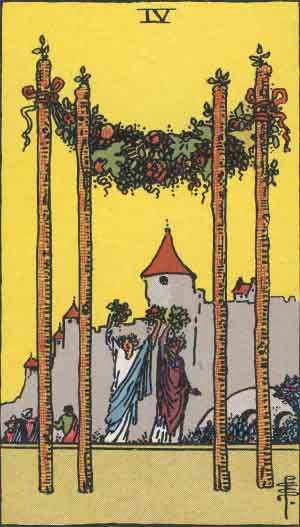
The Four of Wands shows four wands planted firmly in the earth, garlands of flowers and fruit hung between them in a canopy of harvest. Two figures raise bouquets in celebration. Behind them, a structure: built, settled, occupied, the evidence of sustained effort having produced something real and inhabitable. The image is one of arrival, of completion, of the satisfaction available when effort has produced a result and there is space to acknowledge and receive it.
When this card appears once, it may mark a moment of completion, welcome or homecoming. When it appears repeatedly, it can describe a person who reaches recognisable milestones yet moves past them before satisfaction, rest or belonging has registered. It can also appear when the external celebration is present but the achievement does not feel safe, shared or complete from the inside.
One common pattern is the seeker who reaches completion and immediately reorients toward the next beginning. The project is done, the milestone reached, the creative, vocational or personal accomplishment real, and within moments the mind is already assessing what is next, what is insufficient about what was built, what would be needed to do it better. The completion exists; the seeker is already elsewhere. The Four of Wands returns because the capacity to receive completion has not yet been developed, and without it, each arrival is a brief transit rather than a homecoming.
A second pattern belongs to the seeker who builds but cannot stop building long enough to live in what was built. This seeker has creative or vocational fire, initiative and capacity to bring things into existence. But the fire has become associated so thoroughly with the act of building that the act of inhabiting, of enjoying what was made, of allowing the built thing to be used and lived in, feels foreign or even threatening. The castle in the Four of Wands image is not just a backdrop; it is the point. Stopping to live in what you have built is not a failure to produce. It is the completion of the arc that production began.
A third pattern is the seeker who minimises their own completions before they can be fully received. The project is finished, but it could be better. The milestone is reached, but it was not the important milestone. The creative work is done, but it does not count as the real achievement because the real achievement is still ahead. The seeker has a characteristic move of reframing every completion downward, so that what was accomplished becomes provisional, a draft version of the real thing, rather than something that deserves to be acknowledged and received. This move is often so habitual that the seeker does not experience it as a choice but as an accurate assessment.
A fourth pattern belongs to the seeker who allows themselves the celebratory moment but immediately loads it with the weight of what comes next. There is a pause at the garland, but it is already coloured by what the next period will require. The celebration is present; the rest is not. The seeker is in the homecoming moment but their attention has already begun organising the next departure, and the sense of fully arriving, the full permission to rest in what has been accomplished without orienting toward what remains, is never quite reached.
What all these patterns share is a difficulty with receiving: allowing what has been built and earned to be acknowledged through rest, recognition and actually living in what has been made. The Four of Wands keeps returning because the seeker keeps arriving at that threshold and declining to enter fully.
When This Card Repeats Weekly
A week of Four of Wands repetition marks an immediate completion or arrival: something in the current landscape has reached a point of finishing or homecoming, and the seeker’s characteristic pattern of bypassing their own completions is engaging with it now.
This might be the conclusion of a creative project, the successful completion of a significant professional effort, or a personal accomplishment that deserves to be acknowledged and received. The card this week is not asking the seeker to stop permanently; it is asking them to pause briefly and fully, and to allow the experience of completed effort to be felt in the body rather than managed into the next to-do list.
The weekly question is practical and immediate: what has been accomplished this week, and what would it mean to receive that accomplishment rather than immediately assessing what remains?
When This Card Repeats Monthly
A month of Four of Wands repetition suggests a developing pattern in which the seeker repeatedly passes through moments of arrival rather than inhabiting them. The question is how they respond to the completions already present in their life.
The monthly recurrence asks the seeker to look at the past weeks and identify the arrivals they have moved through: the completions, the milestones, the moments when creative, vocational or personal fire produced something real and finished. How were those moments received? Was there acknowledgement, rest, permission to be in the completed thing? Or was the characteristic move the immediate reorientation toward what is next?
A month of this card may also mark the seeker who is in a period of harvest: multiple things completing simultaneously, multiple arrivals asking to be received. The question the monthly recurrence is asking is whether the seeker can allow this period of completion to be inhabited, or whether the harvest will be gathered and immediately planted again before its own abundance has been received.
When This Card Repeats Seasonally
A season of Four of Wands energy marks a sustained period in which the seeker’s life is asking for celebration and inhabitation that the seeker’s pattern has been consistently denying. Something has been built, something significant, and the season is the period in which the built thing deserves to be lived in rather than immediately improved upon or transcended.
What the seasonal recurrence offers is permission: permission to receive what has been accomplished, to allow the garlands to stay hung for longer than a moment, to inhabit the castle rather than immediately planning its expansion. This is not permission to stop building permanently; it is permission to complete the arc of building by experiencing arrival.
A Four of Wands season also asks the seeker to examine their relationship to celebration itself: whether they can receive the acknowledgement of others for what they have accomplished, whether the communal dimension of the image, the shared celebration, the witnessed arrival, is something the seeker allows or something they deflect or minimise. The two figures in the image are celebrating together. The completion is witnessed and shared.
When This Card Repeats Across Years
The Four of Wands returning across years names a seeker whose characteristic relationship to their own completions and arrivals is a long-arc pattern: who has, across many chapters of their life, built things of substance and consistently moved through the moment of completion without allowing it to be fully received or inhabited.
One possible origin is an early environment in which accomplishment was minimised, immediately followed by a new demand, or treated as evidence that more should now be expected. Where that earlier pattern fits, stopping may feel like falling behind or being caught unprepared for the next demand. Another is a present reality in which milestones have brought additional labour, scrutiny or instability rather than relief. The card cannot establish the origin. It asks the seeker to compare what stopping once meant with what a proportionate pause would mean now.
The multi-year Four of Wands also marks the seeker who has built a great deal across their life and has not yet received the satisfaction of inhabiting what was made. The castle is in the background of the image for a reason; it is the evidence of everything that came before the current moment of celebration. Across years, the growth arc this card traces is towards the capacity to stop at the garland and celebrate what has been accomplished, before turning back to the work.
Life Area Interpretations
Love & Relationships
In love and relationships, the Four of Wands most often marks the seeker whose characteristic difficulty is with allowing relational completion and arrival to be fully received rather than immediately problematised or moved past. The relationship has reached a moment of stability, warmth, or mutual acknowledgement, and the seeker’s pattern is to either minimise it or immediately introduce the next concern.
This might be the seeker who experiences intimacy in a relationship and immediately becomes preoccupied with what threatens it. Or the seeker who receives love or appreciation from a partner and acknowledges it briefly before redirecting attention toward the next relational task. Or the seeker who has built something good with another person and cannot quite allow themselves to rest in the goodness of it because stopping feels like complacency.
The card may also mark the seeker for whom a relational arrival is currently available, a relationship that has developed to the point where shared life is possible, and who is finding it difficult to commit to inhabiting what has been built together.
Career & Purpose
In career and purpose, the Four of Wands marks the seeker who has reached vocational milestones and consistently moves through those accomplishments without pausing long enough to integrate them into a sense of who they are and what they have built.
Where projects, skills or professional standing are supported by evidence, the seeker’s inner accounting may still lag behind it. Yet the card should not be used to declare achievement that the evidence does not support. A grounded review names what was delivered, what others can verify, what remains incomplete and what the milestone changes in practice.
This creates a disconnection between the seeker’s external vocational evidence and their internal experience of their own vocational worth. The castle is built. The seeker is still planning the walls.
Money & Stability
In financial contexts, the Four of Wands may coincide with a savings milestone, a stable home base, the completion of a debt phase or another measurable improvement. It does not itself establish security. Stability should be assessed through income, essential costs, debt, reserves, obligations and risk exposure.
The pattern in financial life often looks like the seeker who reaches financial goals and immediately resets the target upward without acknowledging the achievement of the previous goal. The satisfaction of having reached that goal, and the completion it represents, is skipped over in the move to the next financial objective.
If the figures support greater stability, acknowledgement need not mean relaxing every safeguard. It can mean recognising progress while retaining sensible controls, especially if trusting the improvement feels like giving up the vigilance that helped build it. If the figures remain uncertain, qualified financial or legal advice is more reliable than using celebration to override legitimate concern.
Spiritual Growth
In spiritual growth, the Four of Wands marks the seeker whose practice has deepened or matured in meaningful ways, but who has not yet learned to receive that development as something to live from rather than immediately transcend.
The spiritual version can appear when a seeker discounts changes that are visible in conduct, discernment, humility or consistency because those changes do not feel dramatic enough. This is not evidence of spiritual rank or exceptional attainment. The grounded measure is whether practice is producing a more honest, responsible and inhabitable life.
The Four of Wands in spiritual life is also about communal celebration: the gathered acknowledgement of what has been accomplished, the shared recognition of spiritual development. Seekers whose spiritual life is wholly private often miss the quality of celebration this card marks, the witnessed arrival, the communal garland.
Emotional & Mental Patterns
The Four of Wands in emotional and mental patterns marks a cognitive and emotional style: the seeker whose internal environment is characterised by a perpetual orientation toward what is not yet done, not yet built, not yet achieved, even when the external evidence of accomplishment is substantial.
This is not the same as ambition, which serves development. This is the pattern in which the achievement of goals does not produce the satisfaction the seeker anticipated, because the satisfaction is consistently deferred to the next goal, where it is equally deferred. The target recedes as it is approached. The garland is never the garland; it is always the preview of the next garland.
One possible emotional cost is a background flatness around accomplishment, as if effort never produces the satisfaction anticipated. Perpetual reorientation may contribute, but it is not the only explanation. Exhaustion, grief, unsafe circumstances or changes in mood can also affect the capacity to feel pleasure and deserve appropriate attention rather than symbolic certainty.
Family & Generational Dynamics
In family dynamics, the Four of Wands may invite inquiry into how celebration, rest and belonging were handled. Some families moved immediately to the next demand, treated enjoyment as complacency or reserved celebration for narrow forms of success. Such patterns can influence later responses, but they do not determine them, and the card cannot infer a family history that the seeker does not recognise.
Where this pattern has been inherited, one common move is the reframing of accomplishment as merely preparatory: what was achieved is not the real thing, only the foundation for the real thing, which is always still ahead. This move can look like humility or ambition from the outside; from the inside, it is the pattern of being unable to receive what has been earned.
The generational work this card marks is developing the capacity to celebrate, both alone and in community, what has been built.
Health & Energy
In health contexts, the Four of Wands may symbolically highlight the absence of a recovery phase after sustained effort. Tarot cannot determine the cause of fatigue, tension, sleep disruption or changes in functioning, and celebration is not a medical intervention.
Moving directly from one demanding period into another can leave a person feeling depleted, especially when practical recovery has been postponed. The responsible response is to review workload, sleep, nourishment, movement, support and any persistent symptoms. Ongoing or concerning changes deserve appropriate professional assessment.
A brief, realistic pause can be used as an experiment. Notice whether the body feels more settled, unchanged or unexpectedly uncomfortable when completion is acknowledged. Treat that observation as personal data, not proof that the card explains a physiological state.
Advanced Interpretive Sections
The Shadow Expression
The Four of Wands in shadow produces the seeker who has become so identified with the building phase that they cannot inhabit anything they have built. Every completed thing immediately becomes a launching pad for the next thing rather than a thing to be used and enjoyed. The castle is always under construction; there is always another wing to add before the current rooms can be comfortably occupied.
This shadow also produces the seeker who uses the image of the not-yet-completed as protection against having to evaluate what has been accomplished. If the project is never finished, it cannot be assessed. The permanent state of building protects against the vulnerability of having completed something and having it be seen for what it is.
The Integrated Expression
The integrated Four of Wands seeker has developed the capacity to complete the full arc of creative, vocational or personal effort: to build, reach completion and then inhabit what has been built before orienting towards the next thing. They are recognisable by a satisfaction that is not complacency: enjoyment of what has been made, rest in what has been accomplished and communal celebration of what deserves to be celebrated.
This seeker’s fire burns for building and for inhabitation in equal measure. They have learned that rest in completion does not extinguish the fire; it restores it. The next beginning arrives from fullness rather than from the compulsive momentum of a cycle that never allowed stopping.
Why This Energy Has Not Released Yet
The Four of Wands pattern can persist when the seeker has not yet examined the fear beneath the bypass of completion: what they believe will happen if they stop at the garland. Sometimes this is the fear of complacency: the belief that rest will make them unable to start again, that celebration is the beginning of decline. Sometimes it is the fear of being seen clearly in the completed state: if the thing is done, it can be evaluated, and the evaluation might be less than what the seeker hopes. Sometimes it is a deeper pattern in which the act of completing something is experienced as a form of ending: the ending of the project also feels like the ending of the aliveness the project produced, and the move to the next beginning is the attempt to avoid that grief.
Naming the fear beneath the bypass can help the seeker understand why motion through completion feels protective. When that fear remains unexamined, continuing to move may be a way of avoiding the arrival it makes difficult.
What This Card Wants the Seeker to Understand
The Four of Wands wants the seeker to understand that rest in completion is not the end of their creative or vocational fire. The garland in this image is the fire expressed in a different register: not the spark or the active flame but the fruit, the harvest, the evidence of sustained effort having produced something real.
The seeker who never allows their fire to reach the register of completion and celebration is not protecting their fire by keeping it perpetually active. They are preventing it from cycling through its full natural arc, and fire that never rests in completion has no chance to be renewed by that pause. The castle in the background is there because habitation of what was built is part of the work, not a departure from it.
Signs the Pattern Is Beginning to Resolve
The Four of Wands pattern begins to resolve when the seeker can identify a completed stage in concrete terms and notice their response to it, including what they feel in the body when they pause compared with when they move straight on. Relief, restlessness, grief, pride or no strong feeling are all useful observations. The aim is not to manufacture celebration but to stop automatically erasing the evidence of arrival.
It also resolves when the seeker makes a concrete act of celebration: stopping to receive what was accomplished in a form they themselves recognise as celebratory, rather than performing an acknowledgement that is merely efficient.
And it resolves when the seeker discovers that rest in completion need not extinguish the fire: a later beginning may arrive with renewed vitality after a meaningful pause, rather than being driven only by the momentum of a cycle that never stopped.
Reflective Questions
-
Think about the last time you completed something significant. What did you do in the immediate aftermath? Did you stop and receive the completion, or did you move immediately toward the next thing?
-
Is there a completion or arrival in your current life that you have been moving past without fully receiving? What is it, and what would it mean to stop at the garland for it?
-
What do you believe will happen if you rest in completion? Is there a specific fear of what stopping will produce, or of what celebration will reveal?
-
Can you identify the most significant thing you have built in this chapter of your life? Can you acknowledge the scope of what it required to build it, and allow that acknowledgement to be real rather than immediately moving to what is insufficient about it?
-
What does genuine celebration mean to you, and when did you last actually do it? Not the efficient acknowledgement of completion, but celebration with permission to enjoy what was accomplished.
-
Is there a relationship between difficulty resting in completion and difficulty evaluating what you have built? Does the perpetual motion protect you from having to look clearly at what was accomplished?
-
What did your early environment communicate about the appropriate response to completion? Was celebration welcomed and modelled, or was it treated with suspicion or immediately redirected toward what remained?
-
Do you trust that rest in completion will be followed by a new beginning? Or is there a fear that stopping will mean not starting again?
-
Think about the people in your life who seem to inhabit what they have built. What quality do they carry that is distinct from what you carry in your relationship to your own accomplishments?
-
If the Four of Wands has been appearing for a sustained period, what specific completion or arrival has it been marking that has not yet been received? What would receiving that completion look like in the specific terms of your current life?
Practical Integration Actions
Name one genuine completion. Identify one thing in your life, recent or accumulated, that deserves to be recognised as complete. Distinguish what has actually been built from what remains partial or provisional. Write honestly about what it required and acknowledge the effort it took. This is the practice of giving a real completion its due recognition.
Design a genuine celebration. For the completion you have named, design a celebration you would actually experience as meaningful, rather than an efficient acknowledgement. This is specific to you. For some seekers it is solitary and quiet; for others it is communal. The key quality is permission to enjoy what was accomplished, without the immediate introduction of what remains.
Practise inhabitation. Once each day for one week, spend five minutes inhabiting one thing you have built: a relationship, a skill, a professional reality, a quality in yourself. Not assessing it, not planning its improvement, but experiencing it as something real and yours. Notice what this feels like, and notice any resistance that arises.
Examine the bypass. Write specifically about the move you make when you arrive at completion. What happens in your body and mind in the moment the completion is reached? What triggers the reorientation toward the next thing? Is there a specific thought pattern that systematically reframes completion as insufficiency?
Let the garlands stay up. For the next cycle of effort you undertake, make a specific commitment to the completion before you begin: to stop at the garland when it arrives, to acknowledge the completion fully, and to allow yourself a defined period of rest in the accomplished thing before beginning the next phase. Build the celebration into the plan rather than leaving it to chance.