
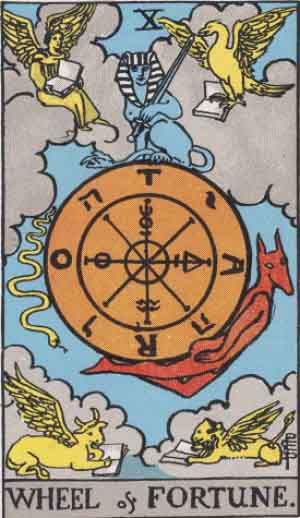
When this card appears again and again, it is not predicting your luck: it is asking you to recognise the cycle you are in and to develop a quality of relationship with change that does not depend on where the wheel has stopped.
Core Repeating Message
The Wheel of Fortune is one of the most visually complex cards in the Major Arcana, and its complexity is deliberate. The great wheel at the centre of the image turns: it is always turning, it has always been turning, it will not stop, and around its rim figures ascend and descend: rising toward the top, falling away from it, perpetually in motion. At the summit sits the sphinx, holding a sword, utterly still. In the four corners of the card, the fixed signs of the zodiac, the angel, the eagle, the lion, the bull, are suspended in clouds, each reading from a book. They are studying. They are not on the wheel.
This image contains the full teaching of the card, and every element of it matters when the Wheel of Fortune repeats.
The wheel gives visible form to a familiar structure of experience: seasons change, fortunes shift, relationships evolve, health fluctuates, careers rise and contract. Nothing in human life remains at a fixed point indefinitely. The person who understands this at a level below intellectual acknowledgement, who has genuinely integrated the cyclical nature of existence rather than simply knowing it as a concept, moves through the turning with a quality of equanimity that is not passivity but genuine freedom. They are less overwhelmed by the descent, less intoxicated by the ascent. They understand, at some structural level, that both are temporary and both are part of the same ongoing movement.
Most people do not yet have this understanding in their bones. They have it as an idea, perhaps a comforting one, but the lived experience of being at the bottom of the wheel does not feel cyclical; it feels permanent. The lived experience of being at the top feels deserved and earned rather than temporary. This gap between intellectual knowledge of cycles and the embodied wisdom that allows genuine equanimity is what the repeating Wheel of Fortune is most consistently asking the seeker to close.
The sphinx at the top of the wheel is the card’s most demanding figure. While figures rise and fall around the rim, the sphinx remains still. The sphinx sits above the turning, with a view across the wheel, and holds a sword of discernment: the capacity to see clearly without being drawn into any particular position on the wheel as the definitive one. The sphinx does not deny the wheel’s existence; it has a direct view of it. But it does not identify with any position on it. This is the quality the card is ultimately cultivating in the seeker: not detachment in the sense of emotional distance, but the development of enough inner steadiness to maintain perspective across the full arc of the turning.
The fixed figures in the corners reading their books are studying the nature of cycles, not the position of any particular cycle. What they are accumulating is not the knowledge of where the wheel is now but the understanding of how the wheel moves: what the laws of the turning are, what generates the rising and the falling, and how the quality of one’s response to any position on the wheel is a matter of understanding rather than luck. This is what the Wheel of Fortune ultimately offers to the seeker who keeps drawing it: not the promise that the wheel will stop in a favourable position, but the development of genuine understanding of cycles that changes the seeker’s relationship to every position on it.
When the Wheel of Fortune repeats, several distinct patterns tend to emerge.
The first is the pattern of the crest-blind: the seeker who is in, or recently was in, an ascending phase of a significant life cycle, and who has not recognised the temporariness of the crest. They have interpreted the high point as arrival, as the deserved and stable result of their efforts, as the natural resting place of their life, and they are not preparing for or even genuinely aware of the possibility of a descent. This is not a failure of intelligence; it is a failure of cyclical awareness, and it can arise when people have not yet developed a genuine relationship with the Wheel’s teaching. The card appearing repeatedly here is asking the seeker to look at the full circumference of the wheel rather than at the point they currently occupy.
The second pattern is the trough-permanent: the seeker who is in a descending or low phase and has lost the capacity to hold the cyclical perspective. They know, intellectually, that things change. They do not feel it to be true. The low point has the quality of permanence that the high point also carries for the crest-blind seeker: it feels like where things actually are rather than where the wheel has stopped temporarily. For this seeker, the card’s repetition is genuinely compassionate: it is not predicting a turnaround, but it is offering the structural perspective that the seeker has lost access to in the weight of the current moment. Cycles are real. This position on the wheel is not the wheel.
The third pattern is the cycle-blind: the seeker who has not yet identified the recurring cycles that characterise their particular life. Such patterns may recur in relationships, in creative phases, in financial rhythms, or in the contraction and expansion of energy and output. Some show a structure that becomes visible in retrospect even when it is not apparent in the moment; other apparent patterns may turn out to be coincidences. The Wheel appearing repeatedly for this seeker is asking them to lift their gaze above the current moment and look at the longer arc: is this part of a pattern I have seen before? Where have I been in this cycle previously, and what did that teach me that I am not yet applying here?
The fourth pattern is the fatalist: the seeker who has encountered the Wheel’s teaching about cycles and has drawn from it a conclusion that is ultimately disempowering: if everything is cyclical and nothing is within my control, why effort? If the wheel turns regardless, what difference does my participation make? This is a misreading of the card’s teaching that tends to produce passivity dressed as wisdom. The sphinx is not passive. The fixed figures are not waiting for the wheel to turn them in a better direction; they are studying. The Wheel of Fortune does not ask the seeker to relinquish agency; it asks them to locate their agency accurately: not in controlling where the wheel stops, but in developing the quality of relationship with the turning that helps them respond to difficult positions and, where possible, learn from them.
Ten is the number of the completion of a first full cycle and the beginning of a new one: it is the point at which the single-digit sequence of the journey, from the Fool’s first step through the Hermit’s long accumulated wisdom, has come to its first synthesis. The Wheel of Fortune marks the moment at which the seeker has enough experience to begin seeing the patterns that govern not just individual events but the structure of change itself. This is genuinely a threshold: the cards before the Wheel are largely about individual growth, individual development, the building and testing of the self. The cards from the Wheel forward tend to deal with larger, more impersonal, more universal forces. The Wheel is the hinge. It is the moment the seeker is invited to locate themselves within a context larger than their personal narrative.
For the seeker who keeps drawing this card, the invitation is to develop what might be called cycle literacy: the capacity to recognise patterns of change in their own life with enough clarity and early enough in the cycle that they can respond to them wisely rather than reactively. Not to control the wheel; no one controls the wheel. But to know the wheel, to understand its particular rhythms in one’s own life, and to develop the quality of inner steadiness that allows the sphinx-position to become genuinely available, even in the midst of the most demanding turns.
This is the card’s repeating gift: not fortune in the sense of favourable outcomes, but the development of a genuinely liberating relationship with the nature of change.
When This Card Repeats Weekly
A week of Wheel of Fortune repetition is asking the seeker to pay attention to movement: something is shifting, something is completing, something is beginning, and the card is marking the reality of that movement in the current period.
The first question in a Wheel week is about the seeker’s orientation toward what is changing. Is the change welcome, and is the card confirming its reality? Is the change unwelcome, and is the card asking the seeker to locate the cyclical perspective rather than the permanent one? Or is something changing that the seeker has not yet fully registered, and the card is drawing attention to a movement they have not yet consciously acknowledged?
Weekly, the Wheel is not asking for a grand reckoning with the nature of time. It is asking for a modest but genuine question: what is different this week compared to last week, what direction is that difference moving, and what does that movement suggest about where the wheel currently is in whatever cycle is most active?
This quality of attention, when practised consistently, builds cycle literacy over time. The seeker who asks this question weekly across a year develops, gradually, a meaningful ability to see the patterns in their own experience that were previously visible only in retrospect.
When This Card Repeats Monthly
A month of Wheel repetition suggests that a significant cycle is active: either completing, shifting direction, or reaching a particular phase that the card is marking as important.
Monthly, the Wheel asks the seeker to take stock of their position across multiple domains simultaneously: career, relationship, creative life, energy, financial situation. Where, in each of these, does the wheel appear to be? What direction is each of these domains currently moving? Are there cycles completing in multiple areas at once, which would suggest a major transitional period? Or is one particular cycle dominant while others are relatively stable?
The month of Wheel energy is worth approaching with deliberate reflection rather than reactive management. The temptation in a month of significant change is to deal with each shift as it arrives, responding to events without ever lifting the gaze to the pattern that contains them. The card appearing monthly is asking for that lifted gaze, at least once, in sufficient depth to see the cycle rather than only its current expression.
Monthly Wheel energy can also appear in months of apparent stillness, when the seeker’s life seems to be turning more slowly than expected or desired. The card here is asking the seeker to examine whether the stillness is a genuine pause between cycles or whether they have mistaken a slow movement for no movement. Wheels do not always turn dramatically. Sometimes the turning is barely perceptible until enough time has passed to see where the movement has been.
When This Card Repeats Seasonally
A Wheel of Fortune season is one of the more significant markers in this system: it suggests that a major cycle is active across the full span of the season, and that the seeker’s relationship to change itself is the primary developmental theme of this period.
Seasonally, the Wheel tends to appear during genuine transitional periods: the years in which multiple major life structures are shifting simultaneously, in which the shape of the daily life is undergoing significant reconfiguration, in which what was familiar is becoming less so and what is coming is not yet clear. These are genuinely demanding periods, and the card’s seasonal repetition is both acknowledgement and orientation: yes, this much is actually changing. There may be a wider structure, direction, or meaning to explore beyond the immediate disruption.
The Wheel season asks the seeker to develop their tolerance for the between-positions quality of cyclical transition: the discomfort of being no longer at the previous position and not yet at the next one, of having left a shore and not yet arrived at a new one. This quality of in-between is genuinely difficult for most people, because the mind is oriented toward stable positions and finds the turning itself uncomfortable. The card appearing seasonally is asking the seeker to extend their capacity to be present with genuine flux without demanding premature resolution.
A Wheel season is also an excellent period for examining the longer cycles in the seeker’s life: possible seven-year rhythms, decade-scale arcs that may show the shape of a life chapter, or generational patterns that can be tested against what actually recurs. This is the kind of cyclical perspective that the fixed figures in the corners are studying, and it is the kind that offers genuine wisdom rather than simply a more organised view of the current disruption.
When This Card Repeats Across Years
The Wheel of Fortune appearing across years is one of the most philosophically significant long-arc patterns in the Major Arcana. It suggests that the seeker has a deep, recurring, and fundamental encounter with the nature of change itself, and that this encounter is central to their development in a way that goes beyond any particular cycle.
Across years, this pattern tends to belong to one of several seeker types. The first is the person who has experienced genuinely dramatic shifts in their life’s circumstances, multiple times, and who is engaged in the long work of developing a relationship with impermanence that neither denies the reality of the losses nor forecloses on the reality of the renewals. For this seeker, the years of Wheel repetition are years of developing genuine wisdom about the nature of change, drawn from direct and often costly personal experience.
The second is the person who is engaged in work that is explicitly concerned with cycles: the healer who works with the cycles of health and illness, the teacher who works within educational cycles, the farmer or gardener who works with seasonal rhythms, the therapist who accompanies clients through cycles of growth and setback. For these seekers, the Wheel appearing across years is naming the nature of the work and asking them to develop the sphinx-quality in relation to it: the capacity to hold cyclical awareness as a genuine orientation rather than simply a framing device.
The third is the person who has, consciously or unconsciously, been living according to a model of progress that is fundamentally linear, and whose experience keeps confounding that model by producing cycles: rises followed by falls, expansions followed by contractions, periods of clarity followed by periods of confusion, in ways that a linear model of growth would characterise as failure but that the Wheel understands as the natural structure of any genuine development. For this seeker, the years of Wheel energy are years of gradually reorienting their understanding of what growth is and what it looks like, from a linear model toward a cyclical one, and discovering that the cyclical model is both more accurate and ultimately more liberating.
The growth arc the Wheel traces across years moves from the experience of cycles as things that happen to the seeker, toward the experience of cycles as the structure within which the seeker is learning to inhabit their own life with increasing skill and increasingly genuine equanimity.
Life Area Interpretations
Love & Relationships
In love and relationships, the Wheel of Fortune’s repetition tends to mark one of several dynamics: the recognition of relationship cycles, the negotiation of different cycle phases within a partnership, or the seeker’s orientation toward change in the relational domain.
Every significant relationship has its own cycles: periods of closeness and periods of distance, periods of high creative collaboration and periods of settling into comfortable routine, periods in which the partnership is the primary source of energy and periods in which it is one of several. The Wheel appearing repeatedly in a relational context is asking the seeker to look at the cycle their relationship is currently in with something approaching accuracy: not the most flattering interpretation, not the most catastrophising, but the most genuinely honest.
For the seeker in a relationship that is currently in a contraction or cooling phase, the Wheel appearing repeatedly is asking them to hold the cyclical perspective: is this the end of the relationship or a phase within it? These possibilities have very different implications, and one of the Wheel’s most practical relational gifts is the invitation to examine which is actually happening before responding as though it were definitely one or the other.
For the seeker in a relationship that is currently ascending, in the warm and energised phases of early connection or of a significant renewal, the Wheel is asking them to love what is present now without requiring it to remain fixed. This is not a warning that the warmth will end; it is an invitation to be genuinely present with it in the knowledge that nothing in relational life remains at any single point indefinitely. The person who can be present with the current phase of a relationship without demanding that it stay there has a significantly healthier relationship with intimacy than the person who requires their relationship to maintain a particular temperature or character in order to feel secure.
For the seeker who has experienced repeated patterns in romantic life, the same cycle playing out across different partners, the Wheel appearing repeatedly is drawing attention to the pattern itself. Not with blame, but with genuine inquiry: what is the structure of this cycle? Where does it begin, what are its characteristic phases, and what usually ends it? What understanding, applied at the beginning of the cycle rather than after its completion, might change the quality of the relational experience?
Career & Purpose
In career and purpose, the Wheel of Fortune marks the reality that professional life, like all other dimensions of human experience, is subject to cycles that are real, often predictable once recognised, and navigable with significantly more skill when their cyclical nature is understood.
Professional cycles come in many forms: the creative cycle in which inspiration is followed by development is followed by completion is followed by fallow is followed by new inspiration; the career cycle in which growth is followed by consolidation is followed by a period of relative plateau is followed by a further growth phase; the industry or market cycle in which expansion is followed by contraction is followed by transformation; the individual professional cycle in which one’s skills and approaches remain useful for a time before needing renewal or reinvention.
When the Wheel repeats in career contexts, the primary question is always about the cycle’s current phase: where is the seeker’s professional life currently positioned, and is their orientation toward that position accurate? The professional who is in a consolidation phase but is straining to produce at expansion-phase levels is fighting the cycle rather than working with it. The professional who is in a genuine expansion opportunity but is treating it with the caution appropriate to a consolidation phase is missing the opening that the cycle is providing.
For seekers experiencing professional disruption, whether from redundancy, industry change, the exhaustion of a career path they have followed for many years, or the collapse of a direction they had invested in significantly, the Wheel’s repetition is asking for a particular quality of response: neither the false optimism that refuses to acknowledge the reality of the fall, nor the catastrophising that treats the current position as permanent. Something is genuinely ending. What comes next may not yet be clear. The quality of what begins depends significantly on how honestly the seeker can examine what the completing cycle actually contained, what it taught, what it built, and what it revealed about what is genuinely needed next.
Purpose and the Wheel have a particular relationship that is worth naming. The seeker who is asking about purpose in the context of this card is often someone who has followed a purpose for some time and has found it reaching a natural completion, or someone who is in the fallow phase between purposes and is not yet able to see what the next one is. The Wheel does not reveal the purpose. But it invites the seeker to consider the between-purposes space as a phase within a larger cycle, and the disorientation of not knowing as part of the turning rather than evidence that the turning has stopped.
Money & Stability
Money is one of the domains in which the Wheel’s cyclical reality is most viscerally felt and most consistently misread. Financial life can contain recognisable cycles. Mistaking every shift for an isolated event, or for proof of personal merit or failure, can make the relationship with money more anxious and leave the seeker less prepared for recurring pressures.
The Wheel appearing repeatedly in financial contexts is most often asking the seeker to examine their orientation toward the current phase of their financial cycle. The person in a period of relative financial ease who is spending as though the ease is permanent is not in relationship with the Wheel’s teaching. The person in a period of genuine financial difficulty who is treating the difficulty as evidence of permanent deficiency, as confirmation of a story about what they deserve or what they are capable of, is also not in relationship with it.
Financial patterns can become more navigable when they are recognised and met with practical preparation. A Seeker who can see in their own history that periods of expansion have sometimes been followed by consolidation or contraction may use that evidence to build reserves, reduce avoidable fragility, or plan for uneven income. This does not make contraction inevitable or guarantee stability. It replaces a universal prediction with informed stewardship based on the Seeker’s actual circumstances.
The Wheel’s financial teaching is not reassurance. It is not a promise that the current difficulty will pass or that the current ease will last. It is the invitation to develop a relationship with financial life that is grounded in the understanding of cycles rather than in the experience of each position as permanent.
Spiritual Growth
Spiritually, the Wheel of Fortune is one of the most philosophically rich cards in the Major Arcana. It raises the oldest questions in any contemplative tradition: what is the nature of fate and free will? What is the relationship between what is within our control and what is not? How does a person develop genuine equanimity in the face of genuine impermanence? And what is the difference between acceptance and resignation?
When the Wheel repeats in spiritual contexts, it is usually marking a period in which the seeker is being asked to develop a more sophisticated relationship with these questions than they currently have. Most seekers arrive at the Wheel with one of two initial orientations: the belief that everything is within their control and that what happens to them is a direct reflection of their will, choices, and worthiness; or the belief that everything is fated and that personal agency is largely illusory. The Wheel’s teaching is in neither of these positions but in the tension between them, and genuine spiritual development in this area requires genuinely inhabiting that tension rather than resolving it toward either pole.
The sphinx is the spiritual figure of this card: still, discerning, above the wheel but not absent from it. The sphinx has not transcended the world of cycles; it is sitting directly above the wheel, in full view of the turning. But it has developed a quality of relationship with the turning that is neither avoidance nor identification. This is the spiritually mature orientation the card is cultivating: fully present with the reality of change, including its losses and its disruptions, without being identified with any particular position on the wheel as the definitive truth.
The four corner figures are doing something equally important spiritually: they are studying. They are not waiting to see where the wheel stops. They are developing understanding that applies across all positions on the wheel. This is what genuine spiritual engagement with the Wheel offers: not a more favourable position on the wheel, but a quality of understanding that transforms one’s experience of every position.
Emotional & Mental Patterns
In the emotional and mental domain, the Wheel of Fortune tends to mark two related patterns: the tendency to treat the current emotional position as permanent, and the tendency to lose cyclical perspective under the pressure of intense emotion.
The emotional experience of being at the bottom of a wheel can feel indistinguishable from permanence. Grief, anxiety, depression, or despair during a difficult life period may feel less like a phase than the whole truth. The Wheel appearing repeatedly in emotional contexts should not minimise that experience or replace appropriate support. Symbolically, it offers a second perspective alongside the feeling: intensity does not by itself prove permanence, and a present state need not be treated as the final definition of a life.
This does not mean the feelings should be rushed past or argued away. The Hermit’s contemplation and the Wheel’s cyclical perspective are sequential for a reason: one must genuinely encounter one’s own interior before one can work with the perspective the Wheel offers. But the perspective, once genuinely available, is a significant resource in navigating the emotional dimension of cyclical change: the knowledge that intensity does not imply permanence, that the weight of a current feeling is not an accurate measure of how long it will last.
Mentally, the Wheel can appear when the seeker’s thinking has become trapped in a particular frame: a linear, fixed, or overly determined interpretation of their current circumstances that is preventing them from seeing the larger pattern. The card’s repetition here is asking for a genuine mental step back, a move from the view from inside the wheel to the view from outside it, which requires deliberately taking a longer temporal perspective, a wider contextual one, or both.
Family & Generational Dynamics
Families are among the most cyclically organised human structures, and the Wheel of Fortune in family contexts often points to the recognition, or the necessary recognition, of cycles that operate across generations.
Families can show recurring patterns across generations: approaches to money, emotional expression, relationship, work, connection, and estrangement may reappear in altered forms. Some repetitions reflect modelling, shared conditions, or inherited resources and constraints; others may be coincidental or only superficially similar. The Wheel asks the Seeker to look for evidence of pattern without forcing every resemblance into a single family cycle or treating health histories as symbolic destiny.
When the Wheel repeats in family contexts, the most useful question is: where in the family’s cycle is this moment? Is this a moment of completion, of transition, of a pattern reaching the end of its natural arc? Or is it a moment of repetition, in which a familiar cycle is doing another turn and the seeker is being asked to recognise it this time rather than simply experiencing it?
The generational Wheel also asks about inheritance: which cycles has the seeker inherited without choosing them? Which family patterns are they continuing because they are the natural recipients of a cycle that was set in motion before they were born? And what does the seeker’s genuine understanding of those cycles, rather than simple participation in them, allow them to do differently?
The Wheel is not deterministic in this context. The sphinx does not deny the wheel; it sits above it with discernment. The seeker who genuinely recognises a generational cycle is not automatically caught in it. Recognition is itself a form of freedom, or at least the beginning of one.
Health & Energy
The Wheel of Fortune’s relationship to health and energy is one practical application of cyclical awareness. Human bodies have rhythms, including sleep and waking patterns, changing energy, recovery needs, and longer shifts associated with life circumstances and age. Individual experiences vary, and not every symptom or health change is cyclical. The card’s symbolism can support observation, but it cannot identify a mechanism, prognosis, or treatment.
When the Wheel repeats in health contexts, the primary question is about the seeker’s orientation toward their body’s cycles. Are they working with their actual energy rhythms or against them? Do they have an accurate understanding of their own patterns of vitality and depletion, or are they treating their body as though it should maintain a constant, steady output regardless of the season, the phase of the week, or the longer arc of their life?
For Seekers in a period of health difficulty, the Wheel’s cyclical perspective may offer orientation without promising recovery or declaring the condition temporary. Capacity, symptoms, and treatment responses can change, but their course belongs to medical reality rather than tarot prediction. The symbolic question is whether the Seeker is allowing for their present capacities, following appropriate care, and distinguishing useful persistence from pressure to perform as though nothing has changed.
The Wheel may also resonate for Seekers who are past an acute phase of a health challenge and adapting to what follows: structuring life around actual rather than wished-for capacities, noticing changing patterns without over-interpreting them, and making meaning from the experience where that feels honest. Meaning is not an obligation, and the difficulty does not need to become a lesson in order to be acknowledged.
Advanced Interpretive Sections
The Shadow Expression
The Wheel of Fortune’s shadow is not the naivety of someone who has never thought about cycles. It is the sophisticated fatalism of someone who has thought about them too reductively: the use of cyclical thinking as a reason not to act, not to commit, and not to take responsibility for what is within genuine human agency.
In shadow, the Wheel seeker has absorbed the teaching that cycles turn and concluded from it that effort is ultimately futile, that commitment is ultimately undermined by change, and that genuine investment in any outcome is the folly of someone who does not understand the nature of impermanence. They are philosophically sophisticated about this position, and they can defend it impressively. They also use it, with remarkable consistency, to avoid the genuine risks of genuine engagement.
The shadow Wheel seeker is the person who does not commit to the relationship because relationships cycle anyway; who does not invest fully in the project because projects rise and fall; who holds themselves at a slight remove from every circumstance because full presence would require genuine vulnerability to change. They mistake the sphinx’s equanimity for the sphinx’s detachment, and in doing so, they miss the sphinx’s actual quality, which is not removal from the wheel but wisdom within it.
A secondary shadow expression is the use of cyclical thinking to dismiss personal responsibility without examining it: when the wheel turns unfavourably, the seeker assumes that nothing they did or might have done could have made a difference. When it turns favourably, they attribute the outcome entirely to good fortune, overlooking choices and efforts that may also have helped. Chance and circumstances beyond personal control remain real; the shadow lies in using them to rule out agency before considering the evidence. The wheel then becomes a way of removing oneself from the story of one’s own life.
The Integrated Expression
The integrated Wheel of Fortune seeker is someone who has developed genuine cycle literacy: the capacity to recognise where they are in various life cycles with reasonable accuracy, to respond to that position wisely rather than reactively, and to hold the full arc of the cycle in mind even when the current position is demanding.
This seeker is not unaffected by difficulty. They genuinely grieve loss, genuinely celebrate growth, genuinely struggle in the difficult phases of the cycles they move through. What is different is that the difficulty does not cut them off from the larger perspective. They can be in genuine pain and simultaneously hold some access to the understanding that this is a phase, that the wheel turns, that what is true now may not be true in the same way in six months or a year. Not as a bypass of the pain, but as a larger context that allows them to remain present with the pain without being permanently identified with it.
This seeker has also developed a particular quality of preparedness that is not anxiety but genuine wisdom: the capacity to tend to what is needed during the ascending phases in order to be adequately resourced during the descending ones. Not hoarding, not bracing, but the calm, intelligent stewardship of what the current phase offers in genuine knowledge of what the full cycle requires.
The integrated Wheel seeker moves through their life with a quality that others often describe as groundedness, though the word undersells what it actually is: a genuine relationship with impermanence that has been earned through long, honest engagement with the reality of cycles. They are, in the fullest sense, on the wheel, genuinely present at whatever point the wheel has reached, and they are also, in their deepest orientation, something like the sphinx: still, discerning, and not finally defined by any particular position.
Why This Energy Has Not Released Yet
The Wheel of Fortune’s pattern does not release when the seeker is still experiencing cycles primarily as things that happen to them rather than as patterns they can learn to recognise and engage with more skilfully.
The most common reason the card keeps returning is that the seeker has the understanding of cycles at an intellectual level without having genuinely integrated it into their lived response. They know, when asked, that everything is impermanent and that what is current will change. They do not feel this to be true at the level at which it might actually be useful: at the moment when the descent is underway, or when the crest is tempting them into complacency. Intellectual knowledge of cycles and the embodied wisdom that genuinely shifts one’s response to them are different things, and the Wheel’s repetition is most often asking for the latter.
The pattern also persists when the seeker has not yet identified their own specific cycle patterns: when the cyclical awareness is general rather than particular. The general understanding that life is cyclical is far less useful than the particular understanding that one’s own creative cycle tends to follow a specific rhythm, that one’s financial cycle has a characteristic arc, that one’s relational patterns have a recognisable structure. The Wheel appearing repeatedly is asking the seeker to develop this particular knowledge, which requires the patience to observe one’s own patterns across enough time to see their structure.
The pattern can also persist when the seeker is still primarily attempting to control the wheel’s position, to find the strategies, behaviours, or magical thinking that will keep the wheel in a favourable place, rather than developing the relationship with the turning itself that allows for genuine equanimity across positions.
What This Card Wants the Seeker to Understand
The Wheel of Fortune wants the seeker to understand that change itself is not a failure. Change is the medium in which a human life is lived, and the attempt to escape all change or arrest it permanently can become a source of particular, persistent suffering.
It wants them to hold open the possibility that their current position on the wheel can change, without turning that possibility into a promise. If the current position is painful, the pain is real without being the only truth about their life. If the current position is favourable, it is worth being genuinely present with rather than anxiously monitoring for signs of the turn. Both positions are real. Neither needs to define the whole of a life.
The Wheel wants the seeker to understand that genuine equanimity is not the absence of response to what happens but the presence of a perspective that is larger than any single position. The sphinx is not unmoved by the wheel’s turning; it witnesses the turning. Witnessing is not indifference. It is the capacity to be fully present with what is happening without being entirely defined by it.
It wants them to consider that some events in their life form recognisable patterns while others may be random, externally imposed, or not yet understandable. None needs to be read as punishment. Patterns can sometimes be known well enough to inform a response, but apparent repetition should be tested against evidence rather than assumed. The knowing does not stop change, yet it can alter how change is inhabited.
Finally, the Wheel wants the seeker to understand that there is profound freedom available in a genuine, lived relationship with impermanence that goes beyond intellectual acceptance alone. The person who has genuinely integrated the cyclical nature of experience, who does not require any particular phase of life to be permanent in order to inhabit it fully, is free in a way that the person who is perpetually bracing against the next turn cannot be. This freedom is not detachment. It is the freedom of genuine presence, fully available to the current moment precisely because it is not desperate to arrest it.
Signs the Pattern Is Beginning to Resolve
The Wheel’s pattern begins to resolve when the seeker notices that their response to change has a different quality than it used to: not that the change is less disruptive, but that the seeker can hold the disruption with slightly more spaciousness than before, can access the cyclical perspective slightly earlier in the process rather than only in retrospect.
It resolves when the seeker begins to recognise cycles in real time rather than only in retrospect: when they can notice, while in a descending phase, that this has a quality they have experienced before, and draw on what they learned previously rather than experiencing it as entirely unprecedented.
It resolves when the seeker’s relationship with the ascending phases of their life changes: when they can be genuinely present with good fortune, with ease, with growth, without the anxious monitoring that previously characterised it, because the genuine acceptance of the cycle’s full arc has made the ascent something to inhabit rather than something to defend.
It resolves when the seeker stops trying to stop the wheel and starts working with the turning: using the ascending phases to build what will sustain the descending ones, using the descending phases for the reflection and consolidation they may allow, using the transition points for the genuine assessment that the wheel’s position requires.
And it resolves, finally, when the seeker can sit with a degree of genuine stillness at the centre of their own turning life: not unaffected by it, not removed from it, but present with it without being entirely defined by any particular position on it. This is the sphinx. This is what the card has been working toward. Not arrival at a favourable position, but genuine presence across all of them.
Reflective Questions
-
What is the dominant cycle in your life right now, and where on the arc does this current moment sit? Rising, descending, completing, or beginning?
-
Think of a significant difficulty in your past that you now understand as part of a larger cycle. What does the perspective you have now offer that you did not have when you were inside it?
-
Where in your life are you treating a current position as permanent, either a high point you are defending or a low point you cannot imagine recovering from? What does the Wheel’s perspective offer to that place?
-
What are the recurring cycles in your own life? What patterns have completed and returned, in what domains, and with what characteristic rhythm? Have you studied them seriously?
-
Is there a difference in your life between accepting change intellectually and inhabiting the cyclical nature of experience genuinely? What does that gap feel like, and where is it most apparent?
-
When you are in an ascending phase of a significant life cycle, what is your habitual relationship with the ease? Do you inhabit it fully, defend it anxiously, or manage it in some other way?
-
Where in your life have you used cyclical thinking as a reason not to commit, not to invest, or not to take genuine responsibility for what is within your actual agency?
-
Think of the person in your life who most embodies the sphinx quality: present with the turning, not defined by any position on it. What is it that they have developed that allows this? What would it take for you to develop something similar?
-
Are there generational cycles in your family that you have participated in without fully recognising? What does recognition of those cycles make possible that simple participation does not?
-
If you genuinely believed, at the level of lived experience rather than intellectual knowledge, that your current position on the wheel is temporary, what would you do differently? And what does the answer to that question tell you about how you are currently relating to where you are?
Practical Integration Actions
Map your personal cycles. Take the last seven to ten years of your life and map the major domains: career, relationship, creative output, financial situation, health, and general energy. Look for the patterns of expansion and contraction in each. Note the timing: how long the ascending phases tend to last, what typically precedes or follows the high points, what the characteristic texture of each phase is. This is the fixed figures’ work. This is what they are studying.
Identify your current cycle position. For each major domain of your life right now, write a sentence naming where on the wheel that domain currently appears to be. Use honest language: ascending, at peak, beginning to descend, at trough, beginning to turn, in transition. Then write one sentence about what that position is asking for in terms of response. Not what you wish were true, but what the position actually requires.
Develop a descent protocol. Most people have strategies for managing the ascending phases of their cycles. Far fewer have deliberately developed their approach to the descending ones. Write out what you genuinely need during your particular version of a descending phase: what resources, what practices, what kinds of connection, what quality of self-talk, what you have found genuinely useful in previous difficult periods. Have this available before you need it.
Practise the longer view. Once a week, take five minutes to look at your life from one year’s distance: not the current moment but the arc of the past twelve months. What has changed? What cycle has been active? Where were you a year ago and where are you now? This practice, maintained consistently, builds genuine cyclical awareness over time.
Locate one thing you are treating as permanent. Choose one current circumstance, either difficult or favourable, that you notice you are treating as though it will remain fixed. Write honestly about what it would change in your daily orientation if you genuinely held the cyclical perspective about that circumstance: what you would do differently, what you would worry less about, what you would appreciate more fully.
Study a completed cycle. Choose one significant cycle from your past that is genuinely complete: a relationship, a career chapter, a health experience, a creative period. Map its phases: how it began, how it developed, what its peak was, how it descended, how it ended. Then ask: what did I learn from this cycle that I am applying to current ones? And what did I learn that I have not yet applied?
Practise equanimity as a skill, not a state. Equanimity is not something you either have or do not have; it is a capacity that is developed through practice. Choose one circumstance in your current life where your response is more reactive than you would like, and practise, specifically and deliberately, bringing the cyclical perspective to that circumstance before responding to it. Not every time; once a day, once in the relevant moment. Over months, this practice builds the muscle.
Honour the between-positions. The spaces between cycles, the moments when one thing has ended and another has not yet begun, are among the most uncomfortable and most generative periods in any life. If you are currently in such a space, resist the reflex to fill it with new activity or premature decisions. Write instead about what this between-positions space is asking you to understand, what it is offering that cannot be accessed once the next cycle begins, and what you want to carry from the completing cycle into the one that is coming.