
Some suspensions are imposed and some are prolonged by resistance, avoidance, or uncertainty. The card returns to ask what is outside the Seeker’s control, what remains within their agency, and what the pause may make visible.
Core Repeating Message
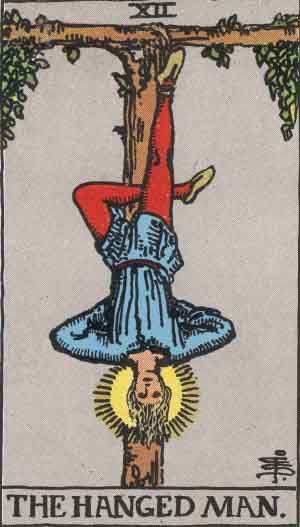
The Hanged Man hangs from a living tree by one foot, his other leg bent at the knee in a figure four, his arms held behind his back, and his face serene. In the Rider-Waite-Smith image used here, his hands are hidden; their freedom is a symbolic reading, not something the image visibly establishes. This is the detail that stops most people who look at this card for the first time: the face. He does not look tortured. He does not look afraid. He is not straining against the rope or looking desperately at the ground beneath him. He looks as though he has arrived somewhere, or perhaps as though arriving is no longer the point.
The nimbus of light around his head in the Rider-Waite-Smith image directs attention to his altered perspective. Something is illuminated. Something is being understood that was not visible from the upright position, from the ordinary orientation, from the right-way-up perspective that most experience is lived in. He is seeing the world inverted, and what he is seeing from that inverted angle is apparently worth the discomfort of the position. Or perhaps discomfort is not quite the right word. Suspension might be more accurate. He is suspended.
The first thing to understand about The Hanged Man is that suspension can become the field of inquiry. It may be chosen, imposed, or produced by circumstances that carry no inherent lesson and deserve practical response. The card does not romanticise preventable delay, illness, exclusion, or loss. Symbolically, it asks what becomes visible in the interval between what was and what will be, when one foot has left familiar ground and a new way of standing has not yet formed. Some insight may require less control over outcome and timing, but surrender is not an obligation to abandon safety, treatment, boundaries, advocacy, or necessary action.
When this card repeats, one question is: what is the seeker not willing to surrender, and what might that reluctance be protecting?
In the image, the figure appears to hang voluntarily. His hands are free and his face is calm, which makes yielded attention central to the card’s symbolism. Real circumstances are not always voluntary, and a calm figure should not be used to judge how a person responds to pain, coercion, disability, grief, or uncertainty. When this card repeats, it may invite the Seeker to identify where deliberate non-forcing is possible within an imposed pause, or where chosen suspension has become avoidance. Completion is not guaranteed by surrender; the value lies in meeting the actual situation with less distortion.
Surrender is not the same as collapse. This distinction matters enormously when The Hanged Man appears repeatedly, because chosen stillness and diminished capacity may look similar from the outside. Both may involve a halt to striving. Both may interrupt the active forward pushing that characterises ordinary time. But collapse may reflect overwhelm or circumstances that have exhausted the seeker’s capacity, rather than an abandonment of understanding. Surrender, in The Hanged Man’s teaching, is an active state: the deliberate relinquishing of a demand for control in order to discover what becomes visible when that demand eases. The distinction concerns what support and choices are available, not which seeker is doing suspension correctly.
There are several distinct patterns this card tends to mark when it appears repeatedly.
The first is the strategic suspender: the seeker who is waiting deliberately for something they cannot yet control to resolve itself, and who is using this waiting as a reason to defer any action in the areas of their life they could in fact address. There is often a real external circumstance that is not yet resolved, a job decision that depends on someone else, a relationship that is in limbo, a practical situation that has not yet clarified. And there is a way in which this uncertainty has expanded to fill the entire life, so that the seeker is not just waiting on the external situation but is waiting generally, using the unresolved external thing as a reason not to take any action anywhere, including in areas where action would be possible and valuable.
The second pattern is the resistance expert: the seeker who is being asked to change something fundamental about how they are oriented, something about their worldview, their values, their professional direction, their relational patterns, or their sense of self, and who is resisting this change with considerable energy and sophistication. They are not refusing overtly; they are waiting for conditions to change, for the necessity to become clearer, for someone else to make it possible, for enough certainty to accumulate that the change feels safe. The Hanged Man appearing here is not asking them to leap into change without preparation; it is asking them to examine whether they have made certainty a precondition for every change. Some of the new perspective may emerge only through trying a different orientation, rather than waiting to know in advance exactly what it will reveal.
The third pattern is the unrecognised sacrificer: the seeker who is making significant sacrifices, of time, energy, identity, opportunity, or life direction, without being fully conscious of what they are sacrificing or why. They have organised their life around someone or something else’s needs, priorities, or wellbeing in ways that have suspended their own development, and they have described this suspension as virtuous without fully acknowledging its cost. The card repeating here is not telling them their care and dedication are wrong. It is asking them to be more conscious: to look directly at what has been suspended, to name it honestly, and to decide whether this is the sacrifice they intend to be making or whether the suspension has become habitual in a way that serves neither them nor the person or purpose they have organised themselves around.
The fourth pattern is the perspective-resistant seeker: the person who is in a situation that genuinely requires a complete reorientation of understanding, and who is doing everything in their capacity to find a way to maintain their existing framework while accommodating the new information. They are trying to fit the inverted world into the upright map. They are standing on their head while insisting they are right-side up. The card’s repetition here is patient and unrelenting: the new perspective calls for more than adding an exception to the old framework. The reorientation needs to reach the assumption that is no longer holding. Half-turned is not transformed.
The fifth and perhaps most psychologically rich pattern is the seeker who is afraid of stillness itself: the person whose ordinary mode of being is characterised by forward momentum, productivity, planning, and the doing of things, for whom the suspension of all of that is not experienced as illuminating but as terrifying. Not because of what might be discovered in the stillness, necessarily, but because the stillness itself feels like cessation, like death of the self that has been constituted around activity and forward movement. For this seeker, The Hanged Man’s repeated appearance brings the declined invitation to voluntary stillness into view: the consistent, unconscious preference for familiar motion. The card is marking not a single moment of needed pause but a sustained and fundamental invitation to discover who this seeker is when they are not moving.
Read symbolically as three times four, twelve brings together the trinity of creative process and the four elements of material reality. There is something about this card’s number that suggests the complete operation of creative surrender in the material world, the full cycle of letting go, waiting, and receiving the new orientation that could not be forced or planned. The initiation of The Hanged Man is not a shortcut; it is a full cycle of its own, and it takes as long as it takes.
For the seeker who keeps drawing this card, the central work is the development of what might be called sacred tolerance for suspension: the capacity to remain genuinely engaged with one’s own life and understanding while occupying the uncomfortable, disorienting, potentially illuminating space between what was and what will be. This is not passive. It can be one of the most demanding initiations in the Major Arcana, because it asks the seeker to be fully present in a state of radical uncertainty, to neither force the resolution nor abandon the engagement, to hang, deliberately and consciously where that remains a useful choice, while attending to what becomes visible from this inverted position. Its value must be judged in the seeker’s actual life; discomfort is not proof that the process is working.
When This Card Repeats Weekly
A week of Hanged Man repetition asks the seeker where a deliberate stop might help. The invitation is to genuinely pause a decision, a project, a relentless inner narrative, or a default habit of filling every available space with activity or planning, rather than slow down marginally or add a meditation practice to an already packed schedule.
The card appearing multiple times in a single week may mark resistance to a pause. The Seeker may sense that continued pressure is not producing clarity, yet stopping feels like losing, giving up, or failing to act responsibly. The card asks them to test whether a defined pause would be more responsive than another push. That does not mean doing nothing where safety, care, deadlines, legal duties, or material needs require action. It means separating necessary action from activity used mainly to escape uncertainty, and allowing some progress to be quiet, preparatory, or not yet visible.
A Hanged Man week can bring the temptation to leave a pause just as an unfamiliar perspective begins to emerge: the seeker senses a possible shift, yet its implications feel uncomfortable enough to provoke a return to familiar activity. The card does not establish how close a breakthrough is. The question for the week is whether staying with that particular discomfort would allow something to become clearer, rather than using action to avoid looking at it.
When This Card Repeats Monthly
A Hanged Man month suggests that the seeker is in a liminal period: a threshold time in which the previous chapter has ended and the new one has not yet taken shape, and the work of this particular month is to inhabit that threshold consciously rather than forcing a premature resolution.
Liminal periods are psychologically demanding in a culture that places a very high value on resolution, productivity, and visible forward movement. The seeker in a Hanged Man month may feel that they are failing simply by virtue of not being able to answer the question “what’s next?” with any confidence. The card repeating here is naming this period as a legitimate part of life, with qualities and possible insights easily missed in periods of active forward movement, and it is asking the seeker to engage with what is available in this suspension rather than spending the month in the agony of resistance to a phase they cannot yet exit.
A monthly Hanged Man pattern also often marks a seeker who is learning something genuinely new about how their life, their psyche, or their circumstances actually operate, and who is in the process of discovering that the new understanding requires a complete revision of how they have been approaching something. The month of cards is the month of learning to see upside down: to look at a significant situation from a perspective so fundamentally different from their habitual one that the familiar features of the situation are rendered strange and new and finally able to be re-examined.
When This Card Repeats Seasonally
A season of Hanged Man energy can mark a significant developmental period: a sustained encounter with surrender that may rearrange something fundamental about how the seeker is oriented to their own life.
Hanged Man seasons may coincide with circumstances that enforce a pause the Seeker would not have chosen: illness, injury, job loss, changed personal circumstances, grief, or a creative block that might also become a threshold. None of these experiences is valuable merely because it interrupts momentum, and the person affected has no duty to turn suffering into insight. The seasonal question is gentler: alongside treatment, support, problem-solving, or mourning, is there anything the altered pace reveals about needs, limits, priorities, or perspective? Adaptation can coexist with a legitimate wish for conditions to improve.
What a Hanged Man season can offer is a shift in perspective that comes through lived experience rather than intellectual effort alone. Having been held in suspension, having had to remain still while the world moved around them, the seeker may discover what sustains them when familiar activities, identities, and forward movements are unavailable. This kind of understanding is not simply a decision to think differently; it develops through meeting the actual conditions of the pause. The season is the experience. Whether that experience yields insight or mainly calls for care and adaptation cannot be decided in advance.
When This Card Repeats Across Years
The Hanged Man appearing across years can mark a seeker whose recurring life themes involve the repeated and deepening encounter with the initiatory power of surrender, and whose development is substantially shaped by what they learn in the suspended places of their life.
These seekers often have an unusual relationship with time: they have spent significant portions of their life in periods that others might describe as stuck, fallow, unproductive, or waiting, and they have discovered, often slowly and sometimes painfully, that these periods are not the empty spaces between the real events of their life but in many cases the most formative spaces within it. The suspended period before the next relationship, the months of creative paralysis before the significant work, the long season of professional uncertainty before the genuine vocation became visible: each of these may, in retrospect, have allowed something to develop that the forward-moving periods left little room for.
Across years, The Hanged Man tends to belong to seekers who are engaged in unconventional paths: paths that require sustained tolerance for uncertainty, for periods without visible markers of progress, for the development of a relationship with their own inner process that is patient enough to allow genuine emergence rather than forced construction. The artist who cannot rush the work. The healer who must wait for the understanding. The teacher whose own experience needs long digestion before it can be offered to others. The contemplative whose work is the deepening of their capacity to be present in uncertainty. All of these are, in their different forms, Hanged Man vocations.
The growth arc this card can trace across years is from reluctant suspension to voluntary surrender to what might be called sovereign stillness: the seeker who has learned, through repeated initiatory encounters with the suspended state, to inhabit it with genuine presence and even with something approaching appreciation for what it offers. They have discovered that the perspective available from the inverted position has its own value, that stopping the ordinary momentum can reveal what it had obscured, and that the understanding they carry from having lived through the suspended places of their life is among the most valuable things they have to offer.
Life Area Interpretations
Love & Relationships
In love and relationships, The Hanged Man’s repetition most frequently marks the seeker who is suspended between two relational realities and has not yet found the courage or clarity to commit to either.
The most common version of this is the seeker who is in a relationship that is in limbo: not clearly over but not clearly alive; not actively chosen but not honestly released; sustained by habit, fear, obligation, or the genuine affection of a long history rather than by a present decision. The card appearing repeatedly in this relational context is not prescribing an ending. It is asking the seeker to stop pretending the limbo is a settled state. The suspension is real, and engaging with it means honestly examining what remains and what has been lost. That examination can help make either wholehearted recommitment or an acknowledged ending possible.
For the single seeker, The Hanged Man’s repetition often marks a period of relational waiting that may have outlasted its usefulness: the seeker who is waiting for the right person, for the right circumstances, for the resolution of some other life area before they open themselves to partnership, and who has been waiting for long enough that the waiting has become its own relational identity. The card here is not telling them to stop being selective or to accept less than genuine connection. It is asking them whether the waiting is discerning or whether it has become a way of remaining safely suspended, with the risks and gifts of intimacy indefinitely deferred despite a wish for connection.
The Hanged Man in relationships also frequently marks the seeker whose primary relational mode is self-sacrifice in ways that have suspended their own development. They have made themselves small, patient, endlessly accommodating in their significant relationships, and they are discovering, often after a long time, that this accommodation has a cost that they are now paying. The suspension is the cost: the delayed development, the unexpressed needs, the life direction that has been in abeyance while they oriented around someone else’s. The card is asking the seeker to examine what has been sacrificed, whether the sacrifice was consciously chosen and worth its cost, and what expressing their own needs and direction would require.
Career & Purpose
In career and purpose, The Hanged Man’s repetition most often marks a seeker who is in a professionally suspended state: a pause that may be necessary and being resisted, or one that has outlasted its usefulness and is being rationalised as necessary. External barriers can also prolong the interval, whatever the seeker’s attitude towards it.
The genuinely necessary suspension is the period between professional identities: after a significant chapter has ended, before the next one has taken shape, when the seeker is in the fallow territory of vocational discernment. This is the period that career culture tends to treat as failure or stagnation, but which is often a formative professional period, because it is in this suspension that vocational clarity can emerge. What cannot be rushed: the recognition of what actually matters, the honest acknowledgement of what the previous chapter was and was not, the quiet deepening of understanding that can gradually produce a sense of direction. The card appearing here is naming this period as legitimate and asking the seeker to stop forcing a resolution before that understanding has had time to develop.
In an unnecessarily prolonged suspension, the seeker has been in professional limbo for longer than is generative. They have a feasible next step available but are finding reasons not to take it, using the vocabulary of discernment and waiting to sustain an avoidance of the risk that the next step would require. The card repeating here is asking the seeker to be honest about which kind of suspension they are in: the necessary and generative kind, or the kind that has outlasted its usefulness.
Purpose and The Hanged Man have a particular and important relationship: many seekers whose life purpose involves serving others, contributing to something larger than themselves, or working in domains that require a fundamental orientation away from ordinary achievement metrics may find that their vocational path includes extended periods of what looks like failure, waiting, or going backward. The Hanged Man across a career context is often naming exactly this: the path that goes through the suspended places, through the experiences that cannot be accelerated or managed, toward an understanding and a form of service shaped by the particular knowledge gathered during the suspension.
Money & Stability
The Hanged Man’s relationship to money is consistently uncomfortable for the seeker whose stability depends on forward momentum and the reliable delivery of visible results.
The card appearing repeatedly in financial contexts often marks a period of suspension: unstable income, circumstances in transition, a professional change whose implications have not settled, or a renegotiation of money and material security whose outcome is unclear. The discomfort and risk of this period are real. The card asks the Seeker to remain engaged with what can be assessed, documented, planned, or supported rather than forcing artificial stability through unsustainable decisions or treating uncertainty as proof that nothing can improve. Engagement can widen options, but it cannot guarantee an outcome or erase structural constraints, so qualified financial, legal, employment, or benefits advice may be part of the response.
A significant Hanged Man financial pattern is the seeker who has organised their entire professional and daily life around the achievement of a particular level of material stability and who is discovering that this stability does not, when achieved, deliver the sense of security they anticipated. The suspension here is internal: a fundamental rethinking of the relationship between material security and genuine wellbeing, an honest examination of what they have sacrificed in pursuit of financial certainty and whether the exchange was worth it. This is a destabilising reconsideration, and the card appearing repeatedly is both confirming the importance of the inquiry and asking the seeker to follow it through rather than returning to the familiar financial orientation before the reorientation is complete.
Spiritual Growth
Spiritually, The Hanged Man is perhaps the most initiatory card in the entire Major Arcana: it is the card of the willing sacrifice, the deliberate descent, the voluntary relinquishing of what one has known in service of encountering something difficult to recognise from the familiar position.
As a symbolic pattern of spiritual initiation, the figure who hangs voluntarily enters uncertainty by choice and releases the ordinary orientation in search of a wider understanding. The seeker may not know in advance what that change of view will reveal. The invitation is to allow room for discovery without requiring a complete explanation first, while retaining the discernment to ask what is being surrendered, to whom, and at what cost.
The Hanged Man’s spiritual challenge, when the card repeats, often concerns the seeker’s relationship to control in spiritual matters. They may have developed a spiritual practice that they have some sense of mastery over, and they are being asked to release that mastery into genuine not-knowing. They may have beliefs about the nature of the spiritual dimension of life that are being genuinely challenged, and they are holding those beliefs with greater tenacity than genuine spiritual inquiry allows. They may be in a period of spiritual drought, of apparent disconnection from the source or sense or practice that has sustained them, and they are trying to solve this drought through effort when the invitation may be to remain with the question rather than force an answer.
The Hanged Man’s spiritual gift is the development of genuine spiritual humility: not performative humility, self-effacement, or an intellectual claim to uncertainty, but the willingness to be taught and reoriented, and to discover that previous knowledge was partial. The suspended perspective is one symbolic route to this humility, not the only route, and no hardship is required as spiritual proof. The card repeating asks what the current pause can teach that ordinary momentum has obscured, while leaving room for the answer to be modest, practical, or simply not yet known.
Emotional & Mental Patterns
In the emotional and mental domain, The Hanged Man’s persistent appearance tends to mark a seeker who is in a significant and unresolved relationship with their own uncertainty, and whose ordinary mode of managing this uncertainty, through planning, analysis, doing, and forward movement, is not available in the present circumstances.
The emotional texture of the Hanged Man pattern is distinctive: it tends to feel like a combination of restlessness and numbness, activity and inertia, urgent wanting to do something and the sustained experience of being unable to identify what the something should be. The seeker may be doing a great deal, externally, while feeling internally suspended: carrying on with the ordinary tasks and commitments while a deeper level of the self remains unresolved, waiting, not yet oriented.
Mentally, the Hanged Man seeker who has not yet found a new orientation is often characterised by circular thinking: returning to the same questions repeatedly without arriving at new understanding, cycling through familiar analyses of unfamiliar situations without reaching resolution. This circularity is not a failure of intelligence; it may mean that the familiar analytical approach has reached its limit. The Hanged Man’s invitation is to try thinking differently rather than simply thinking harder, by approaching the question from the inverted angle, and often by setting analysis aside long enough for feeling, observation, or a fresh association to become available.
The emotional work the card is often asking for is the permission to not know: to genuinely rest in the experience of not having an answer, not having a plan, not being able to predict or control the outcome of a significant situation, and to discover that genuine emotional presence is possible even in this condition. The seeker who is afraid of not knowing often finds that the feared state, when genuinely inhabited rather than resisted, is more manageable than their anxiety about it suggested. The Hanged Man’s emotional gift can be the discovery that a sense of self is possible without immediate certainty. In the suspended place, the seeker may recognise values, needs, or relationships that remain available even while their familiar answers have been lost.
Family & Generational Dynamics
The Hanged Man in family and generational contexts often marks the seeker who has been positioned, within the family system, as the one who waits: the one who adjusts, accommodates, defers to others’ needs, timelines, and priorities; the one whose own development has been in suspension while the family’s needs were attended to.
This role can be loving and appropriate for periods of time. What The Hanged Man’s repeated presence is examining is whether the suspension has extended past those periods, whether the accommodation has become so habitual that it no longer corresponds to genuine choice, and whether the seeker has a clear sense of what their own life requires that is distinct from what the family’s maintenance requires.
In families that model self-sacrifice as the primary expression of love, the Hanged Man seeker may have internalised the suspension so completely that they have very little access to what their own development and direction would look like independent of the family’s structure. The card appearing repeatedly in this context is not suggesting that family obligations are unimportant. It is asking the seeker to develop, alongside their genuine care for the people they love, an honest relationship with the question of what they are doing with their own life and whether the perpetual suspension of that question is genuinely serving anyone.
Generationally, The Hanged Man often marks the seeker who is the first in their family line to pause the inherited forward momentum and examine whether the direction the family has been moving is the right one. The willingness to hang, to stop going in the familiar direction long enough to discover whether a different direction is possible, is itself a profound act of generational courage, and it is rarely comfortable and rarely immediately understood by the family members who are still moving.
Health & Energy
In health and energy readings, The Hanged Man may symbolically mirror fatigue, reduced capacity, or the frustration of a body that cannot maintain its usual pace. These experiences are not a distinctive tarot signature, and fatigue that persists or does not respond to rest can have many physical, psychological, environmental, or medication-related causes that deserve qualified assessment.
Sustained overexertion, inadequate recovery, and the stress of resisting changed capacity can contribute to depletion, but the card cannot identify a mechanism or assign symptoms to the immune, endocrine, or nervous systems. Its useful question is whether the Seeker is repeatedly exceeding current limits, and whether pacing, accommodation, support, or clinical care might reduce avoidable strain. Rest and acceptance may help some situations; in others, active investigation, rehabilitation, advocacy, or urgent treatment is needed. Symbolic reflection should not decide between them.
The card’s health invitation is to honour periods of lower capacity without shame and to notice whether marginal slowing is being offered where genuine recovery time is possible and appropriate. The body is not an infallible oracle, yet changes in pain, fatigue, sleep, appetite, mobility, mood, or function are information worth recording and discussing with a qualified professional. Listening means neither pushing through every signal nor interpreting every signal symbolically. It means responding proportionately, including seeking timely care when symptoms are severe, sudden, persistent, or concerning.
When a necessary pause is met with less self-judgement and a realistic plan, some Seekers may experience greater ease or more effective restoration. Others may remain unwell, depleted, or distressed despite exemplary acceptance. The card does not make recovery conditional on attitude. Its contribution is to separate the additional strain of self-criticism from the underlying condition and to support a more compassionate relationship with rest, care, pacing, and uncertainty.
Advanced Interpretive Sections
The Shadow Expression
The Hanged Man in shadow produces one of the more seductive and more difficult to recognise patterns in the Major Arcana, because the shadow state looks so much like the genuine initiation.
In shadow, the seeker has adopted the posture of suspension without the internal engagement that might make it transformative. They are waiting, apparently, but not open to what the waiting might reveal. They are suspended, apparently, but unwilling to question the familiar view. They have found, in the vocabulary of spiritual surrender and necessary pause, a sophisticated justification for avoidance: no new perspective is allowed to disturb the comfort of not acting. The figure hangs, but their eyes are closed to what the altered position could show.
This shadow often presents as a form of spiritual bypassing: using the language of trust, of divine timing, of releasing control, to avoid the internal work that the suspended period requires. The seeker in this position has learned to describe their avoidance in elevated terms, and the elevated terms make it difficult for them or anyone else to see clearly what is actually happening.
A second shadow is the Seeker who has become overwhelmed within the suspension and feels unable to move in any direction. This is not a moral or spiritual failure, and it may reflect depression, trauma, burnout, illness, material constraint, or circumstances the card cannot diagnose. The symbolic distinction is between a pause that retains some contact with choice and a state in which capacity and hope are contracting. When functioning, safety, or connection is deteriorating, the appropriate response is not deeper surrender but practical and professional support, including urgent help if there is risk of harm.
The Integrated Expression
The integrated Hanged Man Seeker has developed a grounded capacity to remain present in uncertainty without pretending that uncertainty is easy or inherently meaningful. They can pause before forcing a conclusion, recognise what is beyond their control, and preserve attention for the choices that remain available.
In its integrated form, the Hanged Man describes the person who has a genuine relationship with not-knowing: who can inhabit uncertainty without requiring its immediate resolution, who can remain open and engaged in the suspended place rather than fighting it, and who has discovered what becomes visible from the inverted position often enough that they can remain open to its possibilities even when it does not initially feel generative.
The integrated Hanged Man seeker has a distinctive quality: a kind of grounded spaciousness that can help them support people who are in crisis, in transition, or in the terrifying middle of a significant change. They know how to be with what is not yet resolved. They can hold genuine uncertainty without filling it with premature conclusions. They can wait with someone, genuinely wait, without anxiously rushing them toward a resolution that would serve the witness’s discomfort more than the other person’s process.
They may also discover that identity is larger than the role, plan, or certainty temporarily relinquished. Suspension can reveal capacities, values, relationships, and limits that were obscured by momentum. This does not mean every loss leaves the self intact or improved. Significant endings can change a person permanently. The integrated expression is the willingness to meet that change without reducing the whole self to what has been interrupted.
Why This Energy Has Not Released Yet
The Hanged Man’s pattern may remain unresolved when the seeker is still fighting the suspension rather than inhabiting it, or when they have found ways to perform the suspension without genuinely experiencing it.
The most common form of this is the seeker who is in genuine liminal territory but who is spending most of their energy trying to force their way out of it rather than discovering what it genuinely offers. They are doing everything possible to accelerate the resolution of the uncertain situation, to force clarity where it is not yet available, to make a decision they are not yet equipped to make because the understanding the suspension is building toward has not yet arrived. Read in this way, the card asks whether a still-useful pause is being resisted. Its recurrence cannot establish that a delay is necessary or that the seeker caused it.
The pattern can also remain unresolved when the seeker has confused surrender with passivity. The Hanged Man’s surrender is active: a deliberate choice to remain present in uncertainty, to engage with what the inverted position reveals, and to maintain attention rather than simply stopping. Where the capacity for choice remains, waiting can become a way of avoiding that engagement. Where overwhelm has narrowed capacity, the response may instead be support that makes some choice possible again. The distinction is between attention, avoidance, and diminished capacity, not between successful and failed initiations.
It may also persist when there is a specific thing the Seeker is unwilling or not yet ready to release: a belief, relationship, professional identity, worldview, emotional position, grievance, or hope. Repetition does not prove that relinquishment is required. It asks the Seeker to name the attachment, examine what it protects and costs, and distinguish a value worth keeping from a grip that prevents new information entering. No symbolic invitation overrides consent, safety, legal rights, treatment, or material responsibility.
What This Card Wants the Seeker to Understand
The Hanged Man wants the seeker to understand that the suspended state they are in is not a failure. It is not a punishment. It is not evidence that they have done something wrong or are being delayed from the life they are supposed to have. Within the card’s symbolism, suspension can be an initiation in its own right, rather than merely an interruption before life resumes. Whether that language fits the seeker’s experience remains theirs to judge.
It wants them to understand that the new perspective this card invites may require more than effort, analysis, or the accumulation of information within an unchanged framework. It involves surrender to the inverted position: a willingness to see the situation, the relationship, the professional circumstance, or the question of their own identity from a completely different angle, even when that angle is deeply disorienting.
The card asks whether what the Seeker is most reluctant to surrender is central to the current suspension, while refusing to assume that it must be surrendered. Reluctance may signal identity, love, responsibility, fear, trauma, practical necessity, or an important boundary. The inquiry is to understand the grip precisely and, where safe, to experiment with loosening certainty rather than abandoning the person, commitment, treatment, or protection itself. The deeper invitation is to discover what remains available when one familiar orientation is held less rigidly, even temporarily.
Finally, the card wants the seeker to consider that time in the suspended place need not be lost time. Some understanding develops slowly: through sustained presence with a question, through the patient inhabiting of not-yet-knowing, through discovering what becomes visible when the familiar orientation is released. This does not erase the opportunities, security, or ease a delay may have cost. It allows what has been learned to matter without requiring the seeker to believe that every loss was necessary or that the time could not have been used differently.
Signs the Pattern Is Beginning to Resolve
The Hanged Man’s pattern begins to resolve when the seeker notices a genuine shift in their relationship to the uncertainty they have been carrying: when it begins to feel less like imprisonment and more like spaciousness, less like being stuck and more like being present in an unfinished process. The outer circumstances may still be unchanged.
It resolves when they can report, honestly, that they have stopped trying to force the situation in a particular direction and have genuinely opened to discovering where it is actually going. This is not resignation; it is a different quality of engagement, one that asks for sustained presence and tolerance for the unexpected in place of the controlled forward push.
It resolves when something new becomes visible, when the inverted perspective genuinely produces new information, new understanding, new possibility that was not available from the upright position. This is often a quiet moment rather than a dramatic one: a sudden clarity about why something has not been working, a recognition of a pattern that had been invisible before the suspension, a new direction that becomes apparent only because the forward momentum that had been concealing it has stopped.
Another sign of integration is the seeker’s ability to speak about the suspended period, or the suspended quality of their current life, with something other than frustration or defensiveness: when they can acknowledge something that developed during this time, even if it is not yet fully understood, alongside honest grief or anger about what the pause cost. They do not have to decide that the gain outweighed the loss.
And a further sign of resolution is that the seeker finds themselves ready to come down from the tree: not because the uncertainty has been resolved externally, but because they have arrived at an internal orientation that makes it possible to engage with the unresolved situation from a new place. The halo is fully formed. The understanding is embodied. In this symbolic image, the figure stands upright again and meets the world differently because their way of seeing has changed. Readiness may arrive gradually, and resuming action need not wait for complete understanding.
Reflective Questions
-
What are you currently waiting for, and how long have you been waiting for it? Is the waiting genuinely necessary, or has it become a way of remaining in a safe suspension while the world moves around you?
-
What would you have to genuinely release, what belief, what identity, what relationship, what certainty, if the suspended state you are in is asking for a real surrender rather than a temporary pause?
-
Is there a specific thing you are most unwilling to see from an inverted angle, a situation or belief that you are most resistant to re-examining? What is it, and why does it feel so important to maintain the current view?
-
Think about the periods in your life that have felt most fallow, most suspended, most unproductive by ordinary measures. What, in retrospect, was genuinely happening in those periods? What did you discover, or become, that you could not have forced?
-
What does the difference feel like, in your body and your interior, between a suspension that is genuinely generative and one that has become avoidance? Can you identify which kind you are currently in?
-
Who or what are you currently organising your life around in ways that have placed your own development in suspension? Is this genuinely your chosen sacrifice, or has the accommodation become habitual past the point of conscious choice?
-
If you genuinely stopped trying to control the outcome of the uncertain situation you are carrying, what would you discover? What are you afraid would happen if you genuinely released the effort to manage it?
-
The Hanged Man’s face is peaceful. What would have to shift in your relationship to your current circumstances for genuine peace, not resignation but genuine equanimity, to be possible while the uncertainty remains?
-
What is the perspective you cannot yet see because you are too close to the situation, because you are seeing it from the ordinary upright angle? What would looking at it completely differently reveal?
-
When you imagine the version of yourself who has genuinely come through this suspended period, who has stayed in the uncertainty long enough to discover what it was offering, what are they able to see or offer or be that the current you cannot?
Practical Integration Actions
Create genuine fallow space. Identify one area of your life where you have been relentlessly maintaining forward momentum and where a pause would not compromise safety, care, essential income, or a deadline. Deliberately stop that momentum for a defined period, even a single week. Not by abandoning the area, but by releasing the push and simply being present with what is there without the pressure to advance it. Notice what becomes visible in the stillness that was invisible in the motion.
Name what you are not surrendering. Sit with the question: what is the specific thing you are most unwilling to release in the current situation? Write it down without justification. This is not about determining whether you should release it; it is about getting genuinely honest about what the attachment is. Once named clearly, the question of whether to hold or release becomes possible in a way it is not while the attachment remains unconscious.
Practise tolerating the not-knowing. Choose one non-urgent question in your life that does not currently have a clear answer and practise, deliberately and repeatedly, not answering it. When the mind offers an answer, notice it and release it. When manageable anxiety arises about the unresolved question, notice it without immediately resolving it through action or analysis; if the exercise becomes overwhelming, stop and seek support. This is a concrete training in the Hanged Man’s core capacity: the genuine tolerance of uncertainty.
Examine the involuntary suspensions of your past. Make a list of the periods in your life that felt most like stagnation, most like being stuck or waiting or unable to move forward. For each one, write a short description of what you can now see was happening: what, if anything, was building or being learned, what was lost, and what remains unresolved. Notice any understanding that time allowed to develop without assuming the pause had to happen. This practice can build a more discerning trust in the suspended state, including recognition of when a pause did and did not help.
Identify the self-sacrifice pattern. Write an honest account of what, in your current life, is in suspension because of your accommodation of someone or something else’s needs or priorities. Include in this account whether the accommodation is consciously chosen and proportionate, or whether it has become habitual and has extended past the point where it is serving anyone. This is not an exercise in blame or resentment; it is an exercise in clarity.
Explore the inverted view. Choose one significant situation in your life that you are currently struggling with and deliberately write about it from a perspective that is completely opposite to your usual one: from the other person’s perspective, from the perspective of someone who values what you have been dismissing, from the perspective of the version of yourself who made the opposite choice. This is not about determining who is right. It is a practice in developing the genuine flexibility of perspective the Hanged Man consistently invites.
Rest without justification. For one period each week, practise resting without any productivity goal: not resting to restore yourself for more doing, not resting because you have earned it, but resting simply because rest is part of genuine human engagement with life. Notice the resistance this practice encounters and what it is trying to tell you about your relationship to stillness and productivity.
Develop a relationship with liminal time. If you are in a genuinely transitional period, create a small ritual for acknowledging the threshold: a daily writing practice of five minutes that simply asks “what is present right now?”, a weekly walk with no destination, a regular practice of beginning the day without immediately reaching for plans or screens. Liminal periods can contain subtle information that is easily missed at the ordinary pace of life. These practices offer ways to notice it without making each quiet moment responsible for producing insight.