
Tarot interpretation tool

Repeating Card Meanings

Choose the tarot card that keeps appearing to explore what the pattern may be asking you to notice.

Choose a card

For full searchable reference pages, visit the repeating card pattern library.
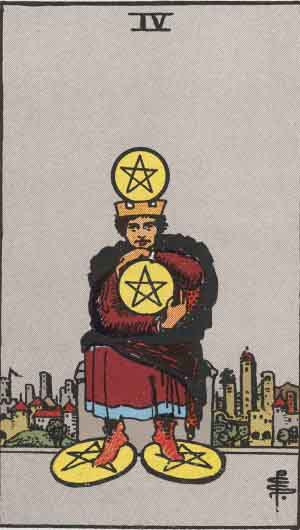
Four of Pentacles tarot card

Four of Pentacles

The Four of Pentacles repeats when a seeker's relationship to material security has become so tight that the holding itself is now the primary obstacle to genuine material development. The resources are real. The protection is genuine. What the card keeps marking is the seeker's characteristic pattern of gripping what has been accumulated so tightly that nothing can circulate, nothing can be invested, nothing can be received, and the material life stays exactly as it is because letting anything move feels indistinguishable from letting everything go.

The figure in this card has the pentacles. They are not in danger of losing them in this moment. The city behind them is evidence of what has been built. But the arms are wrapped around the pentacle at the chest, the feet are planted on two more, and the fourth is balanced on the crown of the head. Every available point of control is occupied. The question this card keeps returning with is not whether the seeker has something worth protecting. It is what the grip is costing them, and whether what is being held is still growing or has simply stopped.

Core Repeating Message

The Four of Pentacles shows a figure in a seated posture of deliberate holding: pentacles at the crown, the chest, and both feet, in a configuration that leaves no part of the figure free for movement or reception. The city in the background is established, real, evidence of genuine material development that has occurred. What the image presents now is not the building but the guarding: a specific posture of protective control that is characteristic of someone who has something and is afraid of losing it.

When this card appears once, it marks a specific moment of legitimate material protection: the seeker has built or accumulated something of genuine material value, and a certain quality of careful stewardship is genuinely warranted. When it appears repeatedly, it marks a seeker for whom this specific posture of protective holding has become the characteristic mode of material engagement: whose relationship to money, resources, or material security is characterised by a tightness that has stopped protecting and started preventing.

The most common pattern is the seeker who has developed a scarcity orientation as the operating frame of their material life: who experiences their material circumstances through the persistent lens of not having enough, of what could be lost, of what needs to be protected, even when the objective material picture does not warrant that specific quality of vigilance. The scarcity frame is not a simple cognitive error; it was usually learned in a context where scarcity was genuinely real, and the body internalised the protective posture as a survival necessity. What the card marks is the degree to which that learned protective posture is now operating in a material context that it no longer accurately describes, and the cost that the ongoing grip is producing.

A second pattern belongs to the seeker who cannot genuinely invest material resources in future-oriented directions because investment requires the release of what is currently held, and release feels like the beginning of loss. This seeker may objectively have sufficient resources to make a genuine investment in their own development or in a genuinely promising material direction, and may find that the specific act of releasing a portion of what is held toward a future that is not yet certain produces a quality of anxiety that is genuinely disproportionate to the actual material risk involved. The grip is tighter than the situation warrants, and the tightness is costing the seeker the specific material growth that genuine investment would produce.

A third pattern is the seeker who grips things other than money in the specific way the Four describes: who holds position, status, routine, or familiar material structures with the same characteristic tightness, who cannot allow a role to change, a routine to shift, or a familiar material arrangement to be restructured because any change to the established structure is experienced as threat rather than development. The Four of Pentacles in this pattern is marking not financial hoarding but the broader pattern of excessive material control that extends into the seeker’s relationship to change in any of its practical dimensions.

A fourth pattern belongs to the seeker who holds material resources genuinely and appropriately, but who is currently in a specific phase of material life that requires the release of the holding posture in order for the next phase of genuine material development to begin. The held resources are genuinely the seeker’s; the holding was genuinely appropriate in its time; and now the card is returning because the material life is asking for the release of something: a specific investment, a specific gift, a specific restructuring that the seeker knows would serve the material life’s development but that the grip keeps preventing.

What all these patterns share is a specific relationship between protection and circulation in the material domain: the understanding, usually accurate, that genuine material security requires some degree of protective holding, and the specific pattern in which that holding has tightened past the point of genuine protection into the point of genuine constraint, preventing the material circulation that allows genuine growth.


When This Card Repeats Weekly

A week of Four of Pentacles repetition is marking a specific immediate situation in which the seeker’s characteristic material grip is engaged: some material decision, opportunity, or practical reality is currently asking for a quality of release or investment or structural change, and the seeker’s characteristic posture of holding is meeting that invitation.

The card this week is asking the seeker to identify specifically what is being gripped and what the grip is costing in the immediate practical context. Not the general pattern but the specific form it is taking this week: what specific material resource, position, or arrangement is being held so tightly that it cannot genuinely develop or genuinely move?


When This Card Repeats Monthly

A month of Four of Pentacles repetition suggests that the seeker’s characteristic material tightness is consistently engaged across multiple practical contexts and is producing a visible pattern of material stasis: things are being maintained, but nothing is developing, because development requires the specific quality of material release and investment that the holding posture prevents.

The monthly lens asks the seeker to look across the past several weeks and identify: what material opportunities have appeared that were not taken because they required releasing some of what is currently held? What material conversations have been avoided because they might require restructuring something currently in the grip? What development is not occurring because the conditions required for it have not been allowed to form?


When This Card Repeats Seasonally

A season of Four of Pentacles energy marks a sustained period in which the seeker’s material life is significantly shaped by the tight holding posture, and the specific cost of that holding in terms of genuine material development is becoming visible and felt across the length of the season.

The most important question a genuine Four of Pentacles season raises is the question of what the grip is protecting against: what specific material loss or material destabilisation the tightness has been organised around preventing. Until this is genuinely examined, the grip continues at a level that does not accurately reflect the current material reality, because it is responding to the feared future loss rather than the actual present material conditions.


When This Card Repeats Across Years

The Four of Pentacles returning across years names a seeker for whom the tight material holding posture is a long-arc pattern shaped by a specific material history: who has, across multiple phases of their life, related to their material resources and material security through the specific lens of protective control, and for whom genuine material generosity, genuine material investment, or genuine material flexibility has consistently been more difficult than genuine material protection.

This long-arc pattern most often develops in seekers who experienced genuine material scarcity or genuine material instability in early life: whose bodies learned, correctly and necessarily in that original context, that material resources needed to be protected because they were genuinely insufficient and the consequences of insufficiency were genuinely difficult. The learning was accurate at the time and appropriate. The challenge across years is the gradual updating of the material body’s operating assumptions to reflect the actual current material reality rather than the remembered previous one.

The long-cycle Four also marks the seeker who has inherited a specific relationship to material holding from their family system: who carries a generational orientation toward material scarcity and material protection that was formed by the material history of people who came before them, and who has not yet developed their own genuinely assessed relationship to their current actual material conditions.

Across years, the growth arc this card traces is toward the development of genuine material wisdom: the capacity to hold material resources with genuine appropriate care and to release them with genuine appropriate generosity, in a relationship to material reality that accurately reflects the actual present conditions rather than the historically formed fear.


Life Area Interpretations

Love & Relationships

In love and relationships, the Four of Pentacles most often marks the seeker who brings the same characteristic tightness to relational material life that they bring to money: who holds space, time, emotional resource, and practical investment with a quality of protective control that prevents the genuine circulation that intimate relationship requires.

This might be the seeker who cannot genuinely give practical time, attention, or resource to a relationship without a quality of calculation or conditional holding that the other person can feel. Or the seeker whose relational difficulty is specifically about material practicalities: who controls the shared finances, who withholds practical generosity, who cannot allow the material dimensions of the relationship to be genuinely shared and genuinely flexible.

The relational Four also marks the seeker who clings to relational structures that are no longer genuinely nourishing because the familiar structure, however depleted, feels safer than the specific material and practical uncertainty of change.


Career & Purpose

In career and purpose, the Four of Pentacles marks the seeker who holds their vocational position, professional identity, or career structure with the same tightness that the figure holds the pentacles: who cannot risk the vocational change, the professional investment, or the career restructuring that would allow genuine further development because the current position, however constrained, is held and known.

This seeker may have genuine vocational potential in a direction that would require releasing the current structure in order to move toward, and may find that the specific material and professional security of the current position, however limiting, feels genuinely preferable to the material risk of genuine vocational movement. The Four keeps appearing in vocational contexts because genuine vocational development is requiring something that the holding posture cannot provide.


Money & Stability

In financial contexts, the Four of Pentacles is most directly its own specific meaning: the seeker whose characteristic financial behaviour is shaped by a tight holding orientation that prevents genuine financial circulation, genuine financial investment, and genuine financial generosity. Money is saved and protected in ways that are genuinely responsible but also genuinely constricting: the financial life does not grow, does not circulate, and does not genuinely serve the broader material life because the protective holding has become the primary financial activity.

The specific financial question this card asks is whether the seeker’s current financial holding is serving genuine long-term security or whether it has become a form of material anxiety management that is using the financial domain as its primary expression.


Spiritual Growth

In spiritual growth, the Four of Pentacles marks the seeker whose spiritual life has developed a specific characteristic of protective holding: who holds their spiritual practices, beliefs, and understandings with a tightness that prevents genuine development. Spiritual development requires genuine willingness to allow current understanding to be genuinely changed by genuine experience; the Four in spiritual contexts marks the seeker who is holding the current spiritual framework so tightly that new experience cannot genuinely penetrate it.

This seeker is not spiritually dishonest; they genuinely hold what they hold. But the holding has become so tight that the specific quality of genuine spiritual openness, the willingness to be genuinely changed by genuine encounter with the sacred, is not available within the grip.


Emotional & Mental Patterns

The Four of Pentacles in emotional and mental patterns marks the seeker whose characteristic relationship to their own emotional and material resources involves a specific quality of anxious accounting: who monitors material levels with persistent vigilance, who experiences any diminishment of material or emotional resource as potentially threatening, and whose inner life is significantly shaped by the ongoing effort of maintaining what is held at a sufficient level.

The mental texture of this pattern is specific: a background quality of material watchfulness, a chronic orientation toward what could go wrong in the practical domain, a persistent low-level anxiety about sufficiency that does not resolve even when material circumstances are objectively stable. The holding posture is not only physical or financial; it is a characteristic mode of inner engagement with material reality.


Family & Generational Dynamics

In family dynamics, the Four of Pentacles most often marks the seeker who has directly inherited a specific family orientation toward material holding and material scarcity. Families whose material history included genuine deprivation, significant loss, or material instability across multiple generations tend to develop specific cultural and psychological orientations toward material resources that persist even when the material circumstances have genuinely changed.

The inherited material orientation may be explicit, a family culture of explicit frugality, material caution, and the specific moral valuation of holding over spending, or it may be implicit, a quality of material anxiety in the household that the seeker absorbed without ever being directly taught. Either way, the seeker is often not responding to their own current material reality but to the material reality their family carried, and which was transmitted through the specific texture of material life in the household.


Health & Energy

The Four of Pentacles in health contexts points to the specific physical quality of sustained protective holding: the body that chronically holds tension, that does not genuinely release, that experiences letting go, whether of breath, of muscle tension, or of the effortful management of physical energy, as genuinely threatening rather than as restoration.

This seeker’s body often carries the physical signature of chronic constriction: tight chest, shallow breath, shoulders held, jaw set. The body is performing, at the physical level, the same protective holding that the Four describes in the material domain. The physical holding and the material holding are often the same pattern expressed in different registers, and work on either tends to produce movement in the other.


Advanced Interpretive Sections

The Shadow Expression

The Four of Pentacles in shadow produces the seeker who has become so organised around material protection that the accumulation of what is held has become the primary definition of material success and the primary source of felt safety. The specific quality of material life that genuine circulation produces, the generosity, the investment, the genuine exchange, has become unavailable not from conscious choice but from the depth at which the grip has become habitual. The seeker is not choosing to hold; the holding is simply what material life is.


The Integrated Expression

The integrated Four of Pentacles seeker has developed genuine material wisdom: the capacity to hold material resources with appropriate care and discernment, to invest with genuine intelligent generosity, and to distinguish between the holding that genuinely serves long-term security and the holding that serves primarily the management of material anxiety. They have genuine material security, not as an achievement of maximum accumulation, but as an internal relationship to material reality that does not require perpetual protective vigilance to feel safe.


Why This Energy Has Not Released Yet

The Four of Pentacles pattern does not release when the seeker has not yet genuinely updated their body’s operating assumptions about material reality: when the protective posture continues to respond to a remembered material insecurity that is no longer an accurate description of the current material conditions. Until the body has had sufficient genuine experience of material adequacy to begin to trust that the current conditions are genuinely different from the original conditions that produced the grip, the protective holding continues regardless of the objective material picture.

The pattern also does not release when the seeker has not yet genuinely examined the relationship between material holding and emotional safety: when the grip is serving a psychological function that the seeker has not yet found another way to provide.


What This Card Wants the Seeker to Understand

The Four of Pentacles wants the seeker to understand that the city in the background of this image was built through the specific combination of holding what matters and investing what is ready to grow. Security is not the same as maximum accumulation; it is the capacity to hold what genuinely needs holding and release what genuinely needs to move.

The seeker who holds everything with the same tightness does not have greater security than the seeker who holds wisely and releases wisely. They have a different kind of insecurity: the specific insecurity of material stasis, of a material life that is protected but not growing, that is held but not inhabited.


Signs the Pattern Is Beginning to Resolve

The Four of Pentacles pattern begins to resolve when the seeker makes a specific, deliberate, genuine act of material release: not a dramatic gesture but a specific real one, the investment, the contribution, the financial decision made with genuine generosity toward the future rather than with the protective reflex toward what is currently held.

It also resolves when the seeker begins to notice the specific difference in their body between the experience of holding and the experience of genuine material circulation: the specific quality of aliveness that genuine material generosity and genuine material investment produces, which is genuinely distinct from the specific quality of security that the holding posture provides.


Reflective Questions

  1. What specifically are you holding most tightly in your material life right now? Is it money, position, routine, structure, or something else? And what is the specific quality of fear beneath the grip?

  2. Is there a genuine material investment, genuine financial commitment, or genuine practical restructuring that you know would serve your material development and have been consistently unable to make because the grip prevents it? What specifically would that investment require you to release?

  3. What is the minimum material holding that would genuinely produce genuine material security for you? Is your current holding level significantly above that minimum, and if so, what is the excess holding serving?

  4. Can you trace the specific origin of your material tightness? Was there a specific period or specific experience when the grip became this tight, or was the orientation toward material protection something you absorbed more gradually over time?

  5. What does your body do when you consider releasing a portion of what is materially held? What is the specific physical quality of that experience, and where in the body do you most reliably feel the grip?

  6. What did your family system communicate, through practice and atmosphere, about the appropriate relationship to material resources? Was holding celebrated, giving treated with suspicion, or was genuine material generosity genuinely modelled?

  7. Is there a specific material domain in your current life where the holding is clearly no longer serving genuine security but has become primarily the management of material anxiety? What would genuine security in that domain actually look like if you were building it from scratch rather than defending what already exists?

  8. Have you experienced genuine material generosity, either as giver or receiver? What was the quality of that experience, and what did it produce in the relationship between the people involved?

  9. What would you do with your material resources if you were not afraid of losing them? Not as a fantasy exercise but as genuine practical information about what your material life genuinely wants to produce if the grip were genuinely relaxed?

  10. If the Four of Pentacles has been appearing for a sustained period, what specifically has it been marking as the material release that would allow genuine material development? What is the one specific act of genuine material investment or genuine material generosity that the pattern has been consistently preventing?


Practical Integration Actions

Name the grip honestly. Write specifically about what you are currently holding most tightly in the material domain: the exact resource, the exact amount, the exact structure, the exact arrangement. Write about what specifically you fear would happen if it were released, in as much concrete detail as you can. The exercise is not to diminish the fear but to see it clearly enough to assess whether it is responding to the current material reality or to a remembered one.

Make one act of deliberate release. Identify the smallest specific material release that would genuinely serve your material development rather than primarily your material anxiety management, and make that specific release before this month ends. Not the dramatic gesture but the real one: the investment, the contribution, the financial restructuring, the practical flexibility. Notice the specific quality of your body’s response both before and after the release.

Examine the scarcity frame. For one week, keep a simple record of the moments when a scarcity orientation shapes your material thinking or material behaviour: when the lens of not-enough, of potential loss, or of the need for protection shapes a practical decision. The exercise is not to judge the orientation but to make it visible as a pattern that is operating consistently and to assess whether it accurately reflects the current material reality.

Update the security assessment. Write a genuinely honest assessment of your current material security: what you have, what it provides, what genuine risks exist, and what level of holding genuinely serves the actual current material conditions. Compare this honest assessment with the level of holding that is currently in place, and notice where the holding significantly exceeds what the genuine security assessment would warrant.

Practise one genuine material generosity. Identify one person, project, or cause that you genuinely want to support materially and make a specific genuine material contribution to it this month: not a token gesture but a real one, at a level that genuinely costs something. Notice what the experience of genuine material generosity produces in your body and in your sense of your own material life, and use that experience as data about the relationship between giving and genuine material wellbeing.

About repeating card patterns

When the same tarot card continues appearing across readings, the repetition often points toward something unresolved, unintegrated, re-emerging, or still unfolding beneath the surface of events.

This tool explores what recurring cards may be attempting to stabilise across time: across days, seasons, relationships, transitions, emotional cycles, and longer life patterns.

Rather than treating repeated cards as isolated meanings, the readings examine:

  • what continues returning into awareness
  • where pressure, timing, avoidance, or unfinished movement may exist
  • how the meaning of repetition shifts as the Seeker's circumstances and relationship to the pattern evolve

There is no draw here. The interpretation unfolds from the card already present in your life.

Created by Leigh Spencer for Tides of Knowing, drawing on 40+ years of tarot practice, symbolic interpretation, and The COMPASS MethodTM.

Back to Tarot tools

Stay close to the work

Get new articles and early access

This work develops over time. Join the list to stay close to it.

Join the list →