
Tarot interpretation tool

Repeating Card Meanings

Choose the tarot card that keeps appearing to explore what the pattern may be asking you to notice.

Choose a card

For full searchable reference pages, visit the repeating card pattern library.
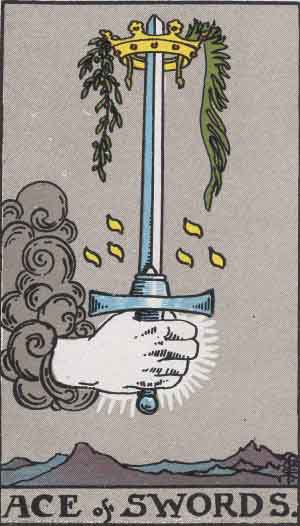
Ace of Swords tarot card

Ace of Swords

The Ace of Swords repeats when a truth, insight, or decision has formed with genuine clarity and has not yet been spoken, acted upon, or fully integrated. The sword is present. The seeker's pattern of deferring the cut, circling the decision, understanding without articulating, or processing without completing, is what the card keeps marking. Its return is not a demand for dramatic confrontation; it is a patient insistence that what has become genuinely clear deserves genuine expression.

A sword does not become less true by remaining undrawn. The question this card keeps returning to ask is not whether the seeker has found clarity, but what they are still doing instead of speaking it.

Core Repeating Message

The Ace of Swords shows a hand emerging from a cloud, grasping an upright sword whose tip is crowned. From the crown hang branches of olive and palm: peace and victory, the twin consequences of genuine truth applied at the right moment in the right direction. The sword is double-edged, always. What cuts through also carries risk; what clarifies also changes the shape of what follows. The image is entirely directional, entirely committed. Nothing in the hand’s posture is uncertain. The sword is held, and it is held upright.

When this card appears once, it marks the arrival of genuine clarity: a thought formed with real precision, a truth perceived without distortion, a decision that has become genuinely available, an insight that could, if followed through, cut cleanly through what has been clouded. When it appears repeatedly, it is marking a seeker whose characteristic relationship to this kind of clarity is not the act of using it but the act of holding it suspended.

The sword is there. The question the card keeps returning with is: what is happening between the forming of the clarity and its expression?

The most common pattern is the seeker who perceives truth clearly and consistently does not speak it. This is not always the simple cowardice it is sometimes described as. The unsaid truth is often the result of something more psychologically specific: a genuine understanding that saying the true thing will alter the situation permanently, combined with a genuine reluctance to be the agent of that alteration. The seeker knows what they know. The blade has formed. And something keeps the sword raised but not yet moved, because moving it would mean that what was true in private has become true in the world, and truth in the world is not reversible the way truth held privately is.

A second pattern is the seeker whose mental engagement with clarity never quite completes into action. The thinking is extensive, genuinely so: the problem has been turned over from every angle, the decision has been rehearsed repeatedly, the implications have been assessed with considerable intelligence, the same core insight has emerged from the analysis dozens of times. And at the point where this processing would produce either speech or decision or some concrete form of integration, the mind returns to the beginning of the loop. The sword keeps forming; the hand keeps adjusting its grip without delivering the cut. This is not stupidity. It is a specific pattern in which mental activity has become a substitute for the thing mental activity is supposed to produce.

A third pattern belongs to the seeker whose clarity is being consistently undermined by anxiety before it can fully arrive. The Ace of Swords in this pattern does not show the seeker avoiding the truth; it shows the seeker reaching the truth and encountering, at the exact moment of arrival, the nervous system response that is the mind’s way of asking: but what if I am wrong? What if this clarity is not trustworthy? What if speaking it produces consequences I cannot manage? The analysis that was supposed to produce certainty instead produces more analysis, because each new layer of analysis is, at this level, less about the original question and more about the management of the anxiety the original clarity has produced.

A fourth pattern is the seeker standing at a genuine decision point, sword in hand, who cannot make the cut. The decision is genuinely available; the seeker has genuinely thought about it; they know what they would decide if they decided. The Ace keeps appearing because the decision remains technically open while being practically clear, and the maintenance of technical openness is protecting the seeker from the specific weight of genuine irreversible commitment. To name what is true is to make it so. The sword, once swung, cannot be unswung.

What all these patterns share is a specific relationship to the consequences of clarity: an understanding, usually accurate, that genuine truth spoken or genuine decisions made will change the landscape in ways that cannot be undone, and a preference, usually below the level of explicit choice, for the specific safety of holding the sword upright without using it. The seeker is not confused. They are protecting something, and the card keeps returning to ask whether what they are protecting is worth what the protection is costing.


When This Card Repeats Weekly

A week of Ace of Swords repetition is marking an immediate situation in which something clear needs to be said or decided, and is not being said or decided, and the gap between the available clarity and its expression is generating a particular quality of internal pressure.

This might be a specific unsaid sentence: a conversation that needs to happen, a boundary that needs to be named, a truth about a situation that the seeker is carrying without yet giving it external form. The mental weight of the unsaid thing is often exactly what the week of this card marks: the specific heaviness of clarity held in suspension rather than in use.

The weekly repetition may also be marking an acute decision that is consuming more cognitive energy than the decision warrants because the seeker is processing it rather than making it. The mind can only spin the same material for so long before the spinning becomes its own significant cost. The card this week is asking: what would it take to simply decide?


When This Card Repeats Monthly

A month of Ace of Swords repetition suggests that the seeker’s characteristic relationship to their own clarity, their own truth, their own capacity for genuine incisive perception, is stabilising as a pattern visible across multiple contexts rather than a single situation.

The monthly framing asks the seeker to look at what they have been thinking, repeatedly, across the month. What is the insight that keeps forming? What is the conversation they have rehearsed mentally more than twice without having it? What truth has presented itself in multiple domains, multiple relationships, multiple moments of genuine interior quiet, and has not yet been given its genuine external form?

A month of this card also frequently marks the seeker in a sustained period of mental over-activity that has begun to feel genuinely exhausting. The mind that cannot complete its processing loop does not rest between attempts; it returns, again and again, to the same territory. The specific tiredness of a month of Ace of Swords energy is the tiredness of someone whose thinking has been very busy without being genuinely useful.


When This Card Repeats Seasonally

A season of Ace of Swords appearances marks a sustained period of engagement with truth in one of its more demanding forms: a truth that requires not just being understood but being spoken, or a decision that requires not just being analysed but being made, or an insight that requires not just being held mentally but being allowed to genuinely reorganise something in the seeker’s actual life.

The seasonal frame often accompanies the seeker who is doing significant reflective work, in therapy or in genuine solitary inquiry, and who keeps arriving at the same core recognition from different angles. The recognition is real; the seeker is not confused about what they have found. The season of the card marks the period in which the recognition is being thoroughly understood and not yet integrated into genuine change. This is not dishonesty; sometimes understanding needs to be complete before it can be genuinely acted on. But a full season of the same insight without any movement in the direction it points is information worth examining.


When This Card Repeats Across Years

The Ace of Swords returning across years or major life phases names a seeker for whom the specific challenge of acting from genuine clarity, rather than only thinking from it, is long-arc work. Year after year, the sword forms. Year after year, what the sword points at is clearly perceived. Year after year, the cut is deferred.

This long-arc pattern most often belongs to seekers for whom speaking truth has carried specific and real historical cost. The child who spoke clearly and was penalised for it, through dismissal, anger, punishment, or the particular loneliness of being right in a context that could not receive that rightness, develops, in genuine intelligent adaptation, a characteristic relationship to their own clarity that involves a careful management of how far clarity is allowed to travel before being called back. They can think it. They may even write it privately. But the specific act of genuine articulation, of allowing truth to become interpersonally real, carries a charge that remains from earlier experience.

Across years, what the Ace of Swords asks of this seeker is not bravery as performance but the gradual development of genuine trust in the specific quality of their own perception: the experience, repeated in safe contexts, of speaking clearly and discovering that clarity spoken is not always the danger that the early experience established it to be. This trust is built slowly and from genuine experience, not from instruction.


Life Area Interpretations

Love & Relationships

In love and relationships, the Ace of Swords most often marks the seeker who is carrying a truth about a significant relationship and has not yet spoken it. This is specific: not a general discomfort, not a vague sense that something is wrong, but a genuine and relatively clear perception about something in the relationship’s actual dynamic, the seeker’s own genuine needs, the other person’s actual behaviour, or the relationship’s genuine state, that has been mentally articulated and not given voice.

The unsaid thing in a relationship has a specific quality of weight that grows over time. What is genuinely true and genuinely unspoken does not simply wait; it shapes the texture of the connection from underneath. The seeker’s interactions are partly organised around the management of what has not been said, and this organisation produces a quality of relational distance that neither person may be able to name clearly but that both, at some level, feel.

The card may also mark the seeker at a genuine relationship decision point: where they genuinely know what they want to do, or genuinely know what would be honest, and cannot yet bring themselves to the specific act of articulating the decision to the person it concerns. The sword is held; the other person is in the room; and what keeps the sword from its necessary movement is something the seeker is often not fully conscious of.


Career & Purpose

In career and purpose, the Ace of Swords most often marks the seeker who has a genuine and specific perception about their current work, vocational direction, or professional situation that is not being spoken or acted on. This might be the clear understanding that the current work is not genuinely aligned with the seeker’s actual capacity or actual values. It might be the specific recognition that a particular decision, about a project, a role, a professional relationship, or a vocational direction, is genuinely available and has been genuinely available for some time, and has not been made.

The card also marks the seeker whose professional voice is not yet fully developed: who has genuine incisive thinking, genuine clear analytical perception, genuine original contributions to make, and who has not yet found the specific confidence or the specific form that would allow this thinking to enter professional contexts with its full weight. The clarity is present; the professional expression of it is consistently more tentative or more managed than the actual thinking warrants.


Money & Stability

The Ace of Swords in financial contexts most often marks the seeker who genuinely understands their financial situation and is not yet acting on that understanding. The truth about finances tends to be clearer than many other truths: numbers are relatively unambiguous. But what they clearly indicate is sometimes very uncomfortable, and the mind that can analyse the situation with precision can also, with equal precision, continue to not reach the conclusions that would require genuine behavioural change.

The card may also mark the seeker who needs to have a specific financial conversation, with a partner, a family member, an employer, a lender, that they are carrying as mental weight without yet having. The specific relief of financial truth spoken is something this seeker has not yet given themselves.


Spiritual Growth

In spiritual growth, the Ace of Swords marks the seeker whose spiritual practice is significantly shaped by the mind’s relationship to its own perceptions: the seeker for whom thinking about spiritual experience is more immediately available than genuine spiritual presence. The sword of discernment, the capacity to perceive clearly and without distortion, is a genuine spiritual tool. The question the card asks in spiritual contexts is whether the seeker is using discernment in the service of genuine spiritual development or as a sophisticated form of distance from genuine spiritual experience.

The card also marks the seeker at a genuine threshold of spiritual clarity: a perception about the nature of their practice, their tradition, their relationship to belief or to the sacred, that has formed with genuine precision and has not yet been genuinely integrated into how they practise, what they say about their beliefs, or how they live the specifically spiritual dimension of their life.


Emotional & Mental Patterns

In emotional and mental patterns, the Ace of Swords most often marks a characteristic relationship to insight in which the mind produces genuine clarity and then generates enough additional mental activity around the clarity to prevent it from arriving as genuine decisive knowledge. The insight forms; the mind immediately begins assessing its completeness, its risks, its possible errors, its alternative readings. By the time the assessment is complete, the clarity has been so thoroughly processed that it has lost the specific directional force it originally carried.

This is the over-processing pattern specific to Swords: the intelligence that is so comprehensive in its analytical capacity that it turns its analysis on its own conclusions, producing a recursive loop in which every insight generates the need for further insight before the original one can be trusted enough to use. The seeker in this pattern is not unclear. They are very, very thorough, and the thoroughness is partly a way of not having to commit to the single clean cut that genuine clarity calls for.

The nervous system dimension of this pattern is specific and important: the state of ongoing unresolved processing, of knowing without concluding, of clarity held in suspension, produces a particular quality of baseline tension. The body is carrying the unresolved mental material as physical holding, and the holding has become normalised to the point where the seeker may not notice it clearly until the pattern begins to shift.


Family & Generational Dynamics

In family dynamics, the Ace of Swords most often marks the seeker who grew up in a family system where clear perception and clear articulation of what was genuinely true were either not modelled, not welcomed, or actively penalised. Families that operated by implicit agreement around certain truths not being named, where the emotional weather was managed rather than clearly described, where genuine honesty was experienced as disruptive rather than as a form of care, tend to produce adults who have a complicated relationship with their own clarity.

The seeker who draws this card repeatedly often knows, from genuine family experience, the specific cost of speaking clearly in a context that was not prepared to hear it. The sword was drawn at some earlier point, perhaps in childhood, perhaps in adolescence, and what followed taught the seeker something specific about what genuine truth-telling produces. The pattern of holding the sword upright without using it is, in many cases, precisely as old as that specific lesson.

The generational work this card marks is the gradual discovery that not all contexts carry the same risks as the original one: that genuine clarity spoken in adult contexts with genuine adults is not the same act, and does not carry the same predictable consequences, as the clarity spoken in the family system that first established the pattern.


Health & Energy

The Ace of Swords in health contexts points to the specific physiological quality of sustained unresolved mental clarity. The body does not differentiate between the stress of genuine threat and the stress of holding a genuine conclusion in suspension rather than acting on it; both produce a characteristic nervous system activation that, when sustained over weeks or months, produces a very specific form of depletion.

The seeker for whom this card repeats over extended periods often carries a particular physical presentation: tension in the jaw, neck, and shoulders, the characteristic location of held speech; a quality of mental vigilance that does not fully release even in rest; disrupted sleep that includes the mind’s return, in the early hours, to the same unresolved territory it has been circling by day. This is not a diagnosis. It is an observation about the body’s response to the specific experience of sustained mental irresolution.

The relief this pattern requires is not physical in origin; it is cognitive and relational. The seeker who finally says the unsaid thing, or finally makes the pending decision, typically experiences an almost immediate quality of physical release that is evidence of how much the body has been carrying what the mind declined to complete.


Advanced Interpretive Sections

The Shadow Expression

The Ace of Swords in shadow produces two distinct patterns. The first is the seeker who uses the language of clarity and truth as a form of aggression: who delivers genuine perception as a weapon, who values being right more than being in genuine relationship, whose sword is never suspended but is instead used indiscriminately, cutting through things that were not in need of cutting and people who were not prepared for the blade. This shadow is recognisable by the absence of any consideration for when or how or to whom the truth should be spoken: the honest statement that is also a form of violence.

The second shadow is the seeker who has intellectualised their way entirely out of genuine emotional presence: who can describe, analyse, and articulate the structure of any experience with considerable precision while not being genuinely present in the experience at all. The sword is very sharp; the seeker is very far from the sea.


The Integrated Expression

The integrated Ace of Swords seeker has developed a genuine capacity for the specific act the card depicts: the formation of genuine clarity and its expression, at the right moment, in the right form, with the right combination of precision and appropriate consideration of consequence. The sword is used, and it is used well.

This seeker can perceive accurately and speak from that perception with genuine directness and genuine care for the person or situation the words are directed at. They are not performing honesty as virtue; they are genuinely oriented toward truth as a form of service, toward themselves and toward others. They have also developed the capacity to tolerate the specific discomfort that follows genuine clarity expressed: the altered landscape, the reaction of others, the irreversibility of what has been genuinely said.


Why This Energy Has Not Released Yet

The Ace of Swords pattern does not release when the seeker has not yet found adequate trust in their own perception: when the chronic self-interrogation of whether the clarity is really true, really complete, really responsible to express, functions as a perpetual deferral mechanism. The insight is genuine. The questioning of the insight is often less about the insight’s actual reliability and more about the management of the anxiety its genuine expression would produce.

The pattern also persists when the seeker has not yet examined the original experience that taught them what genuine clarity costs. The lesson from that experience is operating as a general prohibition on clarity expressed, applied indiscriminately to all contexts regardless of whether those contexts genuinely share the conditions that made the original expression genuinely risky. Until the original teaching is examined with adult eyes, in adult context, the prohibition tends to persist well past the situations that genuinely warranted it.

Finally, the pattern persists in seekers who have not yet experienced enough genuine examples of clarity spoken and well-received: of truth offered and met with genuine engagement rather than with the consequences the seeker’s history has led them to anticipate. Genuine new experience, in genuine relatively safe contexts, is often the specific thing that allows the pattern to begin revising.


What This Card Wants the Seeker to Understand

The Ace of Swords wants the seeker to understand that the clarity they keep arriving at is genuine. The pattern of this card is not the confusion of someone who does not yet see clearly. It is the particular situation of someone who sees clearly and who has not yet allowed that seeing to become fully active: fully articulated, fully decided, fully integrated into the way they speak and act and navigate the specific situations the sword keeps pointing at.

The card wants the seeker to know that held clarity has a cost that is not always smaller than the cost of expressing it. The ongoing maintenance of the suspended sword, the perpetual processing of the same material, the chronic low-grade tension of truth carried without being spoken, is itself a form of expenditure. The specific safety of not-yet-having-said is not free.


Signs the Pattern Is Beginning to Resolve

The Ace of Swords pattern begins to resolve when the seeker notices that they have said something true and clear, perhaps for the first time in a context where they would previously have managed it, and that what followed was not the feared consequence but something more ordinary and more workable. This experience, repeated, builds genuine trust in the seeker’s own clarity and in the act of expressing it.

It also resolves when the characteristic thought loop begins to complete rather than returning to its starting point: when the insight forms, is engaged with, and produces a concrete decision or articulated sentence rather than another round of processing. And it resolves when the seeker begins to notice the physical relief that follows genuine articulation, the release of the tension in the jaw and neck and shoulders that was holding what the mind had been afraid to say, and begins to recognise that relief as the body’s confirmation that the sword has finally been used.


Reflective Questions

  1. What is the thought you have thought most often in the last month that you have not yet translated into a sentence spoken aloud to another person? What specifically is preventing the translation?

  2. Think of the last time you knew something clearly and did not say it. What did you do with the knowing instead? How long did you carry it before the clarity dissipated or the situation resolved without you?

  3. What is your most honest understanding of what you believe will happen if you speak the true thing in the context where it most needs to be spoken? Is this understanding based on genuine evidence from the present context, or on something learned in an earlier one?

  4. Is there a decision that has been technically pending in your life for more than three months? If you examine it honestly, do you actually know what you would decide if you decided? What is keeping it technically open?

  5. What does the experience of genuine sustained mental processing without conclusion feel like in your body? Where does the unresolved clarity live physically? When did you last genuinely feel the release of a piece of mental work that actually completed?

  6. What did your family of origin teach you about the consequences of clear articulation, of naming what was actually true, of saying directly what you perceived? How has this teaching shaped your current relationship to your own clarity?

  7. In what domain of your life is your actual thinking most significantly more incisive than what you are willing to express? What is the gap between the clarity in your interior and the words that come out?

  8. Have you ever spoken a truth that you had been withholding for a long time and discovered that the consequence was not what you had anticipated? What was that experience like, and what did it change about your understanding of what genuine clarity costs?

  9. What is the specific quality of your anxiety around speaking clearly: is it the fear of being wrong, the fear of causing harm, the fear of conflict, the fear of the specific consequences of being right, or something else? Can you name it precisely?

  10. If the sword in your hand were already swung, if the clarity you are carrying had already been spoken or decided, what specifically would be different? What would have been released, and what would need to be managed, and is the management genuinely more difficult than the carrying?


Practical Integration Actions

Write it first. If there is a truth you have been carrying without speaking, write it first: not the managed version, not the diplomatic version, but the clear version, the actual thing as the mind has understood it. Write it in private, without the constraint of how it will land. This is not the same as saying it; it is the practice of allowing the clarity to have genuine form, even in private, which often reveals both how clear the thing actually is and how much the management of it has been costing. Many seekers find that writing the unsaid thing begins to shift the pattern before the speaking occurs.

Complete one pending decision. Identify one decision that has been technically open and practically clear for more than four weeks. Write down, in one sentence, what you would decide if you decided. Then examine what that sentence requires of you next. Not every decision requires immediate action; some require a conversation, some require a concrete step, some require only genuine internal acknowledgement of what has already been decided in practice. Give the decision its genuine form, and notice what the nervous system does when the loop is allowed to close.

Track the processing loop. For one week, notice whenever your mind returns to the same piece of unresolved clarity: the same topic, the same question, the same unsaid thing. Each time it returns, note it briefly. By the end of the week, the pattern’s specific territory will be unmistakably clear, both in terms of what the mind keeps returning to and in terms of how much genuine energy the returning is consuming. This is not an exercise in self-criticism; it is the practice of making the invisible visible so that what has been automated can become chosen.

Choose one safe context for genuine articulation. The seeker who has learned that clarity is dangerous often has genuinely no recent evidence to the contrary, because the management habit prevents new evidence from accumulating. Choose one relationship or context in which genuine clarity is relatively safe, where the other person is likely to receive direct speech with genuine openness, and practise one genuine articulation: one thing said clearly and directly that you would usually manage or qualify. Note what happens. This is the beginning of the evidence base that genuine clarity in the right context does not produce the consequences that the pattern has established as inevitable.

Develop a practice of physical release. Because the Ace of Swords pattern is held in the body as well as in the mind, purely cognitive interventions are often insufficient by themselves. Develop one practice that specifically addresses the body’s holdings around speech: this might be singing, speaking aloud in private, physical exercise that releases jaw and shoulder tension, breath practices that expand and soften the chest and throat, or any practice that moves the held energy in the body rather than continuing to process it in the mind. The body’s release often precedes and enables the mind’s genuine completion.

About repeating card patterns

When the same tarot card continues appearing across readings, the repetition often points toward something unresolved, unintegrated, re-emerging, or still unfolding beneath the surface of events.

This tool explores what recurring cards may be attempting to stabilise across time: across days, seasons, relationships, transitions, emotional cycles, and longer life patterns.

Rather than treating repeated cards as isolated meanings, the readings examine:

  • what continues returning into awareness
  • where pressure, timing, avoidance, or unfinished movement may exist
  • how the meaning of repetition shifts as the Seeker's circumstances and relationship to the pattern evolve

There is no draw here. The interpretation unfolds from the card already present in your life.

Created by Leigh Spencer for Tides of Knowing, drawing on 40+ years of tarot practice, symbolic interpretation, and The COMPASS MethodTM.

Back to Tarot tools

Stay close to the work

Get new articles and early access

This work develops over time. Join the list to stay close to it.

Join the list →