
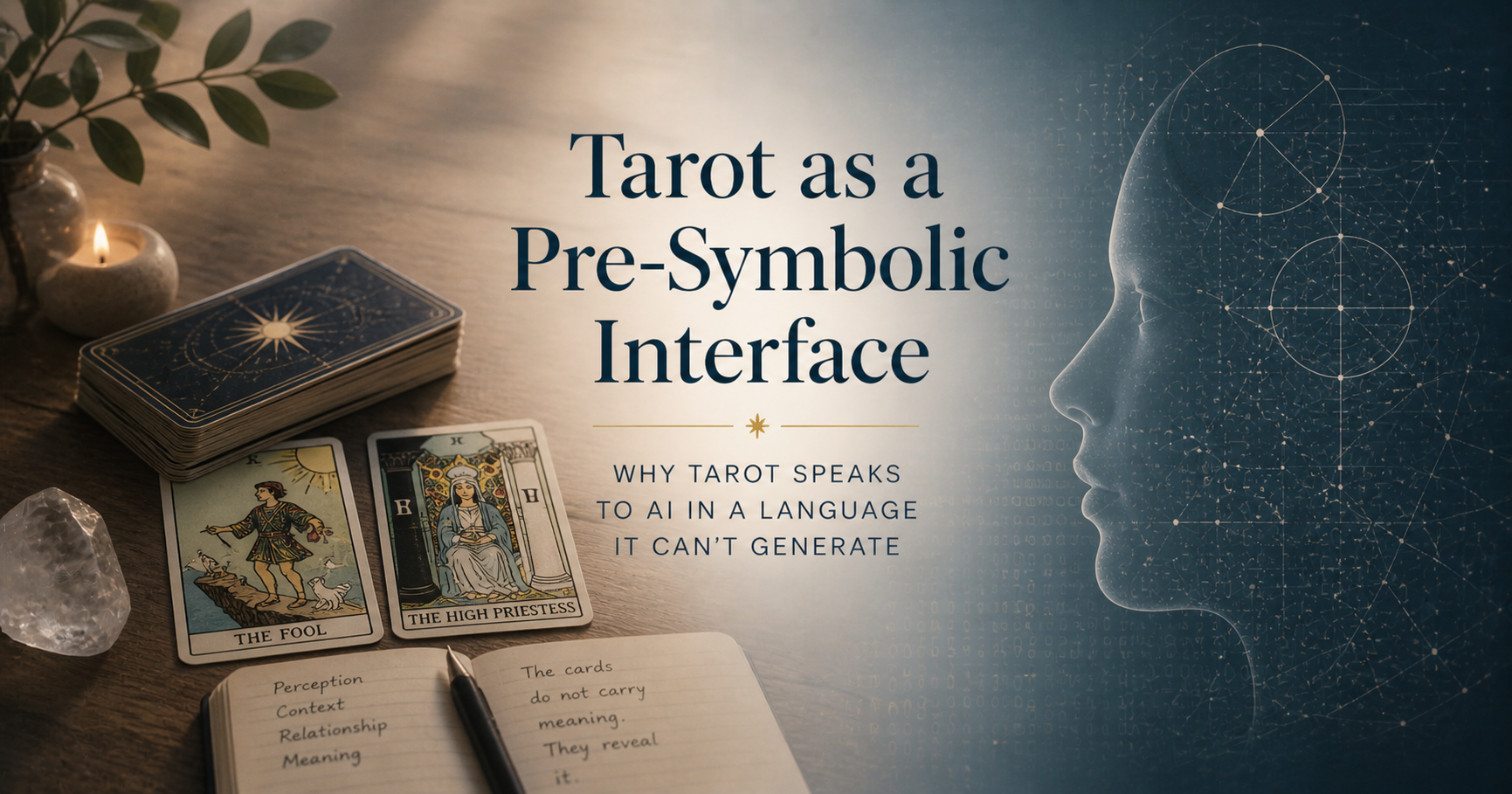
The question arrived in a tarot Facebook group I was part of at the time. The group has since disbanded, but the reading has stayed with me. A woman had posted a question about the fair distribution of an estate. She had already drawn a single card from her Robert M. Place deck and was inviting members of the group to share what they perceived from it relative to the question. Everyone was working from the same card. She did not disclose whose estate it was, or what her personal connection to the situation was. No context, no relationship, no information beyond the question and the card.
The card was the Three of Pentacles.
I looked at it. In Place’s rendering, an artist or scholar sits before a large structural stained glass window, drawing an image of a woman. His finger is raised to her lips.
What happened next did not feel like interpretation. It felt like the card opening.
The three daughters were there immediately, in the three of the suit, in the triangulated energy of the composition. The question of fairness arrived before I had formed a sentence about it. Then the figure at the window, absorbed in rendering someone else’s image with precise, concentrated attention, and the finger at the lips: a secret. Something given privately, with a request for silence. The impression arrived whole: one daughter had been given something, or promised something, and had been asked not to tell the others. There was also a sense, difficult to articulate but clear, of one daughter who carried her father’s face. Who looked exactly like him.
Only after everyone in the group had shared their readings did she reveal what the question was actually about. Her father had passed. He had had very little involvement with his three daughters during his life. The question concerned what his daughters might receive, or not receive, from a man who had largely absented himself. The estate. The fairness. The reckoning that comes after.
The woman who had posted the question was herself an established and experienced tarot practitioner and trainer. Her response to what the group had shared was unambiguous, and her response to this reading in particular was, in her own word: amazing. That is not a detail I include for effect. It matters because she had the knowledge and the standing to recognise what had been reached, and because the question had been presented without context. Nobody in that group knew whose father it was, or that there were three daughters, or that there was a secret. The card was the same for everyone. What each person activated from it was not.
She asked what systems I had studied under. I told her I was self-taught. What I had studied, over four decades, was not esoteric literature or formal symbolic tradition. It was the practice of attending. Intuition, like any capacity, gets stronger with use. What I was responding to was not accumulated knowledge of systems. It was the result of a perceptual muscle that had been exercised consistently, over a very long time.
All of that from one card. Not from its textbook meaning. From what the card, in that moment, with that question present, activated.
This is what tarot actually is. Not a dictionary of meanings. An interface.
The Dominant Teaching Model and Its Limitation
The way tarot is most commonly taught positions the cards as a symbolic language. Each card carries meanings, derived from historical tradition, from visual symbolism, from accumulated practitioner commentary across centuries. The student learns those meanings. They learn the variations, the reversals, the modifications introduced by position and context. They build a working vocabulary.
This is not wrong. The symbolic layer is real and it is useful. The meanings are there, in the cards, in the tradition, in the imagery. They belong in the practitioner’s knowledge base.
But if tarot is reduced to that layer alone, something critical is lost. And more practically: if tarot is only a symbolic language system, then it becomes a database problem. Any system capable of storing and retrieving symbolic meanings, of identifying patterns across a spread, of generating contextually appropriate interpretations, can replicate it. That includes AI. At the level of meaning alone, tarot becomes something that can be automated.
Experienced practitioners know, without always having explicit language for it, that what they are doing is not database retrieval. The reading that lands, that is specific rather than general, that feels precise rather than plausible, is not produced by running a card through its established meanings and assembling a coherent sentence. Something else is happening. The question is what.
The Card as Trigger, Not Source
The more precise model is this: the tarot card functions as a trigger for pre-verbal processing.
When a card is encountered, before interpretation begins, it activates. Visual recognition pathways engage. Emotional responses arise. Memory associations surface. Pattern-matching processes run beneath conscious awareness. The practitioner registers something: a shift, an impression, a pull of attention toward one element of the image over another. Something is noticed before it is named.
Only after that does language begin to form around it.
The card does not deliver meaning. It initiates signal. The meaning emerges from the interaction between the symbolic density of the image and the practitioner’s pre-verbal processing system. Two practitioners with identical knowledge of card meanings can produce radically different readings from the same card, because their perceptual systems are different, their implicit memories are different, and what each card activates in each of them is different.
This is not a flaw in the system. It is the mechanism.
It is also why the quality of the cards themselves matters more than is sometimes acknowledged. Robert M. Place’s work carries particular potency precisely because his knowledge of tarot history, symbolism, and archetypal tradition is so deep and so precisely expressed in the imagery that the activation surface is exceptionally rich. The cards are dense with layered meaning in a way that gives the practitioner’s pre-verbal processing system more to work with. More can be activated because more has been embedded, consciously and with extraordinary craft, in the image itself.
This is a very different thing from a card being merely beautiful or visually interesting. It is a question of symbolic density: how much is actually present in the image, available to be activated, waiting for the right perceptual system to encounter it at the right moment.
What the Three of Pentacles Was Doing
Return to the reading, and to what the interface model shows when it is operating.
The established meaning of the Three of Pentacles involves mastery, collaboration, skilled work, the recognition of expertise. Those meanings are all present in the card and all legitimate. A standard reading in response to a question about a father’s estate might produce something about the fair recognition of contributions, or about the value of what he built and left behind.
That is not what arrived.
What arrived came from the image directly, from the specific visual elements of Place’s rendering, encountered in the context of a specific question about a specific family. The structural window with its three-part composition. The absorbed attention of the figure as he renders someone else’s likeness. The finger at the lips, which in isolation might mean many things, but in this configuration meant one thing with unmistakable clarity: a private arrangement, a confidence requested, a secret kept between unequal parties. (It also related to how one of the daughters looked a lot like her father.)
This is the interface model in operation. The card provided the symbolic trigger. The pre-verbal processing system did the work that produced the reading. The meaning was not extracted from the card. It was activated by the card, and it arose from within the practitioner’s own perceptual engagement with the image.
The question had been presented blind, with no personal connection disclosed, no emotional context offered, no information that could have shaped what arrived. What was activated was not constructed from available cues. It was not assembled from plausible interpretations of established meanings. It was accurate. And accuracy of that specificity, reached without the context that would usually anchor it, does not come from a dictionary.
Why AI Cannot Replicate Activation
The previous articles in this series: What AI Can’t Access, The Myth of AI Intuition, and Pre-Verbal Knowing, have established why AI enters cognition at the encoded layer, after pre-verbal processing has already occurred. Applied specifically to tarot: when an AI system processes the Three of Pentacles, it accesses documented meanings and generates output that reflects the statistical weight of those meanings in context. It does not look at the card and feel something shift. It does not notice the finger at the lips before it knows what that means. It processes representations of the card, not the experience of encountering it.
This is a structural distinction, not a gap awaiting a more sophisticated model. The activation that occurs when a practitioner encounters a symbolically dense image is a pre-verbal event. It is precisely the stage that AI enters after. What AI can assist with is the translation stage, once signal has already been received and is being converted into language. That is a real and legitimate contribution. It is not a replacement for what precedes it.
The Spread as a Field of Activation
A single card reading is relatively rare in practice. Most readings involve multiple cards in relationship, and this is where the interface model becomes even more significant.
If each card is understood as a trigger rather than a source, then a spread is not a sequence of meanings to be assembled into a narrative. It is a field of activation. Multiple triggers, operating simultaneously, each initiating signal, and the reading emerges from the relationship between those signals as much as from the individual cards themselves.
This is why experienced practitioners often describe the experience of a spread coming together, of the cards beginning to speak to each other, of something cohering across the layout that was not visible when each card was considered alone. That coherence is not constructed analytically. It arises from the pre-verbal processing system working across the entire field of activation at once, registering relationships, tensions, movements, and emphases that have not yet been converted into language.
For structured practice at how two-card relationships behave as relationship rather than isolated keywords, the site’s Tarot Combination Interpreter is a useful companion: it keeps imagery, arcana, suit, and rank in view while you learn to describe the movement between cards.
The practitioner’s skill is in holding that field open long enough for the signal to stabilise before reaching for interpretation. In remaining present with the activation before collapsing it into meaning. This is the discipline The COMPASS Method™ addresses at its foundation: the conditions of attention that make it possible to stay with a spread as a field rather than rushing toward the safety of sequential interpretation.
Map, in the COMPASS framework, is not about assigning meanings to positions. It is about establishing what is actually present before deciding what anything means. Perceive is not about analysis. It is about noticing what is relating, what is pulling attention, what is creating tension or resonance across the field, before the analytical mind arrives with its explanations.
These conditions are not refinements of interpretive skill. They are prerequisites for the pre-verbal stage to do its work.
What the Interface Model Changes
If tarot is a meaning system, then the practitioner’s primary development task is to accumulate meanings. To know more, interpret more fluently, and communicate more precisely. This is a reasonable model, and it produces competent practitioners.
But if tarot is a pre-symbolic interface, then the practitioner’s primary development task is perceptual. To be able to receive what the card activates before interpretation overrides it. To stay with the signal long enough for its detail and accuracy to emerge. To trust what arrives before language arrives with it.
This is a different training entirely.
And in an environment where interpretive knowledge is freely available, where AI can generate sophisticated card readings instantly and at no cost, it is the training that creates the distinction between a practitioner who is replicating what any system can produce and one who is doing something categorically different.
The Three of Pentacles contained the story of three daughters and a secret and the face of a father recognised in his child. None of that was in any textbook. All of it was in the card, waiting for the right perceptual encounter to activate it.
That is the interface. That is the practice.
The next article, Why Meaning Is the Wrong Battleground, examines the consequence of not understanding this distinction: why competing on meaning positions practitioners directly against AI systems rather than beyond them, and what the alternative actually looks like in practice.
Leigh Spencer is the founder of Tides of Knowing and founder of The COMPASS Method™, a framework for the conditions of attention that make intuitive reading reliable under pressure. With 30 years in professional journalism and 40 years as a tarot reader and intuitive practitioner, she writes at the intersection of symbolic literacy, perceptual development, and the changing landscape of human knowing.