
The cup is extended, but receptivity is not an obligation. The question is what feeling, care, or creative impulse is actually present, and what conditions would allow it to be met safely.
Core Repeating Message
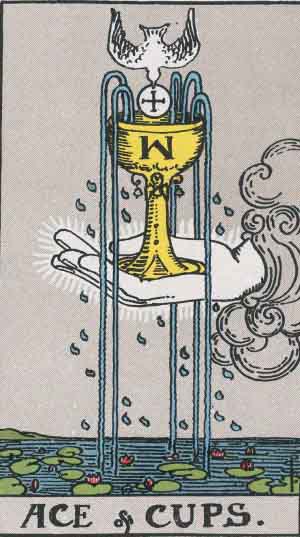
The Ace of Cups shows a hand emerging from cloud, supporting an ornamented golden cup on its open palm. The cup is full. Five streams descend from it into the water below. A dove lowers a cross-marked disc towards the cup, an image of heavenly blessing entering the vessel from above. Water lilies bloom at the surface of the water below. The hand offers, the cup overflows, the dove descends: the image gathers these movements around a vessel that can receive as well as give. Nothing in this image is withheld.
When this card appears once, it can symbolise a fresh emotional current, creative feeling, or increased receptivity. When it appears repeatedly, it may invite closer attention to how offers of care, feeling, and inspiration are recognised, assessed, and received. It does not prove that a particular offer is safe or that the seeker has failed to accept it.
The cup is extended. This is the card’s central image and its central question: what is happening at the threshold of genuine reception, particularly when that threshold keeps being reached without being crossed?
The question is not simple, and the answer is never that the seeker is emotionally broken or unworthy of what the cup offers. The Ace of Cups returning is not a judgement. It can bring attention to moments when something emotionally, creatively, or spiritually welcome meets a protective response before it has time to land.
One form this pattern can take is grief-informed hesitation. The seeker has loved and lost, has opened and been disappointed, has received and then been emptied. The cup was full before. The fullness ended. The heart learned from this that receiving fully means risking the loss of what has been received. The Ace appearing again and again can give this seeker an image for the recurring invitation to emotional receptivity that keeps being met with the emotional memory of prior depletion.
A second form is what might be called worthiness interruption: the moment when warmth, connection, or creative feeling arrives, and something in the seeker redirects or minimises it before it fully lands. The compliment received and immediately dismissed. The tenderness offered and quickly moved past. The creative impulse rising and just as quickly reasoned into silence. The cup is tipped before it is drunk, not from conscious refusal but from a protection so habitual it functions below the level of ordinary notice.
A third form is flooding fear. The seeker has felt feeling arrive before and overwhelm them; the cup ran over and the overflow was genuinely difficult to manage. Now the offer of feeling is met with a contraction that is more protective reflex than considered choice. They want the cup. They also need to be able to hold what it contains.
A fourth form, specific to the Ace’s creative and spiritual dimensions, is the seeker whose feeling-life is rich but private: deep capacity for emotional experience, wells of feeling, responsiveness to beauty and meaning, but no clear vessel into which this feeling currently flows. The cup is full, but there is nowhere to pour it. The Ace returns here as an invitation to find the form, the relationship, the creative container, the spiritual practice, that will hold what is present and wanting to move.
Whatever the shape of the pattern, the Ace of Cups does not ask the seeker to manufacture feeling. It invites an honest distinction between what is present, what is hoped for, and what is being offered by another person or by a creative practice. Receptivity can include boundaries, slow pacing, and the decision that a particular cup should not be accepted.
When This Card Repeats Weekly
A week of Ace of Cups repetition may mirror an immediate emotional current, creative impulse, or offer of care. The useful inquiry is whether the response reflects habit, limited capacity, current risk, or a clear preference. Not every hesitation is interruption, and not every offer deserves access.
This might be a moment of connection with another person that was received at the surface and not allowed to go deeper. A conversation that stayed pleasant when the seeker wanted to speak more openly. A kindness offered and acknowledged but not let in. Where the feeling was welcome and the opening workable, it may be worth noticing what stepped in before it could land.
The weekly repetition asks: is something deflecting welcome feeling this week? Not as criticism, but as a curious orientation towards what is actually there. If something warm wants to land, what is stopping it, and what does that response tell the seeker?
A Cups week of this kind may also correspond to the seeker’s own unexpressed feeling. The card sometimes marks not only what is not being received from outside but what is not being given expression from within: the tenderness that was not said, the care that was felt and not spoken, the creative impulse that rose and was not followed. The cup holds feeling in both directions.
When This Card Repeats Monthly
A month of Ace of Cups repetition invites a look at whether emotional openings have met a recurring form of hesitation across the month, and whether this is becoming a recognisable pattern rather than a passing mood.
The monthly recurrence asks the seeker to look at what has been consistent across the month’s emotional landscape. Not just the occasions but the pattern beneath them: when has feeling been available, and what has happened at the threshold of reception? Is the move one of withdrawal just before a wanted connection? Of receiving warmth and immediately managing it back to a safer level? Of feeling creative or spiritual aliveness briefly and then losing access to it when ordinary life reasserts itself?
A month of this card may accompany early grief or emotional recovery, when feeling changes from day to day and renewed interest can feel precarious. The recurrence cannot confirm recovery or set its pace. It can invite the seeker to notice small changes without demanding openness, interpreting fluctuation as failure, or requiring certainty about how long any state will last.
For the seeker in a sustained creative or spiritual drought, the Ace appearing monthly may give an image to the first return of inspiration, longing, or aliveness in a domain that has felt dry. The card asks them to water these first glimmers rather than dismiss them as insufficient.
When This Card Repeats Seasonally
A season of Ace of Cups energy can provide a frame for a significant emotional period. The seeker may be in sustained encounter with their own capacity for receptivity, with enough time and recurring experience to examine what their relationship with feeling is becoming.
One kind of period this image can illuminate is an emotional thaw after prolonged protective closure: the seeker who shut down after a significant loss and who is now, gradually and cautiously, experiencing the return of emotional availability. The cup is filling again. The season is a season of filling, and the question is how the seeker meets that return: whether they can make room for it, what interrupts it, and when a pause helps them hold what has arrived.
The second is a period in which emotional readiness is felt or spoken of but has not yet found expression. A connection, a creative opportunity, a spiritual opening, a chance at intimacy may be present. Each month the card appears, and the seeker can look at whether they have again circled a wanted threshold without crossing it, or whether their sense of what is possible has changed.
What an Ace season asks of the seeker is not the forcing of feeling but curiosity about the threshold itself. What specifically happens there? What does the seeker notice in the body, in the mind, in the relational dynamic, at the moment when welcome feeling meets an impulse to manage or redirect it? The season offers time to begin knowing the answer.
When This Card Repeats Across Years
The Ace of Cups returning across years or across major life chapters can become an image for long-term work with emotional receptivity. When meeting the threshold of feeling, connection, or creative and spiritual aliveness repeatedly brings a protective response, the seeker may be looking at a pattern that runs through several circumstances rather than belonging to only one.
For some seekers, this long-arc pattern has roots in early experiences of what happens when the cup is full. Perhaps the fullness was met with something that hurt: childhood feeling that found no welcome. Perhaps the cup was full and then dramatically emptied by a loss so significant that the memory of the loss became more formative than the memory of the fullness. Perhaps the family atmosphere communicated, clearly or implicitly, that strong feeling was a burden, an inconvenience, something to be managed rather than received.
Where this history fits, the multi-year Ace of Cups pattern describes a protective step back at the threshold of reception. The step back is not weakness. It can be the intelligence of someone who learned, from experience, that opening fully carries risk. The difficulty arises when a response that once served the seeker also prevents them from receiving what they now want and have room to hold.
Across years, the growth arc this card traces is from reflexive deflection to choice at the threshold. The seeker begins to notice the threshold: they can feel when emotional availability is present and sometimes observe what happens at the point of potential reception. With time, they may become more able to choose there: not the elimination of the protective response, but the ability to recognise it and decide, consciously, whether to allow the cup’s contents to arrive.
When the Ace of Cups appears across years without an obvious shift, it may be useful to explore whether grief, longing, boundaries, relational context, or beliefs about emotional safety contribute. These are possibilities, not hidden facts revealed by the card. The seeker need not disclose or revisit painful material without readiness and appropriate support.
Life Area Interpretations
Love & Relationships
In love and relationships, the Ace of Cups repeating can draw attention to a recurring threshold of connection, particularly when the seeker wants closeness yet notices something interrupting its arrival. This is not necessarily a pattern of avoiding relationship altogether; they may pursue it actively. The question is what happens when mutual feeling begins to deepen, and whether the hesitation belongs to a familiar response or to this particular relationship.
This might look like relationships that reach a point of depth and then stall. The seeker is present, engaged, clearly drawn to the person, and at the moment when intimacy would require vulnerability, something shifts. They become more analytical, or suddenly aware of the other person’s flaws in ways that were not previously pressing. The cup is right there, and something steps away before drinking. The question is whether the newly noticed concern is protective deflection or information that deserves attention.
It might also look like longing for connection alongside a persistent sense that readiness has not yet arrived. The seeker waits for the right person, the right moment, the right feeling of safety. Meanwhile, moments of wanted connection may be registered but not fully inhabited, partly because being present with feeling carries a risk that imagining connection does not.
The Ace can also accompany the seeker who has experienced significant relational loss and whose heart is beginning to open again. Repetition invites them to notice the current filling alongside the memory of loss: what feels welcome, what feels precarious, and what pace allows both to be acknowledged.
Career & Purpose
In career and purpose, the Ace of Cups can highlight creative or vocationally meaningful work that asks for emotional investment, where the seeker senses that something of their feeling is being held back from what they make or offer.
Creative work draws on the cup: on the seeker’s willingness to let feeling move through the work, to bring emotional presence to what they are making. When the Ace repeats in career contexts, it asks whether the seeker is pouring from the cup or keeping feeling at a distance through intellectual control. Thought and craft have their place. The question is whether they help give feeling form or keep it out of the work altogether.
The card also appears when the seeker is at the threshold of work that would ask for more emotional presence, more vulnerability in the offering, more personal investment in what they produce. They may be holding back from this not because they lack capability but because emotional investment in work carries a particular risk: when feeling is in the work, rejection can reach further than when the work is primarily technical.
Money & Stability
The Ace of Cups approaches money through feeling, because its primary territory is emotional rather than material. When it appears repeatedly in financial contexts, it is usually pointing toward the emotional dimension of what money means to this particular seeker.
For some seekers, difficulty receiving financial support, accepting genuine generosity, or allowing material care from others reflects the same pattern of reception that the card marks in other domains. The offer of help feels uncomfortable. The unexpected gift produces anxiety rather than simple gratitude. The cup extended in material form may meet the same reflexive deflection as the cup extended emotionally, though the terms of the offer and any obligations attached also matter.
The card may also appear when the seeker’s work of the heart, the creative or vocationally meaningful work, is in genuine tension with financial necessity. The Ace appearing here is marking the emotional cost of that separation and asking whether the gap between what nourishes the feeling-life and what currently pays for the practical life is being genuinely examined.
Spiritual Growth
The Ace of Cups has an explicitly spiritual dimension: the dove descends towards the cup, the offering comes from above. This is the card of spiritual receptivity as much as emotional receptivity, and when it repeats, it can give form to an invitation towards spiritual openness that the seeker senses but has not yet fully received.
Spiritual receptivity is different from spiritual practice. A seeker can be diligent in practice and still find protection activating at the moment of spiritual feeling. A moment of prayer, interior opening, or spiritual emotion arrives and is observed rather than inhabited, allowed to the surface but not to the depth.
The Ace repeating in spiritual contexts asks whether the seeker is allowing the cup of spiritual feeling to land. Not whether their practice is sufficient, but whether they can stay with the experience of receptivity when it comes.
For seekers in intuitive or creative spiritual practice, the Ace often marks the relationship between feeling and form: the seeker has spiritual feeling but has not yet found the regular form into which it flows. The prayer, the meditation, the creative practice, the contemplative walk. The card returning asks which of these, in practical and regular ways, the seeker is using to receive what they sense is being offered.
Emotional & Mental Patterns
In the emotional and mental domain, the Ace of Cups repeating can describe a pattern of meeting the threshold of feeling and, just before it has time to land, applying a form of management that reduces it to a more containable level.
For someone who recognises this pattern, the management may be so practised that it feels automatic: they do not experience themselves as managing emotion so much as simply having moderate feelings. Strong feeling arrives, is briefly experienced, and is then reorganised by the thinking mind into something more structured: explained, contextualised, placed in a larger framework. The feeling is not necessarily suppressed. It is processed before it can genuinely land.
The Ace is not asking this seeker to perform more emotional expressiveness than they genuinely feel. It is asking whether feeling, when it arrives, is given time before the explanatory framework arrives to contain it. Whether there is a moment, however brief, in which the cup’s contents are felt rather than immediately known.
Family & Generational Dynamics
In family contexts, the Ace of Cups most often marks the emotional inheritance: what the family of origin communicated, explicitly or atmospherically, about feeling and its reception, and how this communication has shaped the seeker’s current relationship to emotional opening.
Families that were uncomfortable with strong emotion, that met feeling with redirection or dismissal or simple silence, may teach a child to manage feeling before it becomes uncomfortable for others. A seeker who recognises that history can use the Ace of Cups to examine what they learned when the cup was offered: perhaps they offered their own cup and it was not received, perhaps the family atmosphere communicated that emotional fullness was too much for the people around them to hold.
The generational work this card marks is the gradual revision of these inherited communications: the discovery, often tentative and often requiring genuine support, that offering the cup and receiving from it is genuinely possible in some contexts with some people, and that the learning from the family of origin does not define the full range of what emotional receptivity can be.
Health & Energy
In health and energy readings, the Ace of Cups can symbolise the felt bodily dimension of emotion, such as warmth, tension, tears, changes in breath, or a sense of opening and closing. These experiences vary widely and do not identify a psychological pattern or medical cause.
Emotion can influence bodily experience, while chest, throat, and breathing changes can also have many medical, environmental, and situational causes. Tarot cannot determine why they occur. Persistent, severe, or sudden symptoms require appropriate professional assessment, and urgent breathing or chest symptoms require urgent care.
The seeker may notice that welcome and tolerable emotion coincides with softening, fuller breath, tears, warmth, or no clear bodily change at all. The practical invitation is observation without forcing a response or treating one sensation as proof of authentic feeling. Grounding, rest, and qualified support can accompany reflection where needed.
Advanced Interpretive Sections
The Shadow Expression
The Ace of Cups in shadow produces two distinct patterns.
The first is the seeker who performs emotional receptivity without genuinely experiencing it. They have developed the language and presentation of openness, the vocabulary of someone who is moved and emotionally available, while underneath, the cup remains carefully tilted so that nothing is truly received. This shadow is difficult to recognise because the performance is often convincing, sometimes even to the seeker themselves.
The second shadow is the pursuit of intensity in place of reception: making emotional extremity itself the goal and mistaking overwhelming feeling for depth. Seeking one powerful experience after another can become a substitute for the quieter and more demanding work of sustained emotional presence. Flooding is not the same as reception, and becoming overwhelmed does not by itself mean someone has chosen this shadow. The distinction is between pursuing intensity and learning to hold what is felt. The cup inverted and pouring constantly is also not the same as drinking from it.
The Integrated Expression
The integrated Ace of Cups seeker has developed a more conscious relationship with their own emotional receptivity: they can recognise what is welcome, allow it to land, and hold what they receive without needing to intensify or deflect it. The cup is held. The contents reach them.
This seeker is recognisable by a quality of warmth that is not performance: they are touched by the things that touch them, gladdened by what gladdens, without needing to immediately manage either response back to a more comfortable level. The cup is not always full; they have dry periods. But when they choose to drink, they can let themselves taste what is there.
They are also capable of genuine offering: of extending warmth, care, creative feeling, and spiritual attention from a place of interior fullness rather than from the performance of fullness or the depletion of someone who gives from an empty cup.
Why This Energy Has Not Released Yet
The Ace of Cups pattern may persist when the seeker has not yet been able to name what the threshold experience is: what happens when welcome feeling approaches and something steps in before reception.
Naming it can help when protection was learned before it could be consciously chosen. An unnamed response may appear to the seeker as simply how they are, rather than as a pattern that can be understood and sometimes revised. The seeker who can say “I notice that when warmth is offered, I do this particular thing” has begun to distinguish the response from their identity, making room to consider what it still protects and whether another response is possible.
The pattern may also persist where grief remains difficult to acknowledge. The seeker’s history with the cup may carry several kinds of loss: grief over what was offered and not received, grief over what was received and then lost, grief over the feeling-life that might have been if protection had not become so comprehensive. Meeting that grief can clarify the protection around it, without requiring the cup to be full now or the grief to be finished before feeling can return.
Finally, the pattern may persist when the seeker wants certainty before opening emotionally. Perfect certainty is rarely available, but sufficient safety should not be minimised. Evidence of consent, consistency, reciprocity, boundaries, and the freedom to pause matters, and a seeker may reasonably decline emotional access when those conditions are absent.
What This Card Wants the Seeker to Understand
The Ace of Cups asks the seeker to examine the cup as a symbolic offer, then identify what is actually present in their life. A card cannot establish that an offer is meant for them or matched to their capacity. That requires context, evidence, consent, and honest attention to limits.
It also suggests that protection and receptivity are not opposites. Repeatedly drawing the card is not evidence of an interior state, but it can support inquiry into moments when openness and caution coexist. The aim is not to cross every threshold. It is to choose consciously which threshold, pace, and relationship merit entry.
The card wants the seeker to understand that feeling that lands can change something. This may be part of why protection developed: because feeling can alter a relationship, a hope, or a sense of what matters, and change has not always felt safe. The Ace asks them to consider whether they now have more room for that change than the old response allows, or whether the response is still naming a limit that needs respect.
Signs the Pattern Is Beginning to Resolve
The Ace of Cups pattern begins to resolve when the seeker can notice feeling without immediately dismissing it or being required to act on it: warmth can register, creative interest can remain present, and another person’s care can be assessed rather than reflexively accepted or deflected.
It resolves when the seeker can speak about their emotional experience with more contact and less management: not more expressiveness necessarily, but more presence with what they are feeling as they speak, rather than a description of feeling delivered from a slight remove.
It resolves when the specific pattern at the threshold becomes visible to the seeker in real time: when they can notice, as it happens, the moment of protection activating and can sometimes choose to allow what is being offered rather than deflect it.
And it resolves when the cup’s fullness can be inhabited while it is there, even as it changes: when the seeker’s attention is less occupied by how soon feeling might leave and more able to rest in what is present now.
Reflective Questions
-
Think about a recent moment when warmth, connection, or emotional aliveness felt available and welcome to you. What happened at the moment it could have landed? Did you receive it, or did something step in?
-
What does the word “full” feel like when you apply it to your emotional life? Is there a way in which genuine emotional fullness feels unwieldy, unsafe, or simply unfamiliar?
-
What is your most honest understanding of what the cup may be offering in your life: in relationships, in creative work, in spiritual experience? If you recognise a recurring invitation, what form does it take?
-
When did you last allow yourself to be genuinely moved by something, not just to notice that it was moving but to feel moved yourself? What made that moment different?
-
Is there a grief in your emotional life that has not been named as grief? A loss of feeling, a closing of the heart at a particular point, a farewell that was never formally acknowledged as a farewell?
-
What did your family communicate, through atmosphere and example, about the appropriate level of emotional feeling? What was considered too much? What was met with warmth?
-
When feeling is present, where, if anywhere, do you notice it in your body? Does it feel held back, or does it move? What would help you stay with it at a tolerable pace?
-
What might making room for emotional receptivity across an ordinary day feel like in your life, allowing for moments of openness and withdrawal? What would need to be different for this to be possible?
-
What is the specific thing you most persistently encounter at the threshold and do not quite receive? Can you name it plainly?
-
If the cup is genuinely extended towards you right now, what is in it? If you have not yet drunk, what is the most honest reason?
Practical Integration Actions
Notice the threshold. For one week, notice any moment in which warmth, feeling, connection, or creative aliveness is available to you, and pay attention to what happens at the moment of potential reception. Do not try to change the pattern; simply observe it with curiosity. What move do you make at the threshold? Do you notice anything in the body? This is the beginning of the pattern becoming conscious, which can create room for choice without requiring an immediate change.
Receive one thing fully. Choose one moment in the coming week in which something warm and welcome is offered to you, whether a compliment, a gesture of care, a moment of beauty, or a creative impulse that wants to develop. Practise giving it your attention rather than immediately managing it. Let it land in its own measure. Notice how you experience this, in the body or otherwise, and whether an urge to manage it returns. Even a few seconds of genuine reception is information.
Name the grief. If a loss feels present and the exercise is tolerable, spend up to fifteen minutes writing about what changed, what mattered, and what support you need now. Stop if the writing becomes destabilising, and do not force emotional intensity or recovered detail. Naming grief can clarify experience, but it does not guarantee release and may be better undertaken with qualified support.
Find the vessel. If your feeling-life is rich but has not found a form into which it can flow, identify one form that might serve as the cup: a creative practice, a relationship in which emotional presence is welcome and safe enough, a spiritual practice that invites feeling rather than managing it, a body practice that allows room for emotion. Choose one and give it regular attention for a month, noticing whether it helps you hold and express what is there.
Practise emotional presence in small increments. If flooding is a concern, the invitation is to explore manageable feeling rather than push towards overwhelm. Choose a small, safe context in which to allow a moment of emotional presence: a pause with beauty, brief contact with what you feel right now, one authentic expression of care or longing that you would usually redirect. Return to this when it is tolerable. Small practices of reception may help you learn what you can hold, without requiring each practice to become larger.
Write to the cup. Address, in a piece of free writing, what the cup in your life seems to be offering that you have not yet received. Write directly to it: what in you wants it, and what in you has not yet drunk. The writing is not for resolution; it is for genuine contact with the pattern. What you can honestly name may help you see where choice is possible.