
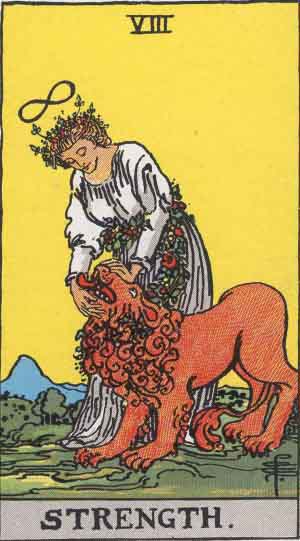
When this card appears again and again, it is not asking you to try harder: it is asking you to discover the kind of strength that does not require effort at all.
Core Repeating Message
Strength is the most misread card in the Major Arcana. Its name invites misinterpretation: the seeker expects a card about power, fortitude, endurance, the gritting of teeth and the bearing of difficulty. What they find instead is a figure in a white robe bending gently toward a lion, opening or closing its great mouth with bare, unarmoured hands, wearing an expression of absolute calm. No weapon. No cage. No contest. The lion is not being subdued; it is being known, tended, brought into a relationship that honours both its wildness and the figure’s wholeness. The lemniscate, the infinity symbol, rests above the figure’s head, the same sign The Magician wears, but where the Magician’s lemniscate signals possibility and command, Strength’s signals a different kind of mastery: ongoing, cyclical, rooted in relationship rather than in will.
When Strength repeats, the question at the centre of the card is always some version of this: what is the seeker doing with their instinctual, animal, or shadow nature? Have they met it? Do they know it? Are they trying to destroy it, contain it, deny that it exists, or are they learning the infinitely harder and more rewarding work of bringing it into genuine relationship with the rest of who they are?
There are several recurring patterns this card tends to mark.
The first is the pattern of the suppressor: the seeker who has learned, usually early in life, that their more instinctual responses, their anger, their sexuality, their hunger, their grief, their wildness, are not acceptable. They have not destroyed these forces; they cannot be destroyed. But they have learned to present a face to the world that gives nothing of them away. The suppressor is often admired for their composure. They are calm in crises, steady in difficulty, measured in conflict. They have also, typically, entirely lost access to their own vitality. Their composure is not strength; it is the performance of strength over a very loud and very imprisoned interior. The lion is in the basement, and the basement is beginning to shake. Strength appearing repeatedly for this seeker is a persistent, patient invitation to go downstairs and open the door.
The second pattern is the combatant: the seeker who is very much aware of their lion but who relates to it purely as something to be fought, overcome, or shamed into silence. They may have powerful anger they work relentlessly to suppress. They may have desires they consider evidence of weakness or moral failure. They may have a shadow quality, perhaps a capacity for cruelty, manipulation, or self-destruction, that they know is real and are in constant battle against. The combatant’s relationship with their interior life is exhausting, because they are spending enormous energy fighting themselves, and the lion, for its part, grows more powerful the more it is opposed. Strength returning repeatedly here is asking something radical: what if the lion is not the enemy? What if fighting it is itself the problem?
The third pattern is the collapser: the seeker who goes the other direction, who lets the lion run the show. They are overwhelmed by their emotions, ruled by their impulses, at the mercy of their reactive patterns, and they experience this as lack of choice. They feel what they feel immediately and completely, and they act from that feeling without the tempering presence of anything more considered. This is sometimes misread as authentic emotionality or passionate living, and there are elements of vitality and genuine feeling in this pattern. But the card appearing repeatedly here is asking: where is the figure in white? Where is the part of you that can be present with the animal without being consumed by it? The work of Strength is not to eliminate the passion but to become someone capable of accompanying it with wisdom.
Beneath all three patterns is a deeper question that the card is quietly asking each time it appears: what is the seeker’s fundamental relationship with their own inner life? Not their thinking mind, not their values or their aspirations, but the deeper, older, more visceral strata of who they are: the impulses that precede language, the feelings that arrive before reasoning, the animal intelligence that has been with them since before they had words for any of it. This is the lion. This is what Strength asks the seeker to meet.
The figure in the card is not afraid. This is one of the most important things about the image. She is not bracing herself or protecting herself or steeling herself against the encounter. She is simply present, genuinely present, with one of the most formidable creatures in the human imaginary, and she is tending it with her bare hands. This is the quality the card is cultivating in the seeker: not immunity to the lion’s power, not dominance over it, but the capacity to be genuinely present with it, to know it in all its ferocity, and to remain oneself in that knowing.
Strength is associated with Leo in most traditions, and this resonance is meaningful. Leo’s gifts are warmth, generosity, creative vitality, and the capacity to shine without apology. Leo’s challenges include pride, the need for recognition, and a particular kind of grandiosity that mistakes the performance of magnificence for the actual thing. Strength’s figure is leonine in her own right: she is not opposed to the lion; she is its counterpart. The card is not asking the seeker to become something other than themselves. It is asking them to become fully themselves, which includes the warmth and vitality and creative wildness the lion carries, integrated with the calm and clarity and genuine compassion the figure in white embodies.
The lemniscate is the card’s most important element for the seeker working with its repeating energy. The infinity symbol is not a promise of an ending. It is a description of the nature of the work. Strength is not a goal to be achieved and then possessed; it is a practice, a relationship, an ongoing encounter. Every time the seeker returns to the lion, they will find it changed, because they have changed, and the encounter will ask something new. This is why the card can appear again and again across years without exhausting its relevance: there is always more lion than the previous encounter revealed, and there is always a deeper quality of presence available to the figure who tends it.
For the seeker drawing this card repeatedly, the invitation is not to try harder at being calm, or to work harder at self-improvement, or to develop more willpower in managing their difficult emotions. All of these approaches are the combatant’s approach, and they miss the card’s core teaching entirely. The invitation is to cultivate genuine relationship with the parts of themselves they have most avoided, most feared, or been most ashamed of, and to do this not through gritted teeth but through the kind of open-handed, curious, compassionate attention that the figure in the card embodies. This is the strength that does not require effort. This is what the card keeps coming back to offer.
When This Card Repeats Weekly
A week in which Strength appears multiple times is a week in which something instinctual or shadow-adjacent is pressing for attention in the seeker’s daily life. It may be appearing as a repeating emotional trigger, a situation that keeps producing the same reactive response, a desire or impulse that keeps surfacing despite attempts to redirect it, or an unusual intensity of feeling that seems out of proportion to the circumstances.
The Strength week is asking the seeker to resist the reflex of management. The temptation in such a week is to handle the emotional intensity, to bring it under control, to get back to the regulated state they prefer. This is understandable, and short-term management is sometimes necessary. But the card appearing repeatedly across the week is suggesting that the management strategy, however habitual and however effective in the short term, is not resolving the underlying dynamic. Something needs not to be managed but to be met.
Even a small practice of genuine meeting can shift the week’s energy significantly: sitting with the difficult emotion for five minutes without trying to change it; writing honestly about the desire or impulse without self-judgement; asking what the reactive response might be trying to protect and taking that question seriously rather than dismissing it. The lion does not need to be tamed in a week. But it needs to know it has been seen.
When This Card Repeats Monthly
A Strength month is one in which the seeker is in a sustained encounter with some aspect of their inner life that has been asking for more honest attention than it has been receiving. This is often not dramatic, not a crisis or a breakdown, but a kind of persistent low-frequency signal from the interior: a feeling that something needs to be addressed, a quality of restlessness or heaviness that doesn’t quite resolve, a pattern in relationships or in emotional responses that keeps generating the same consequences.
Monthly Strength work tends to involve some form of genuine self-inquiry or sustained self-compassion practice. Not self-improvement, not the disciplined management of difficult traits, but the more demanding and more rewarding practice of genuinely getting to know the parts of oneself that one has kept most at a distance. This might look like working with a therapist or counsellor, pursuing a somatic practice that brings the seeker into relationship with their body’s intelligence, engaging seriously with a journalling or reflective practice, or simply committing to a month of non-judgement toward the parts of themselves they most judge.
The Strength month has a quality of gentleness about it that is easy to mistake for lack of urgency. The card is not screaming. But its patience is active, not passive. It will keep returning until the work it is asking for is genuinely engaged with.
When This Card Repeats Seasonally
A season of Strength represents a significant period of inner work, one that will likely leave the seeker meaningfully changed in their relationship with themselves by its end. Something that has been held at arm’s length, perhaps for a very long time, is being brought into genuine relationship. This is the season’s primary work, and it tends to ask more of the seeker than any single month of Strength energy would.
Seasonally, Strength often appears during the following kinds of periods: a period of deep therapy or healing work that is bringing shadow material into conscious relationship; a period of recovery, whether from a physical illness, a loss, an addiction, or a relational rupture, in which the seeker is learning to meet their own fragility with compassion rather than fighting it; a creative period in which work that is being produced is drawing from a much more instinctual or emotionally raw source than the seeker is used to working with; or a period following a crisis in which the seeker’s habitual coping strategies have failed, and they are learning to relate to their interior life without the usual armour.
What characterises Strength seasons is a quality of deepening familiarity with one’s own interior that cannot be rushed and cannot be forced. The seeker who tries to move through a Strength season quickly, who tries to achieve the resolution or the integration as an accomplishment, will find the card continuing to appear. The lion is not on the seeker’s schedule. It is on the card’s schedule, which is the schedule of genuine human growth, and that schedule is reliably slower and more thorough than any agenda the mind brings to it.
When This Card Repeats Across Years
Strength appearing across years is one of the most profound and personally significant long-arc patterns available in the Major Arcana. It suggests that the seeker has a deep, recurring, and fundamentally important encounter with the question of instinct, compassion, and the integration of the shadow, and that this encounter is not incidental to their development but central to it.
Across years, this pattern most often belongs to one of two types of seeker. The first is someone who had early experiences of their instinctual or emotional nature being treated as dangerous, shameful, excessive, or unacceptable. They learned, as a survival response, to distance themselves from those parts of themselves, and the distancing was so thorough and so early that the reconnection work is genuinely substantial. For this seeker, the years of Strength are years of careful, patient retrieval: learning to locate emotions that have been cut off, learning to recognise impulses that have been buried so deeply they present as absence rather than as presence, learning to trust that the wildness in them can be met and known without destroying the self.
The second type is someone who is engaged in significant creative, healing, or spiritual work that requires them to operate from a level of instinctual authenticity that their early conditioning does not easily permit. The artist who keeps pulling back from the edge of genuine expression. The healer who can accompany others into their shadow but cannot enter their own. The leader whose public authority is genuine but whose private inner life is still a stranger to them. For this seeker, the years of Strength are years of expanding their capacity to work with the fullness of who they are, rather than the edited and acceptable version they learned to inhabit.
Across the years, the growth arc Strength traces moves from a relationship with inner experience characterised by avoidance, combat, or overwhelm towards one characterised by companionship. The seeker who has worked with Strength across years is not someone who no longer has a lion. They are someone who knows their lion, has developed a more honest relationship with it, and is less governed by fear of what will happen when it is present. This can alter the creative work, the relationships, and the quality of presence they bring to their own life. The integrated seeker who carries Strength in their bones may radiate the quality the card depicts: warmth, ease, and an inner authority rooted in self-knowledge rather than dominance.
Life Area Interpretations
Love & Relationships
In love and relationships, Strength’s repetition speaks most directly to the question of how the seeker shows up with their full interior self in intimate connection, and whether the parts of them they most fear or most judge are permitted into the relational space.
For many seekers, the love relationship is the context in which the lion appears most dramatically, because intimacy is the domain in which the managed, presented self is hardest to maintain. The anger that is otherwise controlled tends to surface in close relationship. The neediness that is otherwise suppressed tends to press against the walls of partnership. The desire that is otherwise redirected tends to arrive with full force in the context of genuine attraction. This is not a flaw in the relationship; it is one of love’s primary functions: it creates the conditions in which the full self, including the parts usually hidden, is pressed into appearance.
When Strength repeats in the relational context for a seeker who suppresses their lion, the card is asking: are you allowing your partner to know you? Not the curated version, not the managed version, but the one who gets angry, who is sometimes unreasonable, who has desires that feel complicated, who carries old wounds that occasionally produce unexpected rawness. The relationship that cannot accommodate the lion is a relationship built for a partial self, and partial selves do not sustain genuine intimacy over time.
For the seeker in the collapser pattern, whose lion runs the relational dynamic, Strength in relationship is asking for the complementary work: where is the figure in white? Where is the part of you that can be present with intense emotion without immediately expressing it, that can hold relational tension without it becoming rupture, that can love someone without requiring them to manage your interior life for you? The lion that runs free in relationship, that acts from every feeling immediately and completely, that requires its partner to constantly navigate around its reactive patterns, is not yet in relationship with itself. And a self that is not in relationship with itself cannot be in full relationship with another.
Strength across relationships over years often maps the seeker’s developing capacity for genuine intimacy: from relationships characterised by distance, management, or overwhelm towards relationships characterised by mutual knowing. This is not a linear progression, and it is not always comfortable. The repeated card suggests that the seeker’s relationship with their own instinctive and disowned qualities may be shaping how much of themselves can enter intimacy. Work there can create better conditions for other relationships, though it does not determine their outcomes.
Career & Purpose
In career and purpose, Strength appears in two primary configurations, and they are almost opposite in their surface presentation.
The first is the seeker who is not bringing their full instinctual and passionate self to their work. They are professionally competent, perhaps highly so, but the work has a quality of flatness, of technical execution without genuine vitality. They have learned to leave the lion at the door when they enter professional contexts, because professional contexts have (explicitly or implicitly) asked them to, and the cost is that their work lacks the quality of aliveness that would make it genuinely excellent rather than merely competent. The Strength card appearing in career contexts for this seeker is asking: what would it look like to bring more of yourself to this? What has been left outside the professional door that, if brought in, would change the quality of what you produce?
The second configuration is the seeker who is in a career that is explicitly asking for Strength’s qualities: work that involves sustained compassionate engagement with difficult human experience, work that requires the seeker to remain present and grounded while accompanying others through high-emotion or high-stakes situations, work that draws on the capacity to hold complexity and shadow without being destabilised by it. Therapists, teachers, medical practitioners, social workers, artists, and many others do this kind of work. For them, the Strength card appearing repeatedly is a signal about the state of their own lion: are they tending it? Is the compassion they offer to others available to themselves? Is the steady presence they bring to difficult work being sustained by genuine inner resources, or by the performance of steadiness that will eventually cost them?
Purpose, in Strength’s frame, often has a quality of calling that is inseparable from the seeker’s shadow work. The things we are most called to do are frequently the things that also require us to work with what is most difficult in ourselves. The healer who was not healed. The teacher who was not taught. The artist whose most powerful work draws directly from the experiences they most had to survive. Strength appearing repeatedly around purpose is often pointing at this connection: the very gifts that are being called forward are rooted in the same territory as the lion.
Money & Stability
Money and Strength intersect in a domain that is not always obvious but is remarkably consistent: the seeker’s instinctual, often deeply embodied relationship with scarcity, abundance, and what they believe they fundamentally deserve.
Financial behaviour can carry strong emotional drivers beneath its rational explanations. Shame about not having enough, guilt about having more than others, impulsive spending, or rigid holding may coexist with practical pressures and material constraints. Financial advice can address skills and decisions, while Strength draws attention to the emotional meanings that a budget alone may not reach. The card asks for curiosity about those meanings without reducing every financial difficulty to psychology.
When this card repeats in financial contexts, the question worth sitting with is: what is the instinctual story I carry about money and what I merit? Not the intellectual answer, not the values statement about how money is just a tool, but the lived, felt, automatic response to abundance and scarcity. For many seekers, this story was formed so early and so completely that it is experienced as fact rather than as narrative. The seeker who grew up in real or perceived scarcity often carries an internal lion that either hoards against deprivation or spends in frantic relief that there is enough right now, without being able to occupy the middle ground of steady financial stewardship.
Strength’s invitation here is not a financial strategy. It is a meeting: a genuine, compassionate, curious encounter with the instinctual financial self, the one beneath the budget spreadsheets, and an honest inquiry into what that self needs to understand, what reassurance it needs, and what it might be able to release if it actually felt heard.
Spiritual Growth
Spiritually, Strength is one of the most demanding and most rewarding cards in the Major Arcana. Its spiritual teaching is the full integration of the shadow into conscious spiritual life, and this is not a gentle or comfortable process, even when it is approached with the gentleness the card depicts.
Many spiritual traditions have, in various ways, asked their practitioners to transcend the animal self: to move beyond desire, beyond reactivity, beyond the instinctual in the direction of the pure and the elevated. This approach produces a particular kind of spiritual seeker: one who is genuinely developed in certain domains of spiritual capacity (equanimity, contemplative depth, ethical refinement) and genuinely impoverished in others (embodied vitality, access to the full emotional range, the ability to be in genuine relationship with the complexity of human experience without retreating to the elevated position). The lion in the basement of such a seeker is often more powerful than ever, precisely because of how long and how thoroughly it has been opposed.
Strength appearing repeatedly in a spiritual context is asking for integration rather than transcendence. Not the elevation above the animal nature but the genuine meeting of it. Not the spiritual practitioner who never feels desire or anger or fear but the one who has genuine relationship with all of these, who can be present with them without being ruled by them, and who has discovered that the full range of human experience, including its most difficult and most instinctual elements, is not an obstacle to spiritual depth but part of what spiritual depth means.
The infinity symbol above the figure’s head is relevant here: this work does not end. The spiritually mature seeker does not achieve a state in which the lion is permanently quiet and the integration is complete. The lion keeps appearing, in new forms, at new levels of development, asking for a new and deeper quality of meeting. This is not failure; it is the spiral nature of genuine spiritual growth, always returning to the same territory at a deeper level of understanding.
Emotional & Mental Patterns
In the emotional and mental domain, Strength’s recurring appearance tends to map a specific pattern: the seeker has developed strong capacity for emotional regulation and intellectual management, and these capacities, while genuinely useful, have been deployed in ways that increasingly cut them off from their own emotional and instinctual intelligence.
Emotional regulation is a genuine developmental achievement. The ability to sit with difficult feelings without immediately acting from them, to tolerate uncertainty without rushing to premature resolution, to remain thoughtful under pressure: these are real strengths. But there is a version of emotional regulation that crosses into emotional suppression, and the distinction matters. Regulation is in relationship with the feeling; suppression has replaced the feeling with its absence. The regulated person knows they are angry; the suppressed person has stopped being able to locate the anger even when the evidence of it is in their behaviour.
Strength appearing repeatedly in the emotional domain is often pointing at a seeker whose regulation has become suppression, and who is experiencing the downstream consequences: a quality of flatness or numbness, difficulty accessing motivation or genuine pleasure, a sense of going through the motions, recurrent eruptions of emotion that feel out of proportion and out of character (the lion finding its way out regardless). The card is not asking the seeker to become less regulated. It is asking them to find their way back to genuine relationship with the emotions they have been managing out of their experience.
Mentally, the Strength pattern can show up as very strong intellectual capacity operating in service of emotional avoidance: the seeker who analyses their feelings in great detail without ever actually feeling them; who has sophisticated narratives about their psychology without the corresponding somatic and emotional experience; who reads extensively about emotional intelligence while remaining experientially cut off from their own. The figure in white does not intellectualise the lion. She touches it, with her bare hands, and meets it as it is.
Family & Generational Dynamics
The lion in any family system is the material that has been designated as too much: too dangerous, too shameful, too uncomfortable to be named or acknowledged. This might be specific emotions (anger in women, grief in men), specific experiences (addiction, abuse, illness, financial failure), specific desires (same-sex attraction, creative ambition, the refusal of inherited roles), or specific traits (sensitivity, intensity, unconventionality). Whatever has been assigned as the family lion is what Strength is asking the seeker to meet.
When this card repeats in a family context, the most useful question is: what in my family of origin was not permitted, and where do I carry that? The suppressed family material does not disappear when the seeker leaves the family system. It migrates. It becomes part of the seeker’s own internal landscape, continuing to operate under the same rules of suppression that governed it in the family: unnamed, unmet, and therefore ungoverned.
Generationally, Strength’s repetition may mark a seeker engaging with a family wound that was expressed through behaviour rather than openly named: a pattern of tension, absence, volatility, or silence that no one discussed directly. Bringing such material into conscious relationship is Strength work in a generational register. It can change how the seeker responds in the present and may influence what is modelled or passed forward, without granting one person control over an entire family’s inheritance.
The tenderness of the figure in white toward the lion is particularly relevant in the family context. The family lion is not evil. It is suffering, in most cases. It is the accumulation of generations of unmet experience pressing for acknowledgement. Approaching it with the open-handed compassion the card depicts, rather than with shame, combat, or the desire to simply escape it, is the act that begins to genuinely resolve it.
Health & Energy
Strength and the body have a direct and immediate relationship. The card is one of the most embodied in the Major Arcana: the encounter it depicts is physical, sensory, and intimate in a way that is registered in the body before the mind has time to interpret it.
When this card repeats in health contexts, its symbolic question concerns the seeker’s relationship with bodily experience. Tension, hunger, sexual energy, pain, fatigue, and pleasure can all carry useful information, but none has a single psychological meaning and tarot cannot determine its cause. For Seekers who have learned to privilege the intellectual and managed over the instinctual and felt, the body may be experienced as irrelevant, inconvenient, embarrassing, or threatening. Strength asks whether attentive curiosity could replace either automatic obedience or automatic override.
Strength appearing repeatedly in health contexts invites a different quality of attention towards bodily signals: not obeying every impulse uncritically, but listening with curiosity while seeking appropriate professional guidance for persistent, severe, or concerning symptoms. What conditions surround this tension, hunger, fatigue, or pain? What practical need may have been overlooked? What changes when the Seeker records the experience rather than assigning it an immediate symbolic explanation?
The embodied dimension of shadow work is an important aspect of Strength’s teaching, but it is best held as experiential rather than diagnostic. People may notice muscular tension while angry, heaviness in the chest while grieving, or restlessness around an unexpressed desire. These associations vary and do not establish that an emotion causes a symptom or occupies a particular body part. Strength’s invitation is to include bodily experience in reflection, meeting it with the same gentle attention the figure brings to the lion while preserving the distinction between symbolic meaning and medical assessment.
Advanced Interpretive Sections
The Shadow Expression
Strength’s shadow is not weakness. Its shadow is the weaponisation of gentleness: the use of compassion, patience, and self-control as instruments of superiority.
In shadow, the Strength seeker has learned that gentleness is power, and they deploy it as such. They never lose their temper; they are impeccably composed; they are known for their patience and their capacity to absorb difficulty without reacting. And they know it. The composed, unruffled, eternally patient person who is quietly aware of how much more composed and unruffled and patient they are than the people around them is Strength in its shadow expression. The lion is not gone; it is performing its own absence, and the performance has become its own kind of pride.
This shadow can also manifest as a particular form of helping: the seeker who positions themselves as the one who can handle the difficult people, who is always available for the person in crisis, who is in their element tending the wounded and managing the overwhelming, and who has quietly built an identity around their capacity for this that depends on others continuing to need tending. They are not helping from genuine compassion alone; they are helping to maintain the self-narrative of being the one who can.
A second shadow expression is the use of patience as a form of passive control: waiting for others to exhaust themselves, staying calm while allowing the other person’s emotional intensity to become the problem, deploying composure as a weapon in conflict. This is sometimes difficult to distinguish from genuine equanimity; the difference lies in the interior. Genuine equanimity is not invested in the other person’s response. Shadow patience is.
The Integrated Expression
The integrated Strength is recognisable in a quality that is genuinely rare: warmth that is not conditional, steadiness that is not managed, and an ease with the full range of human experience (their own and others’) that comes from having genuinely met it rather than merely survived it.
The integrated Strength seeker is not without their lion. They have an animal nature, instincts, impulses, desires, reactive patterns, and shadow material just like everyone else. What is different is that they are in genuine relationship with all of it. The anger is known to them; they can feel it arising, understand what it is responding to, and choose how to engage with it. The desire is present and acknowledged; it does not need to be acted upon compulsively or suppressed completely; it can simply be known. The grief, the fear, the neediness, the wildness: all of it is present and none of it is running the show, not because it has been controlled but because it has been genuinely met.
This seeker may offer others a felt quality of safety: not the impossible promise that nothing will affect or destabilise them, but the sense that difficult material can be met without immediate judgement, panic, or withdrawal. They remain human and permeable rather than armoured. That steadier presence can support creative depth, intimacy, and forms of helping that do not depend on performing invulnerability.
The integrated Strength seeker also knows the limits of their capacity at any given time: when they need to return to the lion themselves, when they have been away from their own interior for too long, when the steadiness they are offering to the world is beginning to hollow out because they have not tended their own inner life. They know how to receive as well as give, and they do not require their composure to be permanent proof of their worth.
Why This Energy Has Not Released Yet
The pattern of Strength does not release while the seeker continues to relate to their lion primarily through avoidance, combat, or shame.
The most common reason the card keeps returning is that the seeker has been doing something in relation to their inner life but not the right something. They may be working hard on self-improvement: exercising more, meditating more, being more disciplined in their habits, eating better, sleeping more. All of these are genuinely beneficial, and none of them is Strength’s work. Strength is not asking the seeker to improve. It is asking them to know themselves, which is a completely different project and considerably more uncomfortable.
The pattern also persists when the seeker confuses compassion toward others with compassion toward themselves. Many Strength seekers are extraordinarily kind, patient, and generous toward the people they love, and often toward strangers, but maintain a private interior voice that is harsh, critical, and entirely without the gentleness they so readily extend outward. The figure in the card is not approaching the lion with the quality of voice this seeker uses on themselves in private. Until the quality of attention that is available for others is made available to the interior, the card will keep returning.
The pattern also has a timing dimension. The lion rarely reveals every association in a single encounter. With genuine openness, the seeker may discover grief beneath anger, fear beneath defensiveness, unmet need beneath control, or an entirely different sequence. No hierarchy of emotions should be assumed in advance. The card returns not because the seeker has failed but because further experience may be ready to be recognised and related to differently.
What This Card Wants the Seeker to Understand
Strength wants the seeker to understand that the parts of themselves they have most tried to eliminate are not their flaws. They are the source material for their greatest capacities, and they have been trying to eliminate what they most need.
The person who has fought their anger for years often carries the most powerful capacity for righteous action, once the anger is genuinely known and directed rather than suppressed and reactive. The person who has suppressed their sexuality from shame often carries the most genuine creative vitality, once the life force that was poured into suppression is released into creative expression. The person who has spent decades managing their grief often carries the deepest capacity for genuine empathy and accompaniment. The lion is not the seeker’s enemy. It is their most significant unmet ally.
Strength wants the seeker to understand that the quality of inner life they most fear showing, the rawness, the wildness, the need, the intensity, is not what makes them too much or unsafe. It is what makes genuine connection possible. The seeker who shows only their curated self to the world creates connection with a partial person. The seeker who allows genuine meeting, who is present with their own lion and allows others to sense that, creates connection with a real person. This is what is being asked for.
The card also wants the seeker to understand that gentleness is not weakness. The figure in white is not a diminished force. She is, in the context of this image, more formidable than anyone carrying a sword. Her power comes from a place that is entirely different from dominance or control, and it is not less powerful for that. The seeker who learns the quality of strength she embodies will discover a form of personal authority they did not know was available, one that does not depend on external conditions, does not require the suppression of others, and does not exhaust itself in the effort to maintain itself.
Signs the Pattern Is Beginning to Resolve
The pattern of Strength begins to resolve when the seeker notices they can be with a difficult emotion without immediately needing to do something about it: when they can sit with the anger without expressing or suppressing it, when they can feel the sadness without managing it away, when they can acknowledge the desire without either acting on it or shaming themselves for it.
It resolves when they begin to hear their own interior voice with the same quality of patience and curiosity they would bring to a friend in difficulty, when the private narrative becomes measurably kinder toward the parts of themselves they most struggle with.
It resolves when they can be in the presence of someone else’s lion, someone else’s anger, grief, neediness, or intensity, without needing to fix, manage, distance from, or become overwhelmed by it. The seeker who has done genuine Strength work can become a safer person for others to be real with, not because they are impervious but because they are less afraid of what real looks like.
It resolves when the vitality begins to return: when the seeker who had become flat or numb begins to notice the return of genuine desire, genuine anger when something matters, genuine delight in embodied experience. The integration of the lion does not suppress vitality; it liberates it.
And it resolves, finally, when the seeker stops waiting to be a person who no longer has a lion, and starts inhabiting their life as a person who knows their lion, who tends it, who drives with it and not against it, and who has discovered that this relationship is not a problem to be solved but the most interesting and most significant relationship of their life.
Reflective Questions
-
What is the quality in yourself that you have most tried to manage, suppress, or eliminate, and when did you last approach it with genuine curiosity rather than judgement?
-
Think of the last time you felt your internal lion most strongly: what was happening, and what did the intensity of that response tell you about what matters most to you?
-
Is there a part of yourself that you only allow people to encounter in fragments, if at all? What do you imagine would happen if someone genuinely knew that part of you?
-
In your relationships, do you tend toward over-control (the lion managed to invisibility) or overwhelm (the lion running the show), and what does either pattern cost you in intimacy?
-
What would change in your creative or professional life if you brought the full range of your instinctual and passionate self to the work, rather than the version you consider appropriate?
-
When someone else expresses intense emotion in your presence, what is your first impulse? What does that impulse reveal about your relationship with that same emotion in yourself?
-
Is there a quality that your family designated as the lion, as too much, too dangerous, too shameful, and how much of that designation have you internalised as your own conviction?
-
What does the gentleness of the figure in the card feel like, when you imagine turning it toward yourself rather than toward the lion? What makes that direction difficult?
-
Have you ever experienced the kind of inner authority that comes not from control but from genuine self-knowledge? What were the circumstances? What had you allowed yourself to meet?
-
If you were to name your lion directly, not as a flaw or a problem but as a force with its own intelligence and its own gifts, what would you name it, and what is it actually asking you for?
Practical Integration Actions
Begin a lion log. For two weeks, keep a simple record of the moments when your instinctual or shadow nature most makes its presence felt: moments of strong emotion, reactive impulses, desires you redirect, internal states you habitually manage. Write without judgement: what happened, what arose, and what you did with it. The log is not for analysis; it is for noticing. You cannot tend what you have not seen.
Develop a non-management practice. Choose one recurring emotional state, one you typically manage quickly, and for one week, allow it to be present for five minutes before doing anything with it. Sit with it. Locate it in the body. Notice what it actually feels like, what it seems to be responding to, whether it shifts when it is given genuine attention rather than immediate management. This is the figure in white bending toward the lion. Five minutes is enough to begin.
Write to your shadow quality. Choose the aspect of yourself you are most ashamed of or most at war with, and write it a letter. Not to fix it, not to negotiate with it, but to acknowledge it. Begin: I know you are there. I have been avoiding you for a long time. Then write what you actually observe about it: what it seems to want, what it appears to be trying to protect, what it might be like to be this part of you in a system that has tried so hard to make you invisible.
Locate the lion in the body. The next time you notice significant emotional or instinctual activation, before doing anything with it, scan the body to notice whether and where it makes itself felt. Is it in the chest? The jaw? The gut? The hands? If you find a location, place a hand there and breathe toward it for three full breaths. You do not need to understand it. Whether or not it has a clear body location, the experience can be acknowledged without treating it as a problem of character.
Practice receiving. The Strength seeker often has a significant imbalance between what they give and what they allow to come toward them. For one month, practise one deliberate act of genuine receiving each week: asking for help rather than managing alone, accepting care without immediately reciprocating, allowing someone to tend to you in the way you tend others. Notice what arises when the arrow of Strength’s attention turns toward you.
Identify the family lion. Spend one reflective session tracing the question: what could not be said, shown, or felt in my family of origin? What happened when it appeared? Who carried it, how, and at what cost? Then ask: where do I carry it now, and what has the carrying cost me? This is not for assigning blame; it is for genuinely understanding the origin of the suppression so that the suppression becomes a choice rather than an automatic inheritance.
Develop self-compassion as a specific practice. Find one statement of genuine, non-conditional compassion toward a struggling part of yourself and practise saying it daily for a month, not as affirmation but as actual meeting. Something specific and real: something that acknowledges what is genuinely hard about carrying what you carry, without minimising it or rushing past it. The figure in white does not rush. She stays. Practise staying with yourself.
Ask what the lion is protecting. Some shadow qualities, reactive patterns, and instinctual impulses developed partly as protection, while others have different origins or functions. Choose one aspect of your lion and ask honestly: could this be protecting something? What did it once help me survive, avoid, express, or navigate? What was happening when the response first became familiar? This inquiry does not excuse harmful behaviour or presume a hidden wound. It tests whether a protective story helps explain the pattern and opens a more humane relationship with it.