
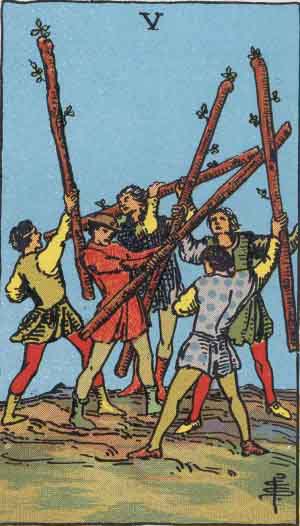
When the Five of Wands repeats, energy is meeting energy without a settled order. The central question is whether the friction is useful contest, avoidable conflict or a signal that too many legitimate claims are competing for the same limited capacity.
Core Repeating Message
The Five of Wands shows five young figures, each holding a wand, each apparently in contest with the others. The scene is active, chaotic, full of motion. Whether it depicts actual conflict or competitive play is ambiguous; what is clear is that every person in the image is pushing and being pushed back, that no single direction is winning, and that the energy in the scene is substantial but not producing anything singular or clear.
When this card appears once, it may describe productive challenge, ordinary competition, confused coordination or open conflict. When it repeats, attention shifts from the isolated disagreement to the recurring structure: how energy becomes fragmented, how contest is escalated or avoided, and whether the field has any agreed way to convert difference into progress.
One common pattern is the seeker whose fire is present but consistently divided among competing directions, none of which receives enough sustained attention to develop into something real. The ideas matter; the impulses and desires are sincerely felt. But there are too many of them simultaneously active, and the dynamic between them is one of competition rather than integration. Each claim on the seeker’s energy interrupts the others. The wand lifted for one direction is immediately challenged by another. The result is significant expenditure of energy across multiple fronts, none of which advances, and the seeker experiences this as either an excess of possibility or a deficit of discipline, when it is actually the pattern of fragmentation that the card is marking.
A second pattern belongs to the seeker who generates friction in collaborative or creative environments without entirely understanding why. This seeker has fire; they bring energy to every context they enter. But the energy consistently produces contest rather than coalition. Others find them stimulating and exhausting in equal measure. Creative projects become debates. Collaborative efforts become competitions. The seeker’s fire is real but has not yet been separated from the pattern of challenge and counter-challenge that characterises the Five, and the pattern produces an environment around them that mirrors the scene on the card.
A third pattern is the seeker whose inner life is the site of the contest: who carries multiple desires, each legitimate and deeply felt, and who cannot integrate them because the form in which they are held has them competing for the same limited resource of attention, time, or creative investment. The creative vision contests with the vocational obligation. The desire for expansion contests with the desire for roots. The impulse to make something new contests with the responsibility of what has already been made. Each matters. The contest between them is what the card keeps marking, and the contest is not being resolved because the resolution would require a conscious choice about priority that the seeker has not yet made.
A fourth pattern belongs to the seeker who has grown up in environments where competitive striving was the primary mode of forward movement: where achievement was measured against others, where attention was won rather than given, where the contest was the structure through which fire was expressed and recognised. This seeker knows how to push, how to compete, how to raise the wand in the space where others are raising theirs. What they may not yet know is how to direct the fire in the absence of opposition, how to build in a space where no one is pushing back, how to sustain the creative flame when the competition that previously organised it is no longer the structure of the situation.
What all these patterns share is a relationship to directed creative fire: the fire is present and substantial, but it is being dispersed, contested, or fragmented rather than gathered into a single sustained direction. The card returns because the underlying dynamic of the contest has not yet been understood, and understanding it is what would allow the fire to move.
When This Card Repeats Weekly
A week of Five of Wands repetition marks an immediate period of friction and competing demands: multiple things are pushing on the seeker’s attention and energy simultaneously, and the quality of that pushing is making sustained direction in any single one of them difficult to maintain.
This might be literal: multiple pressing demands arriving simultaneously, a creative or vocational environment generating friction, a relationship or collaborative setting currently organised around contest. Or it might be internal: a week in which the seeker’s own competing desires or obligations are particularly audible, each pulling the wand in a different direction.
The weekly repetition is not asking the seeker to resolve the contest immediately. It is asking them to notice it clearly: what specifically is competing for the fire this week, and is any of the contest necessary or productive? Is the friction serving something, or has it become the condition of the field?
When This Card Repeats Monthly
A month of Five of Wands repetition suggests that the pattern of fragmentation and contest has stabilised across multiple contexts rather than being a response to a single particularly demanding week. The seeker is consistently in the Five energy: consistently surrounded by competing demands, consistently generating friction in creative or collaborative contexts, or consistently unable to gather their fire into any single direction because the contest between multiple legitimate priorities is always louder than any single one.
The monthly lens asks: what are the specific things competing for the seeker’s creative fire right now? Not in the abstract but in the concrete events of the past month. Where has friction consistently arisen? What competing demands have consistently interrupted sustained direction? And is there a common thread in what keeps generating the contest?
A month of this card also frequently marks the seeker whose creative life is in a period of reorganisation: where old structures have loosened and the seeker’s fire has not yet found its new shape. The scramble of the Five can precede clarity about direction; the contest between multiple possibilities is sometimes the way priority eventually becomes clear.
When This Card Repeats Seasonally
A season of Five of Wands energy marks a sustained period in which the seeker’s characteristic pattern of dispersed or contested creative fire is asking for examination and reorganisation. The season is long enough to see not just individual instances of friction but the pattern beneath them: the dynamic that keeps producing contest and fragmentation rather than gathered, directed creative vitality.
A central question a Five of Wands season raises is this: what would it mean to choose one direction over the others? Not to foreclose the others permanently, but to consciously gather the fire towards one thing for long enough to allow it to develop past the initial stage at which it is most easily interrupted by competing claims.
A season of this card also invites the seeker to examine the role that friction and contest play in their sense of their own aliveness. For some seekers, the energy of competition is itself a source of vitality: the push-and-pushback of the Five is not just an obstacle but a form of stimulation. The question is whether that stimulation is currently serving development or whether it has become the condition the seeker generates because they do not yet know how to sustain their fire without the structure of opposition.
When This Card Repeats Across Years
The Five of Wands returning across years names a seeker for whom the pattern of fragmented, contested, or dispersed creative fire is a long-arc dynamic: who has, across multiple phases of their life, consistently found their energy divided among competing directions, consistently generated friction in creative or collaborative contexts, or consistently been unable to gather the fire into sustained single-direction development.
One possible origin is an environment in which attention, resources or influence were routinely contested. Another is repeated participation in workplaces, communities or relationships where roles and decision rights were unclear. The card cannot determine which history applies. It invites the seeker to identify where competition was learned, where it remains structurally real and where it is now being reproduced by habit.
The multi-year Five of Wands also marks the seeker who has developed, over time, expertise in managing competing demands while having less experience of singular focus. The seeker can operate successfully in the chaotic field; what they have not yet practised is stepping out of the field and directing the fire towards a single chosen thing without the organising structure of external competition or internal contest.
Across years, the growth arc this card traces is towards creative sovereignty: the capacity to direct fire from inner authority rather than from the dynamics of the contested field.
Life Area Interpretations
Love & Relationships
In love and relationships, the Five of Wands most often marks either the seeker whose relational life is characterised by consistent friction and contest, or the seeker whose relational fire is consistently competing with other legitimate claims on their energy and unable to find sustained direction.
The relational friction pattern produces relationships in which warmth and contest are thoroughly intertwined: where connection is experienced primarily through the push-and-pushback, where intimacy requires opposition to feel alive. This can be stimulating in early stages of a relationship; when it persists as the primary mode, it can eventually exhaust both parties.
The competing-claims pattern produces the seeker who wants a deepened relational life but consistently finds that the time, attention, and energy that relational development requires are in direct competition with other equally legitimate claims: the creative work, the vocational obligation, the inner contest about what kind of relational life they actually want. The relational fire is present and real; it simply cannot find sustained direction because something is always pushing back from another direction.
Career & Purpose
In career and purpose, the Five of Wands is one of the most recognisable patterns: the seeker whose vocational life is characterised by too many directions simultaneously active, each legitimate, each claiming priority, none receiving enough sustained investment to develop fully.
This seeker may have multiple vocational possibilities and consistently experience their multiplicity as the primary obstacle to vocational development. Each possibility is real; the contest between them prevents any from being fully pursued. The seeker knows what they want, in aggregate, but the work of choosing and committing is consistently deferred because it would mean acknowledging the competing claims rather than holding all of them simultaneously.
The card in vocational contexts also marks the seeker who generates productive friction in their professional environment, who challenges and is challenged, who functions well in debate and contest but who struggles with the demands of sustained collaborative building in the absence of opposition.
Money & Stability
In financial contexts, the Five of Wands may reflect competing claims on limited resources: essential bills, debt, savings, dependants, business costs or several income strategies demanding attention at once. The card does not determine which claim has priority.
The card may also mark the seeker who has financial drive, desire and capacity to build financial stability, but who consistently finds that fire dispersed across too many simultaneously active financial directions: multiple income streams, multiple investment strategies, multiple competing financial priorities, none of which is receiving the sustained attention it would need to develop.
The practical question is what must be protected first, what can be reduced or deferred, and which assumptions need figures rather than intuition. Where the stakes are material, use a written budget and qualified financial, legal or debt advice as appropriate.
Spiritual Growth
In spiritual growth, the Five of Wands may describe tension among different beliefs, communities or practices. Breadth is not inherently shallow, and a seeker does not need to force one tradition into exclusive authority. The issue is whether exploration is producing understanding or preventing any practice from being examined with enough continuity to reveal its effects.
The spiritual Five can describe a seeker drawn to several paths, with sincere resonance in more than one tradition, who has not yet distinguished a calling worth pursuing in depth from an intellectual appetite for variety. Both the interest and the competing possibilities may be real. The question is whether one chosen practice could receive enough sustained attention to develop depth, without requiring the seeker to reject every other source of meaning.
The card may also mark the seeker whose spiritual life is contested: who carries conflicting beliefs, or whose spiritual intuitions are in tension with the framework they inherited, and who has not yet done the work of honestly distinguishing what they believe from what they have been told to believe.
Emotional & Mental Patterns
The Five of Wands in emotional and mental patterns can symbolise the felt noise of competing priorities, desires and obligations. The result may be restlessness, indecision or overwhelm, but the card does not diagnose anxiety or establish its cause. Persistent distress or impaired functioning deserves appropriate support.
This inner contest may extend beyond a single overwhelming situation. One way it persists is through holding every possibility in active competition rather than choosing among deeply felt desires and accepting the grief of those set aside. Each possibility stays alive, but none receives enough attention to develop. That pattern can coexist with real responsibilities that cannot simply be dropped.
The emotional quality is a kind of exhaustion: not the depletion of someone who has given too much to a single thing, but the particular drain of someone who is holding too many things in simultaneous active tension.
Family & Generational Dynamics
In family dynamics, the Five of Wands may invite inquiry into whether attention, resources or influence were commonly obtained through competition. High sibling rivalry, unclear adult boundaries or conflict as a primary mode of engagement can provide a template for later life. They do not produce one inevitable adult pattern, and the card should not be used to assign blame or reconstruct events without evidence.
Where this dynamic has been inherited, it can involve difficulty imagining a creative, vocational or relational field that is not organised by contest: where space, attention and resources are not things to be competed for but things that can be shared and sustained. The seeker’s fire has learned to express itself in relationship to opposition, and the absence of opposition produces not ease but a disorienting formlessness.
The generational work the card marks is developing the capacity to direct fire from a position of inner authority rather than from the structure of the contested field.
Health & Energy
In health contexts, the Five of Wands may symbolically reflect feeling pulled in several directions, braced for the next competing claim or unable to find a period of quiet. Tarot cannot identify nervous-system states, explain physical symptoms or diagnose a condition.
If conflict and overload coincide with tension, fatigue or sleep disruption, note the timing without assuming causation. A familiar level of alertness can be easy to overlook, so describe what you actually notice rather than assuming it is simply how you must feel. Workload, health conditions, environment and many other factors may contribute. Persistent or concerning symptoms deserve professional assessment.
A short reduction in non-essential demands can serve as a safe experiment. Observe whether the felt load changes, including any sense of easing or remaining braced, and use that information to plan capacity. Lack of improvement is also information and should not be treated as a failure of insight.
Advanced Interpretive Sections
The Shadow Expression
The Five of Wands in shadow produces the seeker who has become so identified with the contested field that they actively recreate it wherever they go. The contest is no longer a response to circumstance; it is the condition the seeker generates because the contest is where they know who they are. Collaboration that is not generating friction begins to feel flat; creative environments that are not competitive begin to feel uninspiring; relationships that are not characterised by push-and-pushback begin to feel insufficiently alive.
The shadow also produces the seeker who uses the complexity and friction of the contested field as a permanent legitimate reason why sustained direction in any single thing is not currently possible. The field is too full. Too many things are competing. The time will come for focus when the situation settles. The situation does not settle because the seeker is among its primary architects.
The Integrated Expression
The integrated Five of Wands seeker has developed the capacity to engage fully with competing demands and conflicting perspectives without being disoriented or dispersed by them. They can enter the contested field, contribute their wand to the contest, and then make conscious choices about where to direct sustained fire rather than continuing to hold every direction simultaneously.
This seeker’s relationship to friction has matured from reactive contest to discernment: they know the difference between productive challenge that serves development and the reflexive raising of wands that merely sustains the familiar texture of the crowded field. They can choose collaboration when it serves and competition when it serves, and they have the capacity to sustain direction without requiring opposition to feel alive.
Why This Energy Has Not Released Yet
The Five of Wands pattern may persist when priorities remain implicit and every claim is allowed to present itself as equally urgent. It can also persist because authority is unclear, resources are genuinely inadequate or several responsibilities cannot ethically be abandoned. Resolution begins with naming these different conditions rather than reducing all conflict to a failure to choose.
The pattern can also persist when the seeker has not yet examined the function that the contest serves: what it provides in terms of aliveness, identity, stimulation, or protection against the vulnerability of singular commitment. The contest may be doing more than creating a problem; it may be meeting a need. Identifying that need can make it possible to meet it without continually recreating the contest.
Finally, the pattern persists when the seeker has not yet developed tolerance for the grief involved in choice: the honest acknowledgement that choosing one direction means, for now, not fully pursuing the others. The Five pattern is often sustained partly by the pain of that acknowledgement, and the maintenance of the contest is one way of deferring the pain indefinitely.
What This Card Wants the Seeker to Understand
The Five of Wands wants the seeker to understand that the energy in this image is not the problem. The five figures have fire, and the contest between them is alive. What the card is marking is the pattern in which that aliveness is being dispersed rather than gathered, contested rather than directed.
The card is not asking the seeker to extinguish any of the desires or impulses that are currently competing for their fire. It is asking whether any one of them, given the priority of focused attention, would reward that attention in ways the sustained contest cannot. The fire wants a direction. The question is which one, and whether the seeker is willing to choose.
Signs the Pattern Is Beginning to Resolve
The Five of Wands pattern begins to resolve when the seeker begins to make conscious, specific choices about which competing direction will receive their fire: not the abstract commitment to prioritise better, but the actual decision, made in the context of particular competing demands, to direct sustained attention toward one and consciously set another aside.
It also resolves when the seeker begins to notice the difference between friction that is productive and friction that is the habitual recreation of a familiar contest. This distinction, when it becomes available in practice, allows the seeker to engage with challenge while no longer generating unnecessary opposition.
And it resolves when the seeker develops tolerance for the periods of creative life when the field is not crowded, when focused direction in a single thing produces a quality of sustained aliveness that the contested field does not.
Reflective Questions
-
What are the specific things currently competing for your creative fire? Make a list, without yet trying to prioritise them. How many of them are genuinely competing, and how long has this particular set of competing demands been active?
-
If you were forced to choose one direction for your creative fire and set the others aside for the next six months, which would you choose? And what specifically makes this choice difficult?
-
Is there a pattern across multiple periods of your life in which the structure of competition or contested attention has been the primary texture of your creative or vocational environment? What is consistent across those periods?
-
Do you generate friction in creative or collaborative contexts? Not as self-criticism but as honest observation: do projects and relationships in your life consistently develop a contested quality, and if so, what do you contribute to that quality?
-
What does the contest give you that focused direction in a single thing does not? Be honest about what the multiplicity of competing wands provides in terms of stimulation, safety, or protection.
-
When you imagine having resolved the inner contest and gathered your fire toward a single direction, what is the predominant feeling? Relief, grief, aliveness, flatness? Each feeling is useful information.
-
What did your early family environment teach you about competing for what you needed? Were attention, resources or recognition things you had to compete for, and if so, how might that experience have shaped the way your fire currently moves?
-
Is any part of the current contest productive and generative in the way that productive friction can be? Or has the contest become the condition of the field rather than a stage in a process that moves somewhere?
-
What would you need to release, in concrete terms, in order to gather your fire toward a single direction? Not as a permanent foreclosure but as a present choice?
-
If the Five of Wands has been appearing for a sustained period, what specifically has it been marking as the central contest? And what specific thing has been making resolution of that contest feel impossible?
Practical Integration Actions
Map the competing claims. Write out specifically every direction currently competing for your creative fire: every project, obligation, desire, possibility, and impulse that is actively pulling on your attention. Include the ones that seem too small to matter; they count in the total. The exercise is to see the full scope of the contest rather than managing each competing claim in isolation.
Practise the genuine choice. From the list you have made, identify the one direction that would receive your fire first if you were choosing a priority. Write specifically about what focused attention on this direction would look like: what it would require, what it would produce, and what would have to be set aside. This is not a permanent life decision; it is a specific present choice about where you want to direct your fire.
Examine the role of friction. Write honestly about what the contest provides that directed focus in a single thing does not. What quality of stimulation, aliveness, or identity does the contested field produce? This is not a blame exercise; understanding the function of the pattern can help you find alternatives to it that do not require simply suppressing what the pattern was providing.
Reduce one competing claim. Identify one lower-priority claim that is consuming disproportionate attention. Check first for duties, dependencies, consent and foreseeable harm. Then reduce, delegate or time-box it for one month where that is workable and safe, or for a shorter explicitly defined trial if your circumstances require it. Record what capacity is released and what consequences actually follow before deciding whether the change should continue.
Create a condition of genuine focus. Once in the coming week, create conditions in which one chosen direction has access to your fire for a defined and protected period. This might be two hours, it might be a morning, it might be a single day. Arrange cover for duties that cannot be deferred, and during that period set aside the other non-essential claims. Remain available for safety-critical needs. Notice the quality of creative attention that singular focus produces, and use that experience as the reference point for what your fire is capable of when the contest is reduced.