
When this card appears again and again, the question is not whether you need solitude: it is whether the solitude is becoming wisdom, or whether it is becoming shelter.
Core Repeating Message
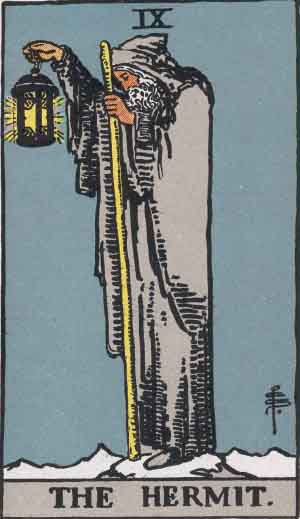
The Hermit stands at the peak of a mountain in mid-winter, robed in grey, holding a lantern aloft into the darkness. He does not look lost. He does not look lonely, at least not in the ordinary sense of the word. He is entirely alone, and he is entirely present in that aloneness, as though this is where he has always been going, as though the mountain was the destination and the lantern was always in his hand. In the lantern burns a six-pointed star, the seal of wisdom, and the staff in his other hand is not for defence but for the steadiness of a person who has walked a great deal and knows how to carry their own weight.
He is not hiding. This is the first and most important thing to understand about The Hermit. The lantern is raised, not cupped. It is held at shoulder height, directed outward into the darkness ahead. The wisdom gathered in solitude is not being hoarded; it is being offered. The Hermit is a guide. He has gone ahead so that others, when they reach this passage, will have a light to follow.
This distinction matters enormously when the card repeats, because it marks the line between The Hermit’s genuine invitation and its shadow.
The genuine invitation of The Hermit is one of the most valuable things any human life can receive: a call towards deep, honest engagement with one’s inner life. The kind of knowing that grows through sustained solitude, away from the noise of consensus reality, other people’s expectations, the social performance of the self, and the relentless chatter of external stimulation. When the card appears, it is marking a period in which the seeker’s own interior, their own examined experience, their own developed and tested understanding, is what is most needed. And it is suggesting that the conditions for that knowing require some form of genuine withdrawal, not necessarily from society entirely, but from the particular forms of distraction, performance, and external orientation that have been preventing genuine inner encounter.
But The Hermit’s repetition also marks one of the more common and more painful ways a genuine gift becomes a defence mechanism, which is the transformation of necessary solitude into permanent shelter.
The seeker who cannot return from the mountain, who has found that the mountain is safer and quieter and less demanding than the valley, who has refined their interior life to a considerable degree but in service of never having to bring it into genuine contact with anyone, is not living The Hermit’s teaching. They are living its shadow. The lantern is turned inward. The light is beautiful, and it is warming no one but themselves.
When The Hermit repeats, the first question is always about the quality and the purpose of the solitude that is present in the seeker’s life. Is there enough? Is there too much? Is it genuine retreat, or is it sophisticated avoidance? Is the wisdom being gathered being lived, or only contemplated? Is the lantern raised, or cupped?
There are several distinct recurring patterns this card tends to mark.
The first is the called retreater: the seeker who genuinely needs to withdraw, who is being asked by their own development to pull back from the noise of external life and do something that can only be done in genuine quiet, and who is resisting this call because withdrawal feels like failure, like giving up, like admitting that the outer world has been too much. This seeker may be surrounded by people and commitments and stimulation, and may be managing all of it adequately by external measure, but there is an exhaustion in them that does not respond to ordinary rest, a hollowness that social engagement does not fill, a sense that something important is trying to surface that cannot be heard over the ambient noise of their life. The card appearing repeatedly here is not a criticism. It is a direction: inward, quieter, and with more seriousness than has been given to the inner life recently.
The second pattern is the unreturnist: the seeker who has retreated, genuinely and perhaps usefully, and who is now past the period in which withdrawal is serving growth. They have gathered real wisdom in their solitude. They have done genuine interior work. And they are staying anyway, because the mountain has become comfortable in a way the valley no longer is, because they have forgotten how to be with people and the forgetting has become its own kind of inertia, because the thought of bringing their developed inner life into contact with real, messy, unpredictable human community is more frightening than the thought of remaining on the peak indefinitely. The Hermit appearing here is not asking them to abandon the inner life; it is asking them to complete the arc. To bring the lantern down.
The third pattern is the accidental hermit: the seeker who has arrived at significant solitude not through choice but through circumstance, through loss, illness, geographic isolation, the collapse of a social world they had taken for granted, or the long slow erosion of connection that sometimes happens without any single dramatic event. They are alone, and they are not sure whether this is where they should be or where they have ended up. The card repeating here is asking them to be more deliberate about the solitude than circumstance has made them: to examine what it is genuinely offering and to take that seriously, while also examining what it is withholding and whether that withholding is a choice or a drift.
The fourth pattern is the wisdom-hoarder: the seeker who has developed a rich, complex, and genuinely insightful interior life and whose primary relationship with that life is private. They know a great deal. They have thought carefully about existence, about meaning, about human nature. They are the person others sense as deep, even when they can’t quite articulate why. And they share almost nothing of this, not from false modesty, but from a combination of introversion, selectivity, and the lingering sense that genuine understanding cannot survive contact with ordinary communication. The lantern is full but it is cupped. The Hermit here is asking: who is the light for?
Beneath all of these patterns is the card’s central repeating question: what is the relationship between the seeker’s inner life and their life in the world? Not how much solitude is optimal, not how much socialising is expected, but the quality of the relationship between the two. The Hermit’s teaching is that genuine wisdom, genuine inner knowing, needs a relationship with life beyond the self. It finds that relationship through some form of expression, transmission, or lived action; without it, it risks turning in on itself and becoming a kind of spiritual narcissism: exquisitely developed and entirely self-referential.
Nine is the number of completion in most numerological traditions: the end of the single-digit cycle, the place of fullness before the wheel turns. The Hermit carries the gravity of completion. Something is being concluded, digested, brought to its natural end. The withdrawal he embodies is not the withdrawal of the beginning of a journey but the withdrawal of someone who has been travelling for a long time and has come to the place where the travelling is done for now, and the understanding of what has been learned must be gathered and consolidated before the next movement begins.
For the seeker who keeps drawing this card, the work is not solitude itself but what solitude is for: the honest, careful, unglamorous task of examining one’s own experience with clear eyes and genuine courage, developing a relationship with one’s own knowing that is not dependent on external validation, and finding, eventually, the particular form in which the light gathered in that aloneness can be carried into the world and held aloft for others.
This is the card’s repeating gift: not escape from the world, but a path to genuine presence within it, prepared by the depth and honesty of what has been developed in the necessary aloneness.
When This Card Repeats Weekly
A week of Hermit repetition is a week that is asking, persistently and probably somewhat urgently, for more genuine interior space than the seeker has been creating or allowing.
This does not necessarily mean more hours of formal solitude, though it may. It means the quality of attention that is available when the seeker is alone with themselves: whether the phone is always in hand, whether silence is routinely filled with noise, whether genuine interior quiet ever actually arrives in the day’s structure or whether it is perpetually deferred to a later, quieter time that never quite comes.
Hermit weeks ask the seeker to create at least one genuine encounter with their own inner life each day: not as self-improvement, not as meditation technique, but as simple honest presence with oneself. What is actually happening for me today? What do I know that I have not yet allowed myself to articulate? What is pressing on the interior that has not yet had a moment of quiet in which to surface?
The week may also be registering genuine social exhaustion that has not been acknowledged. The Hermit appearing repeatedly in a week of high social or professional demand is not asking the seeker to withdraw from their commitments; it is asking them to notice the cost of those demands on someone who genuinely needs interior restoration, and to build some form of restorative solitude into even the most demanding week rather than waiting for the week to provide it.
When This Card Repeats Monthly
A Hermit month is one in which the seeker is being asked to take the inner life seriously as a primary orientation for this particular period. Not exclusively, not at the expense of all outer engagement, but as the primary lens through which the month is approached: what is my own knowing telling me, and am I listening?
Monthly Hermit energy tends to arise at periods of genuine life transition, when the old orientation is ending and the new one has not yet become clear, and the temptation is to fill the space between with activity, with new commitments, with other people’s opinions about what should come next. The card appearing monthly is asking the seeker to resist this temptation and to allow the not-yet-knowing to be present for longer than is comfortable, because genuine discernment cannot be rushed.
It can also arise in months following significant loss or disorientation, when the seeker has withdrawn somewhat from their ordinary life simply because their ordinary life no longer quite fits, and the card is acknowledging this withdrawal as appropriate and necessary while also gently ensuring that the seeker remains in relationship with the lantern’s purpose: this withdrawal is for something. What is being gathered?
A monthly Hermit period is also worth examining for signs of drifting isolation: the gradual withdrawal from connection that is not deliberate but accumulated, week by week, until the seeker looks up and realises they have not genuinely engaged with another person in some time. The card appearing here is both validation and gentle challenge.
When This Card Repeats Seasonally
A season of Hermit energy is a significant developmental period: the card suggests a sustained, deliberate withdrawal into the interior that may leave the seeker with understanding difficult to reach amid the ordinary demands of life.
Hermit seasons tend to align with the natural rhythms of retreat: they often occur in winter, or in the periods of life that function like winter, when the world outside is not particularly hospitable and the fire within is the primary source of warmth and light. They also occur after the completion of a major life chapter, when the full weight of what has been experienced needs time to be digested before the next chapter can begin.
What a Hermit season can offer, if genuinely engaged with, is a quality of self-knowledge that sustained honest encounter with one’s own experience makes more available. This is not only the immediate processing of daily events but the deeper, slower digestion of a life’s accumulation: what has actually been learned, what genuinely matters, what can be released, and what becomes easier to recognise when ordinary noise recedes.
The risk of a Hermit season is the drift into stagnation: withdrawal becoming permanent, the interior life becoming increasingly self-referential, the quality of discernment becoming so refined that it applies only to itself. The seasonal marker suggests that the Hermit energy has a natural term: it is for this season, and then the lantern is to be carried down the mountain and offered.
When This Card Repeats Across Years
The Hermit appearing across years is one of the most significant and quietly demanding long-arc patterns in the Major Arcana. It suggests that the seeker has a fundamental and sustained encounter with solitude, inner knowing, and the question of what to do with wisdom, and that this encounter is not a temporary phase but a recurring and central feature of their spiritual and personal development.
Across years, this pattern most often belongs to seekers of a particular temperament: the natural introvert whose inner life is unusually rich and whose engagement with external life has always been selective and deliberate; the seeker who came through early experiences that taught them the inner life was safer than the outer, and who has developed a rich internal world partly as a result; the person who is genuinely called to a contemplative vocation of some kind, whether formally religious, creative, intellectual, or healing, in which solitude is not a retreat from life but a fundamental condition of the work.
It also belongs to seekers who have spent decades in the world and who are now, in the later chapters of their life, in a genuine Hermit season: consolidating, digesting, discerning what has been real and what has been performance, finding the particular quality of inner light that is genuinely theirs rather than borrowed from others.
Across years, the growth arc The Hermit traces is from withdrawal as refuge to solitude as mastery. The early Hermit seeker withdraws because the world is difficult and the interior is safer. The maturing Hermit seeker withdraws because the interior is genuinely more interesting, and the wisdom gathered in that engagement becomes increasingly the substance of what they offer to the world. The late Hermit seeker holds the lantern without self-consciousness: they know what they know, they know how they came to know it, and they hold it openly and without either performance or withholding.
The years-long Hermit persistently asks for, and ultimately rewards, the development of genuine inner authority: the capacity to know what one knows without external confirmation, to trust the slow accumulation of examined experience as a valid and reliable guide, and to inhabit one’s own understanding with the same quiet certainty the figure on the mountain embodies.
Life Area Interpretations
Love & Relationships
In love and relationships, The Hermit’s repetition tends to mark one of the most nuanced and sometimes most painful dynamics available: the seeker whose inner richness and relational reticence are in genuine tension.
The Hermit seeker in relationship often presents as someone who is deeply present in some ways and mysteriously unavailable in others. They may be perceptive, genuinely attentive, and capable of the kind of quality presence that comes from someone who has developed real interior depth. And they may simultaneously be very difficult to reach at the level of genuine personal disclosure, to know in the way that intimacy requires, to draw out of the inner world and into the shared one. Their partner may feel the presence of something rich and real just beyond the lantern’s glow and not quite be able to reach it.
This is rarely deliberate and rarely simple. The Hermit seeker in relationship is often genuinely uncertain about how much of their inner life can be shared without losing the quality of it. They have developed their interiority in solitude, and the thought of bringing it into the full light of mutual knowing sometimes feels threatening in ways they cannot easily articulate: as though the depth of it depends on its privacy, as though understanding shared is understanding diminished.
The card appearing repeatedly in a relational context is asking the seeker to examine this belief carefully. Genuine intimacy does not diminish depth; it tests it, and depth that can survive the test of genuine mutual knowing is more real than depth that requires protection to exist. The Hermit is not asking the seeker to expose everything or to abandon their genuine need for interior space. It is asking them to find the place where the lantern can be held between two people, illuminating the shared terrain, rather than held exclusively inward.
For the seeker who is single and consistently drawn to solitude over partnership, The Hermit appearing repeatedly is not a confirmation that solitude is what they are meant for. It may be, genuinely; some people are called to a life of primarily solitary engagement and this is not a lack. But the card’s repetition is asking them to examine the distinction between genuine vocation and comfortable avoidance: whether the solitude is the life they are choosing from their deepest self or the life they have drifted into because genuine connection requires a quality of vulnerability and relational risk that the mountain does not ask for.
Career & Purpose
In career and purpose, The Hermit’s repetition often marks a seeker who is carrying a depth of experience, knowledge, or insight that has not yet found its form of expression in the world.
The Hermit career pattern tends to belong to the person who has spent a significant period in development: studying, researching, practising, accumulating experience and understanding in whatever their domain is, and who is now at the point where the wisdom they have gathered needs to move from private accumulation to genuine offering. The internal work is done, or done enough. The lantern is full. What has not yet happened is the raising of it.
This may look like the writer who has been working on material for years and has not yet offered it; the therapist or coach who has developed significant craft and insight but whose practice is smaller than their capacity; the teacher whose understanding of their subject has outgrown the scope in which they are currently teaching; the healer whose own healing work has generated a body of experiential wisdom that is not yet in service. The Hermit in these contexts is asking: who is this for? When does it leave the mountain?
For seekers in career crisis or transition, The Hermit is often asking for a more deliberate period of genuine reflection before the next chapter begins. The instinct in career difficulty is usually to respond quickly: to update the CV, to network, to move as fast as possible toward the next opportunity. The card repeating here is asking the seeker to pause long enough to examine what the crisis is actually revealing about what has not been working, not just logistically but in terms of genuine alignment between the work being done and the seeker’s actual values, genuine interests, and developing sense of purpose.
Purpose and The Hermit have a particularly important relationship. The Hermit’s purpose is not separate from his wisdom; it is constituted by it. The wanderer who has become the guide has not changed careers; they have discovered what the wandering was always building toward. For seekers asking about purpose, the card appearing repeatedly is suggesting that the answer is not outside and ahead but inside and behind: in the accumulated, examined, often undervalued understanding that has been quietly building through every experience the seeker has had.
Money & Stability
The Hermit tends to approach money in a non-transactional spirit, which is both a genuine orientation and an occasional practical difficulty.
The Hermit seeker often has a relationship with money that reflects their relationship with the material world more broadly: it is acknowledged as necessary but it is not the primary organising principle of their choices. They may make professional decisions that prioritise meaning, freedom, or the quality of their interior life over financial optimisation, and they may be at peace with this most of the time. The difficulty arises when this orientation becomes a form of magical thinking: the belief that if one is genuinely doing meaningful work, the material dimension will take care of itself, or the avoidance of careful financial attention on the grounds that engagement with money is somehow beneath the level of their concerns.
When The Hermit repeats in financial contexts, it is often asking the seeker to bring the same quality of honest, careful attention to their material life that they bring to their inner life. Not to change their values, not to become primarily financially motivated, but to stop treating the material dimension as something other people manage while they pursue the interior. The lantern illuminates the path the seeker is actually walking, including the ground beneath their feet.
The Hermit’s financial gift is a particular form of simplicity: the ability to live well on less because the inner life is genuinely rich and does not require external stimulation to sustain it. This is a genuine advantage when deliberately chosen. It becomes a difficulty when it is a rationalisation for not attending to the practical realities that any life in the material world requires.
Spiritual Growth
The Hermit is, in many ways, the spiritual card of the Major Arcana. Not because spirituality requires solitude, though for many seekers it benefits from it, but because The Hermit embodies the qualities that genuine spiritual development requires: the willingness to examine one’s own experience honestly, the discipline to pursue understanding that is genuinely one’s own rather than borrowed from external authority, the patience to allow deep knowing to emerge slowly, and the eventual courage to offer what has been found to others rather than keeping it for oneself.
When this card repeats in spiritual contexts, it is often marking one of two phases. The first is the active withdrawal phase: the seeker is being called to go deeper into their own direct experience rather than continuing to import their spiritual understanding from teachers, traditions, or community. This is not an anti-tradition position; it is an invitation to supplement received wisdom with personal, embodied, tested knowing. The seeker who can only understand their spiritual life through the language of a particular teacher has not yet completed The Hermit’s task.
The second phase is the integration phase: the seeker has done significant interior work and is now being asked to bring it into genuine relationship with the world. The spiritual practitioner who remains on the mountain indefinitely is not, in The Hermit’s teaching, more advanced. They are incomplete. The lamp is for others. The wisdom is for the valley as much as for the peak.
The Hermit’s particular spiritual gift is the development of what might be called inner authority: the capacity to know what one genuinely understands, as distinct from what one has been told to believe, what is intellectually interesting, or what one would like to be true. This quality of discernment is not arrogance; it is earned through long, honest encounter with one’s own experience. And in The Hermit’s teaching, it is a necessary stage in genuine spiritual maturity: the point at which the practitioner is no longer sustained primarily by external structures but by their own genuine relationship with what they have come to understand.
Emotional & Mental Patterns
In the emotional and mental domain, The Hermit’s repetition tends to mark a particular style of interiority that has genuine gifts and genuine costs.
The Hermit seeker in the emotional domain is often a careful, reflective processor: someone who does not react quickly, who takes time to understand their own responses, who is capable of genuine emotional insight and whose understanding of their own inner life has often deepened through sustained reflection. They tend to pause rather than react impulsively. They try to understand emotion before acting on it. They have developed a quality of emotional discernment that is a genuine asset.
The cost of this pattern, when The Hermit is in its more closed or defended expression, is the tendency to over-process at the expense of simply feeling. The Hermit seeker can sometimes disappear into such thorough interior analysis of an emotion that the emotion itself never quite arrives: they have understood it, categorised it, placed it in narrative context, and found its developmental origins before they have ever simply been sad or angry or afraid. The lamp illuminates what it points at, but it also keeps the holder at a certain remove from the darkness it penetrates.
Mentally, The Hermit can describe seekers who think carefully, deeply, and with unusual capacity for sustained independent inquiry. They can follow a thread of understanding through its complexities over a long period without losing it. They can sit with genuine uncertainty without rushing to premature resolution. They read carefully, reflect seriously, and come to conclusions they have genuinely earned. The shadow of this is the tendency toward excessive mental self-sufficiency: the conviction that their own thinking is always the most reliable guide, a resistance to genuine intellectual challenge or influence, and occasionally the lonely certainty of someone who has thought their way to a position that no one around them shares.
Family & Generational Dynamics
The Hermit’s presence in family contexts tends to mark two distinct dynamics. The first is the seeker who came from a family in which genuine solitude and interior life were not valued, modelled, or permitted, and who has spent their adult life learning, sometimes against significant internal resistance, to take their own inner life seriously as a primary resource. The second is the seeker who has been the family’s designated wise one, the one others have come to, the keeper of the family’s understanding, and who is now examining whether this role was genuinely a calling or a burden that foreclosed on other aspects of their development.
In families that treated solitude as suspicious or selfish, the Hermit seeker grew up without models for how to inhabit their own interior. They may have been gregarious on the surface while privately starving for genuine quiet. They may have learned to associate their need for solitude with shame, as anti-social or self-absorbed, and to override it so consistently that they lost contact with what it was trying to give them. The card appearing repeatedly in such a seeker’s life is engaged in the long work of legitimate rehabilitation: teaching the seeker, often decades late, that the inner life is not a luxury or a failure but a genuine necessity.
Generationally, The Hermit often carries questions about what was not transmitted: what elders may have understood but did not say, what lived in silence rather than speech, and what forms of reflection were not modelled because the family had little language or space for them. For some Seekers, drawing this card repeatedly suggests becoming the first in their line to take the inner life seriously, to cultivate a contemplative depth that was not visible in their inheritance, and to offer that quality to those who come after them. This is a Hermit function: the light held aloft without claiming certainty about what previous generations privately knew.
Health & Energy
The Hermit’s energy in the body symbolically points towards restoration through reduced input. Some Seekers find that sleep alone does not address the depletion they associate with constant conversation, noise, decision-making, or digital attention. Silence, solitude, and periods without new demands may help them feel more settled and available to themselves. This is an experiential pattern rather than a physiological diagnosis, and ongoing fatigue or changes in functioning deserve appropriate professional assessment.
When this card repeats in health contexts, the most consistent question it is asking is about the quality of restoration in the seeker’s life. Not quantity of rest, though that matters too, but whether genuine restoration is occurring: whether there are periods of real quiet, real absence of stimulation, real privacy of interior experience that help the seeker recover from the demands of engagement.
For some Hermit seekers who have been pushed too long in high-stimulus, high-output conditions, depletion may feel like a gradual withdrawal of available energy. They may experience it as the accumulated cost of sustained over-engagement, especially when their need for interior space has gone unmet, but the card cannot establish its cause. Read symbolically, it asks whether something needs to change in the structure of daily life so that restoration is treated as a health need rather than a luxury.
The Hermit seeker also needs to be attentive to the possible health costs of their shadow pattern: the isolation that has gone past healthy withdrawal and into genuine disconnection. Extended periods of significant isolation, even for someone who genuinely loves solitude, can make social engagement harder and gradually narrow perspective when there is too little genuine encounter with minds and lives different from one’s own. The lantern needs to be taken down the mountain eventually, and the walk down can itself feel restorative.
Advanced Interpretive Sections
The Shadow Expression
The Hermit’s shadow is not loneliness. Its shadow is spiritual pride, which is the most difficult pride to recognise because it wears the face of wisdom.
In shadow, the Hermit seeker has developed considerable inner depth and has allowed this development to become a source of subtle superiority. They know things that others do not know. They have seen through the illusions that others are still living inside. They have done the work, in their estimation, that others have not been willing to do. And they hold this not as a gift but as a distinction, something that separates them from the ordinary world and justifies the separation.
This shadow can be very difficult to see clearly from the inside, because the understanding is often real. The Hermit in shadow is not always wrong about what they know. The problem is not the knowledge but what they are doing with it: using it to maintain distance from genuine engagement rather than to fuel genuine service. The lamp is being used to see how far they have come, not to illuminate the path for others.
A secondary shadow expression is the use of wisdom as a defence against intimacy: the seeker who knows so much about human nature, about psychology, about the dynamics of relationship, that they believe they can see exactly what is happening in any relational situation, name it with precision, and remain entirely unreached by it. They are the analyst of the feeling rather than the feeler of it. Their considerable understanding has become a form of armour, and the card appearing here is asking whether the understanding is genuinely lived or whether it is the most sophisticated form of avoidance the seeker has yet developed.
The Integrated Expression
The integrated Hermit is one of the most quietly formidable presences in any community: the person who has gone far enough into themselves to become genuinely useful to others. Not because they have all the answers, but because they have learned how to hold genuine questions. Not because they can tell others what to do, but because they have developed a quality of attentive, honest, non-judgmental presence that allows others to find their own clarity.
The integrated Hermit has made peace with their own nature: they know they need more solitude than most, they have structured their life to provide it, and they no longer experience this as isolation or failure but as the fundamental condition of the work they are here to do. The lamp is full. The staff is steady. And when others need a light on the path they are navigating, this is the person who knows how to hold it without getting in the way.
This seeker has also learned when to come down from the mountain, when the inner work of a particular period is complete and the wisdom gathered is ready to be offered. They do not cling to the peak. They have genuine affection for the valley, for the particular quality of encounter with other human beings that cannot be found in solitude, and they return to it with something to give. The oscillation between retreat and engagement is not conflicted for them; it is the rhythm of a life genuinely lived.
The integrated Hermit’s presence is characterised by a quality that is hard to name but immediately recognisable: the sense that they are saying what they actually think, that there is no performance in it, that the understanding they offer comes from a place of genuine encounter with reality rather than from received opinion or social positioning. This quality is a significant gift in a world that is saturated with opinion and thin on genuine discernment.
Why This Energy Has Not Released Yet
The Hermit’s pattern does not release when the seeker is doing the solitude without doing the knowing, or doing the knowing without doing anything with it.
The first form of this is the seeker who has created the external conditions of retreat, less socialising, more quiet time, perhaps some meditative practice, but who is not using that space for genuine interior engagement. They are in the quiet, but the quiet is passive: they are resting in it rather than working with it. The Hermit is not asking for passive quiet; it is asking for active, honest, sustained self-examination. Not comfortable self-reflection but the genuinely demanding kind: the kind that encounters what is actually there rather than what the seeker hopes to find.
The second form is the seeker who has done real interior work and has gathered real understanding but who has not found any form in which to offer it. The understanding has become self-contained, self-referential, increasingly abstract. The card appearing here is asking not for more introspection but for more expression: what form, however small and however private, can carry the understanding into the world? The journal that no one reads but that forces the seeker to articulate what they know. The conversation with a trusted person in which genuine insight is risked. The creative work that draws from the interior and offers it outward. The mentoring or teaching relationship in which the lantern is held for someone else.
The pattern also persists when the seeker has not yet developed what might be called the courage of their own knowing: when they have gathered genuine insight but do not trust it without external validation, or when they quietly defer to the received wisdom of their community even when their own examined experience suggests something different. The Hermit’s lantern is the seeker’s own light. Until they trust it to illuminate the path, the card will keep appearing to ask whether it has been raised yet.
What This Card Wants the Seeker to Understand
The Hermit wants the seeker to understand that genuine wisdom is not a destination but a quality of attention: a way of meeting experience that is honest, unhurried, and genuinely one’s own.
It wants them to understand that solitude is not the same as loneliness, that the difference between them is not determined simply by the presence or absence of other people: it can also depend on the quality of one’s own company. The seeker who is alone and genuinely present with themselves need not be lonely. The seeker who is surrounded by people but has no access to their own interior can feel profoundly lonely in a way that simply adding more company may not address.
The Hermit wants the seeker to understand that the inner life they have been developing is not an eccentricity or an indulgence but the foundation of everything they have to offer the world. The quality of presence, the depth of understanding, and the capacity for genuine attentiveness that they sometimes dismiss as nothing special or as simply part of their nature are genuine and significant gifts, and the world is not overflowing with them.
It wants them to understand that the lamp is not for them alone. That the years of interior work, the extended solitude, the long slow development of genuine discernment, have been building toward something that is meant to be offered, in whatever form is authentic to who they are. The monk who prays. The elder who witnesses. The writer who renders inner experience into language that others can see themselves in. The therapist who can be present with another’s darkness without flinching. The teacher who holds the flame steady while the student finds their own. Any of these, and many others: all Hermit functions, all expressions of the lamp raised.
Finally, The Hermit wants the seeker to understand that they are not too much in their interiority, and they are not failing by needing what they need. The world shaped for extroversion and constant stimulation does not know what to do with people who require genuine solitude to function. But the world’s ignorance of what they need does not mean the need is wrong. The mountain exists. The lamp is necessary. The seeker who keeps coming to this card is someone for whom these things are not metaphors but genuine orientations. That need is not, in itself, a pathology. It may be part of a vocation.
Signs the Pattern Is Beginning to Resolve
The Hermit’s pattern begins to resolve when the seeker notices that their solitude has become genuinely generative rather than simply protective: when they return from periods of interior quiet with something to show for it, new clarity, a creative piece, an insight they are prepared to share, a quality of renewed presence for others.
It resolves when the movement between solitude and engagement becomes more natural and less charged: when withdrawing does not feel like failure or abandonment, and returning does not feel like threat or capitulation, but both feel like parts of the same living rhythm.
It resolves when the seeker begins to share their inner life more readily, not exposing it wholesale but allowing it to be genuinely present in their relationships and their work, when the lamp begins to appear in the shared space rather than only in the private one.
It resolves when they notice that other people feel differently in their presence: more genuinely seen, more able to think clearly, more capable of honest encounter with their own experience. This is the Hermit function in operation, not because the seeker is doing anything deliberate, but because they have developed a quality of attentive, non-judging presence that is itself a gift.
And it resolves, finally, when the seeker can look at their own inner life with something approaching appreciation rather than ambivalence: when the depth and the seriousness and the need for genuine quiet are no longer experienced primarily as the things that make them different from others and difficult to be with, but as the ground from which everything genuine in their life has grown.
Reflective Questions
-
In your daily life right now, is there enough genuine interior space? Not rest, not entertainment, not even meditation necessarily, but the particular quality of honest, unhurried encounter with your own experience. If not, what is filling the space where it would be?
-
Think about the solitude that is present in your life. Is it chosen, is it circumstantial, or is it a drift? And when you are in it, what quality of engagement with your own interior does it produce?
-
What do you know from your own direct, examined experience that you have not yet fully trusted or fully offered? Where does the lamp get dimmed before it reaches others?
-
Is there a distinction you can draw between times when your withdrawal from the world has genuinely fed you and times when it has primarily sheltered you? What has been different between the two?
-
If your inner life were fully visible to the people closest to you, what would they see that they currently cannot? And what would it cost you to let that be seen?
-
The Hermit’s lantern is held aloft for others, not only for himself. What form, however modest, does your wisdom currently take in the world? Is there a form it could take that it does not yet?
-
What do you genuinely know, from sustained honest examination of your own experience, that you are not yet saying? What prevents you from saying it?
-
Is there a pattern in your life of developing understanding and then remaining on the mountain with it? What would it look like to bring it down?
-
When you are with other people, is there a quality of genuine presence available to them, or do you tend to remain partially interior, partially observing, only partially engaged? What does full contact with another person feel like, and how often do you allow it?
-
The Hermit’s journey, in the arc of the Major Arcana, comes after a significant period of building and doing. What period of your life are you digesting right now, and what is it telling you about what genuinely matters and what can be released?
Practical Integration Actions
Create genuine interior time. Identify one period in each day, even fifteen minutes, in which there is no input: no phone, no music, no podcast, no screen. Not meditation necessarily, simply genuine quiet in which the interior can be present without competing for attention. Do this for a month and notice what surfaces.
Begin a knowing journal. Not a diary of events but a record of genuine insight: things you have come to understand from your own experience that you are confident are true. Write them without hedging. Write them as though you trust them. Over weeks, this practice builds relationship with your own inner authority and makes visible the lamp that has been burning without your full acknowledgment.
Identify the unraised lantern. What understanding, creative work, or genuine insight has been sitting in private for longer than is genuinely necessary? Name it specifically. Then take one small action that brings it one step closer to being offered: write one paragraph of it, share it with one trusted person, take one preliminary step toward the form it might take in the world. Not the whole journey; one step down from the mountain.
Examine the quality of your solitude. For one week, at the end of each day, write two sentences: what the solitude of the day felt like, and what it produced. Not what you did in it, but what quality of interior engagement was available. This practice begins to distinguish between genuinely generative solitude and solitude as habit or avoidance.
Practise deliberate return. If your pattern is the unreturnist, choose one form of genuine engagement with others and commit to it for a month: a regular shared meal, a weekly conversation with someone who challenges you, a group of any kind that requires your genuine presence and participation. The mountain will still be there. The practice is in learning that the valley is survivable, and what the valley offers that the mountain cannot.
Risk a genuine disclosure. Choose one person you trust and share something from your inner life that you have not previously shared: not a dramatic revelation but something genuine. A piece of understanding you have developed that you normally keep private. A doubt or a discovery or a question that has been living only on the interior. Notice what happens. Notice what does not happen. Often the seeker discovers that what felt so exposing was received simply as interesting, which is information about how much the inner life actually needs protecting.
Trace the wisdom forward. Take one piece of genuine understanding you have developed through your own experience and follow it: if you offered this, in some form, to the world, what form might it take? It could be writing, conversation, teaching, mentoring, a creative work, or simply the quality of presence you bring to a particular kind of encounter. This is not a commitment; it is an exploration. The Hermit does not need a plan; he needs a direction to point the lamp.
Honour the need for restoration. Identify the specific conditions under which your particular form of restoration actually occurs, not what you think should restore you, but what actually does, and then defend at least one of those conditions each week as a non-negotiable. This is not indulgence. It is the maintenance of the lamp’s flame. A Hermit without a burning lantern has nothing to offer anyone, and the lamp requires tending.