
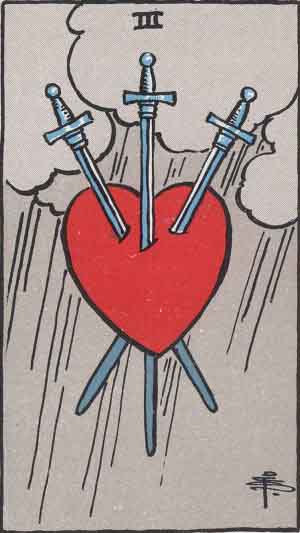
Three swords pierce a heart beneath storm clouds. The question this card keeps returning to ask is how painful knowledge can be acknowledged without turning one wound into the meaning of every present experience.
Core Repeating Message
The Three of Swords shows a heart suspended alone in a grey sky, pierced by three swords, with rain and clouds behind it. There is no figure, no ground, no surrounding landscape: only the heart, the blades, and the weather. The image is stark without needing to predict a betrayal or identify a culprit. It can symbolise the moment painful knowledge, disappointment or loss becomes impossible to keep at a distance. The storm around the heart is the atmosphere that grief and recognition may share when they occupy the same moment.
This is the card of the relationship between honesty and pain, and the specific difficulty that arises when the two are so consistently paired that the seeker begins to equate them: truth hurts; therefore avoid truth. Or, in its inverse: pain is significant; therefore truth that does not hurt is not genuine truth. Either conclusion, held without examination, produces a persistent and characteristic relationship to both clarity and feeling that the Three of Swords keeps marking when it returns.
When this card appears once, it can mark grief arising alongside recognition: the discovery of something painful, the cost of seeing a situation differently, or the effort of making sense of loss. When it appears repeatedly, it may point to a persistent relationship between pain and interpretation. The card does not confirm that a feared story is true. It asks how evidence, grief and present experience are being held together.
One common pattern is the seeker who has experienced the swords so many times that they have developed a specific and comprehensive protection against their arrival. Truth that might be painful is managed before it can fully land. The heart is kept in motion rather than in clear still air where it might be found and pierced. Emotional subjects are circled rather than entered. Conversations are steered away from whatever might produce the particular quality of pain that clarity generates. The seeker is not, in this pattern, in denial about the truth: they see it clearly enough. The management is of the feeling the truth produces rather than of the truth itself.
A second pattern is the seeker whose grief around a painful event remains active after a long time. This does not mean they have failed to grieve correctly or that grief should follow a fixed timetable. The three swords may symbolise a historical reality that still influences the present, asking what acknowledgement, witness, boundaries or support might help the person carry it differently rather than promising that the wound will close completely.
A third pattern belongs to the seeker for whom the experience of pain has become such a reliable accompaniment to their thinking that they have begun to expect it as a feature of genuine depth. Shallow thinking does not hurt; deep thinking produces the swords. And so the seeker has come to associate intellectual and emotional depth with the three-sword quality of pain, and anything that does not carry this quality seems, by comparison, superficial. This pattern produces a characteristic relationship to experience in which suffering is unconsciously valorised as evidence of genuine engagement.
A fourth pattern is the seeker who cannot let themselves think clearly about situations that involve genuine emotional material. The crossing of clarity and grief is so consistently painful that the seeker has established a characteristic divide: thinking and feeling are kept in separate compartments. Analysis occurs without emotional engagement; emotional experience occurs without cognitive framing. The three swords never quite pierce the heart because the heart and the mind are maintained at sufficient distance to prevent genuine simultaneity.
When This Card Repeats Weekly
A week of Three of Swords repetition marks an immediate encounter with painful truth: something that is true and also costs the seeker something to see clearly. The card this week is not asking the seeker to minimise the pain or to produce rapid integration. It is asking them to resist the characteristic protection against genuine feeling that arises when clarity and grief arrive together.
The weekly repetition may also mark a specific conversation that has occurred, or needs to occur, in which honesty would involve emotional exposure. Something true needs to be said, and the saying of it could be painful to someone, or to the seeker themselves, and this pairing of honesty and pain is what the card is marking.
When This Card Repeats Monthly
A month of Three of Swords repetition suggests that the seeker is in a sustained reckoning with something true and painful, and is still finding a way to live with what it means. The grief is real; the truth is real; the two have not yet found a way to coexist without either being pushed aside.
The monthly framing asks the seeker to notice the state of the grief without grading it. Has its intensity, meaning or place in daily life changed, even unevenly? Does it feel fixed, repeatedly reactivated, or unsupported? Grief is not a linear task to complete. The distinction matters because pain that is changing may need patience, while pain that remains overwhelming or severely disruptive may warrant compassionate professional or community support.
When This Card Repeats Seasonally
A season of Three of Swords appearances marks a significant period of grief work, in which the seeker is in sustained encounter with the relationship between what is true and what it costs to see it clearly. This is honourable and demanding work, and the card across a season is acknowledging both the weight of what the seeker is carrying and the importance of the process being sustained rather than prematurely resolved.
The question the seasonal repetition asks is whether the seeker has enough support to hold painful knowledge without being governed by it. Movement may appear as changing intensity, a wider range of feeling, clearer boundaries or greater capacity to return to daily life. Some grief remains recognisably present across a season or much longer. If pain is unchanging, overwhelming or interfering substantially with life, seeking appropriate support may be worthwhile, without implying that grief has failed.
When This Card Repeats Across Years
The Three of Swords returning across years or major life phases names a seeker for whom the specific wound of truth-and-grief is long-arc work. The three swords have been in the heart for a long time. The pain is familiar in the specific way that long-held pain becomes familiar, not comfortable exactly, but known, predictable, no longer acute in the way it was initially.
This long-arc pattern may belong to seekers who met loss, disappointment or betrayal when adequate support was unavailable, especially in formative years. That is one possible symbolic account, not a conclusion about the seeker’s history. The image of enduring swords can describe pain that has remained influential because it was not safely witnessed, because present circumstances keep reactivating it, or because some losses continue to matter even after substantial integration.
Across years, the growth this card asks for is not the absence of pain or the absence of truth. It is the development of the capacity to hold both: to perceive clearly and feel what that perception brings, without requiring either the feeling or the clarity to be managed in service of the other.
Life Area Interpretations
Love & Relationships
In love and relationships, the Three of Swords can mark the seeker who is carrying a painful truth about a significant relationship and who has not yet found a way of engaging honestly and tenderly that would allow both the truth and the grief to be present in the relationship.
This might be the seeker who knows something genuinely difficult about the relationship or about the other person, and who has been managing this knowledge protectively: either not sharing it with the other person, or not allowing themselves to fully feel its implications, because the combination of clarity and grief that would result feels too much to bear within the relational context. The three swords are present; the seeker is managing the entry point of each one separately rather than allowing them to be simultaneously felt.
The card may also accompany the aftermath of a known relational betrayal or disappointment. It should not be used to accuse a partner or confirm a suspicion. Where facts are unclear, the work is to distinguish evidence from fear; where harm is established, the work may involve grief, boundaries, safety and support as well as meaning-making.
Career & Purpose
In career and purpose, the Three of Swords marks the seeker who has received, or is in the process of receiving, a painful truth about their work: a significant professional disappointment, a creative rejection, a vocational direction that has proved different from what was hoped, or a truth about their own capacities or limitations that costs something to acknowledge.
The card in career contexts asks the seeker to resist two characteristic responses to this kind of pain: the first is the immediate cognitive reframing that neutralises the feeling before it can be felt; the second is the sustained emotional dwelling that prevents the clarity from becoming information that is useful in practice. The Three of Swords asks for both the grief and the truth to be held, and what the pain reveals about what genuinely matters to the seeker can become clearer when both are allowed a place.
Money & Stability
The Three of Swords in financial contexts can mark the seeker reckoning honestly with a painful financial truth: a loss that has occurred, a situation more serious than they have fully acknowledged, or a financial reality they can see but have been reluctant to face in full. Looking directly at the financial situation can be painful. The pain has been managed by not looking quite directly.
The card is not asking the seeker to intensify fear about their finances. It asks them to separate factual assessment from the emotions the situation evokes, so that neither is denied. Urgent or complex decisions should be based on verified figures and qualified financial or legal guidance where needed, not on the card’s appearance.
Spiritual Growth
In spiritual growth, the Three of Swords marks the seeker whose path has included loss of faith, disillusionment, or an encounter with suffering that has been difficult to integrate with whatever framework for meaning the seeker holds. This is honourable and testing territory, and the card repeating in spiritual contexts is acknowledging the difficulty of holding both the reality of suffering and the possibility of meaning in the same moment.
The card may also mark the seeker who has developed, from spiritual intelligence and lived experience of the three-sword quality of truth, a suspicion of spiritual frameworks that do not adequately account for pain. Any spirituality that cannot contain the Three of Swords is, from this seeker’s experience, insufficient. The question the card asks is whether this hard-won discernment has yet been able to find a spiritual home that can hold it.
Emotional & Mental Patterns
In emotional and mental patterns, the Three of Swords can mark a habit of keeping thought and feeling from meeting. Either the thinking is doing the work, producing precise analysis of a situation while the feeling is held at bay, or the feeling is doing the work, producing emotional engagement with experience while the analytical precision that might sharpen and locate the grief is being withheld.
The pattern the card marks is the maintenance of this separation as a habit rather than a temporary protection. Under strong emotion, clear thinking may narrow for understandable reasons; at other times, analysis may create useful distance. Integration does not demand simultaneous intensity. It means developing enough flexibility for the sharp sword and the tender heart to inform each other over time.
Family & Generational Dynamics
In family dynamics, the Three of Swords can describe the seeker who absorbed, in the family of origin, a message about the relationship between truth and pain. Families that equated honesty with cruelty, that treated clear speech as inherently wounding, may have taught a seeker to soften truth to the point of obscurity in the name of protection. Families that equated emotional expression with weakness or manipulation may have taught a seeker to separate feeling from the clear perception that might dignify it.
The seeker who draws this card repeatedly may recognise family messages in which truth-speaking was associated with pain, emotional expression was dismissed, or honesty and tenderness were rarely modelled together. These are possibilities for reflection, not facts supplied by the card. The generational work is to develop a more nuanced personal relationship to honesty and grief while recognising that family members, cultures and circumstances may have held different risks and resources.
Health & Energy
The Three of Swords in health contexts uses the heart and storm as symbols for the embodied experience of grief. Some people notice changes in breathing, appetite, sleep, energy or muscular tension during painful periods, while others experience grief differently. The card cannot determine the cause of chest or throat sensations, and it should never be used to interpret physical symptoms as merely emotional.
The card can invite gentle attention to how sorrow is experienced physically and what kinds of rest, company or care feel supportive, without promising catharsis or bodily release. New, severe or unexplained chest pain, pressure, breathlessness or other concerning symptoms require prompt medical assessment. Emotional support and healthcare can sit alongside symbolic reflection rather than being replaced by it.
Advanced Interpretive Sections
The Shadow Expression
The Three of Swords in shadow produces two distinct patterns. The first is the seeker who uses the language of painful truth as a form of power over others: who delivers clarity without compassion, who treats the wounding quality of honest speech as a feature rather than a cost, who equates the capacity to inflict the Three of Swords with genuine intellectual or moral superiority.
The second shadow is the tendency to treat suffering as the primary evidence of depth: to distrust experiences that do not contain the three-sword quality of pain, or to remain in familiar painful dynamics because intensity feels more recognisable than steadiness. This reading should be held without blaming someone for harm done to them. Familiarity can shape expectation, but responsibility for another person’s harmful behaviour remains with that person.
The Integrated Expression
The integrated Three of Swords seeker has developed the capacity the card depicts at its most honest: they can perceive clearly and feel at the same time, without requiring either to be managed in service of the other. When truth is painful, they allow the pain its weight without letting it prevent them from integrating the truth. When grief is present, they allow clarity to sit alongside it without using clarity as a mechanism for managing the feeling.
This seeker can also speak truth that is painful to hear with genuine care for the person receiving it: they understand that honesty and tenderness are not opposites, and they have developed the specific skill of delivering the three swords with both the precision the blade requires and the compassion the heart deserves.
Why This Energy Has Not Released Yet
The Three of Swords pattern may persist when grief has had too little time, safety, witness or practical support, or when present events repeatedly reactivate the loss. Grief does not have to be completed to be integrated, and no one is required to feel its full weight all at once. A more workable aim is enough contact with the pain to acknowledge it, alongside enough support and distance to remain within the person’s capacity.
The pattern also persists when the seeker has not yet examined what they believe about the relationship between truth and pain: whether they believe, from genuine experience or inherited assumption, that honest perception is inherently wounding, or that suffering is inherently meaningful, or that clarity without pain is somehow insufficient. Until these beliefs are examined, they tend to organise experience in ways that confirm them.
What This Card Wants the Seeker to Understand
The Three of Swords asks the seeker to understand that pain can accompany meaningful contact, but pain is not proof of truth, love or depth. Protection is not failure, especially where harm or overwhelm is present. The image asks what support, boundaries and honest acknowledgement the heart needs, while refusing the idea that suffering must be endured to validate the experience.
The card wants the seeker to know that truth and grief are not the same thing, even when they arrive together. The sword is not the wound; it is the instrument of clarity. The wound is the wound. Both deserve acknowledgement, in their own terms, without requiring one to be the servant of the other.
Signs the Pattern Is Beginning to Resolve
The Three of Swords pattern begins to resolve when the seeker has more choice about how and when to approach the painful material. They may speak about it with greater steadiness, need less recovery after doing so, or recognise when the subject is too activating for that moment. Integration is not measured by perfect calm. It is reflected in increasing capacity, self-compassion and freedom from organising every present experience around the wound.
It also resolves when clarity and grief can inform one another without either taking complete control: when painful facts can be acknowledged without immediate reframing, and feeling can be present without compulsory analysis. The seeker may notice bodily ease at times, but physical sensations are not a measure of emotional success. The more reliable signs are wider perspective, restored engagement, appropriate boundaries and an increased ability to seek help when needed.
Reflective Questions
-
What is the most painful true thing you are currently carrying? Have you been able to feel what it evokes and think about it clearly, or have you been managing one of these in service of the other?
-
What is your characteristic response when truth and pain arrive together: do you manage the feeling in service of clarity, manage the clarity in service of the feeling, or something else entirely?
-
Is there a grief in your current life that remains especially active? What conditions, reminders or missing forms of support affect it, and what would carrying it more gently look like without demanding completion?
-
What did your family of origin teach you about the relationship between honesty and pain? Was clear truth-telling understood as inevitably wounding, or was emotional response to truth considered excessive or manipulative?
-
In what circumstances have you been the one who spoke a truth that was painful to hear? What guided your sense of when and how to speak it? What happened afterward?
-
Is there a way in which you have come to associate genuine depth of experience with the three-sword quality of pain, such that experience without this quality seems somehow superficial or insufficient?
-
What would greater integration look like for the most significant painful experience you have been carrying? What might remain tender, and what could become more spacious or less governing?
-
Do you notice any bodily sensations when painful thoughts arise? What other explanations should remain possible, and what kind of care would be appropriate if those sensations are persistent or concerning?
-
Is there a truth about yourself, your situation, or someone you love that you have been preventing yourself from seeing clearly because you anticipate that the clarity would produce pain you do not yet feel equipped to manage?
-
What conditions would allow you to be genuinely honest about something painful with someone who needs to hear it, in a way that honours both the truth and the tenderness the relationship deserves?
Practical Integration Actions
Allow the grief to be specific. If you are carrying grief arising from something true and painful, spend time making it specific rather than general: not the atmospheric quality of pain that surrounds the situation but the precise thing that hurts, the exact loss, the specific betrayal, the particular thing you had hoped for and that is not there. Naming the grief precisely can make it easier to address; when it remains an indistinct atmosphere of pain, it may be harder to recognise what needs attention.
Practise holding both simultaneously. Choose one situation where facts and feelings have been kept apart. For a brief period, name one verified fact and one feeling it evokes, then pause and orient to the present. Do not force simultaneous intensity or continue beyond your capacity. If the material is overwhelming, destabilising or linked to trauma, this exercise may be better approached with qualified support.
Find genuine witness for the wound. If painful material has been carried alone, consider a trusted person, support group, cultural or spiritual elder, or qualified professional who can listen without forcing solutions. Choose according to the nature and severity of the experience, and retain the right to stop or set limits. Witness can support integration, but no single conversation is required to resolve grief.
Write the truth and the grief separately, then together. Use three separate pieces of writing. First, write the truth of the situation as clearly and as analytically as possible. Then write the grief of it: the feeling, the loss, the specific weight. Then write a third piece in which you allow both to be simultaneously present. The third piece is often the hardest and the most useful, because it is the practice of the integration the card is asking for.
Examine your inherited beliefs about honesty and pain. Write about what you learned, from family and from significant early experience, about the relationship between speaking truth and causing pain. Do you believe that genuine honesty is inherently wounding? That pain is the reliable evidence of genuine depth? That feelings and clarity are incompatible? Examining these beliefs explicitly, rather than allowing them to operate as invisible organising principles, is cognitive work that can help the Three of Swords pattern begin to shift.