
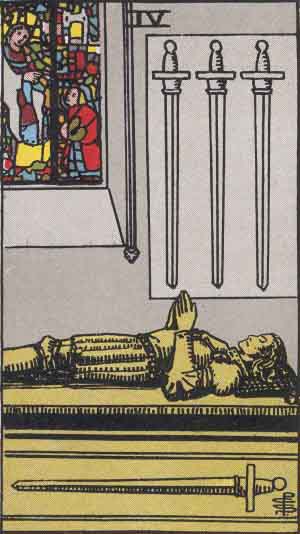
A figure rests while the swords remain visible. The question this card keeps returning to ask is what kind of pause is actually possible, restorative and sufficient in the seeker’s present circumstances.
Core Repeating Message
The Four of Swords shows a figure in repose, lying still in what appears to be a tomb or chapel, with one sword horizontal below the figure and three swords arrayed on the wall above. The hands are folded. The face is turned upward. The posture is not of someone who has given up but of someone who has withdrawn from active engagement, deliberately and with full awareness that there are swords still to be carried and battles still to be considered. The rest is not the absence of the work. The three swords above the figure are still there, present and visible. The rest is the deliberate withdrawal from active engagement with them.
This is the Swords suit’s clearest image of deliberate rest, and its presence is significant. The suit that covers thought, analysis, language, conflict, decision, and the mind’s relationship to truth contains an image of stillness within it. Rest is not a weakness of the thinking mind, although its form and availability differ across bodies, responsibilities and material conditions. The symbolic message is that continuous engagement can reduce perspective, while a suitable pause may restore choice about how the swords are taken up again.
When this card appears once, it may mark a need for rest: a period of withdrawal, recuperation or deliberate stillness that can help the thinking mind recover perspective on the problems it will return to. When it appears repeatedly, the relationship between rest and continued activity becomes a recurring question, in one of several distinct forms.
One common pattern is the seeker who rarely experiences a satisfying pause from mental activity. Many people describe a mind that is always running, and this alone does not establish a problem. The card becomes especially relevant when continued thinking feels costly, repetitive or disconnected from useful action. The seeker may sleep yet wake unrefreshed, sit quietly while thought loops continue, or take time away while remaining preoccupied with the future and the work waiting at home. These experiences can have many causes, so the card offers a reflective lens rather than an explanation.
A second pattern is the seeker who avoids rest because quiet may bring them closer to what mental activity has been keeping at bay. A mind that is always running is also occupied, leaving less room to notice feelings or concerns that busyness helps hold at a distance. Sometimes the reluctance to pause reflects an awareness of what might be encountered there, even when the seeker has not clearly named it.
A third pattern belongs to the seeker whose pause was imposed by illness, injury, caregiving limits or another external circumstance rather than freely chosen. Such periods are not automatically restorative and should not be romanticised as lessons. The card can ask what the experience revealed about pace, support and limits, while recognising that recovery, disability and enforced inactivity are not moral tests and may require medical or practical care.
A fourth pattern is the seeker whose relationship to rest is distorted by a specific belief about productivity: the conviction, often not fully examined, that the value of a period of time is determined by the cognitive or productive activity it contains, and that rest, which may produce no visible output, is therefore somehow wasteful or unjustifiable. This seeker rests guiltily when they rest at all, and the guilt of resting can interfere with recuperation.
When This Card Repeats Weekly
A week of Four of Swords repetition can mark an immediate need to review the balance between activity and pause. The card cannot measure depletion or issue a physiological instruction, but it can draw attention to a week in which concentration, patience or perspective feel reduced. The practical question is what safe and realistic reduction in demand, support or protected quiet is available now.
The card this week is not asking for dramatic withdrawal. It is asking what would allow even a brief pause from working on the swords on the wall: they are acknowledged as present without having to receive the seeker’s attention at every moment. Not managed, not planned, not processed. Simply left alone for a defined period.
When This Card Repeats Monthly
A month of Four of Swords repetition suggests reviewing whether sustained cognitive engagement is being matched by adequate recovery. Fatigue, poor concentration or feeling constantly activated may be present, but the card cannot establish their cause. Workload, sleep, health, medication, caregiving and material stress may all matter, and persistent or marked changes deserve appropriate assessment.
The monthly framing asks the seeker to look honestly at the quality of rest they have been accessing across the month, alongside the time available for it. Have they experienced any mental recuperation, rather than simply continuing the same activity while horizontal? Have there been moments of stillness, or other pauses that felt restorative? If the answer is rarely or never, it is worth examining what their current life structure allows and what it leaves unmet, rather than treating the card itself as evidence of a systemic condition.
When This Card Repeats Seasonally
A season of Four of Swords appearances may focus attention on accumulated mental strain, or on an extended pause the seeker feels they need but has not been able or willing to take. These can overlap; distinguishing them can help the seeker consider both the demands they are carrying and the kind of withdrawal they are seeking.
In the first case, the season may symbolise the accumulated cost of sustained mental engagement without enough recovery. In the second, it may invite a period of deliberate reduction or retreat that has been resisted because work feels relentless, stillness feels uncomfortable, or productivity has become closely tied to worth. Rest is also shaped by money, disability, safety and care obligations, so the reading should include structural constraints rather than locating the whole problem in permission.
When This Card Repeats Across Years
The Four of Swords returning across years or major life phases can bring a long-standing difficulty with mental rest into view: recuperation may have remained inaccessible over an extended period, or avoiding rest may have become so established that the cost of continuous engagement is difficult to recognise.
This long-arc pattern may resonate with seekers whose formative experience linked safety with sustained alertness, including those who had to monitor an unpredictable environment. That is one possible history, not a diagnosis supplied by the card. Others may have learned relentless activity through culture, work, care duties or financial precarity. Understanding the source can help identify whether the next need is inner permission, practical support, professional care or a change in external demands.
Across years, what the Four of Swords asks of this seeker is not simply a holiday but a different relationship to the mind’s activity: gradually learning to step back from demands, cultivating internal permission where it is missing, and developing forms of recuperation that can become dependable parts of life. For someone accustomed to sustained alertness, this may include learning what degree of quiet feels tolerable and what support makes a pause possible.
Life Area Interpretations
Love & Relationships
In love and relationships, the Four of Swords can describe the seeker who spends more time thinking about a relationship than being present within it. They think about the relationship extensively: its dynamics, its history, its future, its implications, what the other person meant by that sentence, what they should have said, what they will say next. The cognitive engagement is genuine and often insightful. What it is not, by itself, is presence with the actual person.
The card may also mark a need for time away from analysing or managing relational complexity, without assuming withdrawal from the relationship itself. Any pause is healthiest when communicated clearly and negotiated rather than used as punishment or disappearance. In unsafe or coercive relationships, seeking confidential support and safety planning takes precedence over a symbolic instruction to rest.
Career & Purpose
In career and purpose, the Four of Swords can mark a period in which sustained intellectual effort has left too little room for recuperation. The work has been genuine; the engagement has been real. The question is whether the current pace is affecting the quality of the work itself, perhaps in ways that are difficult to recognise from inside a familiar routine. Changes in concentration, precision or creativity are worth noticing without assuming that lack of rest is their only cause.
The card is not automatically asking the seeker to stop working. It asks what forms of recovery can be built into working life, and whether workload, staffing, expectations or accommodations need attention. For some, brief protected intervals are realistic; for others, leave, clinical advice or organisational change may be necessary. Rest should not become another private task used to compensate for unsustainable conditions.
Money & Stability
The Four of Swords in financial contexts can draw attention to sustained anxious engagement with money that leaves little room for rest from the topic. The distinction is between attending to a financial problem and circling it continuously without gaining useful information. Focused planning followed by a pause may be more useful than repeated anxious review, while the need for attention still depends on the circumstances.
The card may also invite attention to reduced precision, creativity or confidence at work, without attributing these changes to one cause. Financial pressure can make rest materially difficult, while reduced capacity can itself affect income. A useful response may include prioritising essential tasks, seeking workplace support and obtaining appropriate professional advice if cognitive or energy changes are persistent.
Spiritual Growth
In spiritual growth, the Four of Swords is the suit’s most directly contemplative card. It can mark a seeker drawn to stillness who has not yet found, or is not consistently accessing, conditions in which contemplation feels nourishing rather than becoming another demand on the mind.
The seeker whose contemplative practice includes sustained mental activity need not treat this as failure or as evidence that they are not meditating correctly. The Four of Swords can invite a gentler relationship to thoughts, with practices adapted to the person’s culture, body and capacity. Stillness is not the only valid route; rhythmic movement, sensory attention, prayer, music or supported rest may offer a more accessible form of pause.
The card may also mark the seeker who longs for a period of spiritual withdrawal but has not been able to make room for it: a retreat, a period of reduced engagement, a season of interior quiet that the busyness of their life has been preventing.
Emotional & Mental Patterns
In emotional and mental patterns, the Four of Swords can describe a relationship to mental activity in which rest is either not accessible or not permitted. The seeker’s mind runs, consistently and often at considerable speed, as a baseline condition of their interior life. This running is not always experienced as uncomfortable; someone accustomed to constant mental activity may have little experience of a different pace against which to recognise it.
The specific mental pattern worth noticing is what thought returns to when other occupation is reduced. These loops may reveal unfinished tasks, ordinary worry, creative activity or concerns needing support. Understanding their content can help distinguish problems that need action from repetition that no longer adds information. Rest need not mean an empty mind; it may mean a less compelled relationship to thoughts that continue to arise.
Family & Generational Dynamics
In family dynamics, the Four of Swords can describe the seeker who grew up in an environment in which mental rest was not safe or not available. The family that required sustained vigilance, whether because of unpredictability, emotional volatility, genuine threat, or simply the relentless cognitive demands of a household that required constant management, may have taught a child that alertness was necessary and that lowering the cognitive guard was a luxury that could not be safely afforded.
An adult who recognises this inheritance may have few models for rest that feels safe or accessible. They may understand its value and still find that quiet increases discomfort. The work can involve gradual experiments, external support and respect for the person’s capacity, rather than forcing stillness or promising that nothing difficult will arise. Where alertness is still required by current circumstances, changing those conditions matters as much as inner practice.
Health & Energy
The Four of Swords in health contexts symbolically addresses rest, recovery and the experience of sustained demand. A seeker may notice tiredness, irritability, difficulty settling or changes in sleep and concentration. These signs are non-specific and can reflect many physical, psychological or situational causes; tarot cannot assess sleep quality, nervous-system function or clinical exhaustion.
The card can invite a review of sleep, workload, stimulation and opportunities for mental as well as physical pause, but it does not prescribe a cure. Rest may include quiet, reduced decisions, supportive company, movement, treatment or accommodation, depending on the person. Persistent fatigue, insomnia, sudden cognitive change or other concerning symptoms deserve assessment by an appropriate health professional.
Advanced Interpretive Sections
The Shadow Expression
The Four of Swords in shadow can describe withdrawal that continues after a restorative pause would ordinarily have ended, with avoidance and recuperation becoming difficult to distinguish. This interpretation requires care: prolonged inactivity may reflect illness, disability, depression, grief, burnout or external constraint rather than unwillingness to engage. The question is what support and honest assessment are needed, not whether the seeker deserves blame.
The second shadow is the seeker who performs rest without accessing it: who is technically in rest conditions, who can describe their self-care practices in detail, and who is in practice in a continuous state of cognitive engagement with what they should be doing, what they are not doing, and how the rest is going. The swords are still being actively engaged with; they are simply horizontal rather than upright.
The Integrated Expression
The integrated Four of Swords seeker has developed a more flexible relationship to engagement and rest. They can withdraw when a pause is needed, return when they have sufficient capacity, and revise the plan when rest alone is not enough. Integration is not effortless balance. It is the ability to respond to changing needs without turning activity into worth or rest into failure.
This seeker has also developed an internal sense of what recuperation feels like: they can notice when the mind steps back from its active engagement with the swords on the wall, even if thoughts continue to arise. They have developed the capacity to return to a form of rest that helps them often enough for it to become an actual resource in their life rather than a theoretical aspiration.
Why This Energy Has Not Released Yet
The Four of Swords pattern may persist when internal permission, external resources or an accessible form of rest is missing. The seeker may value rest yet face care duties, financial pressure, unsafe conditions, pain or a mind that becomes more activated in silence. Identifying which barrier is operating helps prevent a structural problem from being mistaken for a personal failure and clarifies whether the next step is a boundary, accommodation, practical support or professional care.
The pattern can also persist when the seeker has not found a form of pause that suits them. For a chronically active mind, stillness may be unfamiliar or activating, and it need not be the only goal. Rest can be practised through reduced demands, rhythmic activity, sensory grounding, supportive company or clinically guided strategies, with patience for experiments that do not work.
What This Card Wants the Seeker to Understand
The Four of Swords wants the seeker to understand that genuine rest is not the absence of the work. The three swords are still on the wall. They will be there when the figure rises. The rest does not eliminate them or pretend they are not present; it acknowledges that continuous engagement can gradually diminish the care and attention available for work, and that a recuperative pause can make returning to it more useful.
The card also suggests that a pause is not empty simply because it produces no visible output. It may contain quiet, discomfort, ordinary thought, sensation or nothing memorable at all. The seeker does not need to uncover a hidden truth for the pause to have value.
Signs the Pattern Is Beginning to Resolve
The Four of Swords pattern begins to resolve when the seeker finds a form of pause that is tolerable and at least somewhat restorative, or when they identify why rest is not currently accessible. Stillness may be useful, but it is not required to reveal clarity or prove safety. Repeated experiences of choice, support and reduced pressure can build trust more reliably than forcing silence.
It also resolves when restorative periods become a valued part of life rather than only a guilty response to crisis, within what the seeker’s circumstances allow. Another sign is improved choice: the person can pause, resume and adjust rather than being trapped in either relentless activity or indefinite withdrawal. Clearer thinking may follow, but the absence of immediate improvement does not mean the rest has failed or that health support is unnecessary.
Reflective Questions
-
When did you last experience genuine mental stillness, even briefly: a moment in which the mind was genuinely quiet rather than actively occupied with something? What were the conditions that allowed it?
-
What does your mind go to when external occupation is removed? What are the default loops it returns to? What do these loops tell you about what the mental activity has been managing?
-
Is there a specific belief, examined or not, that makes genuine rest feel unjustifiable, wasteful, or unsafe? Can you articulate it clearly?
-
Think about a time illness, injury or circumstance forced you to stop. Was the period restorative, distressing, revealing or mixed, and what support was available or missing?
-
What changes have you noticed in sleep, energy or concentration, if any? Which observations belong in reflection, and which deserve practical or professional assessment?
-
What did your family of origin teach you about the relationship between activity and value? Was rest understood as legitimate, or was sustained productivity the implicit standard by which time was evaluated?
-
Does sustained activity appear to keep any feeling, task or uncertainty at a distance, or is that only one possible explanation? What evidence would help you distinguish avoidance from ordinary mental activity?
-
What would your professional or creative work look like if you built genuine and regular recuperative rest into its structure? What would be different about the quality of your engagement?
-
What form of mental rest is genuinely accessible in your current life: quiet, movement, reduced decisions, absorbing activity, supportive company or something else? What practical barrier most limits it?
-
If you paused engagement with the three swords for a short, tolerable period, what might arise? What would help you remain safe and grounded, and how would you know when to stop?
Practical Integration Actions
Establish one genuine rest period per day. Choose a modest period and a form of pause suited to your body and circumstances: quiet, slow movement, sensory attention, prayer, music or reduced decision-making. The aim is not perfect stillness. Notice whether the practice feels settling, neutral or activating, and adjust rather than forcing it. If rest reliably intensifies distress, seek an adapted approach or qualified support.
Map your mental activity patterns. For one week, keep a simple record of when your mind feels rested, when it is actively occupied and when its activity feels repetitive or costly. Note the default topics that the mind returns to when other occupation is removed. Notice the times of day and the conditions under which genuine mental rest is most and least accessible. This mapping can reveal the shape of the pattern more clearly than a general sense of being always busy.
Examine the permission deficit. Where permission is part of the difficulty, write about what you believe would happen if you rested, if you gave the mind permission to lower its swords for a defined period. What would be lost? What would be found? Is there a conviction that sustained mental activity is safer than a recuperative pause, and where did it come from? This examination does not require resolution in a single writing session; it requires honest engagement with beliefs that are often operating below the level of conscious awareness.
Develop a genuine transition practice. Between periods of cognitive engagement, try a brief transition such as comfortable movement, looking outside, changing rooms, drinking water or attending to neutral sensory details. The purpose is to mark a boundary between tasks, not to control the nervous system or guarantee recovery. Keep what feels useful and accessible, and discard what adds pressure.
Investigate what genuine stillness contains. Choose a brief period that feels tolerable and notice what arises without demanding peace or an empty mind. Record thoughts, feelings and bodily sensations as observations rather than hidden truths. If the pause becomes overwhelming, end it, orient to the present and use support. Curiosity is useful only when paired with choice and safety.