
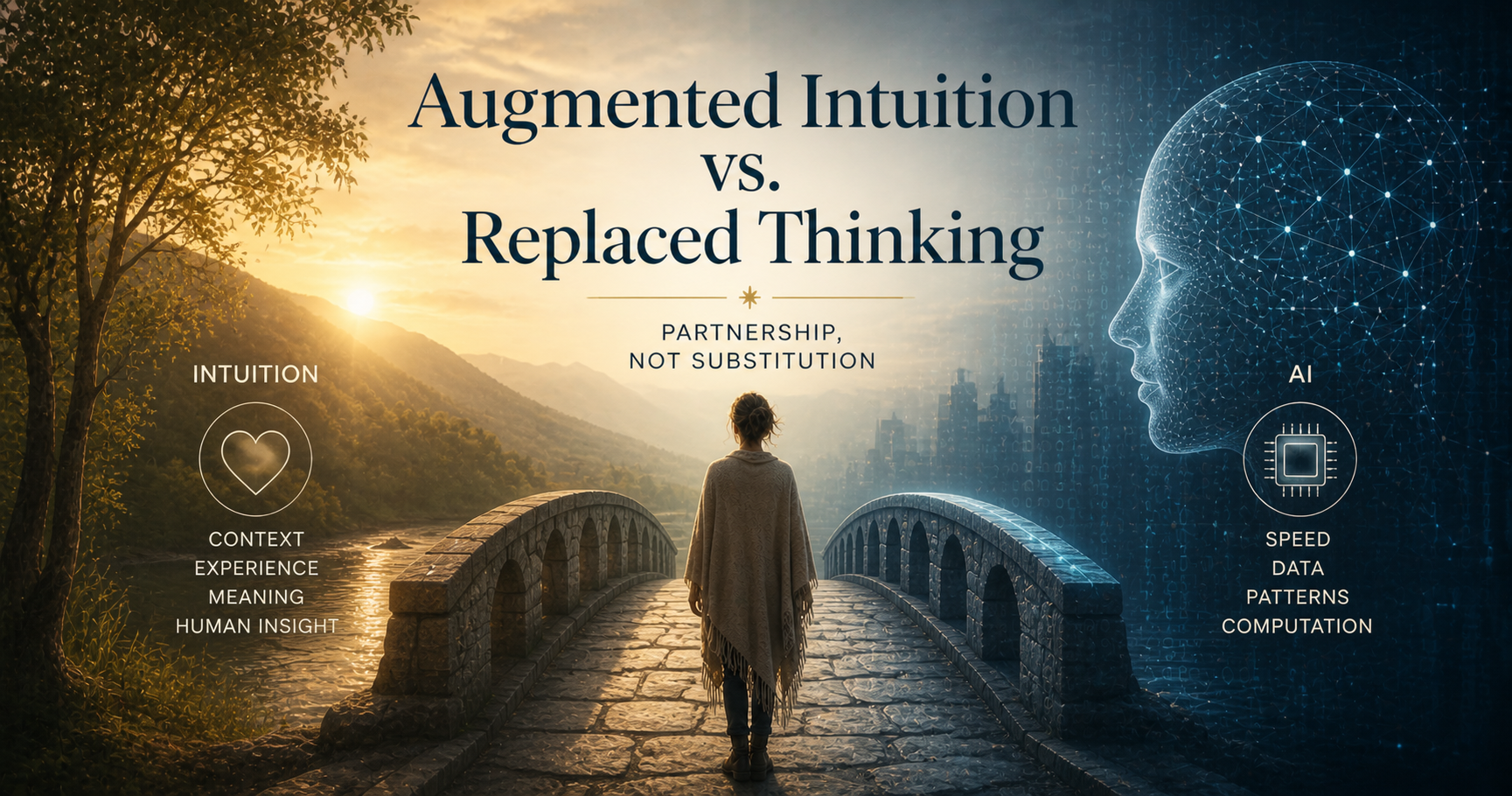
I want to show you exactly how I use AI in a reading, because the detail matters more than the principle.
I start with a three-card spread. Before I look at meaning, before I consult any system or tradition, I look with soft eyes. I let my attention rest on the spread as a whole and notice where it goes first. Then I begin to observe the structural relationships between the cards: not what they mean, but what they are doing. Whether the figures are facing toward each other or away. Whether one card seems to be turning its back on the others. Whether something on the right feels isolated, cut off from what is happening to the left. I register the feeling of the spread, the weight of it, the direction of its energy, and I describe all of that in my own words without reaching for any interpretive framework.
Then I give that description to AI. I tell it what I have perceived, and I ask it to overlay the card meanings onto what I have already observed. I ask it to take my perceptual read and deepen it with the interpretive layer I have deliberately held back until this point.
What happens when those two things combine is genuinely powerful. My perception gives the reading specificity. AI’s interpretive depth gives it extension. Neither produces alone what they produce together. But the sequence is not interchangeable. If AI goes first, the perceptual layer is compromised. The meanings arrive before the signal has been received, and the signal is then filtered through what the meanings suggest it should be.
The human must lead. The tool deepens what the human has already found.
That is augmentation working correctly. And it is one decision away from becoming something else entirely.
The Same Tool, Two Outcomes
The difference between augmented intuition and replaced thinking is not a difference of tool. It is a difference of sequence.
A practitioner who does their perceptual work first and uses AI to extend and deepen what they have already received is developing their intuitive capacity while simultaneously accessing AI’s genuine strengths. The perceptual muscle is being exercised. The pre-verbal stage is being honoured. AI is operating in the position it belongs: downstream of human sensing, in the translation and enrichment of signal that has already been received.
A practitioner who reaches for AI first, who lets the interpretive layer arrive before the perceptual work has been done, is doing something structurally different. The meanings arrive, the output feels coherent, the reading proceeds. But the pre-verbal stage has been bypassed. The signal that would have surfaced through soft eyes, through the quiet attention to structural relationships, through the unforced noticing that precedes naming, has not been given the space to form.
This is not a dramatic failure. The reading produced by the second sequence may be technically sound. It may draw on solid interpretive knowledge, may cover the relevant symbolic territory, may produce a response the seeker recognises as relevant.
But it will be general where it could have been specific. It will be plausible where it could have been precise. It will cover what many situations have in common rather than what this situation, uniquely, is showing.
Over time, the practitioner who consistently bypasses the perceptual stage in favour of the interpretive one is not just producing thinner readings. They are allowing a capacity to weaken from disuse. The neural pathways involved in pre-verbal processing are trainable. They are also prunable. What is not exercised does not stay static.
For a structured drill on how two cards relate after you have done this structural pass, see the Tarot Combination Interpreter, it belongs after your own noticing, not before it.
The Self-Reading Problem
Reading for yourself is where the tension between augmentation and replacement becomes most acute, and where the risk of replaced thinking is highest.
It is very human to have hopes and dreams. To want a particular outcome, to be drawn toward a certain future, to carry a preference into a reading that shapes what you are able to perceive. This is not a character flaw. It is a condition of being human. But wanting something does not mean you have done the work, in the present or in the accumulation of the past, to bring it into being. Hope and readiness are not the same thing. Desire and alignment are not the same thing. The cards will show what is actually present. What the seeker wants to be present is a different matter entirely.
When you read for yourself, personal bias does not announce itself. It operates silently, shaping what you notice and what you overlook, what you emphasise and what you explain away. It is one of the hardest things to escape, and escaping it is one of the most important skills a practitioner can develop. This is sufficiently distinct and demanding a practice that it forms its own area of advanced training, beyond the foundational conditions of attention that anchor any reliable reading, as described in the COMPASS method.
This is precisely where AI, used correctly, becomes genuinely valuable in a personal reading.
You can tell AI your bias. You can say: I am hoping for this outcome. I want this to be true. I have an investment in this particular reading going a certain way. And you can ask it to set that aside and respond directly to your intuitive read and the card meanings, without accommodating what you want to hear.
AI has no stake in the outcome. It has no emotional investment in your hopes. It will not soften a difficult reading because it senses your anxiety. If you give it your perceptual observations and ask it to be direct, it will be direct, held steady against the bias you have named.
Used this way, AI functions as an objective voice that the practitioner cannot easily provide for themselves. Not replacing the perceptual work, but holding the line against the distortion that can compromise that work when the reader and the seeker are the same person.
What Augmentation Actually Looks Like
The three-card spread experiment makes the distinction concrete.
What separates augmentation from replacement is visible in where the reading originates. When perception comes first, the practitioner brings something to the interpretive layer that could not have been generated by it: a specific, contextually anchored observation that is the product of a particular perceptual encounter with this spread, at this moment, with this question present. The interpretive layer then meets that observation and extends it. The result carries specificity that interpretation alone cannot produce, because interpretation works from what many situations have in common. Perception works from what this situation, specifically, is showing.
When the interpretive layer arrives first, the perceptual work that follows is no longer independent. It is shaped, consciously or not, by what the meanings have already suggested. The signal is filtered through the interpretation rather than the interpretation being filtered through the signal. The two processes may appear similar from the outside. Their relationship to what is actually present in the spread is structurally different.
This is not a workflow distinction. It is a diagnostic one.
It reveals whether the practitioner is using AI in the position that serves the reading, or in the position that substitutes for its most important stage.
The Drift and How It Happens
The drift from augmentation toward replacement does not happen in a single decision. It happens in small increments, across many sessions, in the accumulation of small shortcuts that each feel reasonable in the moment.
A reading where the practitioner is pressed for time and goes to AI first, intending to add their own perceptual layer afterward but not quite getting there. A session where the AI output is so fluent and contextually appropriate that the practitioner’s own first impressions feel redundant by comparison. A period of heavy workload where the perceptual practice gets compressed, then compressed again, until it has become a formality rather than a foundation.
None of these moments feel like a significant choice. Collectively, they represent a structural shift in where the reading actually originates.
The practitioner who notices this drift has a significant advantage: the sequence can be restored. The perceptual practice can be reinstated as the non-negotiable first stage. The discipline of soft eyes, of the structural observation before the meaning layer, can be returned to its proper position. It is a habit, and habits can be rebuilt.
But the practitioner who does not notice the drift, who continues producing readings that feel coherent and complete without recognising that the pre-verbal stage has been progressively compressed out of the process, is in a more difficult position. The readings may continue to satisfy. The capacity being quietly eroded may not be missed until it is needed for something that meaning alone cannot reach.
The Broader Stakes
This series has been arguing that the debate about AI in intuitive practice is focused on the wrong layer. The interpretive layer, whether AI should be used to assist with meanings and frameworks and symbolic analysis, is a legitimate question with legitimate answers on both sides.
But beneath that debate, something more consequential is taking place. The practitioners who understand what the pre-verbal stage is, who have developed the discipline to honour it before the interpretive layer is consulted, and who use AI in its correct position downstream of that stage, are developing a capability that will become more valuable as the interpretive layer becomes more thoroughly automated.
The practitioners who allow the interpretive layer to migrate upstream, who reach for AI before the perceptual work is done, are doing something that feels efficient and may produce adequate results in the short term. Over time, they are operating on a narrowing foundation.
The future of intuitive practice in an AI-saturated world is not determined by the tools available. It is determined by the sequence in which those tools are used and by the clarity practitioners have about what they are doing that the tools cannot do for them.
Augmentation requires that clarity. Replacement happens in its absence.
The question every practitioner needs to answer is not whether to use AI. It is whether they are leading, or being led.
The Edge That Cannot Be Automated
There is a quality that a reading carries when the pre-verbal stage has been fully honoured that is recognisable to an experienced seeker even when they cannot name what they are responding to. It is the quality of something having been actually perceived, rather than assembled. Of specificity that could not have been reached by probability alone.
The three-card spread, read with soft eyes first, structural observation second, AI overlay third, produces that quality more reliably than any other method I have found. Not because the sequence is the only valid one, but because it keeps the perceptual stage primary and uses everything else in its service.
That is augmented intuition. The human capacity is not replaced or even supplemented. It is extended, by a tool that has been kept in its correct position, doing what it does well, in service of what only the practitioner can do.
The final article in this series, The Practitioner’s Edge, brings these threads together into a practical account of what the practitioner’s edge actually looks like when it is fully developed, and what it means to operate from that position in a world where the interpretive layer is no longer the primary point of differentiation.
Leigh Spencer is the founder of Tides of Knowing and founder of the COMPASS Method, a framework for the conditions of attention that make intuitive reading reliable under pressure. With 30 years in professional journalism and 40 years as a tarot reader and intuitive practitioner, she writes at the intersection of symbolic literacy, perceptual development, and the changing landscape of human knowing.