
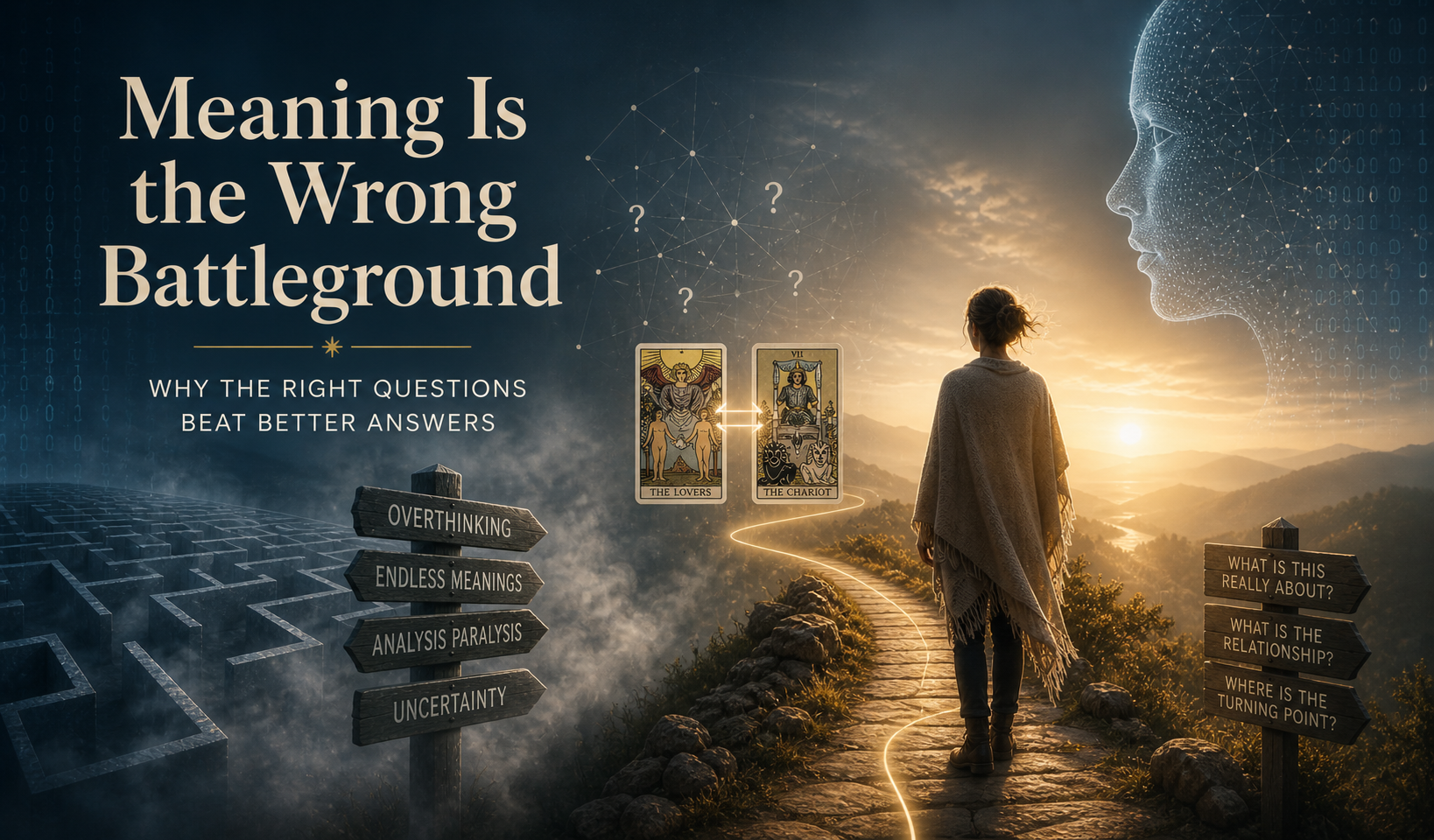
I do my own reading first. Always. I sit with the cards, use the techniques I have developed over decades, and receive what arrives before anything else enters the process. Then, as part of an ongoing experiment in understanding how AI actually operates in the intuitive space, I ask an AI system to interpret the same spread. Then I compare the two: where they meet, where they diverge, and what the divergence reveals.
I have been doing this regularly and deliberately. It is not a test designed to make AI look inadequate. It is a genuine inquiry into what each approach can and cannot reach.
What I consistently find is this. AI’s ability to work with meaning is strong, and it is getting stronger. As more practitioners use these systems, as more knowledge is shared and encoded, the large language models that underpin them become increasingly sophisticated in their handling of symbolic interpretation. The meanings, the traditional associations, the archetypal frameworks, the contextual variations: AI handles all of this with growing fluency.
But there is a layer it does not reach. And that layer is where the reading actually begins.
Soft Eyes
Before I look at a spread for meaning, I look at it with what I call soft eyes.
The technique came originally from my years as a magazine editor. When I was laying out pages, I would squint at the layout, deliberately defocusing, to read the page as a whole rather than as a collection of individual components. I was not looking at the headline or the image or the pull quote. I was looking at the gestalt: the weight distribution, the flow of attention across the page, the gaps and imbalances that would be invisible if I examined each element in sequence. It told me things about the layout that component-by-component analysis would have missed entirely.
Applied to tarot, soft eyes means approaching the spread before reading it. Before any meaning is consulted, before any card is identified by name or position, I let my gaze rest on the whole. I notice where my attention is drawn first. Sometimes it is a colour that pulls across multiple cards. Sometimes it is a symbol repeated in different forms. Sometimes it is a movement, a direction of figures, a diagonal of energy running through the spread that the individual card meanings would never surface.
That first pull of attention is not random. It is the pre-verbal processing system registering something that has not yet been named. It is signal, arriving before interpretation has had the chance to override it.
Only after that do I move into the cards themselves.
This is a critical sequence. What soft eyes surfaces is not available to any system that goes straight to the encoded layer, because the encoded layer is precisely what soft eyes is designed to bypass. AI has no mechanism for the unfocused first look, for the registered pull of attention before naming begins. It processes the cards as a set of symbols with associated meanings. It does not experience the spread as a field of activation with a texture and a weight and a direction that precedes all of that.
The first impression is not a warm-up. It is often the most important information in the reading.
When you want to rehearse how pairs of cards modify one another after you have done this field-level pass, the Tarot Combination Interpreter can help you name arcana, suit, and rank relationships without skipping the perceptual stage you already began on the table.
The Cathedral Window
The same principle applies to how I approach astrological charts, and the contrast with conventional practice is instructive.
The traditional approach to chart interpretation begins with components: houses, placements, planets, aspects. The chart is read systematically, element by element, building toward a synthesis. This is rigorous and it produces reliable results. It is also, at its core, a meaning-first approach. The practitioner goes straight to the encoded layer.
My approach begins differently. Before I look at any placement or aspect, I treat the chart as a cathedral window with light shining through it from behind. I receive the impression the whole gives me before I examine any of its parts. The way the light falls. Which areas seem illuminated and which seem in shadow. Where the eye is drawn and where it resists. The feeling of the chart as a unified field before it becomes a collection of data points.
What I consistently find is that this initial impression contains information that drilling straight into components would not have surfaced, or would have surfaced much later, after considerable interpretive work. The whole tells you something the parts do not. Not instead of the parts, but before them, and in a register that the parts cannot replicate.
This is not a mystical claim. It is a description of how pre-verbal processing works when it is given the space to operate before the analytical mind arrives with its categories. The cathedral window approach keeps that space open. The components-first approach closes it immediately.
AI reads astrological charts the way a technically proficient analyst reads them: component by component, meaning by meaning, building toward a coherent synthesis. It does this efficiently and often accurately. What it cannot do is stand before the window and receive what the light is showing before the glass is broken into its individual pieces.
What AI Does Well, and Where That Leaves Practitioners
Precision requires acknowledging this clearly: AI’s interpretive capability is not a minor thing. It is substantial and it is growing.
The large language models underpinning current AI systems have been trained on more tarot commentary, more astrological literature, more symbolic analysis than any individual practitioner could read in a lifetime. They can generate multiple interpretations of the same card across different traditions, identify thematic patterns across a spread, adapt their register to different querent situations, and produce readings that are coherent, contextually relevant, and often genuinely useful.
At the level of meaning, AI has real advantages: breadth of reference, consistency, speed, and the ability to synthesise across traditions without the blind spots that individual study inevitably produces.
This is not a temporary situation awaiting correction. It is the direction of travel. As these systems develop and as more knowledge is encoded into them, the interpretive layer becomes more and more thoroughly covered.
The practitioner who has built their value primarily on interpretive knowledge, on knowing more meanings, more traditions, more nuanced variations of card combinations, is operating in a domain that AI is increasingly able to cover at scale. This does not make their knowledge worthless. It changes the environment in which that knowledge operates.
The question is not whether to know meanings. Of course meanings matter. The question is whether meaning is where the practitioner’s primary differentiation lives. And increasingly, it is not.
The Illusion of Going Deeper
A natural response to this pressure is to go deeper into meaning. More layers, more nuance, more sophisticated frameworks. More esoteric tradition, more psychological overlay, more intricate synthesis of symbolic systems.
This feels like differentiation. In practice, it often increases the overlap with AI capability rather than reducing it.
Because depth within the symbolic system is still symbolic. AI can model complexity. It can simulate nuance. It can produce interpretations that appear layered and sophisticated, drawing on multiple traditions simultaneously, integrating psychological frameworks with archetypal analysis, producing outputs that a well-read practitioner would recognise as knowledgeable.
The more the practitioner’s differentiation depends on the depth of their symbolic knowledge, the more their work begins to resemble what AI can already produce. The convergence is not immediate, but it is directional. And it accelerates as the systems improve.
Going deeper into meaning, without simultaneously going upstream into perception, is motion in the wrong direction.
That upstream move is what Tarot as a Pre-Symbolic Interface and Pre-Verbal Knowing describe in structural terms.
Where the Actual Differentiation Sits
The soft eyes technique is not a stylistic preference. It is a structural repositioning.
By leading with impression rather than meaning, the practitioner is operating at the stage that precedes the encoded layer entirely. The pull of attention toward a colour, a repeated symbol, a diagonal of energy across the spread: none of that exists in any database. It is not a property of the cards in isolation. It is the product of a specific perceptual encounter between this spread, this practitioner, and this moment. It cannot be reproduced by a system that processes cards as symbols with associated meanings, because what soft eyes surfaces is not yet a symbol. It is a signal, still in the pre-verbal stage, still forming before it has been named.
This is where the practitioner’s irreplaceable contribution sits. Not in knowing what the Tower means, or how the three of pentacles modifies the reading when it appears in the outcome position. That knowledge matters and belongs in the practitioner’s toolkit. But it is downstream of something more fundamental.
The seeker sitting across from you, whether in person or at a distance, does not need someone who knows more meanings than they could find online or generate with an AI tool. What they need is someone who can perceive what is actually present in their situation, at a level of specificity that general interpretive knowledge cannot reach. Someone who can notice what the soft eyes pull toward before the meaning system is consulted. Someone who can stand before their chart as a cathedral window and receive what the light is showing before the components are named.
That is a different service entirely. And it is not one that can be replicated by any system that begins with the encoded layer.
The COMPASS method names the attentional conditions, Center through Seal, that keep that upstream work honest when pressure rises.
The Experiment Continues
I will keep asking AI to read the spreads I have already read. The comparison remains instructive, not because it exposes AI’s failures, but because it clarifies the distinction with precision.
Where AI and I agree, the meaning layer is doing its work. The established interpretations are present and relevant. That agreement is useful information: it confirms that the symbolic system is functioning, that the cards in this position with this question carry the meanings they are traditionally understood to carry.
Where we diverge is where the pre-verbal stage has contributed something that meaning alone does not reach. A direction of attention that the meanings did not predict. A specific detail that the soft eyes pull surfaced before any card was named. A quality in the field of the spread that the component-by-component approach would not have registered.
That divergence is not evidence of AI’s inadequacy. It is evidence of what the pre-symbolic stage actually contributes to a reading. And it is the most precise demonstration available of why meaning is not the battleground that matters.
The practitioner who understands this can use AI exactly where it belongs: as a rigorous check on the interpretive layer, a way of confirming that the meanings are coherent, a resource for traditions and frameworks that lie outside their own study. Used this way, AI strengthens the practice without displacing the capacity at its centre.
Used as a replacement for the pre-verbal stage, it produces readings that are coherent and plausible and general. Readings that could fit many situations, because they are built from what many situations have in common, statistically encoded across a vast training dataset.
What soft eyes finds is specific. What the cathedral window shows is particular. What the pre-verbal stage produces is irreducibly individual.
That is the battleground that matters. And it is one where the practitioner, not the machine, holds every advantage.
The next article, Augmented Intuition vs Replaced Thinking, examines the future tension this series has been building toward: what happens to intuitive capacity in a world where AI handles more and more of the interpretive layer, and whether that represents augmentation or erosion depending entirely on how practitioners respond.
Leigh Spencer is the founder of Tides of Knowing and founder of the COMPASS Method, a framework for the conditions of attention that make intuitive reading reliable under pressure. Soft eyes is one of the perceptual techniques developed within the COMPASS training. With 30 years in professional journalism and 40 years as a tarot reader and intuitive practitioner, she writes at the intersection of symbolic literacy, perceptual development, and the changing landscape of human knowing.