
Before a piece of driftwood arrives on a beach, a great deal has to happen.
A tree grows. Over years, over decades, in soil and light and weather it did not choose. At some point it falls, or a branch breaks, or a storm takes part of it into a river. The wood enters the water. It is carried, shaped by current and friction and time, losing its edges, taking on the particular smoothness that only long immersion produces. It travels. Where it goes is not its decision. The tides move it. Other currents interrupt. It may rest on a riverbank for a season before moving again. Eventually it reaches the sea, and the sea carries it further, and at some point, after a journey whose length and route are entirely beyond anyone’s knowledge or control, it arrives.
It arrived on Westshore Beach in Napier, in Hawke’s Bay, New Zealand. I was there. I noticed it. I picked it up.
I had no control over any of the factors that brought it to that beach on that day. The tree, the fall, the river, the tides, the particular morning I happened to walk that stretch of shore: none of it was arranged. All of it converged. And the only thing I contributed to that convergence was the perceptual readiness to notice something small and unpromising and pick it up anyway, for no reason I could have articulated.
That piece of driftwood is still on my desk. It is small enough to fit in the palm of a hand. Over time, without looking for them, I have seen twelve animal faces in it. A human finger. Other forms still unnamed. It was present in a reading months after I found it, when something in a client’s session drew my eye to it and one of the animals I had noticed weeks earlier was suddenly, precisely relevant. The meaning was not in the wood. It never was. It was in the accumulated perception I had brought to it over time, and in the readiness to reach for it at the exact moment it was needed.
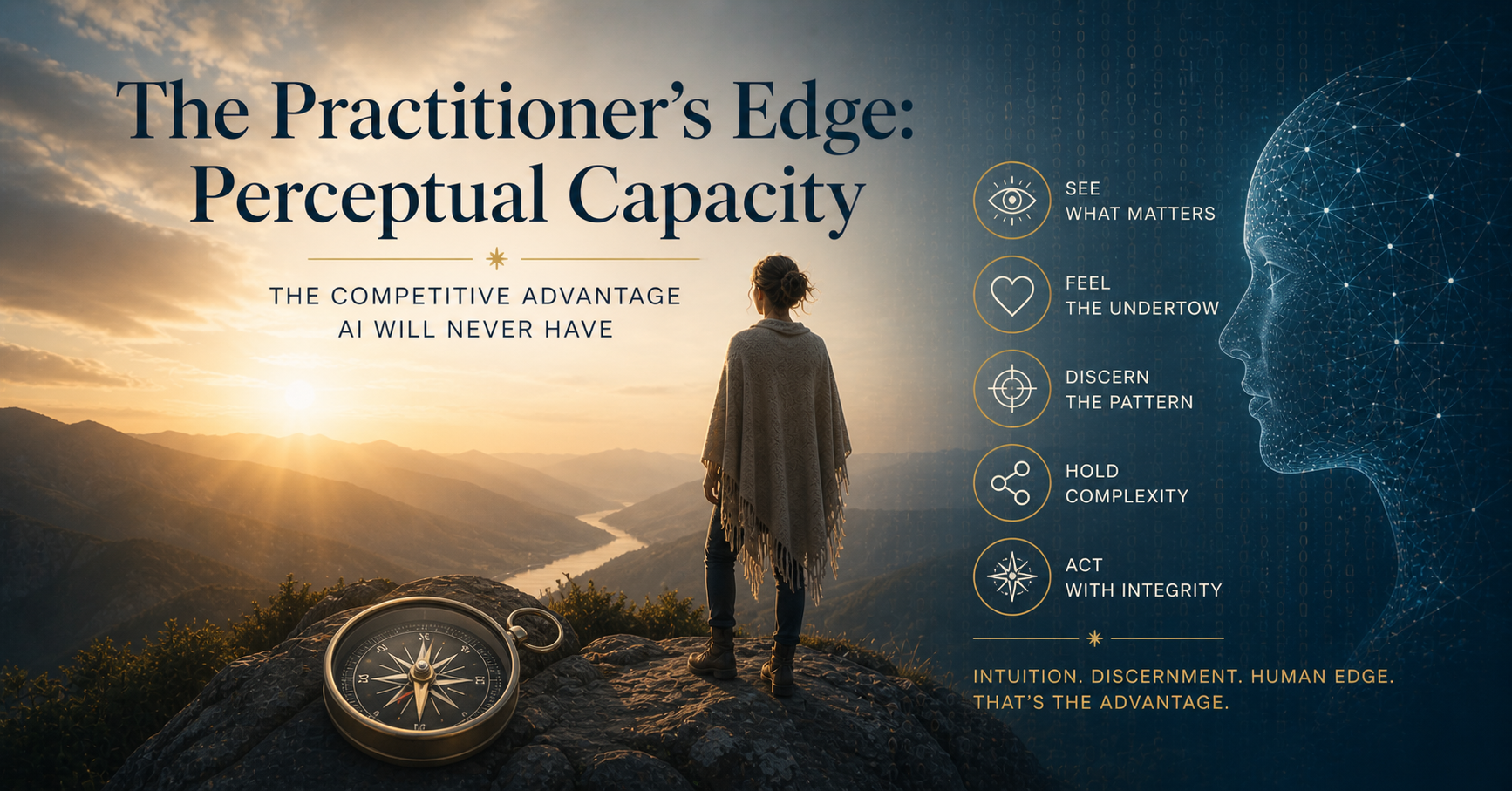
This is what the practitioner’s edge actually is. Not a technique. Not a body of knowledge. The capacity to receive what arrives, formed by forces beyond your control, and to know what to do with it at the moment it is needed.
The Barista and the Beans
Consider your morning coffee.
The beans were grown somewhere distant, in soil with a particular mineral composition, at an altitude that shaped their density and flavour profile, tended by people whose names you will never know. They were harvested at the right moment, processed, dried, transported across continents, through ports and warehouses and distribution chains, passing through many hands before they arrived at your favourite cafe. The roaster worked with them. The barista, who knows this particular roast and this particular machine and has developed over years the precise calibration of grind and pressure and temperature that the beans require, prepares your cup.
You had no part in any of that chain. You did not grow the beans or chart the shipping route or design the roasting profile. But without the barista’s particular skill applied at the final stage, all of that history, all of that accumulated effort and distance and time, produces nothing you can use.
The practitioner’s edge is the barista’s skill. Not the supply chain. Not the beans. The capacity applied at the final moment that converts everything that preceded it into something specific, usable, and irreplaceable.
AI can document the supply chain. It can describe the roasting profiles, analyse the flavour compounds, generate an accurate account of the processing methods. What it cannot do is stand at the machine with forty years of calibration in its hands and produce this cup, for this person, at this temperature, right now.
The pre-symbolic stage is the barista’s hands. Everything else serves it.
What the Edge Is Not
It is worth being precise about what the practitioner’s edge is not, because the misidentification of it is where most of the confusion about AI’s role originates.
It is not the breadth of symbolic knowledge. A practitioner who knows more card meanings, more archetypal traditions, more esoteric systems than another practitioner does not necessarily have the sharper edge. Knowledge of systems is the supply chain. It matters. It contributes. But it is not where the edge lives.
It is not interpretive fluency. The ability to construct coherent, well-articulated readings from established meanings is a valuable skill and it can be developed. It is also, increasingly, something AI does well. Interpretive fluency in a world where interpretation is freely available is a diminishing differentiator.
It is not experience alone. Years in practice without deliberate development of the pre-verbal stage produces a practitioner who is experienced at the interpretive layer. That is not the same as a practitioner who has spent those years cultivating perceptual accuracy. The two can look similar from the outside. They are structurally different.
The edge is perceptual. It is the capacity to receive signal before it has been encoded, to stay with that signal long enough for its specificity to emerge, and to translate it into language with accuracy rather than with approximation. It is what allowed a single card in a blind reading, from a Facebook group where no personal context had been disclosed, to yield the story of three daughters, a secret, and the face of a father recognised in his child, verified in detail by the practitioner who had posted the question, as told in Tarot as a Pre-Symbolic Interface. It is what allowed a piece of driftwood picked up for no articulable reason to arrive with precise relevance months later in a live reading.
Neither of those outcomes was produced by knowledge of systems. Both were produced by the capacity that knowledge serves, when it is in its correct position.
How the Edge Is Built
Perceptual capacity is not a gift distributed unevenly at birth. It is a discipline, built the way any discipline is built: through consistent practice, deliberate attention, and the willingness to remain in the pre-symbolic space long enough for something to form before reaching for the safety of interpretation.
Soft eyes, developed originally from the practice of defocusing on a magazine layout to read the page as a whole before examining its components, is one technique for building this capacity in a reading context. Approaching a spread without immediate focus, noticing where attention goes before any card is named, trains the perceptual system to register the field before the components, to receive the whole before the parts. Used consistently over time, it develops the ability to detect signal at the earliest stage, before the analytical mind arrives to explain it.
The remote viewing discipline, developed in the context of intelligence research and demanding the complete suspension of expectation and interpretation, is another. The protocol requires the perceiver to enter the pre-symbolic space with nothing but a coordinate and the instruction to perceive: without agenda, without preference, without the comfort of a framework to fall back on. What remote viewing contributes to the intuitive practitioner’s development is not intelligence tradecraft. It is one of the most rigorous available training environments for the perceptual stage this series has been describing, precisely because it strips away everything interpretive and demands that the perceiver work with pure signal.
The daily practice of attending without immediately explaining, of noticing before naming, of tolerating ambiguity long enough for it to resolve into something more precise than interpretation alone could produce: this is not a dramatic practice. It does not announce itself. It is built in ordinary moments, in the accumulated discipline of a thousand small decisions to wait for signal before reaching for meaning.
Intuition is a muscle. It responds to use. It also responds to disuse.
The practitioner who consistently honours the pre-verbal stage keeps that muscle developed. The one who consistently bypasses it does not.
Operating Where AI Cannot Follow
AI is a powerful system for working with encoded information: for synthesising meaning at scale, for operating within the symbolic layer with speed and breadth that no individual practitioner can match. It is not a perceptual system. It does not access the pre-symbolic stage. It enters the cognitive process after the translation has already occurred, and it works with the output of human perception rather than the process of it.
This means that a practitioner who has developed genuine perceptual depth is operating, at the most important stage of their work, in territory AI cannot enter. Not because the technology is inadequate by some temporary measure, but because the pre-symbolic stage produces nothing that an external system can receive until the practitioner has already done the essential work of bringing it forward.
The driftwood sat on my desk for weeks. Nothing was encoded. Nothing was recorded. The perception accumulated in silence, without agenda, without any decision about what it would eventually be used for. And then, in a reading, it was needed, and it was there.
AI could not have held that. Not because it lacked the storage capacity. Because what was being held was not yet information. It was potential, existing in the pre-symbolic space, available only to the perceptual system that had been present to receive it from the beginning.
That is the territory of the practitioner’s edge. It is not defended by arguing about AI. It is not protected by rejecting the tools that belong downstream. It is maintained by the consistent, disciplined practice of attending to the stage that precedes everything else. The COMPASS method is one structured way to name and train those conditions of attention.
The Convergence
Everything this series has covered converges here.
AI is not intuition. It is a pattern-prediction system of extraordinary power, operating entirely within the symbolic layer. The myth of AI intuition persists because the outputs can produce a similar effect in the receiver, but the mechanism is categorically different: statistical synthesis, not origination from within a perceptual encounter.
The science of pre-verbal knowing establishes that the stage AI cannot access is not mysterious or inaccessible. It is a specific, identifiable phase of cognition that precedes symbolic encoding. It is trainable with deliberate practice, and it is more valuable in an AI-saturated environment than it has ever been before, precisely because it is the stage the environment cannot automate.
Tarot, used as a pre-symbolic interface rather than a meaning system, activates that stage. The card is a trigger, not a source. The same card, encountered by different perceptual systems with different implicit histories and different conditions of attention, produces different activations. The meaning that emerges is not retrieved from the card. It is generated in the encounter between the image and the practitioner who has developed the capacity to receive what that encounter produces.
Meaning is not the battleground. It is the layer AI covers most effectively and most completely, and the practitioner who competes there is working against a system that has structural advantages at that layer. Moving upstream, into the perceptual stage that precedes meaning, is not a retreat. It is where the practitioner holds every advantage, as argued in Why Meaning Is the Wrong Battleground.
The future tension between augmented intuition and replaced thinking is resolved by a single decision about sequence. Human perception leads. AI extends what has already been received. That order, maintained with discipline across every reading and every session, is what keeps the edge sharp and keeps the practitioner operating in the territory that is genuinely and permanently theirs, as Augmented Intuition vs Replaced Thinking laid out.
What Arrives When You Are Ready
The piece of driftwood on my desk did not know it was going to be useful in a reading. The tree it came from did not know it would end up on Westshore Beach. The currents that carried it had no destination in mind.
All of that had to happen, exactly as it happened, for the wood to be there when I walked that stretch of beach, and for me to notice it, and for it to sit on my desk long enough to reveal what it held, and for it to be present in a reading at the precise moment it was needed.
The practitioner’s edge is not the ability to control that convergence. It is the capacity to be ready for it.
To have developed, through consistent and deliberate practice, the perceptual readiness to notice what arrives, to hold it without rushing it into language, and to reach for it at the moment it is needed with accuracy rather than approximation.
AI will continue to develop. Its capacity at the interpretive layer will continue to expand. The symbolic space will become more thoroughly covered, more rapidly accessible, more fluently navigated by systems that require no human perception to operate.
None of that touches the pre-symbolic stage. None of it reaches the space where the driftwood accumulated its meaning over weeks of unforced attending. None of it was present on Westshore Beach when something small and salt-bleached caught my eye.
That moment, and the capacity it represents, belongs entirely to the practitioner.
Develop it accordingly.
Leigh Spencer is the founder of Tides of Knowing and founder of the COMPASS Method, a framework for the conditions of attention that make intuitive reading reliable under pressure. With 30 years in professional journalism and 40 years as a tarot reader and intuitive practitioner, she writes at the intersection of symbolic literacy, perceptual development, and the changing landscape of human knowing.