
The protocol is deceptively simple. You are given a lexicon: a string of random numbers that corresponds to a target, a person, a place, or a situation you have been given no information about. Your task is to perceive what is there. Not to think about it, not to analyse it, not to construct a plausible answer from available evidence. To perceive it while the usual pull of time, distance, and expectation is held deliberately light, so interpretation does not arrive early and overwrite what you are trying to notice.
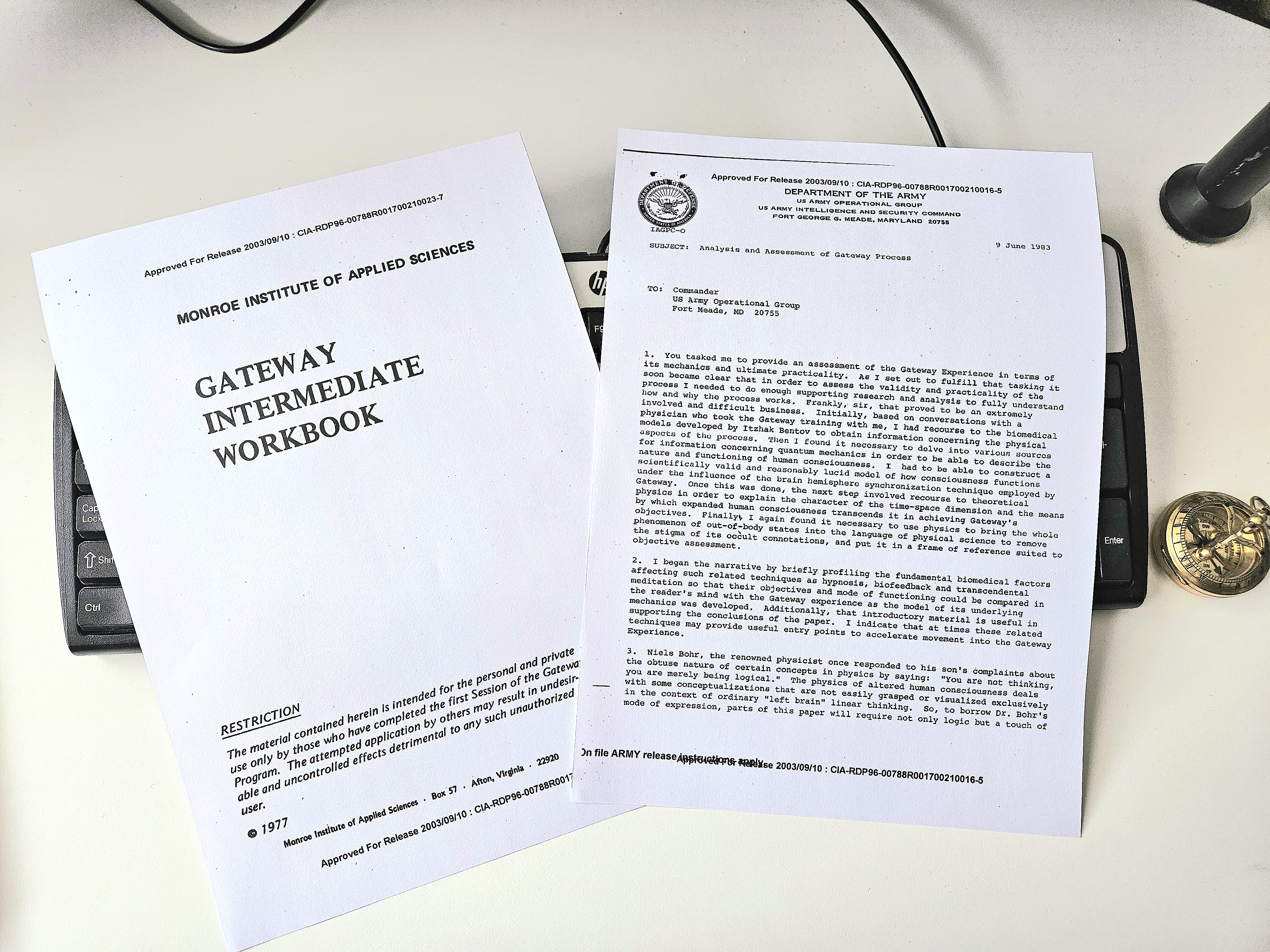
This is remote viewing, and it was not developed in a spiritual retreat or an alternative therapy practice. It originated in a classified US government programme. The Stargate Project was established in 1977 at Fort Meade, Maryland, by the Defense Intelligence Agency and Stanford Research Institute, to investigate whether certain trainable forms of perception might have practical applications for military intelligence when conventional collection could not close a gap. The underlying protocol, known as Coordinate Remote Viewing, was designed to work with targets presented so minimally that ordinary inference offered little purchase. A viewer, given only a set of coordinates and no other context, was trained to report what those coordinates referenced. The internal CIA assessments of this work, including the Analysis and Assessment of the Gateway Process and its companion paper on the human use of altered states of consciousness, were released through declassification in the mid-1990s. They sit in the CIA’s online reading room now, and anyone can read them.
The programme was declassified in 1995. Its results remain contested. What is not contested is what the protocol demands of the person attempting it: the complete suspension of interpretation, assumption, and expectation before a clear impression is allowed to form.
What interests me is not the certainty of its claims, but the discipline embedded within the protocol itself: the attempt to encounter perception before explanation arrives.
I began exploring remote viewing methodologies more seriously in the last five years, as part of an ongoing exploration of how to enter states that resist naming. What drew me was not the intelligence history, though that context is clarifying, and not a settled belief about what was or was not achieved in the programme’s operational claims. I was interested in the method: how practitioners were taught to work before the label lands. It was the discipline at the centre of the practice: learning to enter a pre-symbolic space, to attend without agenda, and to receive what arises before the analytical mind reaches in to explain it. I think of that territory as the part of cognition that has not yet picked a word, where a perception is still forming and can still be noticed without being flattened. It is, in the most precise sense I can offer, what this entire article is about.
I did not follow the protocol as given. I retrofitted it.
In standard remote viewing, the lexicon is assigned. A coordinate leads to an unknown target, and the viewer’s job is to perceive what is there without knowing anything in advance. I built a different version of the same discipline. I created my own lexicon, one that leads to a known interior space rather than an unknown external one, and I structured that space around the Kabbalistic Tree of Life. The Tree of Life is a framework I have worked with for decades, and it appears in a number of tarot methodologies, which made it a map already meaningful to practitioners in the symbolic space. It is a stabilising symbolic scaffold, not a claim about metaphysics: a familiar grid I could step onto so the attending had somewhere to begin. Using it as an anchor in that interior work gave me somewhere stable to stand before the attending began. The structure was not the point. The structure was what allowed me to be in the space without grasping at it.
What I was building was not a technique. It was a capacity. Remote viewing was the closest material framework I had found to what I was already doing. It gave the work a vocabulary and a method, while still insisting on the letting-go the work itself requires.
“Remote viewing gives you a structure for entering the space, then asks you to forget everything you think you know once you arrive.”
The capacity to enter a stretch of attention that has not yet fixed a timeline or a verdict, and to remain there long enough for something to form. That is not mystical language. It is a precise description of what pre-verbal knowing requires, and it is the part of the practice that the published research on remote viewing tends to leave at the edges, because it cannot be scored the way a target hit can be scored. The viewer’s interior conditions, the quality of attention they brought to the session, the way they held expectation, are what make the perception accurate or thin. The written protocol and session instructions assume as much. Most of the public discussion around remote viewing does not stay there for long.
The problem this article addresses is specific: most practitioners in the intuitive space are operating almost entirely at the translation stage of the signal, where meaning is expressed in language, while the two stages that precede it, reception and recognition, receive almost no deliberate attention. That imbalance is not neutral. It has consequences.
What the Research Actually Shows
The science of pre-verbal cognition is more developed than most people realise, and more relevant to intuitive practice than it is usually given credit for.
Cognitive neuroscience has established that a significant proportion of human mental processing occurs below the threshold of conscious awareness. This is not fringe science. It is foundational to how memory, perception, and decision-making are now understood.
Implicit memory is one dimension of this. Unlike explicit memory, which stores facts and events we can consciously recall, implicit memory holds knowledge that influences behaviour without conscious retrieval. Skills, habits, conditioned responses, and pattern recognition built over years of experience are all stored implicitly. When an experienced practitioner looks at a spread and immediately senses something is wrong, or notices that one card is commanding attention across the spread before they can explain why, they are drawing on implicit memory. The knowing precedes the language for it.
Somatic processing is another. The body registers information before the conscious mind categorises it. Research in interoception, the perception of internal bodily states, shows that the body responds to stimuli before conscious awareness catches up. In a reading context, the physical sensation of something shifting, a tightening, a relaxation, a change in attention, is not imagination. It is the body processing signal before the analytical mind has engaged.
Non-linear associative processing describes the brain’s capacity to connect information across contexts without following a sequential logical path. This is what produces the experience of suddenly knowing something without being able to trace the reasoning. The connection was made below the threshold of conscious processing and surfaced as a result.
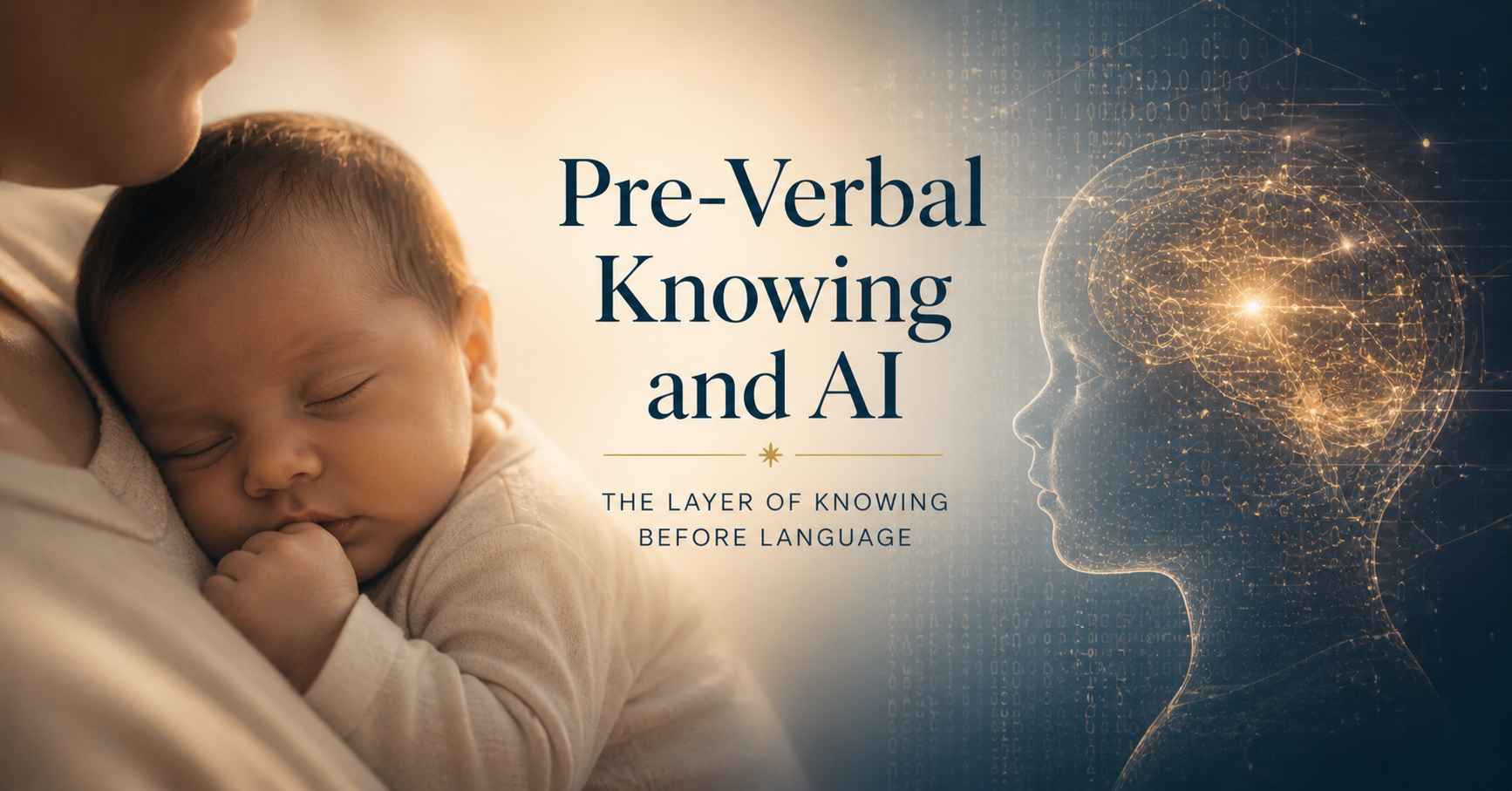
Taken together, these describe what happens in the space before thought becomes language. It is not a gap in cognition. It is a specific and trainable stage of cognition that operates prior to symbolic encoding. Pre-verbal knowing is not the absence of intelligence. It is intelligence running at a level that has not yet been translated into words.
Where AI Sits in the Chain
The first two essays in this series, What AI Can’t Access and The Myth of AI Intuition, established that AI operates entirely downstream of human expression: it requires information to be encoded before it can engage with it, and it works with the output of human perception rather than the process of it. That structural boundary is directly relevant here.
By the time information is available to an AI system, the pre-verbal stage has already completed. The felt sense has become a sentence. The somatic signal has become a description. The immediate impression has become an interpretation. AI belongs at the translation stage, the third stage of the signal, and nowhere earlier.
The problem arises when practitioners reach for AI before that translation has occurred: using it for the initial impression, the first sensing of what a spread is showing, the receptive stage that has not yet resolved into language. The tool cannot do that work. And the capacity that can do it, if it is not exercised, does not stay static. It atrophies.
The Paradox of Expectation
Return to the remote viewing protocol, and to the specific discipline it demands.
The viewer must enter the session without expectation. No assumption about what the target will be. No preference for one kind of signal over another. No agenda about what would be useful or interesting or confirmatory. The instruction sounds simple. The practice reveals it to be one of the hardest cognitive disciplines there is.
Because even the intention to have no expectation is itself a form of expectation. The moment you set out to be open, you have already formed a concept of what openness looks like, and that concept is already filtering what you are able to receive. The training is not in achieving a pure state of no-expectation. It is in learning to notice when expectation has arrived, without reacting to it, without trying to suppress it, and without following it. Noticing, and returning.
This is precisely the same discipline required in a reading. The COMPASS Method™ names one of its foundational conditions as Open: holding the question without constraining it, without already knowing the answer, without needing the spread to confirm what the practitioner or seeker already believes. Open does not mean blank. It means available, without agenda.
Developing this capacity is not a passive process. It is a practice, in the same sense that a musician practises scales or a surgeon practises technique. The neural pathways involved in pre-verbal processing are trainable. Attention itself is trainable. The ability to receive signal before reaching for interpretation, to tolerate ambiguity without collapsing it prematurely into language, to remain in the pre-symbolic space long enough for something to form: all of these improve with deliberate, sustained practice.
What does not improve them is bypassing them.
The Three Stages of the Signal
It is useful to map what is actually happening when pre-verbal knowing moves toward articulation, because understanding the stages clarifies where the practitioner’s skill is most needed and where errors are most likely to enter.
The first stage is reception. Something is perceived. This may arrive as a felt sense, a physical sensation, an image, a shift in attention, an impression that has not yet resolved into meaning. At this stage, nothing has been interpreted. The signal is raw. This is the stage AI cannot access.
The second stage is recognition. The practitioner notices what has arrived. They do not yet name it or explain it. They simply register that something is there and attend to its quality. This is the stage most vulnerable to interference: the analytical mind wants to explain immediately, to categorise, to confirm or dismiss. Premature interpretation at this stage corrupts the signal. What the practitioner thought they noticed overrides what was actually there.
The third stage is translation. The pre-verbal signal is converted into language. This is where meaning is articulated, where the reading becomes communicable, where the practitioner can engage with AI usefully, if it is to be used at all. AI belongs here, in the translation and refinement of what has already been received, not in the stages that preceded it.
Most of the errors in intuitive practice occur at the boundary between the first and second stages: the moment when the raw signal is met with interpretation before it has been properly received.
The practitioner reaches for meaning before the signal has stabilised. What they produce is not wrong exactly, but it is thinner than it could have been. It carries less of what was actually there.
Building the Platform
What the Tree of Life gave me as an anchor was not a belief system or a religious framework. It was a stable symbolic structure inside a stretch of attention that does not yet have fixed edges. A place to stand before the attending began. This is the same logic that sits underneath remote viewing’s coordinate protocol, and underneath every reliable practice that asks the practitioner to enter a pre-symbolic space deliberately rather than by accident.
You need something to walk in with. You also need to be willing to put it down once you arrive.
This is what any reliable pre-verbal practice requires. Not a technique for extracting answers, but a structure for remaining present in a space where answers have not yet formed. The structure must be stable enough to provide orientation without being so rigid that it constrains what can arrive. Remote viewing solves this by giving the viewer a coordinate and nothing else. I solved it by giving myself a map I trust and treating the map itself as the threshold rather than the destination.
The Tree of Life serves this function because it is already a working map in symbolic practice: a way of tracking how diffuse possibility narrows into pattern, and pattern into something you can name and work with in the material situation in front of you. Using it in this interior work is not decorative. It tracks what pre-verbal knowing actually does: it moves from what is not yet fixed in shape toward language you can stand behind, from raw impression toward what can be shared.
Understanding that movement is what makes the practitioner’s capacity reliable rather than occasional. Pre-verbal knowing that is cultivated systematically, that has a structure to support it and a method for moving its signal toward articulation, is not the same as the occasional flash of insight that arrives unbidden and cannot be repeated.
It is a discipline. And disciplines, unlike flashes, can be trained.
What This Means for Practice in an AI-Saturated World
The risk this series has been naming from the beginning is not that AI will take over intuitive practice. It is that while the debate about AI occupies the field’s attention, the pre-verbal capacity that underpins the practice receives less and less deliberate cultivation.
The science is clear on what happens to capacities that are not exercised. Neural pathways that are not used are pruned. Attention that is consistently directed outward, toward external tools and interpretive frameworks, becomes less practiced at attending inward, toward the pre-symbolic signal that those frameworks are meant to serve.
A practitioner who has spent years reading card meanings, studying archetypal systems, refining their interpretive vocabulary, and who now adds AI to that interpretive toolkit, is operating almost entirely at the third stage of the signal. Translation. Articulation. The expression of meaning in language.
The first two stages, reception and recognition, the stages that make the translation worth anything, may be receiving almost no attention at all.
That is the actual problem. Not AI’s presence in the practice, but the practitioner’s absence from the stages AI cannot reach.
The discipline of remote viewing, or any practice that trains sustained presence in the pre-symbolic space, becomes relevant here not as an exotic add-on but as a fundamental corrective. The point is not to become a remote viewer. The point is to develop, through whatever practice is authentic and sustainable, the capacity to remain in the space before interpretation, long enough and steadily enough that what arrives there can be received accurately.
That capacity is the practitioner’s edge. It is what AI cannot replicate, not because the technology is insufficient, but because the pre-verbal stage produces no output that any external system can receive until the practitioner has already done the work of bringing it forward.
The next article, Tarot as a Pre-Symbolic Interface, examines what happens when this understanding is applied specifically to tarot: why the cards are not a meaning system but an interface, and what that distinction changes about how the practice is built and taught.
Leigh Spencer is the founder of Tides of Knowing and founder of The COMPASS Method™, a framework for the conditions of attention that make intuitive reading reliable under pressure. With 30 years in professional journalism and 40 years as a tarot reader and intuitive practitioner, she writes at the intersection of symbolic literacy, perceptual development, and the changing landscape of human knowing.